

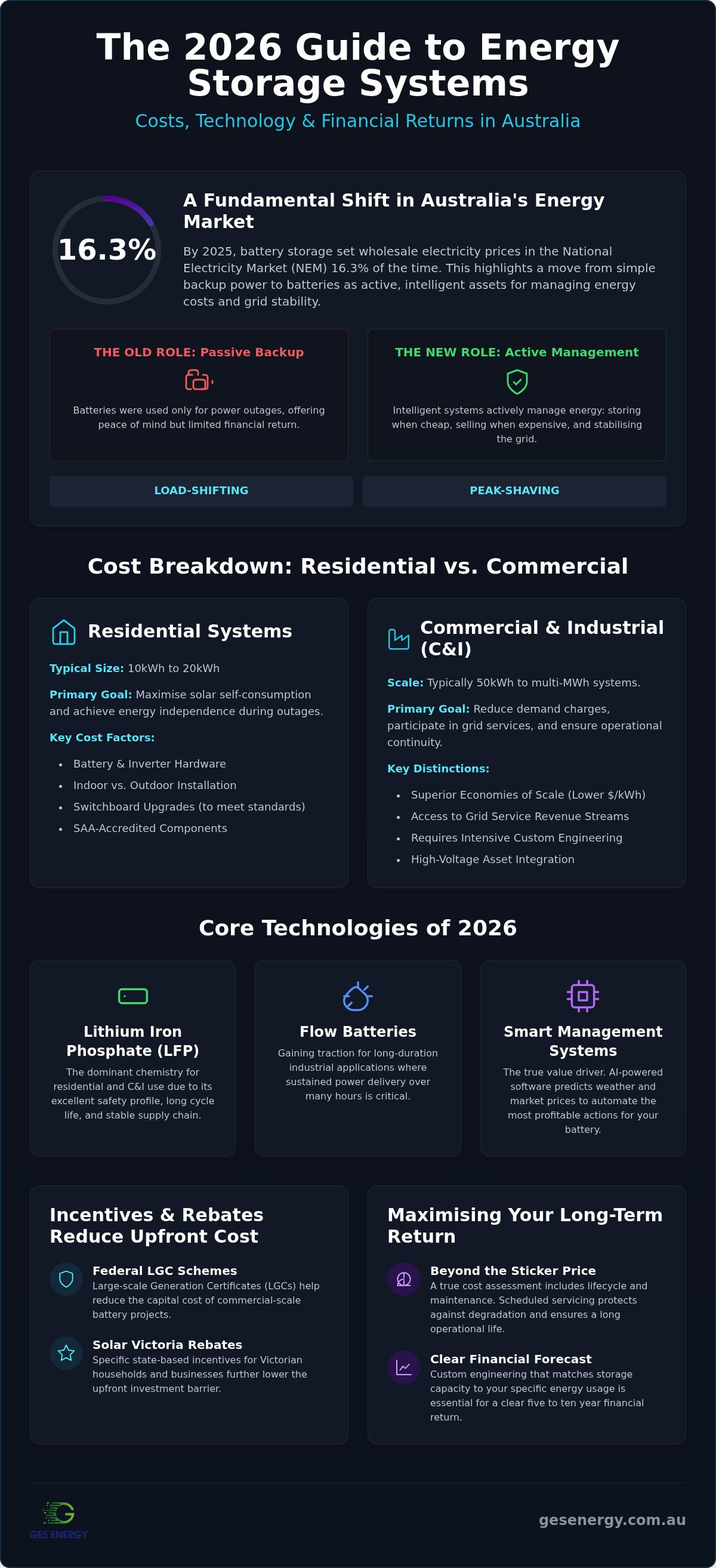
In 2025, battery storage systems set the wholesale electricity price in the National Electricity Market (NEM) 16.3% of the time, marking a significant shift in how the Australian grid operates. You've likely felt the impact of this transition through volatile power bills and the growing pressure to manage your own consumption. It's understandable if you're hesitant, especially with shifting rebate structures and concerns about how long a modern battery will actually last.
Evaluating the cost of energy storage systems australia requires more than a simple quote. It demands a clear understanding of how current technology integrates with your specific needs. This guide clarifies the 2026 market landscape, detailing the latest government incentives and the genuine financial benefits of installing storage for your home or business. We'll explore current pricing tiers, explain how to maximise your return on investment, and provide a detailed 5 to 10 year financial forecast. You'll gain the clarity needed to lower your electricity bills and secure energy independence during grid outages, ensuring your infrastructure is ready for the years ahead.
Key Takeaways
- Understand how 2026 energy storage technology has evolved from simple backup to intelligent load-shifting for better grid management and financial control.
- Evaluate the current cost of energy storage systems australia by comparing residential scales with the superior economies of scale found in commercial and industrial projects.
- Identify the latest 2026 government incentives, including updated Federal LGC schemes and specific Solar Victoria battery rebates, to significantly reduce your upfront investment.
- Learn how to protect your asset through scheduled maintenance and expert repair services that mitigate battery degradation over its expected lifespan.
- Discover why custom engineering is essential for matching storage capacity with your specific load profile to ensure a clear five to ten year financial return.
Understanding the 2026 Energy Storage Market in Australia
Australia's transition to a renewable-led grid has redefined the role of on-site power management. A modern Energy Storage System (ESS) is no longer just a cabinet of batteries designed for blackouts. It is a complex integration of power electronics, thermal management, and digital controls that allows users to interact with various energy storage technologies. By 2026, these systems have evolved into strategic financial tools that help businesses and households manage the increasing volatility within the National Electricity Market (NEM).
Determining the actual cost of energy storage systems australia involves assessing how these assets perform load-shifting and peak-shaving. Instead of simply storing excess solar for the evening, modern systems use intelligent algorithms to discharge power when grid prices are highest. This shift from passive storage to active market participation is what drives the financial viability of installations today. The market has matured, moving away from early-adopter experimentation toward standardised, high-performance infrastructure.
To better understand how these systems are evolving in the local market, watch this helpful video:
The Technology Influencing 2026 Prices
Lithium Iron Phosphate (LFP) remains the dominant chemistry due to its safety profile and long cycle life. However, 2026 has seen a rise in flow batteries for longer-duration industrial needs. Manufacturing scale across the Asia-Pacific region has helped stabilise landed costs. While global supply chains faced hurdles in previous years, the price drops seen in large-scale storage between 2024 and 2025 have set a more predictable baseline for 2026 projects. The real value lies in the software. Smart energy management systems now use AI to predict weather patterns and price spikes, ensuring the battery prioritises the most profitable actions without manual intervention. This technological maturity directly impacts the long-term cost of energy storage systems australia by extending hardware life and improving efficiency.
Why Australia Leads in Storage Adoption
Australia has one of the highest rates of rooftop solar penetration globally, which creates a natural demand for storage to maximise self-consumption. Grid stability remains a priority for the Australian Energy Regulator, leading to the rapid growth of Virtual Power Plants (VPPs) where distributed batteries support the network during peak demand. In Victoria, the ongoing transition away from residential gas has increased electrical loads, making integrated storage a necessity for those looking to avoid high peak-period tariffs. These factors combined make the Australian market a global leader in storage deployment, supported by a workforce of SAA-accredited labour that understands the unique requirements of our harsh environment.
Cost Breakdown: Residential vs. Commercial and Industrial (C&I) Systems
The total investment for a battery depends heavily on the scale of your facility and the complexity of its electrical infrastructure. While residential systems focus on maximising self-consumption, C&I projects often target demand charge reduction and complex grid services. This creates a distinct difference in the cost of energy storage systems australia when measured on a per-kilowatt-hour basis. Larger installations benefit from significant economies of scale, though they require more intensive behind-the-meter engineering to ensure seamless integration with existing high-voltage assets.
Residential Solar and Battery Pricing
For most Australian households in 2026, a 10kWh to 20kWh system represents the standard for achieving true energy independence. The final quote is rarely just about the hardware. Factors such as whether the unit is installed indoors or outdoors, and the necessity of switchboard upgrades to meet current standards, play a major role. Quality remains paramount. We prioritise SAA-accredited components to ensure long-term reliability and safety. For a deeper look at these variables, see our Solar and Battery Systems: The Complete 2026 Guide to Energy Independence. These systems provide the steady, reliable power needed to shield families from volatile grid prices.
Industrial Battery Storage Solutions for Enterprise
Large-scale enterprises, ranging from manufacturing plants to agricultural hubs, require systems between 50kW and 1MW or more. These projects involve comprehensive Engineering, Procurement, and Construction (EPC) services. The Large Scale Battery Storage Funding Round initiatives by ARENA highlight how these multi-megawatt systems are becoming central to Australia's infrastructure. The procurement of industrial-grade hardware is a significant portion of the budget, but professional oversight is what secures the investment.
Initial costs for industrial sites include custom project-based solar design fees. These fees cover the sophisticated engineering required for micro-grid development and load-profile matching. While this bespoke engineering adds to the upfront cost of energy storage systems australia, it's essential for long-term performance. It prevents the wasted energy that occurs with one-size-fits-all solutions. If you're looking for a detailed assessment of your facility, request a site-specific engineering review to see how these systems integrate with your current operations.
Incentives, Rebates, and Financing Your Energy Transition
The cost of energy storage systems australia is significantly mitigated by a layered framework of federal and state-level financial support. These incentives are designed to accelerate the payback period, often bringing the return on investment into a very attractive five-to-seven-year window. In 2026, the Small-scale Renewable Energy Scheme (SRES) remains a primary driver for systems under 100kW through the creation of Small-scale Technology Certificates (STCs). These certificates act as a point-of-sale discount. It's vital to remember that the STC "multiplier" reduces every year on January 1st as the scheme approaches its 2030 conclusion. For larger industrial installations, Large-scale Generation Certificates (LGCs) provide ongoing revenue based on the clean energy produced and stored. Payback periods are shrinking.
Navigating Victorian State Rebates
Victorian residents and businesses benefit from some of the most robust localised support in the country. Solar Victoria offers various programs to lower the barrier to entry for storage. While specific battery rebate amounts are reviewed periodically, eligibility generally requires an authorised retailer and SAA-accredited labour. Support is particularly strong for regional hubs like Geelong, Ballarat, and Bendigo, where local grid stability is a priority. Beyond direct rebates, interest-free loans allow households to distribute the cost of energy storage systems australia over several years without incurring high interest charges. The savings are real.
Financing Options for Commercial Solar
Enterprises looking to preserve capital often choose between outright capital expenditure (CAPEX) and a Power Purchase Agreement (PPA). A PPA allows you to host a system and buy electricity at a lower rate without upfront hardware costs. Many Victorian businesses also utilise Environmental Upgrade Finance (EUF), where repayments are made through local council rates. This often results in a cash-flow positive outcome from day one. For a detailed breakdown of how these options impact your bottom line, refer to our Commercial Solar Return on Investment Australia: 2026 ROI Guide.
Participation in a Virtual Power Plant (VPP) adds another layer of financial benefit. By allowing a small portion of your stored energy to support the grid during peak events, you can earn credits or direct payments. When combined with corporate tax incentives and asset depreciation, the net cost of the system becomes a manageable and highly productive investment. This strategy ensures that your energy infrastructure contributes to the balance sheet from the moment it's commissioned. Tax benefits apply.
Beyond the Sticker Price: Lifecycle and Maintenance Costs
Many buyers focus solely on the initial invoice. This narrow view ignores the operational reality of hardware that must perform in harsh Australian conditions for over a decade. The true cost of energy storage systems australia includes the gradual reduction in storage capacity, known as degradation, and the eventual replacement of power electronics. Every battery bank has a finite number of cycles before its capacity drops below a useful threshold, typically around 70% to 80% of its original rating. Understanding this lifecycle is essential for a realistic financial forecast.
While the battery cells themselves might last 10 to 15 years, the solar inverter is often the first component to require attention. These units typically have a lifespan of seven to ten years. Proactive technical support from a local provider ensures these transitions don't lead to extended system failure. Having access to warranty assistance and SAA-accredited labour is a vital safeguard for your investment. It's the difference between a minor repair and a total system write-off.
The Cost of System Maintenance
Scheduled health checks are essential for maintaining the efficiency of industrial battery storage solutions. These inspections involve checking thermal management systems, tightening electrical connections, and performing software updates. In 2026, remote monitoring allows for faster diagnostics, but physical site visits remain necessary to verify system health. Proactive maintenance is especially critical for off-grid solar systems where a failure can leave a facility without any power. Maintenance and repair service fees are a minor expense compared to the productivity loss of a complete system shutdown.
Total Cost of Ownership (TCO) Calculation
To find the real value of an investment, use a 15-year TCO framework. This calculation should include the upfront CAPEX, estimated annual maintenance fees, and a provision for inverter replacement mid-way through the system's life. You should also account for end-of-life recycling or disposal, which is a standard requirement under Australian environmental regulations. Choosing high-quality, SAA-accredited hardware reduces the risk of premature failure. This ensures that the long-term cost of energy storage systems australia remains predictable and manageable rather than ballooning due to unexpected breakdowns.
If your current system hasn't been inspected recently, book a comprehensive maintenance health check to protect your energy investment and ensure peak performance.
Maximising ROI with Custom Energy Storage Solutions
Achieving a superior return on investment requires moving beyond generic, off-the-shelf bundles. A "one-size-fits-all" approach often results in wasted energy or insufficient storage during peak events, both of which inflate the effective cost of energy storage systems australia. We focus on custom engineering that aligns storage capacity with your unique load profile. By analysing exactly when and how your facility consumes power, we ensure every kilowatt-hour of storage serves a specific financial purpose. This precision prevents the common mistake of paying for capacity you'll never use or, conversely, failing to cover your most expensive peak periods.
Integrating EV charging infrastructure with your existing storage system adds another layer of strategic value. Instead of drawing from the grid at peak rates to charge a commercial fleet or personal vehicles, you can utilise stored solar energy. This synergy transforms your battery from a simple backup tool into a comprehensive energy hub. It's about creating a closed-loop ecosystem that reduces operational costs across your entire infrastructure. Future-proofing your site in this way ensures that as your electrical demand grows, your system remains an asset rather than a liability.
The Role of Micro-Grids and Off-Grid Reliability
Micro-grid development offers unparalleled energy security for remote Victorian sites where grid connection is either unstable or prohibitively expensive. For temporary operations or semi-mobile sites, the Mobil-Grid® provides a high-performance alternative to permanent infrastructure. This portable solution allows for rapid deployment while maintaining the sophisticated control found in fixed industrial systems. It's a reliable way to manage the cost of energy storage systems australia in locations that lack traditional utility support. For a deeper look at standalone power, read our Off Grid Solar Systems: The 2026 Guide to Standalone Power in Australia.
Partnering with GES Energy for Your Project
Choosing a local Melbourne-based engineering team means you have access to experts who understand the specific regulatory and environmental challenges of the Victorian market. We don't just install hardware; we remain committed to the ongoing health of your system through dedicated maintenance and support for the life of the asset. Our EPC services provide a comprehensive delivery standard where we manage everything from the initial engineering design and hardware procurement to the final construction and commissioning. This end-to-end oversight ensures your project meets 2026 performance benchmarks and delivers the financial results you expect.
The transition to advanced storage is a significant step toward long-term energy independence. To ensure your system is engineered for maximum performance and longevity, contact our team today for a project-based design and a detailed quote tailored to your specific requirements.
Securing Your Energy Future in 2026
The energy landscape in 2026 has transformed battery storage from a simple backup luxury into a vital financial asset for both households and enterprises. By leveraging current Victorian rebates and focusing on custom engineering, you can significantly mitigate the initial cost of energy storage systems australia while ensuring a robust, long-term return on investment. Success in this transition depends on moving beyond generic hardware and embracing a system designed for your specific load profile.
Our team brings specialised expertise in C&I projects up to 5 MW and provides SAA-accredited labour across Melbourne, Geelong, and Regional Victoria. We remain committed to the ongoing health of your infrastructure, helping you navigate the complexities of maintenance and technical support with confidence. Whether you're seeking energy independence for a remote site or looking to stabilise operating costs for a manufacturing plant, professional oversight is the key to a predictable outcome.
Take the next step toward a stable and efficient energy ecosystem. Request a custom energy storage quote from our Melbourne engineering team and secure your facility against grid volatility. We're here to help you build a more resilient future.
Frequently Asked Questions
What is the average cost of a 10kWh solar battery in Australia in 2026?
The investment for a 10kWh battery in 2026 is determined by several technical variables rather than a flat rate. These include the choice of battery chemistry and the complexity of the installation environment. Whether you require a hybrid inverter upgrade or switchboard modernisation to meet current SAA standards will impact the final quote. Engaging an accredited team ensures your system is eligible for federal incentives that reduce the net expense.
Are there still government rebates available for energy storage in Victoria?
While direct state-level battery rebates in Victoria have transitioned, interest-free loans through Solar Victoria remain a vital incentive for 2026. These programmes are available across Melbourne and regional hubs like Geelong, Ballarat, and Bendigo. Additionally, the federal Small-scale Technology Certificate scheme provides a significant discount that reduces the total purchase price. It's essential to use an authorised retailer to facilitate these claims, as eligibility requires specific hardware and installation standards to be met.
How long does it take for a commercial energy storage system to pay for itself?
Commercial systems generally achieve a full return on investment within five to eight years. This timeframe is influenced by your facility's load profile and your ability to perform peak-shaving or demand charge reduction. By using custom engineering to match storage capacity with operational needs, businesses in Victoria can maximise their savings. Participation in Virtual Power Plants also provides an ongoing revenue stream that helps recoup the initial capital expenditure faster than traditional standalone solar.
Can I add a battery to my existing solar system, and what are the costs involved?
You can certainly retrofit a battery to an existing solar array. This is usually achieved through AC coupling or by replacing your current inverter with a modern hybrid model. When calculating the cost of energy storage systems australia for retrofits, you must account for additional cabling and potential switchboard modifications. These upgrades ensure your existing panels integrate seamlessly with new storage technology, providing the independence needed during grid outages or high-tariff periods.
What are the hidden costs of installing an off-grid energy storage system?
Off-grid installations often involve costs beyond the battery units, such as dedicated housings for thermal management and advanced micro-grid controllers. Civil works for concrete pads and remote monitoring hardware are also common requirements. For sites in regional Victoria, ensuring the system can handle extreme temperature fluctuations is essential. These elements are part of a comprehensive EPC service that guarantees reliability for standalone power systems in locations that lack traditional utility support.
Does the location of my business in Victoria affect the installation price?
Location does influence the final price due to logistics and travel requirements for our engineering teams. While we serve all of Victoria, including Melbourne, Mildura, and Wodonga, regional projects in areas like Traralgon or Sale may require additional coordination for hardware transport. However, we maintain a consistent standard of SAA-accredited labour across all areas. Local knowledge of grid constraints in specific regions ensures your system is designed to meet local distribution network rules effectively.
Is it cheaper to install solar and batteries at the same time?
Installing solar and batteries simultaneously is almost always more cost-effective. You benefit from a single commissioning fee and reduced labour costs since the electrical work is performed in one visit. This integrated approach also simplifies the application process for the cost of energy storage systems australia, as rebates for both components can often be processed together. A combined installation ensures that your solar capacity is perfectly matched to your battery's charging requirements from day one.
What maintenance is required for a commercial-grade battery energy storage system (BESS)?
Commercial-grade systems require annual health checks to monitor battery degradation and ensure the thermal management system is functioning correctly. Software and firmware updates are also necessary to maintain compatibility with the National Electricity Market and any VPP protocols. We provide ongoing maintenance support for systems regardless of the original installer. Proactive care prevents minor issues from becoming expensive repairs, protecting your long-term energy investment and ensuring the system performs at peak efficiency.


