

A corporate solar proposal earns support when its financial case reflects how the business actually uses energy. Getting buy-in for a corporate solar project means showing decision-makers how system size, daytime consumption, financing and emissions outcomes connect to business priorities, rather than relying on broad claims about savings.
Finance, operations and sustainability teams may assess the same proposal differently. A clear analysis brings those perspectives together by setting out the expected effect on electricity use, the costs and obligations of each financing option, and the project’s potential contribution to emissions goals.
This article explains how energy-profile analysis informs system design, how capital outlay, loans and power purchase agreements affect the financial case, and how to report emissions impacts clearly. It also shows how to present assumptions and trade-offs so internal discussions reflect the project’s actual operating conditions.
Key Takeaways
- Compare upfront investment with financing structures to show how each option affects cash flow, ownership and ongoing costs.
- Use meter interval data to align system design with when your business consumes electricity and identify a realistic offset.
- Assess power purchase agreements and loans by considering their payment terms, project responsibilities and fit with your budget.
- Explain emissions impacts alongside financial outcomes, including how the project may relate to your Scope 3 reporting.
- Build a credible ROI and payback case around your electricity use, tariff, system performance and project costs.
Capital and operating expenditure financing
Capital expenditure funds the solar system upfront, while operating expenditure spreads payments over its use. Comparing the two helps finance teams assess cash flow, ownership and long-term commitments.
Commercial solar financing options
Commercial solar financing options are the structures a business uses to fund installation and ongoing costs. They matter because each option affects cash reserves, asset ownership and who manages system performance. Businesses can compare direct capital outlay, green loans, power purchase agreements, Energy Upgrade Agreements and asset finance. Commercial solar leases typically last 10-20 years, so the term should fit the site’s expected use. Present each option against the same energy profile and project assumptions.
Australian rules and financial incentives
Australian rules and financial incentives affect connection, installation and a project’s net cost. Export limits, approvals and eligibility can change the system design and financial case. Certificate incentives depend on location and system size, and may include Small-scale Technology Certificates, Large-scale Generation Certificates or Victorian Energy Efficiency Certificates. Grant support and tax treatment, including depreciation, depend on current criteria and business circumstances. Model them separately from expected bill savings.
For a grid-connected project, the electricity distributor sets connection requirements and export conditions, which can affect system size, export capacity and connection costs. Local building codes and permit requirements also apply. Contact the distributor early and assign approval responsibilities in the installation plan. Solar safety is shared by the installer and the business commissioning the project. Consider roof structure, safe access and electrical integration during design.
The project sequence starts with a site and energy-use assessment, followed by system design and a financial comparison. Procurement then aligns equipment and scope with the approved design; installation proceeds alongside required connection and building approvals. These stages give decision-makers clear checkpoints before capital is committed.
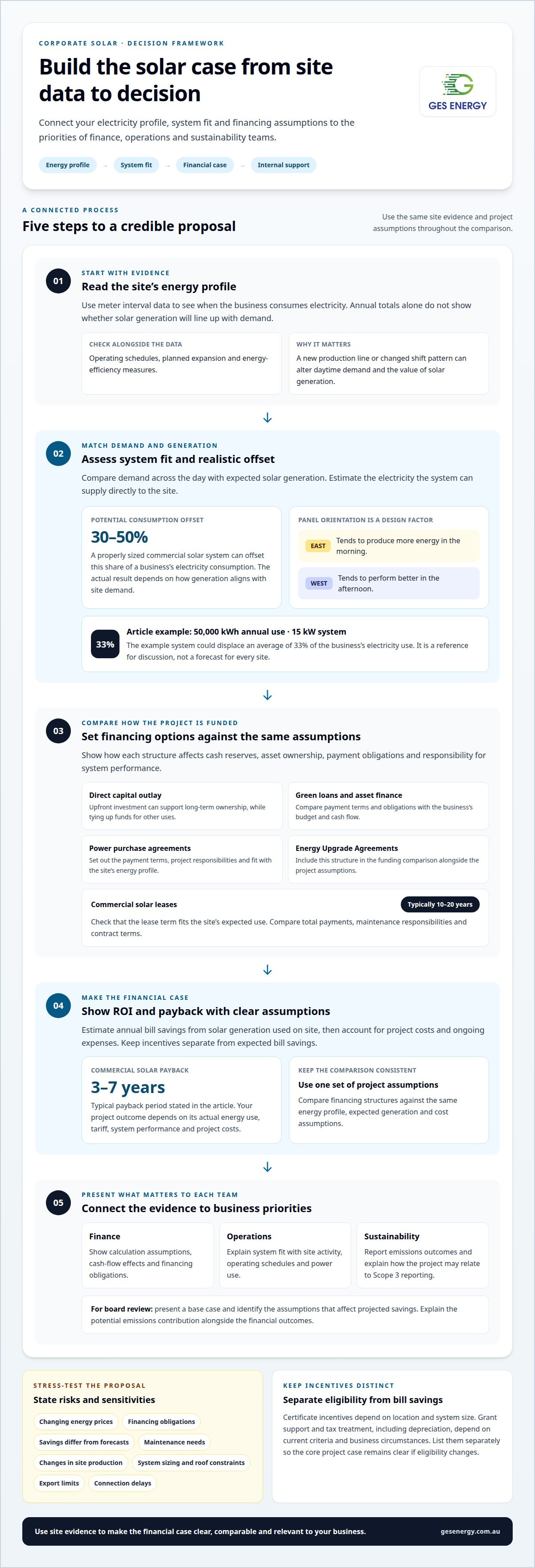
Financial risks include changing energy prices, financing obligations and savings that differ from forecasts. Operational risks include maintenance needs and changes in site production. Technical risks include unsuitable system sizing, roof constraints, export limits and connection delays. Set out these factors in the proposal’s assumptions and sensitivity analysis rather than presenting a single forecast as certain.
Capital expenditure can preserve long-term ownership, but ties up funds the business could allocate elsewhere. Operating expenditure may reduce the initial capital commitment, but creates ongoing payment obligations. Compare both approaches using total payments, maintenance responsibilities, contract terms and expected energy use. List incentives separately so the core project case remains clear if eligibility changes. A transparent comparison helps stakeholders see which financing structure best matches business priorities.
Building internal support through energy-profile analysis
Getting buy-in for a corporate solar project starts with evidence connecting electricity use to business priorities. Meter interval data shows when the site consumes power, helping stakeholders assess system fit and projected benefits.
ROI and payback calculations
ROI compares a project’s financial return with its investment, while payback estimates how long savings take to recover the initial cost. These measures help Australian decision-makers compare proposals using consistent assumptions. Estimate annual bill savings from solar generation used on site, then account for project costs and ongoing expenses. Commercial solar systems in Australia typically have payback periods of 3-7 years.
Start with interval data rather than relying only on annual consumption totals. Match the site’s demand across the day against expected solar generation, then estimate how much electricity the system can supply directly. A properly sized commercial solar system can offset 30-50% of a business’s electricity consumption. The actual offset depends on the relationship between generation and site demand.
Consider the example of a business consuming 50,000 kWh per year. A 15 kW system could displace an average of 33% of its electricity use. This example helps finance and operations teams discuss the potential benefit using an understandable reference point. It also illustrates why annual consumption alone cannot show when solar generation aligns with demand.
Review interval data alongside operating schedules, planned expansion and energy-efficiency measures. A new production line or changed shift pattern can alter daytime demand and the value of solar generation. East-facing panels tend to produce more energy in the morning, while west-facing panels tend to perform better in the afternoon. Compare these patterns with site operations when assessing design options.
Addressing internal objections
Address internal objections with evidence relevant to each concern. Employees, executives and board members assess different impacts. Give finance teams the calculation assumptions, show operations staff how the proposed installation fits site activity, and explain emissions outcomes to sustainability stakeholders. For board review, present a base case and identify the assumptions that affect projected savings.
Employees may ask whether solar will affect daily work or power reliability. Explain how the proposed system connects with site operations, and distinguish solar generation from a battery’s role in storing electricity for later use. Executives may focus on capital allocation, so show how projected returns compare with business priorities. Board members may need clear information on responsibilities, risks and expected outcomes.
For getting buy-in for a corporate solar project, prepare a concise evidence pack with interval-data findings, design assumptions, projected generation and a plain-language summary. Label historical site consumption separately from estimated solar generation. This clarifies the basis of each calculation and helps stakeholders distinguish measured inputs from forecast outcomes.
Structure the discussion around each group’s decision needs, then use project-specific analysis to address information gaps. A shared evidence pack keeps the conversation focused on operating fit, financial return and business benefits.
Power purchase agreements and loans
Australian businesses can fund a solar project through capital outlay, a green loan, asset finance, an Energy Upgrade Agreement or a power purchase agreement (PPA). The choice determines who funds the system, how payments affect cash flow and how the business accesses electricity savings. Compare each structure against the same site demand and project scope.
A business that buys rooftop solar funds the equipment and owns the on-site system. A battery can store surplus solar generation for use when panels produce less, such as at night. This approach offers direct control over the system, but the organisation carries the upfront investment and ongoing asset responsibilities.
A commercial solar PPA lets a business buy electricity generated by a solar system under a long-term contract. Australian commercial solar PPAs typically last 15-25 years and require little to no upfront cost. The agreement’s term, electricity pricing and allocation of operating responsibilities shape the project’s savings and financial commitments.
A solar loan allows the business to finance system ownership through repayments over time. Commercial solar loans typically run for 5-20 years. Compare the repayment schedule with forecast electricity savings, and assess how interest, fees and maintenance affect the overall case. A green loan or asset finance may suit a different funding structure, so align its terms with the project’s expected operating life.
Off-site renewable energy contracts differ from rooftop systems because generation comes from a project away from the business premises. They can support renewable electricity procurement, but do not provide the same direct on-site generation or battery storage arrangement. Compare contract terms, how the renewable energy benefit is recorded, and how the arrangement fits the organisation’s energy and emissions objectives.
For internal approval, compare each option consistently: initial capital required, payment timing, ownership, operating responsibilities and expected savings. List rebates or certificate incentives separately from the core forecast. This makes it easier to assess whether a project remains financially suitable without relying on an incentive to support the case.
For example, a business prioritising lower upfront expenditure may assess a PPA alongside a loan, while one seeking direct ownership may focus on loan terms and asset responsibilities. A battery adds a separate design and investment decision based on when the site needs stored electricity. These distinctions help finance and operations teams assess the trade-offs together.
A battery adds a separate design and funding decision, so include its cost, ownership and operating responsibilities when comparing options. For a tenant, the arrangement may also depend on permission and agreed responsibilities. Tenants may explore an agreement with the landlord or body corporate that sets out responsibilities for installing and maintaining a solar PV system. Clarifying these responsibilities helps the parties assess whether a funding structure fits the site and tenancy arrangement.
Where incentives are relevant, keep them distinct from projected electricity savings and financing costs. STCs are issued based on the system’s expected power generation until the scheme ends in 2030, according to the Clean Energy Regulator. Treat that support as a separate part of the project assessment, alongside the terms of any PPA or loan, rather than as a substitute for checking the underlying cash flow and responsibilities. This helps decision-makers compare funding choices on a consistent basis.
Environmental impacts and Scope 3 emissions
Solar’s environmental case is strongest when a business reports measured generation alongside financial and emissions outcomes. In Australia, project records can connect system size, electricity displaced and emissions accounting, giving executives a clear basis for assessing the project’s contribution.
Measure savings by recording solar generation and comparing it with electricity imported from the grid. Use inverter production records, meter data and electricity bills for consistent reporting periods. Separate electricity generated from electricity used on site, since exported energy does not directly reduce the premises’ grid purchases. For example, compare monthly generation and grid imports before and after commissioning.
To assess emissions reductions, calculate how much grid electricity the business displaced with solar, then apply the emissions factor required by its reporting method. Keep the method and reporting boundary consistent across periods. Changes in system size, site demand or reporting approach can affect the result, so record them alongside the emissions estimate.
Scope 3 accounting needs a separate view. Under many carbon accounting methods, a business’s solar partner and project deployment are counted as Scope 3 emissions. This means the project can reduce grid electricity use while creating emissions in its value chain through project-related activity. Explain both effects rather than presenting solar as having no associated emissions.
A useful report distinguishes measured information from calculated outcomes. Include system generation records, the site’s imported electricity, the calculation method and any assumptions. For example, label inverter readings as measured generation and emissions reductions as a calculation based on displaced grid electricity. This helps finance and sustainability teams understand what the figures represent.
Set a reporting schedule that fits the business’s existing energy and sustainability reviews. At each review, compare the same periods and note operational changes, such as new equipment or altered production hours. This helps explain why solar output and electricity savings may change differently. A battery can also shift when generated electricity is used, so report stored and discharged energy separately where those records are available.
For board presentations, pair the emissions result with a plain-language explanation of system size, on-site use and Scope 3 treatment. Avoid combining project emissions with electricity savings into one unsupported headline figure. A concise table can show generation, grid imports, estimated emissions impact and calculation basis. This gives decision-makers a traceable account of environmental performance and helps them assess the project against business reporting priorities.
ROI and payback for corporate solar in Australia
Calculate ROI by comparing a solar project’s net financial benefit with its total investment. Calculate simple payback by dividing initial investment by annual net savings. Commercial solar systems in Australia typically have payback periods of 3-7 years, but site demand and system design affect the result.
Start with electricity use that solar generation can directly replace. Meter interval data shows whether daytime demand aligns with solar production. Then estimate avoided electricity purchases using the business’s tariff and expected on-site consumption. Include export income only where the project assumptions support it. Separate the inputs so reviewers can see how the forecast was built.
For an illustrative Australian business, a 200 kW system could offset 40% of a medium-sized business’s annual electricity use. To assess its case, compare forecast generation with the business’s actual consumption profile. The offset percentage alone does not establish ROI: the value depends on the electricity displaced, project investment and ongoing costs.
Build a complete cash-flow view rather than relying only on a simple payback result. Include system investment, financing repayments where relevant, maintenance, expected savings and eligible incentives. In Australia, available solar certificate rebates depend on system location and size. Show incentives as a separate assumption so decision-makers can assess their effect on the project case.
Test the assumptions that could change the result. Electricity tariff changes affect the value of each kilowatt-hour used on site. Changes in operating hours may alter how much solar generation the business consumes directly. System output also depends on design and site conditions. Sensitivity analysis can show how ROI changes under different operating and energy-price assumptions.
Keep ROI and payback distinct in the board paper. Payback identifies when cumulative savings recover the initial investment, while ROI expresses financial return relative to investment over a defined period. State the timeframe and calculation method beside each result. If a proposal uses a discount rate or assumes electricity prices rise, show those assumptions clearly rather than presenting the result alone.
Before approval, compare the forecast with the project’s financing structure and operational needs. A loan changes cash-flow timing; a power purchase agreement changes how the business pays for solar electricity. Use the same consumption and generation assumptions across options. This makes the comparison useful to both finance and operations teams.
For a project-specific financial case, assess your commercial solar project against its site demand, system design and financing assumptions.
GES ENERGY
GES ENERGY helps businesses assess commercial solar against site energy use, operational needs and financial priorities. Its Commercial and Industrial Solar offering supports organisations moving from an initial proposal to a project shaped around their facility and objectives. This is a practical next step when stakeholders need a clearer view of project scope, expected energy use and how solar fits the business’s plans.
Bring the energy profile and internal priorities into the discussion. These details help shape a proposal that decision-makers can assess alongside financing, savings and emissions considerations. A well-defined scope also gives finance and operations teams a shared basis for evaluating the project.
Contact GES ENERGY to discuss your corporate solar project.
Turn internal support into a clear next step
Getting buy-in for a corporate solar project is a starting point, not the finish line. Next, turn internal agreement into a defined project scope, with clear ownership of decisions and a shared view of what the business wants its energy infrastructure to achieve.
As plans develop, consider how solar may fit future energy needs. GES ENERGY offers Commercial and Industrial Solar, Off Grid Solar Systems and EV Charging Stations for businesses with different site requirements and infrastructure priorities. Bringing these needs into early project discussions helps keep planning aligned as requirements evolve.
When your business is ready to discuss its project goals and site requirements, Discuss solar with GES ENERGY. A considered next step can help your team move forward with clarity and confidence.
Frequently Asked Questions
What are the business benefits of installing solar for an Australian company?
Solar can help an Australian company reduce grid electricity purchases by generating power at its premises. This can support more predictable energy planning, particularly where business activity coincides with solar generation. A battery may store surplus solar electricity for later use, and some systems can supply premises during a blackout. Solar can also support emissions reporting when the business records generation and its effect on grid electricity use.
How do I build a business case for rooftop solar using electricity bills and interval data?
Use electricity bills to identify your tariff, consumption charges and billing patterns, then compare them with interval data showing when the site uses power. For example, a business operating mainly during daylight hours may use more solar generation on site than one with substantial overnight demand. Add operating schedules and planned equipment changes to explain future demand. This gives finance teams a traceable basis for assessing the proposal.
What information do CFOs and executives need to approve a corporate solar project?
CFOs and executives need a decision brief connecting project scope with cash-flow impact, financing structure, expected operating outcomes and key risks. Include assumptions behind projected savings, responsibilities attached to the chosen funding arrangement, and how performance will be monitored after commissioning. For example, identify the team responsible for reviewing generation records and escalating performance issues. This clarifies accountability and helps leaders judge whether the project fits business priorities.


