

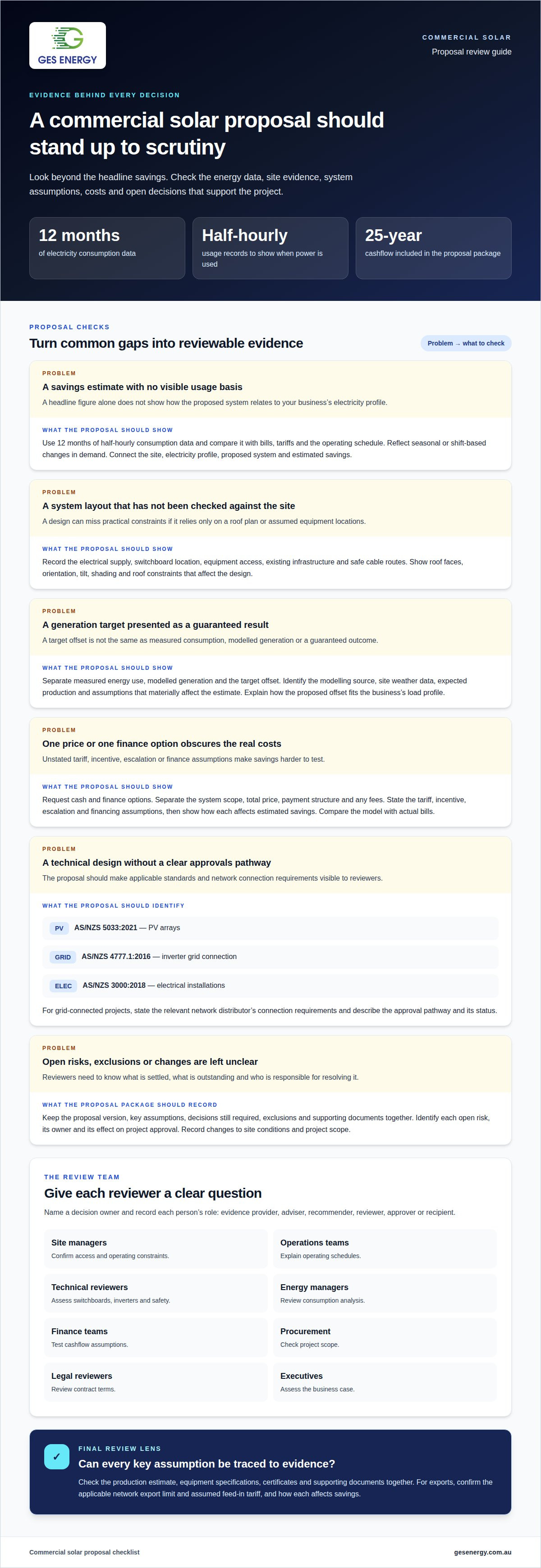
A polished quote is not enough to approve a commercial solar project. A commercial solar proposal checklist should bring together 12 months of half-hourly electricity consumption data, a site assessment, system design, financial modelling, project scope and a 25-year cashflow. Each decision-changing assumption should connect to evidence, so reviewers can see what the proposal is based on and what remains open.
A commercial solar proposal should withstand scrutiny from finance, operations and technical teams, not just look clear at first glance. This guide explains what a professional proposal includes, what information your business needs to provide and what reviewers should assess across assumptions, costs and project scope. You’ll also learn how a controlled proposal package records decisions and changes, helping your business evaluate a solar project with greater clarity.
Key Takeaways
- Match system design to your site’s energy goals, roof condition, orientation, shading and usable area.
- Involve site, operations, technical, finance, procurement, legal and executive reviewers, with a clear question for each.
- Ask for cash and finance options that separate system scope from individual cost items.
- Keep production estimates, equipment specifications, certificates and supporting documents together so reviewers can follow the proposal’s basis.
- Consider battery storage, off-grid power or EV charging where they suit your site’s energy needs and project scope.
Executive Summary and Electricity Bill Breakdown
The executive summary should connect the project site, electricity profile, proposed system and estimated savings. It should also state the proposal version, key assumptions and decisions still required. Reviewers can then see how the design relates to the business’s utility account instead of relying on a headline savings estimate.
For a useful consumption profile, the provider needs 12 months of half-hourly electricity data. This reveals when the site uses power and how demand changes across operating periods. The provider compares that record with bills, tariffs and the business’s operating schedule. If consumption shifts between seasons or shifts, the model should reflect those patterns.
The site assessment records the electrical supply, switchboard location and practical cable routes between equipment. The provider considers access, existing infrastructure and safe cable routes. These details connect the proposed design to actual site conditions and identify constraints that could affect the layout or project scope.
For Australian installations, relevant standards include AS/NZS 5033:2021 for PV arrays, AS/NZS 4777.1:2016 for inverter grid connection and AS/NZS 3000:2018 for electrical installations. Grid-connected projects also require consideration of the relevant network distributor’s connection requirements. The proposal should describe the applicable approval pathway and its status.
Assumptions about electricity price increases affect projected savings over time. The proposal should state the assumed rate, when it applies and how it changes cashflow, rather than treating future utility prices as certain. For example, the model could show a scenario with no tariff increase alongside its base case. Reviewers can then compare project performance under different assumptions.
Who Should Review a Commercial Solar Proposal?
Assign a decision owner and record each reviewer’s role: evidence provider, adviser, recommender, reviewer, approver or recipient. This distinguishes attendance from approval and clarifies who resolves outstanding issues.
Site managers confirm access and operating constraints; operations teams explain schedules; technical reviewers assess switchboards, inverters and safety. Energy managers review consumption analysis, finance tests cashflow assumptions, procurement checks scope, legal reviews contract terms, and executives assess the business case.
Require separate cash and finance options, with the system scope, total price, payment structure and any fees itemised. Financial modelling should state its tariff, incentive, escalation and financing assumptions, then show how each affects estimated savings. Compare the model with actual bills, not an unsupported average.
Compare installers by the clarity of their scope, technical evidence, relevant accreditation and insurance documentation. A proposal should identify exclusions and assign owners to unanswered questions. A market benchmark suggests sending the proposal within 48 hours of the site survey, while review timing depends on stakeholder availability.
For electricity exports, the proposal should state the applicable network export limit, assumed feed-in tariff and how each affects savings. These settings shape the value assigned to electricity sent back to the grid.
There is no single typical Australian commercial solar installation cost per kW that applies to every project. Price depends on system design, site conditions, equipment and connection work. The proposal should itemise its actual scope and costs.
Australian businesses can assess eligibility for Small-scale Renewable Energy Scheme certificates. According to the Clean Energy Regulator, from 1 October 2026, the STC ceiling is 1 MW of site capacity. Any grant or tax treatment should appear as a stated assumption, not a guaranteed incentive.
Review exclusions, export constraints, equipment assumptions and changes to site conditions. The proposal should identify each open risk, its owner and its effect on project approval.
Solar System Sizing Against Historical Usage and Energy Goals
A provider sizes a solar system by comparing recorded electricity use with the project’s energy goals. The proposal should distinguish measured consumption, modelled generation and the target offset. A target is not a guaranteed outcome; the production estimate must be supported by the design and its assumptions.
Around 75-80% of historical energy use is sometimes suggested as a design offset, but no market guidance is cited here to support that figure. Treat it as a starting point, not a fixed rule for every business. Daytime operations may use more solar generation directly, while evening demand may call for a different design or storage assessment. The provider should explain why the proposed offset suits your load profile.
The system design should show which roof faces hold panels and how orientation, tilt, shading and roof constraints affect expected output. Site weather data informs the production model, while seasonal variation helps explain when generation may differ from consumption. The proposal should identify its modelling source and make clear which assumptions materially affect the estimate.
Equipment specifications should identify panel and inverter types, system capacity and expected production. Separate the solar system’s modelled output from electricity savings, which also depend on when the business uses power and any applicable export credits. A sensitivity analysis can show how changes in production affect the investment case.
Review warranties by component and distinguish product coverage from installation workmanship. Around 25 years is described as an industry-standard solar panel warranty period, but the proposal should state the actual terms for the selected equipment. Before contract approval, the business should obtain the contractor’s Certificate of Insurance and review the policy details. This connects the proposed design, project scope and risk documentation.
Measuring Usable Roof Area, Orientation and Pitch
A provider starts with a physical or virtual site assessment and records roof dimensions, orientation and pitch. A detailed roof plan should show usable panel zones, access routes, obstructions and excluded areas. This gives the design team a clear basis for estimating annual production.
Usable area is not simply the roof’s total footprint. Skylights, vents, plant equipment, edges and maintenance access can reduce the space available for panels. The provider maps these features across each roof face and considers how orientation and tilt affect exposure. Nearby buildings, trees and rooftop equipment also need assessment for shading at different times.
Roof condition and structure matter alongside solar access. The assessment should record visible deterioration, roof materials and areas requiring further structural review. For design, roof-zone and wind-loading considerations are referenced in AS/NZS 1170.2:2021 Appendix B6. The proposal should explain how these findings affect panel placement and the system design.
Access planning covers how installation and future servicing teams reach the roof, along with safe routes around equipment. The layout should also show proposed cable paths and any reserved area for an inverter or battery, if included. These details help reviewers understand how the design fits the operating site.
Before finalising the proposal, the provider should confirm who controls the roof and identify the business decision-maker. This avoids progressing a layout without the necessary project approvals. A documented assessment connects roof suitability, access and structural considerations to the proposed system, rather than treating the roof as an empty surface.
Commercial Solar Proposal Sections and Checklist
A reviewable proposal links each claim that could change a decision to evidence, an owner and the affected section. Keep one controlled package with a version and review record so finance, technical and operational reviewers assess the same configuration. If the price and scope describe different systems, return the proposal for clarification before approval.
- Executive summary and design: identify the site, system option, capacity, modelled production and project objective; distinguish estimates from measured consumption.
- Consumption evidence: include the billing and interval data behind the load profile, with its date range and source.
- Production model: show assumptions and output profile, and link each decision-changing input to its source and owner.
- Drawings and specifications: attach the site layout, array plan, cable routes and equipment schedule, including inverter details.
- Compliance records: list relevant design and installation documents, network application status and certificates associated with the project.
- Commercial schedule: separate equipment, installation, connection and other scope costs; distinguish cash pricing from finance options.
- Risk and delivery register: record exclusions, dependencies, open items, response owners and effects on project release.
Include a 25-year cashflow that shows the model’s assumptions and projected results across the period. Attach the supporting documents for decision-changing claims, such as the production model, drawings and equipment specifications. After a material proposal change, reconcile the executive summary, model, price and limitations. Mark superseded files as no longer current, and keep a visible retirement record so reviewers can identify the live package.
Solar System Design and EPC Services for Commercial Projects
GES ENERGY helps commercial businesses turn site and energy requirements into a reviewable solar proposal. Its commercial system designs span projects from 10 kW to 5 MW, matching design scope to project scale. The proposal can set out the system layout, equipment specifications, expected production, assumptions and open decisions for review.
Solar system design connects feasibility assessment with engineering detail. Site conditions, electricity use, roof constraints and project goals inform the proposed configuration. Clear drawings and schedules help reviewers understand how equipment fits the site, while documented assumptions show what underpins the production estimate. This makes it easier to assess the design before project delivery.
For projects requiring coordinated delivery, GES ENERGY provides EPC services for solar and EV projects. EPC means engineering, procurement and construction. The proposal can define the design scope, equipment procurement, construction work and interfaces between solar generation and EV charging. Setting out these elements together helps teams review responsibilities, dependencies and project boundaries before approval.
This approach suits businesses assessing a commercial solar installation, an EV charging project or both as part of one energy plan. GES ENERGY also offers Off Grid Solar Systems for sites that need a solution designed around limited or absent grid access. A clear proposal sets out the selected scope, exclusions and approval requirements, helping the business make an informed project decision and keep design intent aligned with delivery.
Battery Storage Options: Tesla Powerwall and Alpha ESS
A battery can form part of a commercial solar proposal when the project’s energy goals call for storage. The proposal should explain its intended role, how it relates to solar generation and site consumption, and which assumptions shape the design. It should also identify the equipment under consideration and any decisions still open.
Tesla Powerwall may be considered as a named battery option in a solar proposal. The package should identify the proposed model and include its relevant manufacturer specifications, warranty terms and installation scope. This lets technical and finance reviewers assess the documented option against site requirements without relying on generalised claims about capacity, savings or performance.
An Alpha ESS battery may be assessed for backup power, peak shaving, demand response or voltage control. The proposal should state which outcomes the design targets and show how the proposed configuration relates to the business’s operating profile. These functions are design considerations, not a substitute for project-specific evidence.
For either option, reviewers need a clear account of integration with the solar system, connection requirements, equipment location and project boundaries. The proposal should separate battery equipment from installation and associated electrical work. It should also identify exclusions or assumptions that could affect the design, approval or expected use.
For battery systems used with power conversion equipment, Australian documentation should address AS/NZS 5139:2019. The proposal should connect relevant design documents and equipment specifications to the selected configuration. If options are presented, give each a stable identity and explain what project requirement would lead to its selection.
This level of detail helps your business assess storage as part of the project, rather than as an isolated add-on.
Portable Off-Grid Solar Generators and Off-Grid Packages
A portable off-grid solar generator can provide electricity at a remote worksite without grid access. In a proposal, define its intended location and role, such as supporting temporary site operations. The design assessment should document the equipment to be powered, operating schedule and site conditions so the proposed solution matches the task.
For a site needing a broader off-grid system, the Premium Off-Grid Package #2 is another option to consider. The proposal should identify the package configuration and explain how it relates to the site’s energy needs. It should clearly state the included equipment, installation scope, exclusions and any project-specific design requirements.
Review the proposal against the site’s actual operating profile. A remote facility with regular daily demand has different design needs from a temporary work area with changing equipment loads. The package should explain how the design addresses generation, storage and supply without presenting estimated output as a measured result.
- Site requirements: record location, access, operating schedule and the work the power system must support.
- Load information: list equipment and its electricity requirements, with expected use patterns.
- System scope: identify components, installation responsibilities, exclusions and site work.
- Proposal assumptions: document the conditions that affect design, expected supply and future changes.
These details help reviewers distinguish a portable unit for a specific remote application from an off-grid package designed for the site’s broader energy needs. A clear proposal connects the selected option to the work being powered and records the evidence behind its design, giving the business a practical basis for project review.
ABB All-in-One High Power Charger for EV Projects
The ABB All-in-One High Power Charger can be assessed as part of a commercial EV charging proposal. Start with the project’s purpose: the vehicles to be charged, their operating schedule and where they will park. These details help define the required charging service before the proposal settles the equipment configuration.
The proposal should connect charger selection to site conditions and the electrical design. Record the proposed location, cable route, available electrical supply and any site work needed. Include the manufacturer’s product specifications and identify the configuration used in the proposal. This gives technical reviewers a clear basis for assessing the equipment, beyond its product name.
For a project combining solar and EV charging, explain how charging demand relates to the site’s solar generation profile. Show the assumptions behind any modelled use of solar electricity and distinguish it from grid supply. If battery storage is also proposed, describe its role separately rather than assuming it will meet charging demand.
An EPC proposal should define the charger’s scope alongside engineering, procurement and construction responsibilities. List equipment supply, installation work, electrical connections, commissioning responsibilities and exclusions separately. Identify dependencies such as site access or required electrical upgrades. This helps procurement and operations reviewers understand what the project includes and where decisions remain open.
Keep the ABB charger’s selected configuration consistent across the technical schedule, drawings and commercial scope. If the design changes, update the affected documents and assumptions together. This gives decision-makers a coherent basis for reviewing an EV charging station within a wider commercial energy project.
Your next decision is whether the proposed project fits your site’s priorities, operating needs and investment plans. Use the commercial solar proposal checklist as a decision record: note which assumptions your team accepts, what still needs an answer and who owns each open item. This keeps the next discussion focused on decisions rather than revisiting settled details.
GES ENERGY offers Commercial and Industrial Solar, Off Grid Solar Systems and EV Charging Stations. These options support different project scopes, from grid-connected generation to remote power or workplace charging. A clear brief about your business goals helps shape the conversation around the right direction.
Bring your preferred project scope and unresolved review points to the next discussion. GES ENERGY can consider how its services fit the requirements your business has identified, without treating every site as the same project.
Start a project discussion with GES ENERGY and take the next step towards a proposal that reflects your site and business priorities.
Frequently Asked Questions
How does a professional assemble a reviewable commercial solar proposal package?
A professional builds the package around the decision the business needs to make. For example, an early investment review may need a clear project boundary, key dependencies and an outline of the next design stage, rather than construction-level detail. The proposal should clarify the stage and separate estimates from commitments. This helps executives decide whether to progress the project for further development or pause it to resolve a specific issue.
What does a multi-stakeholder proposal checklist decide?
The proposal helps the business decide whether the project is ready to progress, needs changes or should be deferred. That decision can depend on practical matters beyond the solar design, such as whether the site can accommodate planned works during its operating schedule. A useful checklist records the outcome and any conditions attached to it. For example, approval to continue design should not be presented as approval to begin construction.
Which questions and evidence should your provider connect in the checklist?
Connect each open question to evidence that answers it directly. If the layout depends on a roof drawing, identify that drawing and its revision in the record; if the operating plan affects expected consumption, link the relevant schedule. Date-stamping records helps reviewers distinguish current inputs from older material. When evidence changes, revisit the affected question and proposal assumption instead of silently carrying them forward.
What should a commercial solar proposal include in Australia?
Alongside its technical and project scope, the proposal should present commercial information clearly. State whether displayed amounts include GST, distinguish incentive assumptions from the project price, and identify items that still require a separate decision. For a Victorian site, identify the project’s location and relevant network distributor. This lets reviewers assess the proposal in its Australian context without mistaking an assumed incentive or tax treatment for a settled amount.
How does a provider assess your business's electricity usage and solar system size?
A useful assessment distinguishes energy consumed over time, measured in kWh, from peak demand, measured in kW. These describe different aspects of a business’s load and can affect how a design is evaluated. The provider can also model a planned change, such as adding equipment or extending operating hours, as a separate scenario. Comparing scenarios shows whether the proposed system remains aligned with the business’s future operating plans.
How do commercial solar quotes compare on panels, inverters, warranties and performance?
Check that each quote reports system capacity on the same basis, such as DC panel capacity or AC inverter capacity. Then compare the assumptions behind output estimates, including the selected equipment and any stated performance limitations. Read warranty documents for coverage, exclusions and claim conditions, not just duration. A quote using a different capacity basis or excluding a component may not be directly comparable, even if its headline output appears similar.
How to calculate commercial solar payback, bill savings and return on investment?
Look beyond a single payback result by asking how the model treats cashflows over time. A financial analysis may present net present value or internal rate of return alongside simple payback, provided it states the discount rate and modelling period. Test a downside case with lower production or less favourable electricity prices. Comparing scenarios shows how sensitive the investment case is to changing assumptions, rather than treating one forecast as certain.
What roof, structural, electrical and site checks should your provider complete before installation?
Before scheduling works, the project team should account for delivery access, equipment laydown areas and site operating restrictions. It should also identify rooftop services, drainage paths and planned maintenance routes that the panel layout must avoid. If an initial assessment identifies a structural question, record the required engineering review as a project dependency. These practical details help plan installation around site operations and prevent avoidable clashes during delivery.


