

A solar board paper needs to show more than the installation cost. Commercial solar projects in Australia commonly have a payback period of 2-7 years, and presenting a solar business case to the board means explaining the assumptions behind that estimate, including energy use, on-site consumption and exports to the grid.
For a Victorian business, a solar proposal should reflect the site, operating profile and electricity arrangements. In Victoria, assess local network connection requirements and how seasonal solar generation aligns with the site’s energy use. A board paper needs to make the financial case clear and explain what the project means for operations, safety and sustainability.
This article explains what to include in a solar proposal, how to assess costs and payback, and how to frame a recommendation for board approval. It also distinguishes approval for further planning from approval to install, and shows how design and delivery information can support a sound decision.
Key Takeaways
- Build the proposal around the project scope, expected energy output, installation approach and internal approval stage.
- Estimate payback by weighing upfront costs against projected on-site savings, export income and ongoing expenses.
- Show how changes in energy use and electricity prices could affect the financial case, rather than relying on a single forecast.
- Give decision-makers a clear view of project risks, including their potential effects, mitigation measures and responsible owners.
- Use 12-24 months of electricity data to profile energy use and support a board-ready recommendation.
Business case proposal content and internal approvals
A board-ready solar proposal connects system design with electricity use, installation requirements and expected business outcomes. It should state clearly whether directors are approving further planning or committing to installation.
Board-ready proposal contents
A board-ready proposal sets out the project scope, system details, financial assumptions, delivery steps and approval sought. This gives directors a clear basis for deciding what happens next. State how the proposal addresses electricity use, the electricity price, expected on-site use and exports, and potential carbon benefits. Written documentation must cover system details, installation compliance and consumer protections under Renewable Energy Regulations and Australian Consumer Law.
Rebates, incentives and tax deductions
Incentives and tax deductions affect different parts of a business case, so show them as separate assumptions. Australian commercial solar proposals may include Small-scale Renewable Energy Scheme Small-scale Technology Certificates (STCs), according to the Clean Energy Regulator. Present any potential tax deduction separately from rebates, and don’t count it as immediate cash income. The board can then assess projected savings and incentive assumptions without treating a possible tax outcome as funds available for installation.
Installer documentation should support the figures and delivery assumptions in the proposal. Include the system configuration, proposed installation scope, expected generation and the basis for estimating on-site use and exported electricity. Add relevant compliance information, consumer protections, warranty details and a delivery plan that shows surveys, design, installation, commissioning and grid connection. Finance teams can use installer materials to populate an executive summary, typically in 20-30 minutes.
Write the requested resolution in precise terms. For example, directors could approve further site assessment and design without authorising installation. Identify the next decision point, the information needed and who will bring it back to the board. Leave space for relevant approvals and signatures, then record the decision and any conditions in the meeting minutes. This separates permission to plan from a commitment to proceed.
For leased premises, discuss the proposal with the landlord or body corporate before installation. Solar work can involve building alterations, so the approval pathway may affect project scope and timing. Record agreed conditions, such as access arrangements or the areas covered by the proposed installation. This gives directors a practical view of property-related dependencies before they approve the next stage.
Grid connection is another approval step. In Queensland, a business must obtain its electricity distributor’s approval to connect a solar system to the grid before installation. Show this requirement in the project sequence alongside design and installation planning, rather than implying connection is automatic. Directors can then distinguish internal approval from external connection approval and identify what must happen before work begins.
Estimating commercial solar costs, savings and payback
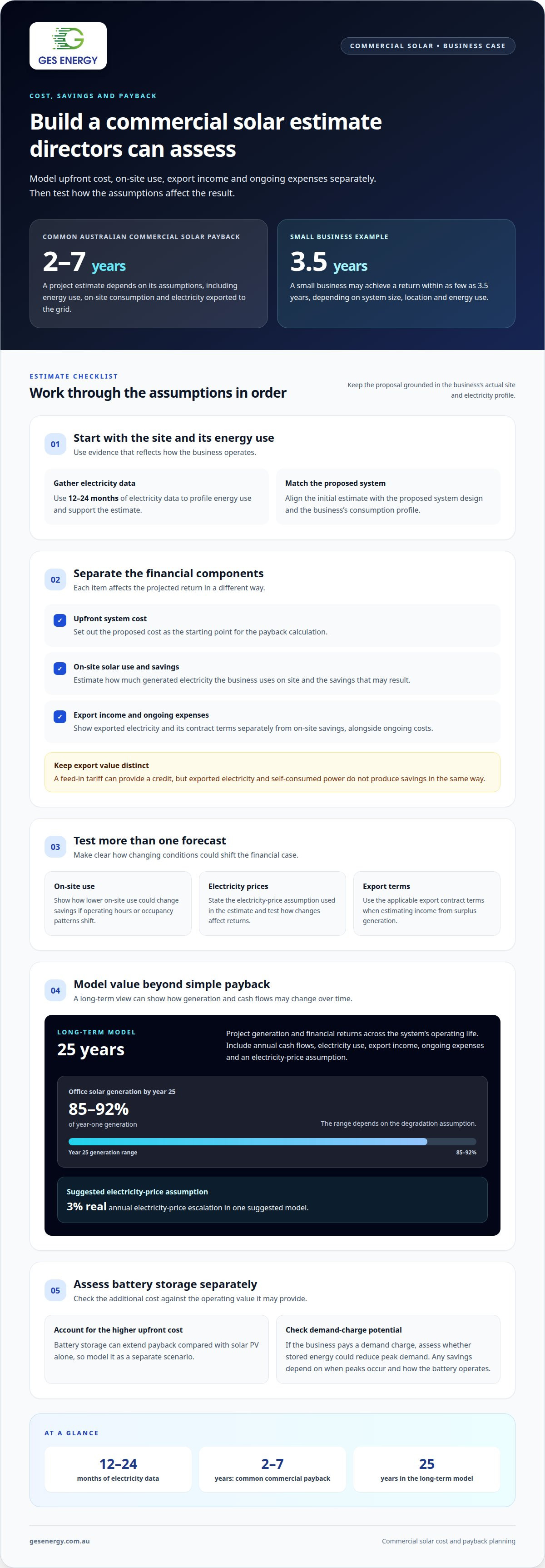
Estimate payback by comparing the upfront system cost with projected savings and ongoing expenses. Model solar generation, on-site use and exported electricity separately, as each affects returns differently.
Cost and payback estimates
SunSPOT can support an initial estimate of commercial solar costs, savings and payback using site and electricity-use assumptions. Use the estimate as a starting point, then align it with the proposed system design and business consumption profile. Commercial solar projects in Australia commonly have a payback period of 2-7 years. A small business may achieve a return within as few as 3.5 years, depending on system size, location and energy use.
Long-term generation and savings
A 25-year generation and savings model projects electricity output and financial returns across the system’s operating life. Include annual cash flows, electricity use, export income, ongoing expenses and an electricity-price assumption. One suggested model uses annual electricity-price escalation of 3% real. By year 25, office solar generation is typically 85-92% of year-one generation, depending on the degradation assumption. This longer view helps directors assess value beyond simple payback.
Battery costs and demand-charge savings
Battery storage can shift solar electricity to periods when panels generate less or electricity costs more. Its higher upfront cost can extend payback compared with solar PV alone, so model it separately. If the business pays a demand charge, assess whether stored energy could reduce peak demand. A demand charge reflects the highest power demand during a billing period, so any savings depend on when peaks occur and how the battery operates.
System size, storage and export tariffs
System size, battery capacity and export terms shape returns, so model them against the business’s actual load profile. Small and medium businesses generally gain financial value by using as much generated solar electricity on site as possible. Large businesses can offset substantial daytime demand. For surplus generation, use the applicable export contract terms: feed-in tariffs can provide a credit, but exported electricity and self-consumed power do not produce savings in the same way.
Compare scenarios rather than relying on a single forecast. For example, show how lower on-site use changes savings if operating hours or occupancy patterns shift. A battery added in year 3-5 may help restore self-consumption when building occupancy changes, but its additional cost belongs in that scenario. Keep solar-only and battery-inclusive results distinct, so the board can assess the added storage commitment separately.
Present the assumptions behind each result, including generation, on-site consumption, export terms, electricity prices and ongoing expenses. That makes the payback calculation traceable and helps decision-makers see which inputs drive the result. For project-specific system design, commercial solar planning can align the estimate with site requirements.
Presenting project recommendations to decision-makers
A strong recommendation links the project’s financial case to operational requirements and accountable delivery. Give decision-makers a clear basis for approval, deferral or further assessment.
Project costs and return assumptions
Return assumptions show how project costs translate into expected financial outcomes. State the calculation method and inputs, including generation, on-site electricity use, exports and electricity-price assumptions. This helps directors see what drives the return instead of relying on a headline figure.
Show how the recommendation changes under different conditions. Test net present value (NPV) with the weighted average cost of capital (WACC) at plus or minus 2%, and electricity prices at plus or minus 20%. A sensitivity analysis can reveal whether the case still supports investment when financing assumptions or energy prices move. Keep the base case and each tested scenario distinct, with assumptions visible beside the results.
For a portfolio-wide assessment, apply the same decision measures to each proposed site. Compare demand profiles, available solar generation, connection requirements and expected returns. Record why one site ranks ahead of another or needs further investigation. This gives the board a consistent view of opportunities without treating buildings as if they have identical energy needs.
Project risks, mitigations and owners
A project risk register records each financial, operational and safety risk, its potential effect, mitigation and responsible owner. It shows decision-makers who will manage each issue and how it could affect delivery or performance.
For example, tighter grid-connection technical standards in Australia have contributed to delays and higher costs for new renewable energy projects. Identify connection as a project risk, describe its possible effect on timing or cost, and assign an owner to track relevant approvals and design requirements. The delivery plan should show how surveys, design, installation, commissioning and grid connection fit together.
Mitigations should relate directly to the risk. An inverter warranty extension covering 10-20 years can be included as a mitigation against inverter failure. For operational risk, record how changes in business demand could affect solar use and expected savings. For safety risk, name the relevant control measures and the person accountable for their delivery. Avoid listing risks without an owner or a response.
Close the recommendation with the decision required and the next review point. Separate approval for planning from approval to begin installation, then state which unresolved risks or assumptions must return for a decision. The board can approve a defined next stage while retaining oversight of costs, connection and delivery risks.
Setting financial and non-financial project criteria
Set decision criteria before assessing a solar investment so each option faces the same test. Include financial returns alongside operational, safety and sustainability outcomes.
Board-level financial metrics
Net present value (NPV), internal rate of return (IRR) and payback measure different aspects of a solar project’s financial performance. NPV estimates the value of future cash flows in today’s terms, while IRR is the discount rate at which NPV reaches zero. Payback shows how long projected savings take to recover the initial investment. Together, these measures give directors a fuller basis for approval.
Define the business’s required return and evaluation period before comparing proposals. Apply consistent assumptions to panels, storage and installation costs, then show how each component affects cash flow. A solar option with shorter payback may not have the strongest NPV over its operating life. Present the measures side by side, with assumptions and exclusions visible to finance and investment committees.
Forecasts and scenario analysis
Financial forecasts estimate future electricity costs, solar generation, export income and operating expenses. Scenario analysis tests how results change when key assumptions shift, helping directors distinguish the base case from outcomes affected by changing business demand or electricity prices.
Set out a base forecast and alternative cases reflecting plausible changes to operating hours, occupancy or energy use. Explain which variables affect savings most and show the resulting movement in NPV, IRR and payback. Keep assumptions consistent across each case. This helps directors see whether the recommendation depends on one favourable forecast or remains aligned with the company’s investment criteria under different conditions.
Financial modelling and return metrics
A financial model links system performance with cash flows and return measures. For a board decision, it should show how solar generation, on-site use, exported electricity and ongoing costs feed into the results. This lets decision-makers trace the outcome back to business operations.
Set non-financial criteria alongside financial targets. These may cover operational continuity, safety controls, carbon reduction and how the system supports the organisation’s energy strategy. For example, a business seeking more predictable electricity costs can assess whether storage fits its operating profile as well as its financial return. Where ESG reporting is relevant, align the project’s reporting with AASB requirements.
Procurement and financing choices also shape the investment case. Compare ownership structure, incentives, technology and system design, and vendor type as separate decision factors. Explain how each approach affects control of the system, cash-flow timing, maintenance responsibilities and approval pathways. Directors can then assess the full commitment rather than judging proposals on panel performance or payback alone.
Commercial solar board submission checklist
A useful board submission brings the site, financial case and delivery requirements into one decision pack. Use this checklist to show what the proposal covers, where its assumptions come from and what approval the board is being asked to give.
Start with the energy evidence. Profile the business’s electricity use with 12-24 months of Australian electricity data, then show how the proposed commercial solar system aligns with demand across operating hours. Set out the system design, expected generation and the business’s approach to surplus exports. Explain the relevant tariff assumptions and distinguish electricity used on site from electricity sent to the grid.
Make the project structure easy to review. Four major areas are ownership structure, incentives, technology and system design, and vendor type. For each, describe the option and its effect on the decision. Ownership structure, for example, clarifies who holds the asset, while technology and system design explain how panels and storage suit the site.
- Energy profile: Include the electricity data period, demand patterns and the basis for the proposed system size.
- Financial case: Show cost assumptions, projected savings, payback, export tariff terms and ongoing expenses.
- Incentives: Identify applicable incentives separately from projected operating savings and potential tax deductions.
- Design and equipment: Describe the system configuration, battery requirements and relevant equipment makers’ warranties.
- Delivery and approvals: Set out the sequence from site surveys and design through installation, commissioning and grid connection.
- Risk ownership: Record each material financial, operational or safety risk, its mitigation and its responsible owner.
If the proposal includes a battery, include confirmation that the system has a UL 9540 listing. Keep safety and technical details visible rather than burying them in an appendix. The board should be able to connect the selected equipment with the proposed design and its intended role at the site.
Include non-financial criteria as carefully as financial measures. State how the project supports sustainability objectives, reduces environmental impact through lower grid electricity use, or contributes to the organisation’s carbon priorities. Explain which outcomes the business will track after installation and who will report progress. This makes sustainability part of the decision framework, not a separate claim.
Close the pack with a clear resolution: state whether the board is approving further planning or authorising installation. Attach the project sequence, identify outstanding decisions and name the internal owners for each next step. To develop a site-specific submission, prepare a commercial solar proposal that brings the design and board criteria together.
GES ENERGY
GES ENERGY can turn a board-approved direction into a defined commercial solar project. Its Commercial and Industrial Solar service covers system design and installation, connecting site requirements with a practical project scope. This is a useful next step when the board is considering further planning and needs technical details to inform its decision.
Bring the business’s energy-use profile, site information and approval requirements into the planning discussion. These details help shape a system suited to the operation and clarify the work needed before installation. If the board is weighing solar alongside other energy priorities, GES ENERGY also offers Off Grid Solar Systems, EV Charging Stations and Solar + Batteries for Homes.
Contact GES ENERGY to discuss your commercial solar project.
Take the next step with a clear project brief
Once the board has agreed on its priorities, turn them into a project brief to guide detailed assessment. Record the outcomes the business values, the site’s operating needs and the decisions that still require approval. This gives the next planning stage a defined purpose, rather than treating board support as automatic approval to install.
Presenting a solar business case to the board is part of a wider energy decision. GES ENERGY offers Commercial and Industrial Solar, Off Grid Solar Systems and EV Charging Stations for businesses with different site and energy requirements. The right project scope depends on the organisation’s objectives and how its operations use electricity.
Bring your priorities and proposed next steps into a conversation with GES ENERGY. Contact GES ENERGY to discuss solar and move your project planning forward with a clear direction.
Frequently Asked Questions
What is included in this solar proposal template?
Use a decision paper that makes the requested decision easy to find, then place supporting material in appendices. A practical template can include a document owner, preparation date, version number and a list of assumptions changed since the previous draft. Keep technical drawings and detailed calculations available for review without crowding the main paper. This makes revisions easier to track as the proposal develops.
How do you calculate the financial returns of commercial solar in Australia?
Start with the electricity charges solar can reduce, rather than treating the whole bill as avoidable. Separate usage charges from fixed charges, then model exports using the applicable tariff. Reconcile the model against the business’s electricity invoices so the tariff assumptions match the account. This checks whether forecast savings relate to costs the solar system can actually affect.
What are current commercial solar installation costs in Australia?
Commercial solar costs are established through a project-specific quote, not a single national rate. The scope can include design, equipment procurement, transport and logistics, civil works, electrical infrastructure, commissioning and connection. A quote can also separate optional maintenance from the core installation. This itemised view helps the business distinguish required work from additions and see how site conditions affect the proposed cost.
How much can Australian businesses save on electricity with rooftop solar?
Savings depend on how closely solar output matches the business’s electricity use. A useful assessment compares interval consumption with expected generation across different operating days, including weekends or shutdown periods. A site that closes on weekends may export more during those periods than during weekday operations. This load-matching view helps explain why two businesses with similar roofs can have different savings outcomes.
What approvals, grid-connection rules, and regulations apply to commercial solar in Australia?
Approval pathways depend on the state, site and proposed design. Alongside internal approval, a project may involve property-owner consent, distributor connection approval, and planning or building requirements that depend on the site. In Queensland, distributor approval to connect is required before installation. Map each approval to the project stage it affects so the board can see what must be resolved before the next commitment.
How should businesses compare solar ownership, loans, leases, and power purchase agreements?
Compare each option against the business’s cash-flow priorities and appetite for managing an asset. For each offer, record who owns the equipment, how payments are calculated, who manages maintenance and what happens when the agreement ends. A business expecting to relocate should consider whether the arrangement addresses a site change. These points reveal contractual differences that a headline payment or tariff alone may not show.
What are the risks and assumptions in a commercial solar business case?
Separate assumptions that feed the forecast from risks that could disrupt the project or its expected performance. For each material risk, record an early warning sign and the action to take. For example, a design change after site assessment could trigger a scope review before procurement proceeds. This gives the business a practical way to manage emerging issues instead of leaving them as general statements in the proposal.
What steps are involved in presenting a solar investment proposal to a board?
When presenting a solar business case to the board, make the requested decision easy to identify and give directors a clear choice. Frame the options as proceeding, deferring for further work or declining, and explain the practical consequence of each. Organise the discussion around the board’s decision, not a technical presentation sequence. After the meeting, record the resolution and communicate the outcome to the teams responsible for the next stage.


