

A community microgrid is more than shared solar: it coordinates local generation, energy storage and electricity use across multiple homes and premises. It can connect to the main electricity grid or operate independently. Developing a community microgrid means planning how these assets will work together. Solar panels generate electricity, while batteries store it for later use and can support the system when the wider grid is unavailable.
Solar and batteries are central to a microgrid, but technology is only part of the decision. Ownership, local needs, grid connections, daily operations, community skills and funding all shape how a project works and who benefits.
This article explains how community microgrids work in Australia, including decisions about ownership and governance, construction and maintenance, solar and battery design, community participation and financing. It shows how these elements fit together and why planning them as one system helps communities make informed decisions about their energy future.
Key Takeaways
- A community microgrid links local homes and premises through shared generation, storage and electricity networks, and can connect to the main grid or operate independently.
- System design works best when it reflects local energy use, network capacity and the community’s resilience needs.
- Clear ownership, inclusive decision-making and agreed responsibilities help keep billing, maintenance and operations accountable.
- Open community discussions and local training can build support, practical skills and greater long-term independence.
- Solar generation and battery storage need to be planned together so the system can meet local demand and support reliable operation.
What is a Community Microgrid?
A community microgrid connects local electricity generation, storage and use across multiple homes or premises. A community microgrid may be able to continue supplying local power during a main-grid outage.
Microgrid design and grid connections
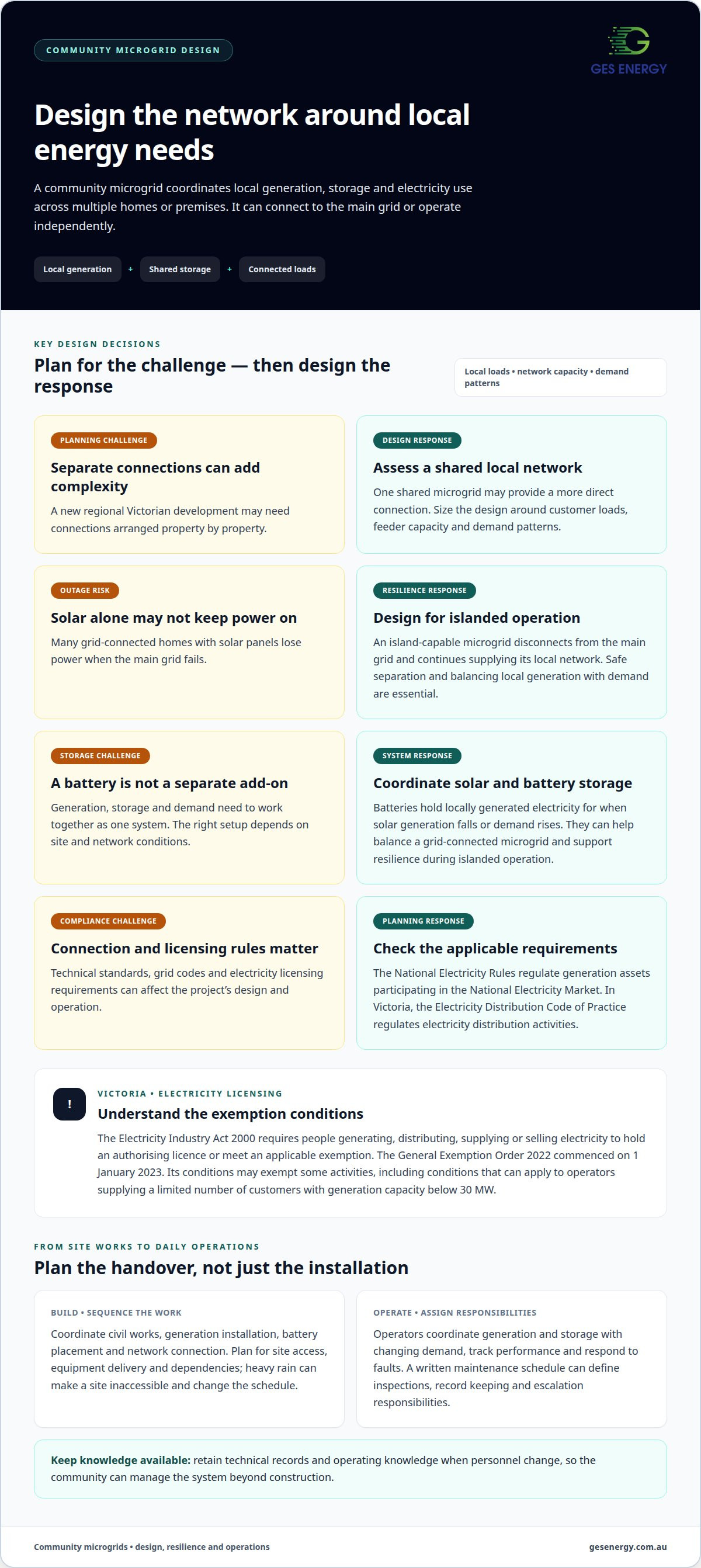
A microgrid can bring local electricity generation and use together across connected homes and premises. It can connect to the main grid or operate independently as an island. For a new regional Victorian development, one shared microgrid may provide a more direct connection than arranging separate connections for each property. Its design needs to account for customer loads, feeder capacity and demand patterns.
Standalone solar supplies an individual property, while a community microgrid coordinates electricity across multiple premises. A backup generator can supply local loads, but does not by itself create a shared network connecting homes and other buildings.
Islanded operation and electricity resilience
Islanded operation means a microgrid disconnects from the main grid while continuing to supply electricity within its local network. During a wider outage, an island-capable microgrid can keep operating, while many grid-connected homes with solar panels lose power when the main grid fails. Safe separation and the ability to balance local generation with demand are central to resilience.
Reliable supply also depends on what the microgrid serves and how it operates. A Victorian community facility, homes and businesses may have different electricity needs, so the design must account for local loads and available generation. Climate and site conditions can also shape the community’s resilience priorities.
Battery storage within the grid connection
Battery storage holds locally generated electricity for use when solar generation falls or demand rises. In a grid-connected microgrid, it can help balance generation and use. During islanded operation, storage can support resilience in a renewables-based microgrid. Battery capacity and operation are therefore part of the grid design, not an add-on to consider separately.
A regional Victorian community could coordinate solar generation with shared battery storage to serve local loads. The right configuration depends on customer demand, feeder capacity and network characteristics, rather than a standard design applied to every site.
Technical standards and grid codes
Technical standards and grid codes set requirements for equipment and electricity network activities. Technical standards help guide the design and connection of grid-connected equipment. The Australian Energy Market Commission says the National Electricity Rules regulate generation assets participating in the National Electricity Market. In Victoria, the Electricity Distribution Code of Practice regulates electricity distribution activities.
Victoria’s Electricity Industry Act 2000 requires a person generating, distributing, supplying or selling electricity to hold an authorising licence or meet an applicable exemption. Section 16(1) relates to that requirement. The General Exemption Order 2022 commenced on 1 January 2023 and sets conditions that may exempt some electricity activities from licensing requirements. Conditions can apply to operators supplying a limited number of customers and with generation capacity below 30 MW. The main risks are mismatched generation, storage and demand, grid connection constraints, project and operating costs, and unclear ownership or decision-making. These factors shape technical design, funding plans and governance from the outset.
Renewable energy construction, operations and maintenance
Building a community renewable energy system involves more than installing solar panels and batteries. Construction planning must coordinate generation, storage, electrical infrastructure and the connection to the local network. It also needs to reflect customer loads and feeder capacity. This helps align equipment choices with the community’s energy plan before work begins on site.
Community-led planning gives residents and local organisations a role in setting project priorities. For example, a Victorian project might identify a community facility as a priority load, then consider how nearby homes and businesses fit into the design. This process helps define which assets are needed, how they connect and what outcomes the community wants.
Construction planning also accounts for site access, equipment delivery and the sequence of electrical works. The project team can map dependencies between civil works, generation installation, battery placement and network connection. If heavy rain makes a site inaccessible, the construction schedule may need to change. Recording dependencies early helps teams manage disruption and keep stakeholders informed.
Operations begin after commissioning, when the system starts serving its intended loads. Operators coordinate generation and storage with changing demand, track performance and respond to faults. A community centre, for instance, may have different usage patterns from nearby businesses. Understanding those patterns helps operators set up the system and keep local energy arrangements aligned with actual use.
A maintenance plan should identify who monitors equipment, logs faults and arranges repairs. It should also explain how technical records and operating knowledge remain available when personnel change. A written schedule can set out inspections, record keeping and escalation responsibilities. These arrangements help the community manage the system beyond construction and support continuity in daily operations.
Replicable community energy models share methods and lessons, rather than prescribing identical equipment for every site. Victorian communities can exchange experience on construction sequencing, safety planning, technical systems, fundraising and administration. Each project can adapt relevant lessons to its network, site conditions and customer needs. This supports learning between projects while keeping system design grounded in local requirements.
Where storage is central to the project’s operating plan, community-scale energy storage planning can help connect construction decisions with intended system use. Aligning storage plans with local loads and network conditions gives the project a clearer basis for its operations and maintenance arrangements.
Community microgrid ownership and operation
Ownership determines who makes decisions about a microgrid’s assets, income and operating responsibilities. Developing a community microgrid therefore involves distinguishing ownership of renewable generation from control of the wider electricity infrastructure. Community projects often own generation assets but rarely control the grid infrastructure connecting them to customers.
A community may own generation through a co-operative, incorporated group or another project entity. Alternatively, a private company may own the assets and operate the system under an agreement with local customers. Most microgrids are owned and operated by private, for-profit companies in both the Global South and the Global North. The structure affects who contributes capital, sets priorities and receives project benefits.
Governance needs clear, inclusive decision-making to keep the system accountable and equitable. Residents, businesses and community organisations may have different energy needs, so agreed rules should explain how decisions are made and concerns addressed. For example, a process can define who approves operating changes, communicates planned maintenance and reviews how the system serves participating premises.
Ownership does not mean every resident must manage technical operations. A community can retain control of its priorities while assigning specialist system tasks to paid support. Trained local participants may also take on administrative duties. In either model, responsibility for operating the microgrid, maintaining equipment and responding to faults should be clearly allocated.
Victoria’s Electricity Industry Act 2000 requires a person generating, distributing, supplying or selling electricity to hold an authorising licence or meet an applicable exemption. This matters when choosing an ownership and operating structure, because the activities performed determine the relevant regulatory responsibilities. A community project may own generation while another party manages distribution or supply, so roles need careful definition.
Administration also needs a practical plan. Microgrid operators must manage billing and maintenance, with work shared between volunteers and paid support where appropriate. A billing process should explain how charges are calculated, when customers receive statements and how payment issues are handled. Maintenance arrangements should identify who records faults, organises work and keeps operating information accessible to those responsible.
Shared infrastructure can serve homes with different energy assets, including properties without suitable rooftop space for solar panels. Governance rules can define how those customers participate and how the system accounts for their use. Clear agreements on access, responsibilities and decision-making align the microgrid’s operation with community priorities and make accountability easier to understand.
Community support, skills and financing
Community participation and practical skills shape how a microgrid is planned, funded and managed. Project financing must cover construction and ongoing operations, not just renewable energy equipment.
There is no single cost for building and operating a community microgrid. The budget depends on generation and storage capacity, grid connection requirements, site conditions, construction and maintenance arrangements. Project costs are established after a quote request.
Building community support and skills
Community support means involving affected residents and organisations in project discussions, decisions and learning. Open conversations explain the proposed technology, the project’s purpose and how benefits will be shared. They also give households and local businesses a chance to raise concerns early, before design decisions become difficult to change.
Local training can build practical knowledge and support long-term independence. For example, a project can arrange training in routine system monitoring, record keeping or maintenance coordination. Local capability can reduce reliance on outside support for suitable tasks. Technical work still needs clear responsibility, so training plans should distinguish community roles from specialist operational duties.
Shared learning between community energy projects can strengthen planning. Groups can exchange lessons on fundraising, safety requirements, technical systems and administration. A new project can use those lessons to develop a clearer plan for its site, network connection and community needs. This shares experience without assuming another microgrid’s design will suit every location.
Grants, rebates and financing options
Grants and rebates can reduce eligible project expenses, while financing provides capital that the project repays or raises from participants. Australian government programs may support eligible energy upgrades or infrastructure, but a community microgrid’s funding plan needs to match each program’s purpose and eligibility rules. No single incentive should be treated as the whole project budget.
Funding can combine government grants or rebates for eligible components, community contributions, loans, private investment and revenue from electricity arrangements. Each source has different implications. A grant can reduce the amount that needs to be repaid, while a loan creates a repayment obligation. Community investment can support local ownership, but requires clear explanations of financial commitments and decision rights.
Build the financial plan around the project’s full lifecycle. Separate construction costs from ongoing expenses such as system operation, maintenance, administration and financing repayments. Then compare expected income and energy use with those obligations. A community group can also plan for changes in electricity demand, equipment servicing and funding conditions over time.
Before seeking funding, prepare a project case explaining the local energy need, proposed assets, governance structure and operating plan. For example, a town seeking shared solar and storage can show how participating premises will use the system and how maintenance will be managed. Clear project documentation helps align funding applications, community contributions and long-term financial responsibilities.
Solar generation and battery energy storage
Solar PV and battery storage can work together to supply electricity across a community microgrid. Their configuration depends on local demand, available sites and the role the system needs to play.
Solar generation for community microgrids
Solar generation converts sunlight into electricity for participating homes, businesses and community facilities. Rooftop panels may suit properties with suitable roof space, while a shared array can serve a wider group. In a Melbourne neighbourhood, for example, a community facility could host generation that contributes to the local network. The choice depends on site access, customer loads and network capacity.
Some premises may not have suitable rooftops or control over their roof space. Shared generation can give those participants access to locally produced electricity. A sound design considers how much energy participating premises use and when, then compares those patterns with expected solar output. This helps determine how generation is distributed across sites.
Battery energy storage
Battery energy storage holds electricity for use when solar output falls or local demand increases. It can help match daytime generation with later consumption, making storage an important part of a renewable microgrid’s operating design. Battery capacity and controls should reflect the system’s purpose, the loads it serves and whether it needs to operate apart from the main grid.
For instance, a regional Victorian project serving homes and a community building could use stored solar energy when those premises need electricity after generation falls. A battery’s role is not only to hold energy; its operating settings also affect when and how that energy is available. Planning storage alongside solar avoids treating either asset as a standalone solution.
Suitable renewable and battery technologies
Solar PV paired with battery storage is one suitable technology combination for Australian community microgrids. The right system depends on local solar conditions, customer demand, feeder capacity and resilience objectives. These considerations guide the choice between rooftop panels, shared generation or a mix, as well as the location and operation of storage.
In a regional town, available land and the distance between premises may influence whether a shared solar array is practical. In a Melbourne residential setting, rooftops may offer suitable generation sites, while a shared battery could support several participating premises. These are design scenarios, not standard templates. Each project needs to match generation and storage to its network and community energy plan.
Grid connection also shapes technology choices. A connected microgrid coordinates local solar and storage with the wider network. An island-capable system must also manage local supply when separated from it. Controls and the operating plan need to reflect the intended arrangement, so generation and stored energy work together to serve the required loads.
To plan solar generation and storage around your project’s network and demand, discuss community microgrid solutions.
GES ENERGY: Micro Grid Solutions
GES ENERGY provides Micro Grid Solutions for communities planning shared generation, storage and electricity networks. Its work can connect microgrid requirements with Commercial and Industrial Solar, Off Grid Solar Systems or EV Charging Stations, depending on the project’s needs. This is a practical next step when a community has defined its energy priorities and needs support translating them into an integrated project design and delivery plan. Decisions about network connection, local demand, storage and long-term operation all inform the system configuration. For a regional development, business precinct or community facility, aligning these elements early helps shape a system around its intended use. Contact GES ENERGY to discuss your community microgrid project.
Set a clear direction for your community energy project
The next step is to turn community priorities into a practical project brief. Set out which premises the system should serve, how decisions will be made and who will oversee ongoing operations. This gives technical planning and funding discussions a shared reference point while keeping the community's intended outcomes central.
Developing a community microgrid is a long-term infrastructure decision, so aligning local leadership, energy needs and project responsibilities early can support confident planning. GES ENERGY offers Commercial and Industrial Solar, Off Grid Solar Systems and EV Charging Stations that may form part of a wider project scope.
Bring your project priorities together and start a conversation with GES ENERGY. A clear first discussion can help shape the next steps for your community's energy plans.
Frequently Asked Questions
How Does a Microgrid Work?
A microgrid uses controls to coordinate electricity flows between local generation, storage and connected equipment. For example, controls can prioritise a facility’s essential loads when local supply is constrained. The operating plan should identify which loads take priority, who can change settings and how faults are recorded. These decisions turn the system design into practical procedures for the people responsible for daily operations.
How Was It Achieved?
A community energy project takes shape by turning agreed goals into documented technical and operating decisions. A useful project brief records the premises to serve, desired outcomes, proposed assets, responsibilities and key constraints. It supports design and funding discussions, then provides a reference during construction and commissioning. It also helps the project team explain changes to participants and keep decisions consistent as delivery progresses.
What Are the Main Components of a Microgrid?
Beyond generation and storage equipment, a microgrid needs electrical connections, inverters, controls, protection equipment and suitable monitoring. These elements must work together: protection equipment responds to electrical faults, while testing can assess power quality and system performance. Project documentation should identify how components interface and who maintains each one. This clarifies responsibilities during commissioning, fault investigation and later maintenance.
What Is a Community Microgrid and How Does It Work?
A community microgrid is a coordinated energy arrangement serving multiple local participants. Unlike a household system, it must manage shared participation: the project needs to define which premises are included, how their electricity use is recorded and how operating decisions are communicated. A written participation agreement can clarify expectations before households or organisations rely on the system.
What Are the Steps to Develop a Community Microgrid in Australia?
Start by recording the project’s purpose and intended participants, then assemble an energy-use profile for the premises involved. Use these records to assess design options and identify decisions that require community agreement. Document ownership, operating roles, funding assumptions and connection requirements before advancing construction planning. Keep a decision register as the project develops. It helps the group track approvals, unresolved issues and changes without losing the reasons behind earlier choices.
How Do You Assess Community Demand and Choose a Microgrid Site?
Build a demand profile using available electricity records and discussions with participating premises. Separate regular use from occasional high-demand activities, such as a community event or business shift. For possible sites, record land access, nearby electrical infrastructure, space for equipment and practical construction constraints. Comparing each location against the same criteria makes trade-offs visible and helps explain why a selected site suits the project.
What Electricity, Planning, Environmental and Safety Regulations Apply to Microgrids in Australia?
Requirements depend on the project’s location, activities, equipment and connection arrangement. In Victoria, project planning should identify whether generation, distribution, supply or sale activities require authorisation or meet an applicable exemption under the Electricity Industry Act 2000. Technical design also needs to account for inverter and network requirements. Prepare an approvals register that assigns each planning, environmental, electrical and safety responsibility to a named project role.
How Do Community Microgrids Connect to the Grid and Sell or Share Electricity?
Before designing a grid connection, define how local participants will receive and account for electricity. Project agreements should describe participation, metering information, billing responsibilities and how operational changes are communicated. Electricity exported to the wider network depends on the project’s connection and commercial arrangements. Clear records distinguish electricity used locally from energy exchanged through the network and support transparent participant accounts.


