

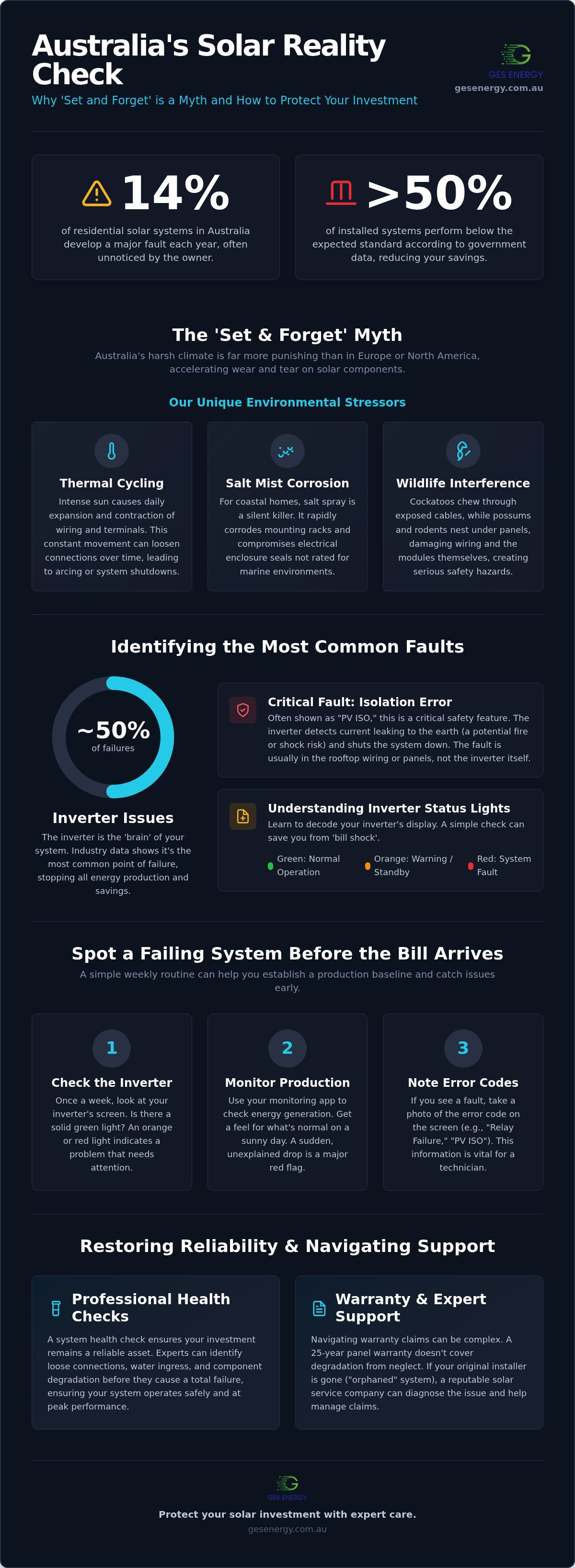
Did you know that approximately 14% of residential solar systems in Australia develop a major fault every single year, often without the owner even noticing? Most homeowners view their rooftop panels as a "set and forget" investment, but with government data showing more than half of these systems perform below the expected standard, that is rarely the case. It’s incredibly frustrating to open a power bill and realise your expected savings have vanished while your inverter flashes a cryptic error code. Understanding the common solar system faults australia experiences is the first step toward regaining control over your energy independence.
You deserve peace of mind knowing your hardware is safe and performing at its peak. This article provides a clear roadmap to help you identify, prevent, and rectify the most frequent failures caused by our unique climate and legacy installation practices. We will examine the impact of the latest AS/NZS 5033:2021 safety standards, clarify what is actually covered under your equipment warranties, and explain how a professional health check can ensure your system remains a reliable asset for years to come.
Key Takeaways
- Understand why the "set and forget" mindset is a myth in Australia’s harsh climate and how extreme UV exposure impacts your system's longevity.
- Learn to identify the most common solar system faults australia encounters, from cryptic inverter error codes to critical isolation failures.
- Recognise the warning signs of DC isolator degradation and water ingress to prevent performance loss and mitigate potential fire risks.
- Discover a simple weekly monitoring routine to establish a production baseline and spot orange or red status lights before your next bill arrives.
- Gain clarity on navigating warranty claims and finding expert support for "orphaned" systems when your original installer is no longer in business.
Busting the 'Set and Forget' Myth: Solar Maintenance in Australia
Many Australians view solar panels as a "set and forget" asset. This mindset is a significant risk to your financial return. While Solar power in Australia has seen record-breaking adoption with over 3.9 million installations, the reality is that these systems require active stewardship to remain efficient. Our environment is far more punishing than the climates of Europe or North America. Extreme UV radiation and high ambient temperatures degrade plastics, seals, and electronic components at an accelerated rate.
The legacy of the "Solar Cowboy" era adds another layer of complexity for homeowners. During various rebate booms, some installers prioritised speed and high turnover over technical precision. These poor installation practices have led to a rise in common solar system faults australia homeowners are now facing years after the original company has disappeared. Neglect carries a heavy price tag. A system that stops exporting energy or shuts down entirely might go unnoticed for a full billing cycle. This often results in "bill shock" where you lose months of feed-in tariffs while paying full price for grid electricity.
The Reality of Solar Longevity
It's vital not to confuse a 25-year panel warranty with a maintenance-free life. A manufacturer's warranty typically covers major defects; it doesn't cover performance loss caused by environmental buildup or loose electrical connections. There is a clear distinction between a total hardware failure and preventable degradation. Dust, bird droppings, and lichen can significantly reduce your output. Regular health checks ensure your system actually hits its expected lifespan rather than becoming a dormant rooftop ornament after only a decade of service.
Australia’s Unique Environmental Stressors
Our local conditions present specific challenges that require professional oversight. These include:
- Thermal Cycling: The intense Australian sun causes wiring and terminals to expand and contract daily. This constant movement can eventually loosen electrical connections, leading to dangerous arcing or system shutdowns.
- Salt Mist Corrosion: For systems installed near the coastline, salt spray is a silent killer. It can rapidly corrode mounting racks and compromise the seals on electrical enclosures if they aren't specifically rated for marine environments.
- Wildlife Interference: Local fauna can be remarkably destructive. Cockatoos are notorious for chewing through exposed cable insulation, while possums and rodents often nest under panels, damaging the underside of the modules and the DC wiring.
By moving away from the "set and forget" myth, you can protect your investment and ensure your system continues to provide the clean energy and financial savings you expected.
The Inverter Heart: Identifying Isolation Faults and Error Codes
The solar inverter is the hardest working component in your energy ecosystem. It operates as the "brain," converting DC power from your panels into usable AC power for your home. Because it manages high voltage and monitors grid stability, it is often the first place you will notice common solar system faults australia homeowners encounter. In fact, industry data suggests that inverter issues account for nearly 50% of major solar system failures across the country. When the inverter stops, the savings stop too.
One of the most frequent triggers for a total system shutdown is an "Isolation Fault," often displayed as "PV ISO" or "Isolation Error." While this can be frustrating, it is a critical safety feature. When your inverter detects that current is leaking to the earth, it immediately ceases operation to mitigate the risk of fire or electric shock. It is important to realise that the inverter is often just the messenger; the actual fault usually lies in the rooftop wiring or the panels themselves.
Decoding the Inverter Screen
Most modern units from brands like Fronius or GoodWe use a colour-coded system or specific numerical codes to communicate their health. A "Warning" might indicate that the grid is temporarily outside of standard parameters, which may resolve itself without intervention. However, a "Hard Fault" usually requires a professional diagnosis. If you see a persistent red light or a code like "Relay Failure" or "DC Injection," your unit has likely detected a significant internal hardware issue. An Isolation Fault is a breach in the electrical circuit’s insulation. If these codes persist after a standard shutdown and restart procedure, you likely need a specialist in solar inverter repairs and warranties to restore your system safely.
Moisture Ingress: The Silent Killer
Inverter failure is frequently a symptom of external environmental issues. Moisture ingress is the primary culprit behind ground faults in DC cabling. Heavy rain or high humidity can allow water to enter poorly sealed conduit or junction boxes, bridging the gap between live wires and the mounting frame. This is a particularly prevalent example of common solar system faults australia experiences during the storm season.
You should never use high-pressure cleaners or garden hoses near your solar hardware. While panels require occasional cleaning, you should never "hose down" your inverter or its surrounding electrical enclosures. Even IP65-rated units can suffer from condensation build-up if they are installed in areas with poor ventilation or direct afternoon sun. This internal moisture leads to corrosion that eventually triggers a permanent electronic failure.
Weathering the Storm: DC Isolator Failures and Environmental Wear
The DC isolator is a small but critical switch designed to manually disconnect the power flow between your solar panels and the inverter. In the Australian context, this component has historically been a major point of failure. Water ingress in rooftop isolators remains the primary cause of solar-related house fires in Australia. When seals perish due to extreme heat or poor installation, moisture enters the enclosure and creates an electrical arc. This can quickly escalate into a high-temperature fire that is difficult to extinguish while the sun is still shining.
Industry safety requirements have evolved significantly to address these risks. Under the AS/NZS 5033:2021 standard, which became mandatory in May 2022 and received a revision in June 2026, the requirement for rooftop DC isolators has changed. While they are no longer mandatory for all system designs, many older installations still rely on them. These legacy systems often lack the protective shrouds and UV-resistant covers now mandated by current CEC guidelines. Beyond the isolator itself, the plastic conduits housing your cables also suffer from UV degradation. Over time, brittle plastic can crack and expose live wires to the elements, leading to the common solar system faults australia experiences during intense summer storms.
The Safety Risk of Faulty Isolators
The industry moved away from certain isolator designs because they were prone to internal mechanical failure and poor weather sealing. You can sometimes spot a failing isolator during a ground-level visual check. Look for signs of heat distortion, such as warped plastic, discolouration, or visible melting on the enclosure. It is essential that any replacement parts are SAA-accredited components. These are specifically tested to withstand the high-UV environments typical of Australian rooftops, ensuring they won't become brittle or fail prematurely.
Panel Micro-cracks and Hotspots
While panels appear robust, they are susceptible to physical and technical degradation that saps your system's efficiency. Micro-cracks are tiny fractures in the silicon cells often caused by heavy hail, improper foot traffic during installation, or extreme thermal stress. These cracks can eventually develop into "hotspots." A hotspot occurs when a damaged cell becomes resistive, heating up significantly more than the surrounding area. This can lead to the glass shattering or the backsheet scorching. Another technical issue to watch for is Potential Induced Degradation (PID). This fault occurs when a voltage leak from the cells to the frame causes a slow, steady decline in power output that standard monitoring might miss.
How to Spot a Failing System Before the Bill Arrives
Waiting for your quarterly electricity statement to arrive is a reactive strategy that often leads to significant financial loss. By the time you notice a spike in your bill, a fault could have been draining your savings for months. Proactive monitoring is the most effective way to manage common solar system faults australia owners face. Developing a simple routine allows you to catch performance dips before they escalate into total system failures.
Start by establishing a production baseline. On a clear, sunny day, note how many kilowatt-hours (kWh) your system generates; this gives you a "gold standard" for comparison. You should check your inverter display at least once a week. A steady green light usually indicates healthy operation. If you see an orange or red light, your system has likely encountered a hard fault or a communication error that requires immediate attention. These lights are your first line of defence against undetected downtime.
A ground-level visual inspection is also a vital part of your maintenance routine. Use binoculars to look for debris, bird nests, or sagging mounting rails on your roof. If you notice panels are misaligned or shading has increased due to tree growth, your output will suffer. For a professional assessment of your hardware, you can book one of our maintenance health checks to ensure every component is operating within safe parameters.
Using Solar Analytics and Smart Monitoring
Digital monitoring platforms, such as Solar Web or proprietary brand apps, provide real-time visibility into your energy ecosystem. These tools can be configured to send automated alerts to your smartphone the moment a fault is detected. Consumption monitoring is particularly important if you have a battery system. It allows you to verify that your stored energy is discharging correctly during the evening peak rather than sitting idle while you draw expensive power from the grid.
The Quarterly Bill Audit
When your bill does arrive, look beyond the final dollar amount. Compare your "Feed-in" credits against the same period from the previous year to account for seasonal variations in sunlight. If your "Self-Consumption" is high but your "Export" has dropped to zero, your inverter may be struggling to push power back to the grid. You might also notice "Inverter Clipping," where production plateaus at a certain level. While often a design choice to maximise morning and afternoon yield, excessive clipping can indicate an undersized inverter or a configuration error that limits your total return on investment.
Restoring Reliability: Professional Health Checks and Warranty Support
A significant number of Australian solar owners find themselves with "orphaned systems" when their original installation company ceases trading. This is a common consequence of the rapid market expansion seen over the last decade. If your installer is no longer in business, you aren't without options. While an installation warranty may be difficult to claim without the original provider, your manufacturer warranties on panels and inverters often remain valid for 10 to 25 years. GES Energy acts as a reliable partner for these owners, specialising in solar inverter repairs and warranties to ensure your hardware continues to perform as expected.
Understanding the difference between these warranties is essential for protecting your investment. A manufacturer warranty covers the physical hardware, such as a faulty internal relay in an inverter. An installation warranty covers the workmanship, such as how the cables were secured or the isolators mounted. When diagnosing the common solar system faults australia experiences, a professional health check is the best way to determine which path to take. A comprehensive check includes cleaning panels, tightening electrical terminals affected by thermal cycling, and testing the integrity of all safety switches.
The Value of a Professional Service
Safety should always be the priority. Only SAA-accredited electricians should open your solar switchboard or inverter casing. A professional service involves sophisticated testing, such as checking "Earth Continuity" and "Insulation Resistance." These tests confirm that your system's safety earthing is intact and that no current is leaking through degraded wire insulation. Beyond safety, maintenance has a direct impact on your wallet. In dusty or high-pollen areas, a professional clean can improve your energy output by up to 15%.
Navigating Warranty Claims
To process a claim successfully, you need accurate data. Before calling a technician, try to locate your system's serial numbers and record any specific fault codes displayed on the inverter screen. Having this information ready streamlines the process with manufacturers. GES Energy is the preferred national partner for maintenance and repair regardless of who originally installed your panels. Our national coverage allows us to address the most common solar system faults australia faces, providing stability for those who feel abandoned by their original providers. To ensure your investment is protected, Organise a professional solar health check with GES Energy today.
Securing Your Solar Investment for the Future
Australia’s climate is unique, and as we have explored, your solar system requires a proactive approach to maintain its efficiency and safety. From identifying cryptic inverter error codes to spotting the early signs of DC isolator degradation, being an informed owner is the best defence against financial loss. Understanding the common solar system faults australia encounters allows you to transition from the "set and forget" myth to a strategy of long-term reliability.
Whether you are managing an orphaned residential system or a large-scale commercial array, professional oversight ensures your hardware remains compliant with the latest safety standards. GES Energy provides specialised inverter repair and warranty assistance alongside SAA-accredited technical support to restore your system’s performance. With our national maintenance coverage, we are ready to help you regain control over your energy production and future-proof your savings.
Book a Comprehensive Solar System Health Check with GES Energy and ensure your system continues to deliver the clean, cost-effective energy you deserve.
Frequently Asked Questions
Is a red light on my solar inverter always a major fault?
A red light indicates a hard fault that has stopped production, but it isn't always a permanent hardware failure. Sometimes it triggers due to grid fluctuations or temporary environmental factors. However, if the light remains red after a standard shutdown and restart procedure, it signals a significant issue. You should record any displayed error codes and contact an SAA-accredited technician to prevent further damage to the unit's internal circuitry.
How often should I have my solar system serviced in Australia?
You should have your solar system professionally serviced at least once every two years to ensure safety and efficiency. While the 2021 standards improved installation quality, Australia’s extreme UV and heat still degrade components over time. A biennial health check allows a technician to test electrical terminals, inspect DC isolators for water ingress, and verify the earthing system. This proactive approach helps identify common solar system faults australia experiences before they cause downtime.
Can I clean my own solar panels to fix a performance fault?
You can clean your own panels from the ground using a soft brush and water, but this rarely fixes an electrical performance fault. While removing dust or bird droppings can improve yield, it won't resolve internal issues like micro-cracks or wiring corrosion. Never use high-pressure washers or harsh chemicals, as these can damage the glass seal. If a production drop persists after a gentle clean, the issue is likely electrical and requires professional diagnostic equipment.
What happens if my solar installer has gone out of business?
If your original installer has ceased trading, you are still protected by individual manufacturer warranties on your panels and inverter. You will need to find a new service partner who can facilitate warranty claims on your behalf. GES Energy specialises in assisting owners of orphaned systems by providing national maintenance coverage and specialised inverter repair services. We can help you gather serial numbers and fault data to navigate the claim process with hardware manufacturers.
Will my solar system still work if there is a "PV Isolation" fault?
No, your solar system will immediately shut down if it detects a PV Isolation fault to prevent electrical hazards. This fault occurs when the inverter senses current leaking to the earth, often due to moisture ingress in the cabling or damaged panel insulation. Because this represents a potential fire or shock risk, the inverter’s safety software will not allow the system to restart until a qualified electrician identifies and rectifies the breach in the circuit.
How much does it typically cost to repair a solar inverter in Australia?
The cost to repair a solar inverter depends on whether the unit is still under warranty and the nature of the internal component failure. If the unit is within its standard 5 to 10-year warranty period, you may only be responsible for the labour costs associated with the swap or repair. For out-of-warranty units, costs vary based on the brand and model. You should always request a detailed quote from a specialist before proceeding with a major repair.
Can faulty solar panels cause a house fire?
Faulty solar panels can cause fires, though the risk is significantly lower than that posed by degraded DC isolators or poor wiring. The primary concern with panels is the development of hotspots caused by micro-cracks or cell damage. These areas can reach extreme temperatures, potentially scorching the backsheet or shattering the glass. Regular visual inspections and professional thermal imaging during a health check are effective ways to identify these risks before they become dangerous.
Does my home insurance cover solar system faults caused by storms?
Most Australian home insurance policies cover solar system damage caused by major storm events like hail or lightning strikes. However, insurers rarely cover common solar system faults australia faces that result from wear and tear, lack of maintenance, or poor installation. It is vital to check your specific Product Disclosure Statement to understand your coverage limits. Maintaining detailed service records can also help support a claim if your system is damaged by a verifiable weather event.


