

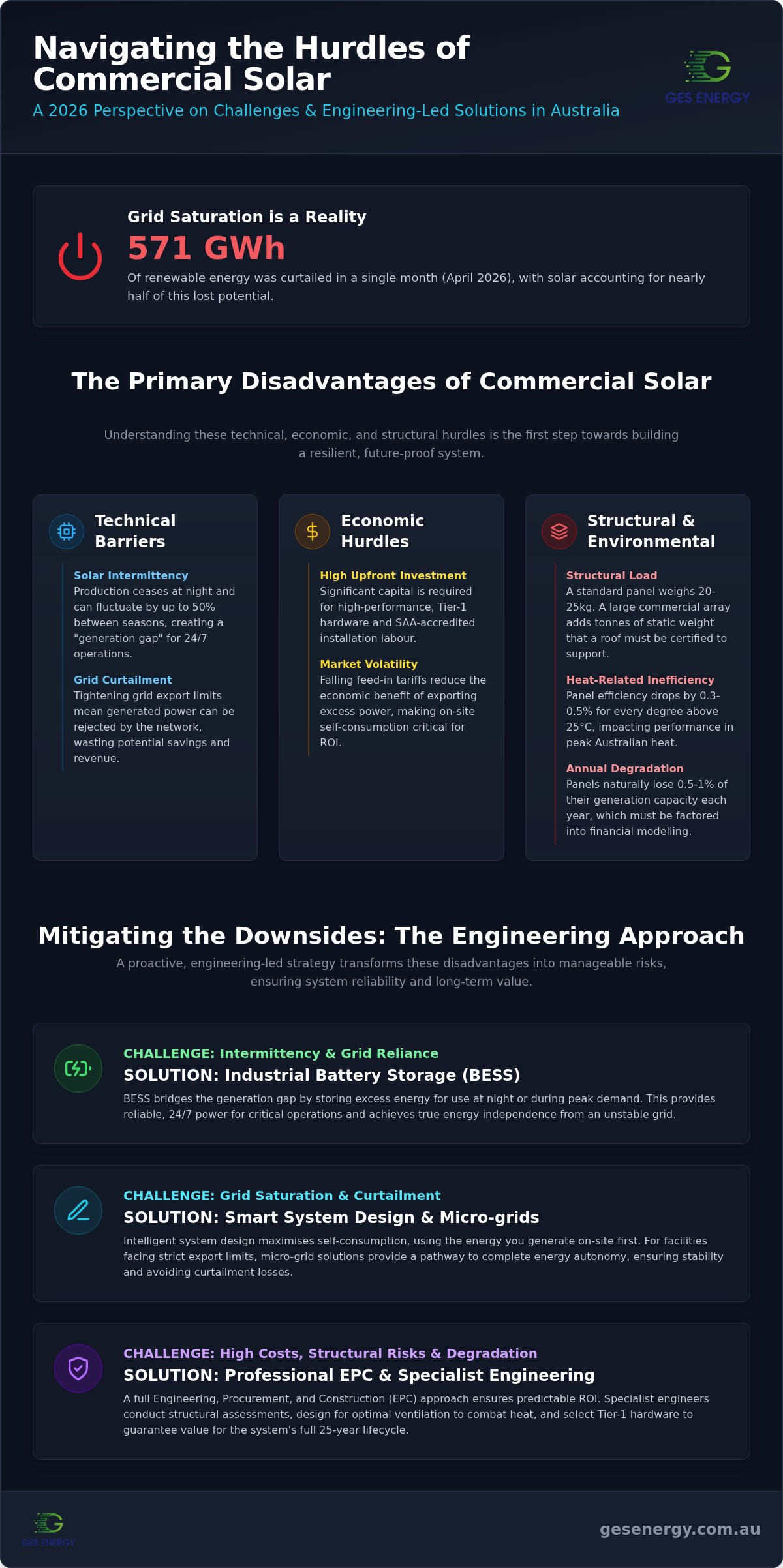
In April 2026, renewable energy curtailment reached a staggering 571GWh across the National Electricity Market, with solar accounting for nearly half of that lost potential. If you're concerned that the golden age of easy savings has passed, you aren't alone. Many Australians now find themselves weighing the genuine disadvantages of solar energy against the promise of lower bills. You might feel frustrated by falling feed-in tariffs or confused by the upfront cost of premium components. It's a complex landscape where yesterday's simple solutions don't always meet today's infrastructure demands.
This guide offers a clear-eyed analysis of the technical and economic hurdles you'll face in 2026. We'll examine why grid export limits are tightening and how the national solar recycling scheme is evolving to handle panel waste. Most importantly, we'll demonstrate how meticulous engineering and battery integration can mitigate these risks. By focusing on system predictability and professional oversight, you can still achieve energy independence. This article provides the technical insight needed to build a resilient, future-proof system that delivers long-term value despite shifting market conditions.
Key Takeaways
- Understand how industrial battery storage (BESS) bridges the gap caused by solar intermittency to provide reliable, 24/7 power for your operations.
- Evaluate the economic disadvantages of solar energy, such as initial capital costs, and learn how professional oversight ensures a predictable return on investment.
- Identify the structural risks that heat and weight pose to commercial infrastructure and how specialist engineering maintains panel efficiency in harsh climates.
- Navigate the challenges of grid saturation and curtailment by using smart system designs that maximise your energy self-consumption and reduce reliance on exports.
- Discover how micro-grid solutions provide a pathway to energy independence for industrial sites facing local network export limits or stability issues.
The Primary Disadvantages of Solar Energy in Australia
Solar technology has transformed the Australian energy landscape, yet it remains a complex engineering challenge rather than a simple plug-and-play solution. While the environmental benefits are clear, the practical disadvantages of solar energy often centre on the lack of consistency. For industrial and commercial operators, energy isn't just a cost; it's a critical input that requires 100% reliability. Relying solely on photovoltaic panels introduces variables that can jeopardise production schedules if not managed through sophisticated system design.
Beyond the weather, several physical and financial constraints define the current market. High-quality tier-1 hardware requires a significant capital commitment, and the physical footprint needed for large-scale generation can be prohibitive for sites with limited roof space. To achieve true energy independence, businesses often find that the initial price of panels is only the beginning. Integrating comprehensive storage solutions to bridge generation gaps adds another layer of technical and financial complexity to the project.
Understanding Intermittency and Reliability
The most persistent hurdle for any solar installation is intermittency. Photovoltaic cells require direct or diffused sunlight to generate electrons; therefore, production ceases entirely at night. In many parts of Australia, seasonal variations can cause energy yields to fluctuate by as much as 50% between summer and winter. This creates a significant "generation gap" that standalone systems cannot fill. For commercial enterprises with 24/7 power requirements, this volatility makes a grid-only or solar-only approach risky. Without a secondary power source or a Battery Energy Storage System (BESS), businesses remain vulnerable to peak evening tariffs and grid instability. When researching the disadvantages of solar power, it's clear that managing this "stop-start" nature of production is the primary focus of modern energy engineering.
The Reality of Upfront Investment
Securing a reliable solar ecosystem requires a substantial initial outlay. This investment is split between high-performance hardware and the SAA-accredited labour necessary for a safe, compliant installation. While budget-grade components might seem attractive, they often lead to higher long-term costs through premature degradation and inverter failure. We see a clear distinction between "cheap" solar and "value" solar. Fortunately, Australian businesses can leverage Small-scale Technology Certificates (STCs) and Large-scale Generation Certificates (LGCs) to offset a portion of these costs. These incentives are designed to reduce the capital barrier, though they don't eliminate the need for a well-planned budget. A professional EPC (Engineering, Procurement, and Construction) approach ensures that these initial funds are spent on infrastructure that actually lasts the full 25-year lifecycle of the system.
Structural and Environmental Downfalls of Solar Systems
Beyond the financial and consistency issues, the physical installation of an array introduces several structural disadvantages of solar energy that are often overlooked. Commercial roofs are designed to shed water and withstand specific loads, but adding hundreds of solar panels fundamentally changes those dynamics. A standard tier-1 panel weighs approximately 20 to 25 kilograms. When you multiply this across a 100kW or 500kW system, you are adding several tonnes of static weight to the building's skeleton. Understanding these physical disadvantages of solar energy allows for better planning during the initial design phase.
Environmental factors also play a counterintuitive role. While solar requires sunlight, excessive Australian heat is actually a detriment. Most panels are tested at 25 degrees Celsius. For every degree above that, efficiency drops by roughly 0.3% to 0.5%. Without proper ventilation and professional engineering, a system in the peak of summer might underperform exactly when energy demand is highest. Additionally, all hardware faces natural panel degradation, typically losing between 0.5% and 1% of its generation capacity every year. This gradual decline must be accounted for in your long-term financial modelling.
Structural Load and Engineering Challenges
Ensuring your facility can support a large-scale array is a non-negotiable step in the EPC process. A structural certificate from a qualified engineer is essential to confirm the roof can handle the combined weight and the wind-lift effect. In high-wind or cyclone-prone Australian zones, solar arrays act like sails. If the mounting hardware and rail systems aren't of sufficient quality, the upward force during a storm can compromise the entire roof structure. Using premium, corrosion-resistant aluminium rails and stainless steel fasteners is vital for long-term stability.
Environmental Impact and End-of-Life
While the energy produced is green, the lifecycle of the hardware has environmental costs. Manufacturing involves hazardous materials and high-energy processes. As systems from the early 2010s reach their end-of-life, Australia faces significant solar panel waste and recycling challenges due to a lack of robust national frameworks. To ensure your investment remains part of a circular economy, it's important to partner with providers who prioritise recyclable components and ethical disposal. Maintaining your system through regular maintenance services can extend the life of your panels, delaying the need for recycling and maximising your environmental return.
Economic Demerits: Assessing ROI and Market Volatility
Navigating the financial landscape of renewable energy requires a shift from short-term gain to long-term asset management. One of the significant disadvantages of solar energy in a commercial context is the extended payback period. While residential systems might see returns in four to six years, larger industrial projects often involve complex financing and longer horizons. This isn't a "set and forget" investment. Market volatility, including the scheduled reduction of federal rebates like the Small-scale Technology Certificates (STCs), means the business case for solar can shift if a project is delayed.
Operational expenses also extend beyond the initial purchase. Building insurance premiums can rise once an array is installed, as insurers account for the increased value of the asset and potential fire risks. Additionally, the fluctuating nature of feed-in tariffs in 2026, which average between 4c and 8c per kWh across various states, makes exporting power less lucrative than it once was. Profitability now depends almost entirely on your ability to use the power you generate on-site rather than selling it back to the grid.
Hidden Maintenance and Repair Costs
Maintaining peak performance requires more than just occasional rain to wash the panels. Dust, bird droppings, and industrial pollutants can create "hot spots" that permanently damage cells if left uncleaned. Most critically, the solar inverter, the heart of your system, typically has a shorter lifespan than the panels themselves. You should plan for a full inverter replacement around the ten-year mark. Engaging professional maintenance and repair services ensures that small faults don't escalate into system-wide failures. Regular health checks protect your ROI by identifying degradation before it impacts your bottom line.
The Complexity of Commercial Energy Billing
Many businesses assume a large solar array will automatically slash their entire power bill, but commercial billing is rarely that simple. A major economic hurdle is the presence of demand charges, which are based on the highest point of energy use during a billing cycle. If a cloud passes over during your peak production hour, your demand spike remains high, and your bill won't drop as expected. Over-sizing a system without precise load analysis is one of the common disadvantages of solar energy planning. Without professional energy modelling to align generation with your specific load profile, you risk investing in capacity that you can neither use nor profitably export.
Technical Barriers: Grid Integration and Curtailment
As Australia accelerates its transition to renewables, the aging electricity grid faces unprecedented pressure. One of the most significant technical disadvantages of solar energy is that our network was originally designed for one-way power flow from large coal stations to consumers. In April 2026, the National Electricity Market (NEM) saw approximately 255GWh of solar generation curtailed because the grid simply could not absorb the excess supply. For large-scale industrial operators, this means the power you generate might be intentionally restricted by the grid operator to maintain system stability.
The "Duck Curve" phenomenon further complicates this. Solar production peaks in the middle of the day when demand is often at its lowest, creating a massive surplus. Conversely, when the sun sets and solar production drops to zero, demand spikes as businesses and homes switch on lights and cooling systems. This mismatch is a core challenge that requires sophisticated management. Without proper integration, you risk investing in a system that is forced to sit idle during its most productive hours.
The Australian Grid and Export Limits
Network operators are increasingly imposing strict export limits on new installations to prevent local infrastructure from being overwhelmed. In many regions, "zero-export" requirements are now common for industrial sites. This means any power you generate must be used on-site immediately or stored. AEMO manages these periods of high generation by remotely curtailing utility-scale and even some rooftop assets. For a 5 MW project, these constraints can significantly alter the financial viability of the system if not factored into the initial design phase.
Voltage Instability and Inverter Tripping
High solar penetration in a local area often leads to voltage rises. When too many systems try to push power into the same local transformer, the voltage on the line increases. To protect your equipment and the grid, modern inverters are programmed to "trip" or shut down when voltage exceeds safe thresholds. This is a common reason why systems might switch off during the sunniest part of the day. Mitigating these issues requires advanced power quality management and reactive power control. To ensure your facility remains productive regardless of grid volatility, consider implementing C&I energy storage systems that allow you to capture and use your own power instead of relying on a saturated grid.
Mitigating the Downsides: The GES Energy Engineering Approach
Identifying technical hurdles is only half the battle. While the disadvantages of solar energy are significant, they are essentially engineering variables that can be managed through precise design and high-quality hardware. We view solar not as a standalone product, but as one component of a larger, integrated energy ecosystem. By moving away from "off-the-shelf" kits and toward custom Engineering, Procurement, and Construction (EPC) models, businesses can bypass the common pitfalls of grid instability and structural risk.
Hybrid systems represent the next evolution in site-specific power. By combining photovoltaic arrays with sophisticated control systems, we can ensure that generation aligns with your actual consumption patterns. This methodical approach transforms a variable resource into a predictable asset. It allows for a level of energy security that standard grid-tied systems simply cannot provide, especially as network constraints become more prevalent across Australia in 2026.
Solving Intermittency with BESS
The most effective way to counteract the "stop-start" nature of solar is through storage. Our industrial battery storage solutions turn intermittent generation into "firm" power that is available whenever your facility needs it. This technology enables load shifting, where you capture excess energy during the midday peak and deploy it during expensive evening periods. In 2026, the business case for BESS is stronger than ever. It provides a buffer against the disadvantages of solar energy like curtailment and negative feed-in tariffs, ensuring that every kilowatt-hour you produce adds value to your bottom line.
Professional EPC and Maintenance
Achieving long-term reliability requires a commitment to quality that extends beyond the installation date. We utilise SAA-accredited labour for every project to ensure that electrical and structural standards are met without compromise. This is vital for mitigating the wind-lift and fire risks mentioned earlier. A professional commercial solar installation should be treated as a managed asset. Proactive maintenance programmes, including regular thermal imaging and inverter health checks, prevent natural panel deterioration from turning into a financial liability. By choosing an end-to-end partner, you gain a diligent steward for your energy infrastructure who remains committed to performance for the life of the system.
Securing a Resilient Energy Future
While the disadvantages of solar energy in 2026 are real, they don't have to undermine your operational goals. Success in the current market requires moving beyond simple panel installation toward comprehensive energy engineering. By integrating industrial battery storage and custom micro-grid solutions, you can overcome intermittency and grid curtailment. This approach transforms a variable resource into a predictable, high-performance asset for your business.
Professional oversight is the key to managing structural loads and maintaining long-term hardware health. Our SAA-accredited engineering team specialises in complex off-grid and industrial micro-grids, providing the technical expertise needed for a safe transition. With national maintenance support, we ensure your infrastructure remains efficient for its entire lifecycle. Each project we undertake is a building block in a larger, stable energy ecosystem designed for longevity.
Take the first step toward a stable energy ecosystem by making informed, data-driven decisions. Contact GES Energy for a Professional Solar Feasibility Study today. You can achieve energy independence with a partner who understands the intricacies of the Australian grid and is committed to your long-term success.
Frequently Asked Questions
Is solar energy still worth it in 2026 despite the disadvantages?
Solar remains a highly viable investment in 2026 because it provides a reliable hedge against rising retail electricity prices. While the disadvantages of solar energy like lower feed-in tariffs are real, the financial benefits now come from maximising self-consumption. By using your own generation to power operations during the day, you avoid expensive peak grid rates. A well-engineered system typically pays for itself through these direct savings rather than through grid exports.
What happens to my solar panels during a blackout?
Most standard grid-connected systems automatically shut down during a blackout to prevent islanding and protect utility workers. If you want your facility to remain operational when the grid fails, you must integrate a Battery Energy Storage System (BESS) with backup functionality. This setup allows your system to form its own micro-grid, providing peace of mind and continuity for critical industrial processes during local network outages.
How much does it cost to maintain a commercial solar system annually?
Annual maintenance costs depend on the scale of your installation and the local environmental conditions. For commercial sites, these expenses cover professional cleaning, inverter performance audits, and thermal imaging of electrical connections. Regular health checks are essential to ensure your system continues to deliver its projected ROI. Investing in a national maintenance support plan prevents minor technical issues from escalating into expensive system failures or generation losses.
Can solar panels damage my roof or cause leaks?
Solar panels won't damage your roof or cause leaks if the installation is handled by an SAA-accredited engineering team. Structural issues usually arise from poor-quality mounting hardware or failing to conduct a proper roof integrity assessment beforehand. Professional EPC services include a thorough structural review to ensure the building can support the added weight and wind load without compromising the underlying waterproof membrane.
What are the main environmental disadvantages of solar panel manufacturing?
The primary environmental disadvantages of solar energy involve the energy-intensive mining of raw materials and the chemical processes used in panel manufacturing. While the energy produced is carbon-neutral, the lifecycle of the hardware requires careful management. Australia is currently developing more robust recycling schemes to handle panel waste. Choosing high-efficiency, long-lasting components reduces the frequency of replacement and minimises the overall environmental footprint of your energy infrastructure.
Why is my solar energy being curtailed by the grid operator?
Grid operators curtail solar exports when the local network becomes saturated with excess energy. This often happens during the middle of the day when generation is high but demand is low. These restrictions prevent voltage rises that could damage grid equipment or household appliances. To mitigate this risk, many industrial sites are turning to micro-grid solutions that allow for higher levels of on-site energy storage and consumption.
How long do solar batteries actually last in Australian conditions?
In typical Australian conditions, modern lithium-ion batteries generally last between 10 and 15 years. This lifespan is largely determined by the number of charge and discharge cycles the battery undergoes. Proper thermal management is vital in our climate, as excessive heat can accelerate chemical degradation. High-quality industrial storage systems include integrated cooling to ensure the battery reaches its full design life despite harsh outdoor temperatures.
Do solar panels work effectively in the shade or on overcast days?
Solar panels still generate power on overcast days, though their output is significantly reduced compared to clear conditions. Shading from trees or nearby buildings is a more serious issue that can cause hot spots and reduce the efficiency of an entire string of panels. Professional design involves using optimisers or micro-inverters to ensure that shade on one panel doesn't cripple the performance of the rest of the array.


