

The solar inverter is no longer just a component that converts power; in 2026, it acts as the strategic command centre for your property's energy resilience. While many focus on the panels on the roof, the inverter is the intelligent brain that dictates your system's efficiency, grid interaction, and overall longevity. Choosing the right hardware is often the difference between a system that thrives in the Australian heat and one that requires constant maintenance.
You likely feel the pressure of navigating technical jargon like string versus microinverters or the latest CSIP-AUS compliance mandates nationally. It's common to worry about failure rates in our harsh climate or whether a three-phase requirement is necessary for your specific site. This guide will help you master the technical specifications and strategic roles of modern inverters to optimise your residential or commercial energy independence. We'll provide a clear breakdown of hardware types, ensure you can confidently select units that meet AS/NZS 4777.2:2020 standards, and show you how to secure your energy future for the long term.
Key Takeaways
- Understand how the modern solar inverter acts as the intelligent command centre for your property, managing power conversion and grid safety.
- Compare the distinct advantages of string, micro, and hybrid technologies to identify the most efficient solution for your specific rooftop configuration.
- Clarify the requirements for single-phase and three-phase connections to ensure your hardware aligns with Australian infrastructure standards.
- Master the selection criteria for hardware, including mandatory AS/NZS 4777.2 compliance and the importance of CEC-approved equipment for grid security.
- Explore how custom-engineered design and proactive maintenance protocols safeguard your system's performance and facilitate future energy independence.
The Brain of the Array: Defining the Modern Solar Inverter
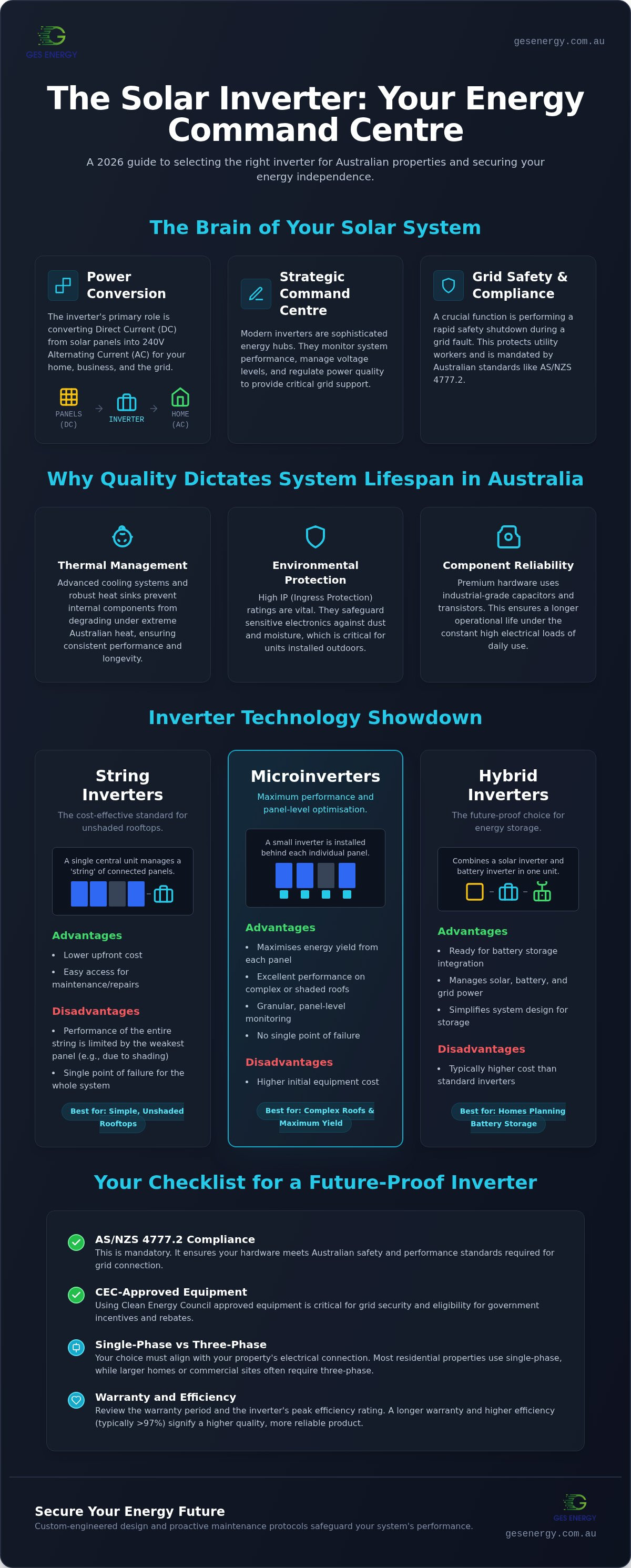
A Solar inverter is the hardest-working component in any solar power system. While panels capture energy, they produce Direct Current (DC), which is incompatible with the 240V Alternating Current (AC) used by Australian appliances and the national energy grid. The inverter bridges this gap, but its modern role extends far beyond simple conversion. It has evolved into a sophisticated energy management hub that monitors system performance, manages voltage levels, and ensures safety during grid outages.
In 2026, these units act as the strategic command centre for your energy array. They provide critical grid support services by regulating frequency and power quality. When the grid experiences a fault, the unit must perform a rapid safety shutdown to protect utility workers. This level of active management makes it the central nervous system of your energy infrastructure, ensuring that your investment delivers predictable, long-term value. It's the component that works most consistently, operating under high electrical loads every day to keep your energy transition stable.
DC vs AC Electricity in the Australian Context
Solar panels generate DC electricity, but our homes and businesses operate on 240V AC. To bridge this divide, the unit must synchronise perfectly with the grid's sine wave. This ensures that the power being fed into your switchboard matches the frequency and phase of the utility supply. Without this precise alignment, you couldn't safely export excess energy or power sensitive electronics. In modern bidirectional units, the rectification process allows the system to convert grid AC into DC for efficient battery storage when needed.
Why Inverter Quality Dictates System Lifespan
Australia's harsh environmental conditions place immense strain on power electronics. High-quality units feature robust heat sinks and superior internal components designed to withstand extreme thermal stress. When selecting a unit, the IP (Ingress Protection) rating is vital for determining whether it's suitable for outdoor exposure or requires an indoor plant room. Lower-quality models often suffer from premature component failure due to heat-induced degradation. Premium hardware maintains efficiency even during peak summer temperatures, significantly reducing the risk of thermal stress failures.
- Thermal Management: Advanced cooling systems prevent internal components from reaching critical temperatures.
- Environmental Protection: High IP ratings safeguard electronics against dust and moisture ingress.
- Component Reliability: Industrial-grade capacitors and transistors ensure a longer operational life.
Comparing Inverter Technologies: String, Micro, and Hybrid
Choosing the right inverter architecture is the most critical decision in the design phase. It dictates how your system handles shading, how you monitor performance, and whether you can easily add storage later. While the core function remains power conversion, the method of delivery varies significantly between string, micro, and hybrid technologies. Each has a specific role depending on your property's layout and energy goals.
String inverters remain the cost-effective standard for unshaded Australian rooftops. These central units manage a series of panels connected in a "string" and are typically wall-mounted at eye level. This makes them easy to access for maintenance and repairs. However, because panels are linked, the performance of the entire string is limited by the weakest performing panel. If one panel is shaded by a chimney or a tree, the output of every other panel in that string drops to match it.
Microinverters and power optimisers solve this by providing panel-level optimisation. Microinverters are small units installed behind every individual panel, converting DC to AC right on the roof. This maximises yield on complex roofs where different sections face different directions. Power optimisers offer a middle ground; they are DC-to-DC converters at the panel level that still feed into a central unit. Both technologies allow for granular monitoring, helping you identify underperforming panels before they impact your energy security.
String Inverters vs Microinverters
The choice between these two often comes down to a balance of modular reliability versus upfront cost. String systems have a lower initial price point but represent a single point of failure. If the central unit goes offline, the whole system stops. Microinverters involve a higher initial investment but provide superior redundancy. If one microinverter fails, the rest of the array continues to produce power at peak capacity. Maintenance also differs; string units are easily serviced on a wall, whereas microinverter issues require roof access, which can increase labour costs for repairs.
The Rise of the Hybrid Inverter
Hybrid units are rapidly becoming the preferred choice for forward-thinking Australians. They manage energy flow from the panels, the battery, and the grid simultaneously. For those considering solar and batteries for homes or commercial sites, a hybrid unit is the most efficient way to achieve energy independence. They allow you to future-proof your infrastructure by providing the necessary software and hardware connections for energy storage from day one. This technology is vital for achieving true independence from rising utility prices through advanced features like peak shaving and load shifting.
Single-Phase vs Three-Phase Inverters for Australian Infrastructure
Understanding the electrical infrastructure of your property is essential before selecting an inverter. Most Australian homes operate on single-phase power, which uses a single live wire at 230V. This is generally sufficient for standard domestic loads. However, larger residential properties and almost all commercial sites require three-phase power. This system uses three live wires at 400V, providing a more stable and high-capacity energy supply for heavy machinery, large-scale air conditioning, and extensive solar arrays.
Distributed Network Service Providers (DNSPs) across Australia have strict regulations regarding how much energy you can export to the grid. In many regions, single-phase systems are limited to a 5kW export capacity. Three-phase connections often allow for significantly higher export limits, making them the preferred choice for those looking to maximise their return on investment. Balancing your energy load across all three phases is a strategic necessity. It ensures you use your generated solar power efficiently before drawing expensive electricity from the utility provider.
Scaling Up: Inverters for Commercial Solar Systems
Commercial and industrial solar projects almost exclusively require three-phase units to manage high energy demands. For large-scale industrial rooftops, engineers often deploy modular string configurations. This decentralised approach ensures that if one unit requires maintenance, the rest of the array remains operational. For systems up to 5 MW, this redundancy is vital for maintaining energy security. You can find more detail on these requirements in our Commercial Solar Installation: A Strategic Guide for Business.
Phase Balancing and Grid Compliance
Three-phase inverters play a critical role in maintaining local grid stability. By spreading the solar output evenly across all three phases, these units prevent voltage spikes that could lead to system shutdowns or equipment damage. Grid compliance is non-negotiable in Australia. To meet these standards, SAA-accredited labour must handle the commissioning process to ensure precise phase alignment. This professional oversight is particularly important in industrial settings where managing reactive power and power factor correction is necessary to avoid utility penalties and ensure long-term infrastructure health.
- Voltage Stability: Spreading output across three phases reduces the risk of local grid over-voltage.
- Higher Capacity: Supports larger solar arrays and higher export limits compared to single-phase setups.
- Industrial Efficiency: Optimises the performance of three-phase equipment like motors and heavy pumps.
Critical Selection Criteria: Efficiency, Warranty, and Standards
Selecting the right hardware requires a focus on rigorous compliance and verified performance metrics. In Australia, the mandatory standard for any grid-connected inverter is AS/NZS 4777.2:2020. This regulation was further strengthened by the Amd 2:2024 amendment, which became enforceable in August 2025. These rules ensure your system possesses the necessary rapid shutdown and grid voltage ride-through capabilities to maintain safety during network instability. Choosing a unit that fails to meet these specific Australian requirements isn't just a technical oversight; it's a legal barrier to grid connection.
Efficiency ratings are another vital benchmark, but they must be interpreted correctly. While manufacturers often highlight "peak efficiency," this figure represents performance under perfect laboratory conditions. For a more accurate prediction of energy yield, you should look at the "weighted efficiency" or CEC efficiency. These figures better reflect how the unit performs across varying solar intensities throughout a typical Australian day. Verified data from the Clean Energy Council (CEC) approved products list provides the stability and predictability needed for long-term financial planning.
Warranty terms often provide the clearest indication of a manufacturer's confidence in their power electronics. It's essential to differentiate between a product warranty, which covers hardware defects, and a performance warranty. Most premium units now offer a minimum 10-year product warranty, though some industrial-grade models extend this further. Reliable support is a key differentiator, as even the most efficient system loses value if a failure results in extended downtime due to poor local service availability.
The Importance of CEC Approval
Only Clean Energy Council approved inverters qualify for federal government rebates and Small-scale Technology Certificates (STCs). The CEC maintains a definitive list of hardware that meets strict safety and performance criteria, and they performed a significant purge of non-compliant models in August 2025. You can verify a model's status directly on the CEC website to ensure it remains current. Installing a non-approved unit voids your eligibility for financial incentives and introduces significant safety risks due to potentially non-compliant shutdown protocols.
Smart Monitoring and Solar Analytics
Modern digital monitoring has transformed the unit into a sophisticated data hub. By using real-time analytics, you can identify underperforming panels or shading issues that were discussed in previous sections. These systems integrate with third-party software to manage load shifting and export limits, ensuring you maximise self-consumption. Remote diagnostics allow technicians to troubleshoot issues without a site visit, which significantly reduces ongoing maintenance costs. For those managing aging infrastructure, our team offers specialised solar inverter repairs and warranties to bring your system back to peak operational health.
Optimising Performance: Integration and Ongoing Maintenance
Achieving peak performance requires moving beyond a one-size-fits-all hardware approach. Professional system design ensures that each component is sized correctly for your property's specific load profile and environmental conditions. A bespoke engineering process prevents the common issues of over-sizing or under-sizing, which often lead to premature component wear or inefficient energy conversion. The inverter must be treated as a long-term asset that requires proactive stewardship to maintain its strategic role in your energy ecosystem.
Ongoing maintenance is the foundation of system reliability. While solar is often marketed as a low-maintenance technology, high-performance arrays require a structured health check schedule to function at their peak. This includes regular cleaning to maintain thermal efficiency and routine firmware updates to ensure the unit remains compatible with evolving grid standards like CSIP-AUS. GES Energy provides comprehensive support for inverter repairs and warranty claims nationally, ensuring that technical faults don't result in prolonged energy insecurity for your business or home.
Off-Grid and Standalone Energy Systems
Off-grid and standalone energy systems demand a higher level of technical oversight compared to standard grid-tie setups. These configurations require units with significant surge capacity to handle the high starting currents of heavy machinery or large pumps. Managing generator integration via advanced inverter/chargers allows for a seamless transition between energy sources, which is vital for 24/7 reliability in remote Australian locations. Designing for these environments means prioritising hardware that can operate autonomously while providing detailed data on system health and fuel consumption.
Partnering for Energy Security
Engaging with a partner that offers end-to-end EPC (Engineering, Procurement, and Construction) services is essential for complex industrial projects. This integrated approach ensures that the design phase accounts for future expansions and the lifecycle of your energy storage battery. Consistent oversight from commissioning through to ongoing maintenance preserves the value of your infrastructure and provides the predictability needed for accurate financial forecasting. Ensure your system is future-ready and Contact GES Energy for a custom solar design to secure your energy independence.
- System Design: Custom engineering ensures hardware matches specific site requirements and load profiles.
- Firmware Management: Regular updates protect against security vulnerabilities and improve efficiency.
- Micro-grid Integration: Advanced units facilitate the development of resilient, standalone power networks.
Securing Your Energy Future Through Strategic Design
Mastering the technical specifications of your solar infrastructure is the first step toward true energy independence. The modern inverter acts as the critical command centre that dictates the efficiency, safety, and grid-compliance of your entire array. Whether you're managing a complex three-phase industrial site or a high-performance residential system, selecting hardware that meets the latest AS/NZS 4777.2:2020 standards is essential for long-term stability and grid security.
The transition to a resilient energy ecosystem relies on more than just high-quality hardware; it requires expert integration and a commitment to ongoing maintenance. GES Energy specialises in utility-scale projects up to 5 MW, providing the technical oversight needed for complex energy transitions. Our team utilises SAA-accredited labour for all installations and offers national maintenance and warranty support to ensure your infrastructure remains a reliable asset for its entire lifecycle. We're committed to being a diligent steward of your energy performance.
If you're ready to optimise your property's performance, discuss your commercial or industrial energy needs with the GES Energy engineering team. We look forward to helping you build a future-ready energy strategy that delivers predictable value and total peace of mind.
Frequently Asked Questions
How long do solar inverters typically last in Australia?
Most quality units last between 10 and 15 years in the Australian climate. Our extreme temperatures and high UV exposure put significant stress on internal power electronics, which can lead to a shorter lifespan than in cooler regions. Regular maintenance, such as cleaning heat sinks and ensuring proper ventilation, is essential for extending the operational life of your hardware and protecting your long-term energy investment.
What is the difference between a pure sine wave and a modified sine wave inverter?
A pure sine wave unit produces electricity that is identical to the power supplied by the Australian grid. This is necessary for running sensitive electronics, motors, and medical equipment safely. Modified sine wave units use a cheaper, stepped waveform that can cause interference, overheating, or permanent damage to modern appliances. For fixed residential or commercial installations, pure sine wave technology is the mandatory industry standard.
Can I add a battery to my existing solar inverter later?
You can add a battery to an existing system, but the method depends on your current hardware. If you already have a hybrid unit, it is designed for direct battery integration. For standard string systems, you'll likely need an AC-coupled battery system, which includes its own internal battery inverter. This allows you to expand your energy storage capacity without needing to replace your entire solar array.
What happens to my solar inverter during a power outage?
Most standard grid-tie units shut down immediately during a power outage for safety reasons. This "anti-islanding" feature prevents your inverter from feeding electricity back into the grid while utility workers are performing repairs. If you require power during a blackout, you must install a hybrid system with a dedicated battery backup and a Changeover Switch to safely isolate your property from the main network.
Why is my solar inverter showing a "Ground Fault" or "Isolation" error?
These errors typically indicate a "leak" of DC electricity between the solar array and the ground. This is often caused by moisture ingress in the DC isolators, damaged cable insulation, or faulty panel connectors. Because this represents a significant safety risk and potential fire hazard, you should contact an SAA-accredited technician to inspect the system and perform necessary repairs as soon as the error appears.
Is it better to have one large string inverter or multiple microinverters?
The choice depends entirely on your roof's complexity and shading profile. A single string unit is more cost-effective for simple, unshaded north-facing roofs. Microinverters are superior for roofs with multiple orientations or shading from nearby trees and structures. While microinverters involve a higher initial investment, they offer better redundancy because a single unit failure won't bring down the energy production of your entire array.
How much does a commercial-grade solar inverter cost to replace?
Replacement costs for commercial-grade hardware vary significantly based on the system's capacity and the complexity of the existing site infrastructure. Factors such as whether the unit is single-phase or three-phase, its efficiency rating, and the required labour for commissioning will influence the total investment. It's best to consult with an engineering specialist to receive a detailed assessment that accounts for current AS/NZS compliance requirements and your specific energy goals.


