

A hybrid inverter isn’t automatically the better choice. In the hybrid inverter vs string inverter comparison, the right fit depends on your whole energy system, not just whether you might add a battery later. A string inverter converts electricity from your solar panels for use in your home or business. A hybrid inverter can also manage energy moving to and from a compatible battery.
Battery plans, site conditions and network requirements all influence system design. Choosing an inverter for battery readiness alone may not suit your project if the equipment doesn’t match your planned battery, energy use or operating needs.
This guide explains how each inverter works, what battery integration can involve and how to weigh flexibility against design and operating needs. You’ll learn which project and network details matter when planning a system for an Australian home or business. For commercial and industrial projects, including those in Victoria, GES ENERGY’s solar system design and EPC services help align inverter choice with site demand, solar generation and storage plans.
Key Takeaways
- In the hybrid inverter vs string inverter comparison, both convert solar panel DC electricity to AC, but they differ in how they integrate battery storage.
- A string inverter system may need a separate battery inverter if you add storage later, while a hybrid inverter can connect a compatible battery.
- Compare current energy use, site conditions, system scale and planned operating mode before choosing an inverter type.
- Battery compatibility and network conditions can affect system design, including for projects in Victoria.
- GES Energy’s solar system design and EPC services help align inverter selection with site demand, solar generation and storage plans.
Hybrid inverter vs string inverter: what is the difference?
A string inverter converts direct current (DC) from solar panels into alternating current (AC) for household or business equipment. A hybrid inverter performs that conversion and is designed to manage battery integration as part of the system. The key difference is how the equipment connects to and controls storage, not whether one type is always better.
A string inverter converts solar electricity for use on site or export, while a hybrid inverter can also manage energy flows to and from a compatible battery. Both rely on the panels producing DC electricity and the inverter converting it into AC. For an overview of inverter functions and types, see Solar inverter.
Battery plans can influence your choice, but the inverter label alone doesn’t determine whether storage can be added. The specific inverter, battery and system configuration all matter. A string inverter system may need additional equipment to work with a battery, while a hybrid inverter must support the chosen battery and intended operating mode. Assess compatibility against the relevant manufacturer documentation.
What does a string inverter do in a solar PV system?
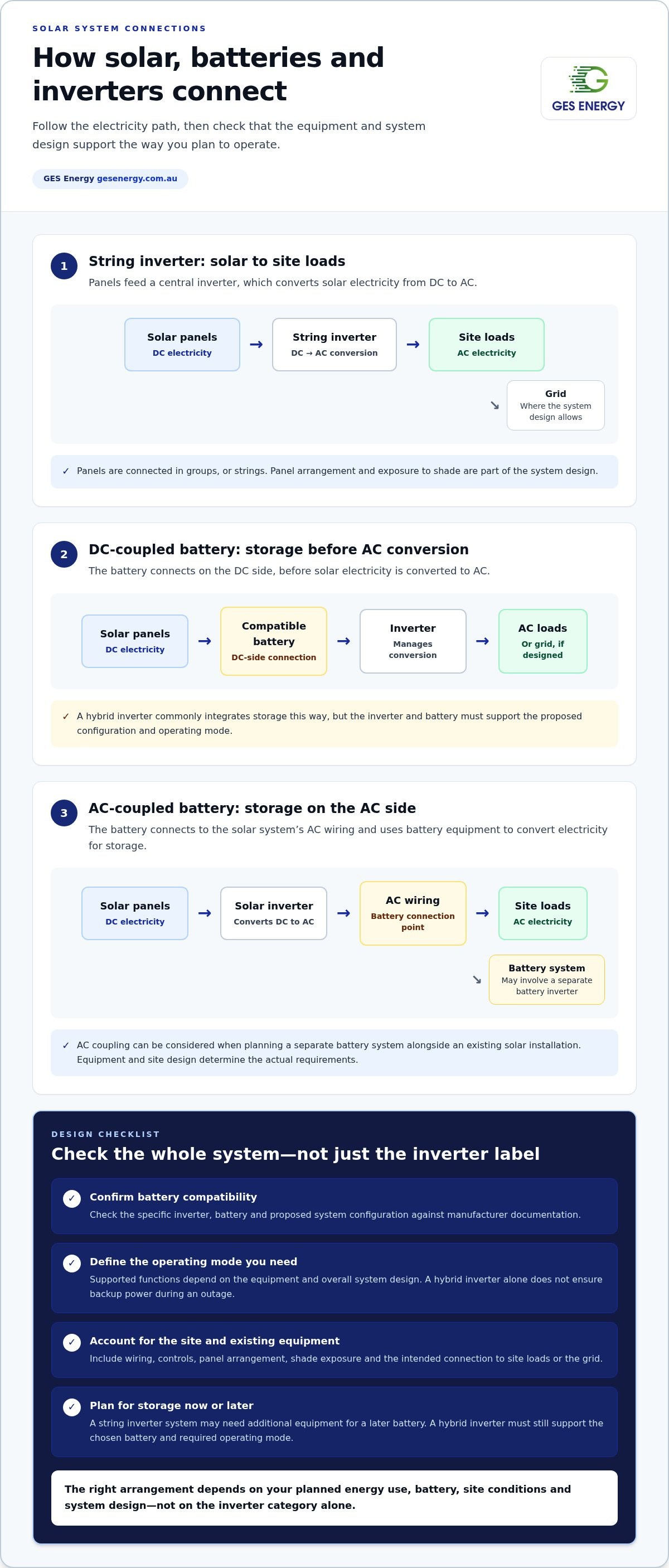
In a typical string arrangement, panels are connected in groups, or strings, that feed a central inverter. The inverter changes the panels’ DC output into AC electricity for site loads and, in a grid-connected system, interaction with the electricity network. How well the system suits a site depends on its design, including panel arrangement and exposure to shade.
What makes a hybrid inverter different?
A hybrid inverter is designed to manage solar generation and battery integration within the system. Depending on its configuration, it can coordinate electricity from the panels with site loads and a compatible battery. This can make battery integration more direct, but it doesn’t mean every battery will work with every hybrid inverter. Supported operating modes depend on the inverter, battery and overall system design.
The terms describe system architecture, not a guaranteed result. A hybrid inverter doesn’t by itself ensure backup power during an outage, and a string inverter doesn’t automatically rule out adding storage. Backup operation, where required, depends on equipment and a system configuration designed to support it.
For a Victorian home or business, consider how the inverter fits the planned solar array, current electricity use and storage plans. If you want a solar-only system now but may add a battery later, the design should account for that option rather than assume every inverter offers the same upgrade path. If storage is part of the plan from the outset, a hybrid arrangement may be worth considering, subject to battery compatibility and the operating functions required.
That’s the useful starting point for comparing hybrid inverter vs string inverter options: identify the role the system needs to perform, then assess the equipment as a matched design. Next, look at how panels, site loads, batteries and the grid connect in each arrangement.
How hybrid and string inverters connect solar panels and batteries
The way components connect determines the path electricity takes through your system. In a grid-connected string setup, solar panels send DC electricity to the string inverter. The inverter converts it to AC electricity, which can supply site loads or flow to the grid, subject to the system design and connection arrangements.
Adding a battery introduces another connection point. With an AC-coupled arrangement, the battery connects on the AC side of the solar system. With a DC-coupled arrangement, it connects on the DC side, before solar electricity is converted to AC. These describe different system layouts, not a guarantee that particular equipment will work together.
How does a DC-coupled battery arrangement work?
In a DC-coupled arrangement, solar electricity can flow from the panels to a compatible battery before conversion to AC. The inverter manages conversion and energy flows according to its design. This is a common way for a hybrid inverter to integrate storage, but the inverter and battery must support the proposed configuration.
The route is generally panels to battery, then through the inverter to AC loads or the grid, where the system design allows. Exact connections and operating functions vary by equipment. A hybrid inverter label alone doesn’t establish that a particular battery can be connected, so assess compatibility against manufacturer documentation.
How does an AC-coupled battery arrangement work?
An AC-coupled battery connects to the system’s AC wiring and uses battery equipment to convert electricity between AC and the form needed for storage. This arrangement can be considered when planning a separate battery system alongside an existing solar installation. It may involve an additional battery inverter, but the equipment and site design determine the actual requirements.
For example, a home with a string inverter may be designed to add storage using an AC-coupled battery system. That doesn’t make the battery compatible with every string inverter or site. The design must account for the specific equipment, wiring, controls and intended system operation.
In a DC-coupled arrangement, the battery connects before solar electricity is converted to AC; in an AC-coupled arrangement, it connects on the system’s AC side. Neither description alone tells you which arrangement will suit your property. The inverter, battery, existing solar equipment and site requirements all shape the design.
This is why the hybrid inverter vs string inverter decision shouldn’t be reduced to “battery now” versus “battery later”. A hybrid inverter can support a DC-coupled battery arrangement when the equipment is compatible. A string inverter may form part of an AC-coupled arrangement with separate battery equipment. The right design depends on the complete system and its intended operation, including whether the site needs functions such as backup.
For a home or business in Victoria, mapping the electricity path helps clarify what equipment a battery plan may require. A project-led solar system design approach considers the panels, inverter, storage and site loads together, rather than treating the battery as an isolated addition.
Hybrid vs string inverter comparison: which project factors matter?
The useful comparison is not simply which inverter can connect to a battery. Consider the system’s current purpose, site conditions and planned operating modes together. A home with a straightforward solar-only design has different priorities from a business assessing solar generation alongside substantial site demand and future storage. The table outlines broad architectural differences and highlights details that depend on the selected equipment.
| Project factor | Hybrid inverter | String inverter |
|---|---|---|
| Battery integration | Designed to manage solar generation and a compatible battery within the system. | Primarily converts solar electricity; storage may require separate battery equipment. |
| Design considerations | Assess the inverter’s supported batteries, controls and intended operating modes. | Consider the solar array design and, if storage is planned, the equipment and layout needed for a retrofit. |
| System scale | Can be considered for residential or business projects, subject to the model and project design. | Can also suit different project scales; site requirements and system architecture guide selection. |
| Future plans | May suit a project integrating solar and storage from the outset, provided all components are compatible. | May suit a solar-first design. Later storage options depend on the inverter, battery equipment and site. |
The table describes general differences, not a promise about a particular product. Features such as backup operation, battery compatibility and control options depend on the model. Check the proposed combination against manufacturer documentation and design it around the site’s requirements.
When can a hybrid inverter be a practical fit?
A hybrid inverter can be worth considering when solar and battery storage are planned as one integrated system. Start by identifying the intended battery, the energy flows the site needs and the operating modes the equipment supports. Include backup power only if the full inverter, battery and system configuration supports that function.
When can a string inverter be a practical fit?
A string inverter can suit a solar-first project that doesn’t require an integrated hybrid arrangement. If you may add storage later, include that possibility in the initial design and account for any separate battery equipment and compatibility requirements. For a larger commercial or industrial site, assess demand, solar generation, network conditions and storage plans together rather than treating one inverter type as the default.
System scale alone doesn’t settle the choice. A home’s roof and load profile, or a business’s operating hours and energy demand, can shape the design alongside battery plans. In Victoria, local network conditions also form part of project planning. Compare the complete system, including how its components are expected to operate, rather than selecting an inverter on its category alone.
If you’re weighing storage options, this guide to solar and battery systems can help connect battery planning with broader energy needs. The next step is to turn those project factors into a practical selection process for your site.
How to choose between a hybrid inverter and a string inverter
Start with the job your solar system needs to do, then compare each inverter architecture against the site and planned equipment. Use this sequence to make the hybrid inverter vs string inverter comparison a practical design decision.
- Set out your current energy needs. Record electricity use, when the site uses power and what you want solar generation to achieve. For a business, include operating patterns and major electrical loads. This grounds the design in actual demand rather than an assumed standard setup.
- Decide how firm your battery plan is. Are you installing storage with solar, or is a battery only a possible later upgrade? A definite storage plan can inform the inverter architecture now. If it’s only a possibility, weigh the cost and design implications of preserving options against your current needs.
- Define the intended operating mode. Consider whether the system will supply site loads, work with a battery or include a function such as backup. Don’t assume an inverter type provides a particular operating mode by itself. The proposed inverter, battery and system configuration must support it.
- Assess the site and electrical setup. A design assessment should consider panel locations and layout, available electrical infrastructure, and whether the site uses single-phase or three-phase supply. These inputs can affect the system configuration. Account for the property’s physical and electrical conditions before selecting an inverter.
- Factor in network connection conditions. For a Victorian project, include relevant local network conditions and current connection requirements in the design process. Requirements can depend on the site and proposed system, so don’t rely on a general assumption or an old project’s settings.
- Match equipment and review the complete design. Compare the intended battery arrangement with manufacturer compatibility information, then assess the full system against your energy objectives. For business projects, commercial solar installation planning can frame inverter selection alongside wider site and project requirements.
What should you assess before specifying an inverter?
Bring together your electricity use, solar objectives and planned storage, along with information about the site’s roof, electrical setup and network connection. These details give the project design team a practical basis for comparing options. For a Victorian site, include local network conditions and current connection requirements in the design.
How should future battery plans affect the choice?
Separate a committed battery installation from a possible future upgrade. If storage is planned, compare the intended battery arrangement and supported equipment before selecting the inverter architecture. If storage is uncertain, consider what a later retrofit could involve. Flexibility depends on the design, compatible components and operating requirements, not the inverter label alone.
GES Energy’s solar system design service aligns inverter selection with site demand, solar generation and storage plans for Australian homes and businesses.
How GES ENERGY approaches inverter selection for Australian projects
Inverter selection is part of designing an energy system around the site, not a standalone product decision. GES Energy considers solar generation, site demand, system scale, storage plans and network conditions together. This project-led approach aligns equipment choices with how a home, business or industrial facility intends to use energy.
For commercial and industrial projects, system size is one part of the assessment. GES Energy designs systems from 10 kW to 5 MW, with engineering and EPC delivery shaped around each site’s requirements. A project may need solar generation to work alongside battery storage or existing site infrastructure. The design considers how those components connect and operate, rather than assuming a hybrid or string inverter suits every project.
For a solar system design tailored to your project, explore GES Energy’s solar solutions.
What does project-led inverter design consider?
Engineering starts with the site’s energy use and solar objectives, then considers the intended role of storage and the wider solar PV system. The design team assesses relevant roof and electrical conditions, system scale, phase requirements and network connection conditions. In Victoria, local network requirements form part of the design inputs. The inverter choice depends on the project and the equipment’s documented compatibility, not a blanket preference for one architecture.
The hybrid inverter vs string inverter decision also needs to account for the proposed operating mode. If a project includes a battery, the selected inverter and battery must support the planned arrangement. If storage is not part of the immediate scope, the design can still assess how current choices relate to possible future plans. This clarifies trade-offs without assuming an inverter guarantees compatibility or performance.
How can EPC experience support complex energy projects?
EPC services bring engineering, procurement and construction into a coordinated project delivery approach. This connects inverter selection with other design and installation decisions, including solar equipment, battery storage and relevant site infrastructure. For a business, this helps align technical requirements and delivery planning across project stages.
GES Energy delivers solar projects across Australia, with a strong focus on Victoria and commercial and industrial work. Site needs differ, so a facility’s energy demand, solar generation, network conditions and storage objectives inform the design. GES Energy serves businesses across Melbourne, Geelong, Ballarat, Bendigo, Shepparton, Melton, Mildura, Wodonga, Traralgon, Wangaratta, Horsham, Sale, Colac, Echuca, Ararat, Portland, Swan Hill, Benalla and Maryborough. The same project-led thinking applies across residential and larger sites, while equipment selection and system configuration remain specific to each project.
The practical choice comes back to matching equipment to the site’s present needs and intended energy system. That gives Australian homeowners and businesses a grounded basis for comparing inverter options, planning storage and setting project requirements before installation.
Plan your next step with confidence
Your inverter decision can shape how your solar system fits your energy plans over time. Before settling on hybrid inverter vs string inverter, write down the outcomes that matter most, such as how you expect to use solar generation, whether battery storage is planned and what operating needs the system must meet. A clear brief gives the design process a practical starting point.
GES Energy brings more than 10 years in renewable energy and over 2,500 successful installations to solar projects across Australia. As a Solar Accreditation Australia-accredited installer, the team can factor your site requirements and energy goals into a project-specific design.
Take the next step with a design shaped around your property, business and future energy priorities. Discuss a solar system designed around your site and energy needs.
A considered design can help you make an informed choice and move forward with greater clarity.
Frequently Asked Questions
Can you add a battery to a string inverter system later?
Yes, a battery can sometimes be added to a string inverter system, depending on the existing equipment and planned battery arrangement. An AC-coupled system may be an option, but it can require separate battery equipment and changes to the system design. Gather the inverter model, solar system details and battery requirements so the proposed components can be assessed for compatibility.
Does a hybrid inverter work without a battery?
Some hybrid inverters can operate with solar panels before a battery is installed, but operation depends on the specific model and its configuration. If you’re planning to add storage later, check that the inverter’s current setup and intended future battery are compatible. For example, a household installing solar first should consider whether the selected inverter supports the later battery arrangement, rather than relying on the hybrid label alone.
Will a hybrid inverter keep my property powered during a blackout?
Not automatically. Backup power during a blackout requires a compatible battery and an inverter system configured to provide backup operation. The design also needs to account for which circuits or loads are intended to receive power. A grid-connected solar inverter generally shuts down when the grid fails, so don’t assume solar panels alone will power a property during an outage. Confirm the backup function in the equipment documentation.
Is a hybrid inverter more efficient than a string inverter?
There isn’t a universal answer. Overall system efficiency depends on the inverter model, battery arrangement, energy conversion path and how the system is designed and operated. A hybrid inverter may manage solar and storage within one system, but that alone doesn’t mean it will perform more efficiently in every installation. Compare manufacturer specifications for the intended setup, including whether the system will regularly charge and discharge a battery.
Can I replace my existing string inverter with a hybrid inverter?
Possibly, but a replacement needs a design review rather than an assumption that it will be a direct swap. The solar array’s electrical characteristics, existing wiring, battery plans and new inverter requirements all affect suitability. The change may also involve updates to system configuration and connection arrangements. Keep the existing system documentation and inverter details available for assessment, especially if you want the replacement to support storage or a particular operating mode.
Are hybrid inverters suitable for commercial solar systems?
They can be considered for commercial projects where the system design calls for solar generation and battery storage to work together. Suitability depends on site demand, project scale, equipment compatibility and the intended operating mode. For businesses in Melbourne, Geelong, Ballarat, Bendigo and regional Victoria, assess these factors alongside the site’s electrical and network conditions. A hybrid architecture isn’t automatically the right fit for every commercial installation.
Do hybrid and string inverters come in single-phase and three-phase options?
Single-phase and three-phase models are available across inverter categories, but options depend on the product range and project requirements. The site’s electrical supply, solar system design and network connection conditions inform the appropriate configuration. For example, a business with three-phase supply needs a design that accounts for that setup, while a home’s requirements may differ. Confirm the selected model’s specifications and connection suitability during system design.


