

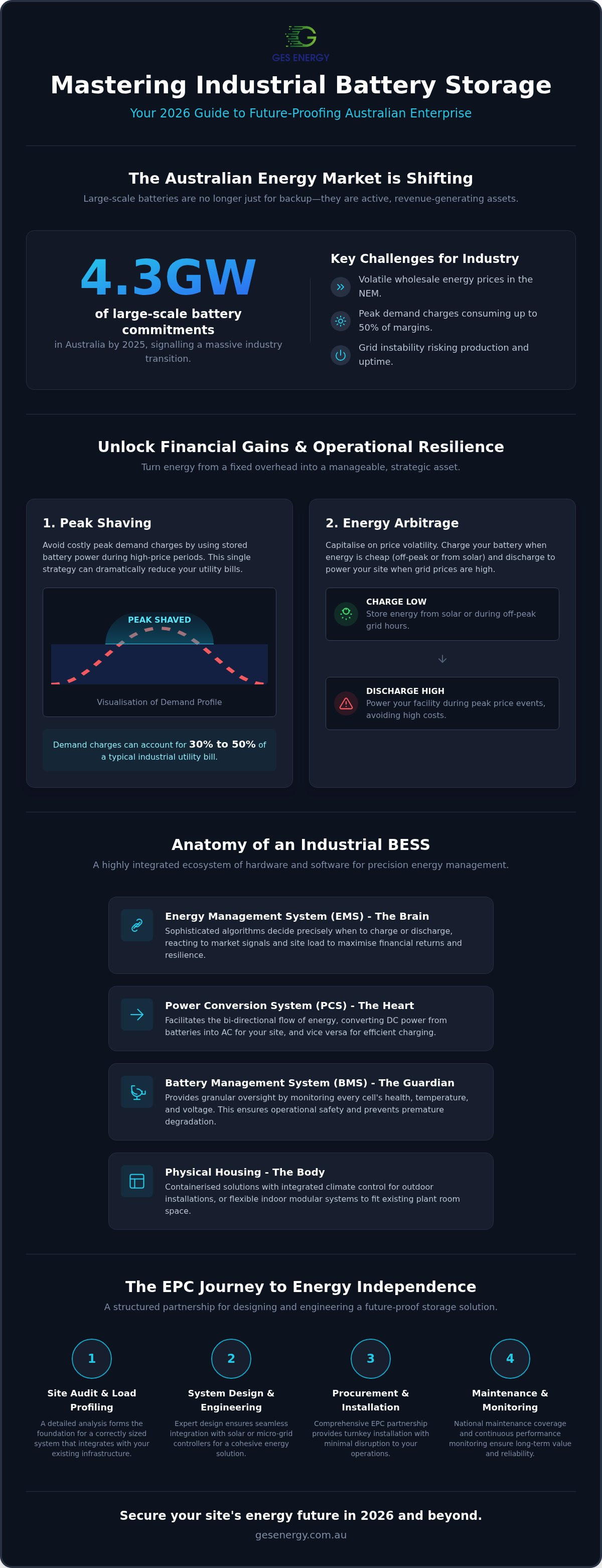
Did you know that Australian large-scale battery commitments reached a staggering 4.3GW in 2025? It's a clear signal that the shift toward decentralised energy is no longer a future concept; it's a present-day necessity for any competitive enterprise seeking robust industrial battery storage solutions. You've likely felt the sting of volatile wholesale energy prices in the NEM or the frustration of seeing peak demand charges eat into your monthly margins. It's understandable to feel that the grid's instability is a risk your production schedule simply can't afford.
This 2026 guide is designed to help you master the technical and financial complexities of energy storage so you can secure your site’s power and slash operational overheads. We'll show you how to take full advantage of recent policy shifts, such as the SRES expansion to 1MW systems, to reduce upfront costs. You'll learn how to achieve genuine energy independence through peak shaving and how to prepare your infrastructure for VPP participation. By the end of this article, you'll have a clear roadmap to future-proofing your facility with reliable, high-performance energy storage that delivers long-term value.
Key Takeaways
- Identify why the 2026 Australian energy market represents a strategic shift where batteries move from simple backup units to active, revenue-generating assets.
- Understand the core engineering of a BESS, including how Power Conversion Systems and Battery Management Systems work together to ensure site safety and longevity.
- Master the financial mechanics of peak shaving and load shifting to ensure your industrial battery storage solutions deliver a rapid and measurable return on investment.
- Learn how a detailed site audit and load profiling form the foundation of a correctly sized system that integrates with your existing solar or micro-grid controllers.
- Discover the value of a comprehensive EPC partnership that provides national maintenance coverage and continuous performance monitoring for your energy infrastructure.
The Strategic Role of Industrial Battery Storage in Australia’s 2026 Energy Market
Industrial energy storage has moved beyond being a simple contingency plan for power outages. In 2026, these systems function as sophisticated financial tools that allow for active energy management. By integrating modern industrial battery storage solutions, your facility transitions from a passive energy consumer to an active market participant. This shift is driven by the expansion of the Small-scale Renewable Energy Scheme (SRES) to include systems up to 1 MW, which has effectively reduced the upfront financial barrier for many medium to large enterprises across the country.
The Australian energy landscape is changing rapidly. While wholesale prices in the National Electricity Market (NEM) averaged $74/MWh in mid-2026, the spread between peak and off-peak remains significant. This volatility creates a unique opportunity for businesses to turn energy from a fixed overhead into a manageable variable cost. Instead of viewing a battery as a CAPEX burden, forward-thinking operations now see it as an OPEX reduction engine that pays for itself through consistent market interaction and demand management.
Energy Arbitrage and Cost Control
Managing costs requires more than just reducing consumption; it requires timing. Energy arbitrage is the practice of charging a battery when electricity prices are low or solar generation is abundant, then discharging that stored power when market prices spike. This strategy is vital because demand charges can account for 30% to 50% of a typical industrial utility bill. By using stored energy during these peak windows, you effectively shave the peaks off your demand profile. This move protects your bottom line from market fluctuations and ensures your site remains in a lower tariff bracket.
Grid Resilience and Business Continuity
Beyond the balance sheet, reliability remains the cornerstone of any industrial operation. A robust Anatomy of an Industrial Battery Energy Storage System (BESS) provides the technical foundation for seamless business continuity. If the regional grid fails, your system can automatically transition to island mode, maintaining critical processes without a millisecond of downtime. This capability is particularly important for facilities running heavy machinery or high-surge equipment. The battery provides the necessary technical inertia to support motor starts that might otherwise trip a standard grid connection. Investing in industrial battery storage solutions ensures that regional instability never dictates your production schedule.
Anatomy of an Industrial Battery Energy Storage System (BESS)
An industrial BESS is far more than a simple collection of battery cells. It's a highly integrated ecosystem of hardware and software designed to manage massive electrical loads with precision. To implement effective industrial battery storage solutions, you must understand how these components interact to provide the reliability your facility requires. The system begins with the Power Conversion System (PCS). This is the heart of the unit, facilitating the bi-directional flow of energy by converting Direct Current (DC) from the batteries into Alternating Current (AC) for your site, or vice versa during charging.
While the PCS handles the muscle, the Battery Management System (BMS) provides the oversight. It monitors every individual cell, ensuring they remain balanced and operate within safe voltage and temperature limits. This level of granular control is what prevents premature degradation and ensures the system hits its expected service life. Above this sits the Energy Management System (EMS). This is the "brain" of the operation. It uses sophisticated algorithms to decide exactly when to charge from the grid or discharge to your machinery, often reacting to price signals from Australia’s 2026 Energy Market to maximise your financial returns.
Physical housing is the final piece of the core architecture. In the Australian climate, containerised solutions are often preferred for outdoor installations because they come with integrated climate control. Indoor modular systems offer flexibility for sites with existing plant room space, provided the ventilation and floor loading requirements are met. Getting this initial design phase right is critical, which is why many enterprises consult with specialist engineering partners to ensure the physical footprint matches their operational reality.
Lithium-Ion and Beyond: Selecting the Right Chemistry
In 2026, Lithium Iron Phosphate (LFP) has become the standard for industrial applications, surpassing Nickel Manganese Cobalt (NMC) in most C&I settings. LFP offers superior thermal stability and a longer cycle life, which is essential for systems that discharge daily. When reviewing specifications, pay close attention to the C-rating. This indicates how quickly the battery can be fully discharged. A 1C rating means the battery can discharge its full capacity in one hour, whereas a 0.5C rating takes two hours. For sites with high-surge equipment, a higher C-rating or liquid cooling is often necessary to manage the heat generated during rapid discharge cycles in harsh Australian environments.
Integration Components
A BESS doesn't sit in isolation; it must be safely integrated into your electrical infrastructure. This requires heavy-duty switchgear and, depending on your site's voltage, a dedicated transformer to step the power up or down. Safety compliance is non-negotiable on industrial sites, meaning fire suppression systems, such as aerosol or clean agent gas, must be integrated directly into the battery enclosures. Finally, real-time monitoring hardware allows your team to track performance and receive alerts for predictive maintenance, ensuring the system remains an asset rather than a mystery.
The true value of industrial battery storage solutions lies in their ability to transform a static energy cost into a dynamic revenue stream. While the hardware provides the capacity, the strategy behind how you use that capacity determines your ultimate return on investment. In the current Australian market, where wholesale prices can fluctuate wildly within a single day, the ability to control exactly when your site draws from the grid is a significant competitive advantage. It's about moving from a position of vulnerability to one of calculated control.
Load shifting is often the first step in this journey. By pairing your storage with a commercial solar installation, you can capture excess generation during the middle of the day and deploy it during the evening peak. This ensures you aren't exporting valuable energy to the grid for a pittance only to buy it back later at a premium. With renewables supplying 42.1% of the NEM's electricity in the second quarter of 2026, the abundance of cheap daytime power makes this strategy more viable than ever for Australian enterprises.
The Business Case for Peak Shaving
For many industrial operators, the most painful part of their utility bill isn't the total energy used, but the demand charges. These fees are often based on the single highest peak of consumption recorded during a billing period. Heavy machinery starts or simultaneous equipment operations create "spiky" load profiles that trigger these high-cost brackets. A battery system acts as a buffer, discharging instantly to cover these spikes so the grid never sees the surge. It's a simple, automated way to protect your balance sheet from avoidable penalties.
Consider a manufacturing plant in regional New South Wales that integrated a BESS to manage its heavy motor starts. By using the battery to smooth out these surges, the site reduced its grid reliance by 40% during peak periods. This didn't just lower their energy usage; it permanently shifted them into a lower network tariff bracket, resulting in immediate and ongoing savings that significantly shortened the system's payback period.
Revenue Generation through Grid Services
Your battery can also work for the grid. Frequency Control Ancillary Services (FCAS) allow industrial users to earn revenue by helping the Australian Energy Market Operator (AEMO) maintain grid frequency at 50Hz. When frequency drops, your battery injects power; when it rises, the battery absorbs it. Smart EMS software automates this participation, ensuring it never interferes with your primary site operations or compromises your energy security. By joining a Virtual Power Plant (VPP), your asset is aggregated with others to participate in wholesale markets, providing a revenue stream previously reserved for major power stations.
The EPC Journey: Designing and Engineering a Future-Proof Storage Solution
Transitioning from a strategic energy plan to a physical asset requires a methodical approach to Engineering, Procurement, and Construction (EPC). While the financial benefits of industrial battery storage solutions are clear, the reliability of those benefits depends entirely on the quality of the initial design. A poorly sized system or an overlooked integration detail can quickly erode your expected ROI. This is why the journey must begin with a comprehensive site audit and load profiling process to ensure the hardware matches your operational reality.
Custom engineering is the next critical step. Your BESS must integrate seamlessly with existing infrastructure, whether that includes a commercial solar array, diesel backup generators, or complex micro-grid controllers. We focus on selecting Tier-1 hardware designed for 10 to 15 year lifecycles, ensuring your investment remains productive well into the next decade. The process concludes with SAA-accredited construction and commissioning, where every safety protocol is tested to meet strict Australian standards. For a detailed assessment of your facility's requirements, you can partner with our EPC specialists to begin your feasibility study.
Feasibility and Load Analysis
Precision in system sizing starts with data. We typically require 12 months of interval data to model your energy usage accurately across all seasons. This detailed analysis allows us to identify "hidden" opportunities for savings that a simple monthly bill won't reveal. By simulating various battery capacities and discharge depths, we can determine the exact configuration that balances upfront cost with long-term performance. This data-driven foundation ensures your industrial battery storage solutions are neither undersized for your peaks nor wastefully oversized for your needs.
Installation and Ongoing Stewardship
The path to commissioning involves more than just electrical work; it requires managing the complex grid connection approvals from your Distributed Network Service Provider (DNSP). Using SAA-accredited labour is a non-negotiable requirement for maintaining warranty validity and insurance compliance on industrial sites. Once the system is live, our role shifts to ongoing stewardship. Scheduled maintenance and remote health checks ensure the storage asset continues to perform at 100% capacity, protecting the integrity of your energy ecosystem and ensuring your site remains resilient against grid instability.
Partnering with GES Energy for Integrated Industrial Storage Projects
Selecting the right partner is the final, most critical step in securing your facility's energy future. GES Energy operates as a national specialist in Commercial and Industrial (C&I) Energy Storage Systems, providing a comprehensive EPC service that spans from initial feasibility to 24/7 performance monitoring. We understand that industrial battery storage solutions are significant capital investments. Our role is to act as a diligent steward of that investment, ensuring every component is engineered to withstand the unique demands of the Australian environment.
Our expertise extends well beyond standard installations. We specialise in high-complexity projects, including off-grid systems and micro-grid developments with a capability of up to 5 MW. Unlike providers focused solely on hardware sales or short-term rentals, we provide engineering-led solutions designed for permanent asset ownership. This approach ensures that your storage system isn't just an add-on, but a fully integrated part of your site's energy ecosystem, whether you're coordinating with existing C&I solar or managing remote diesel generation.
Our Approach to Industrial Energy
We believe that a successful energy transition is built on transparency and long-term reliability. Every project we undertake utilises Tier-1 components to ensure a robust service life of 10 to 15 years. Once your system is commissioned by our SAA-accredited labour, we provide ongoing support through custom maintenance programmes and detailed energy analytics. This constant oversight allows you to see exactly how your asset is performing, with clear reporting on demand charge reductions and revenue generated through grid services. Our national coverage means that regardless of your site's location, you have access to expert health checks and technical support.
Getting Started with Your Energy Transition
The path to energy independence begins with a clear understanding of your current consumption patterns. We invite you to book a comprehensive site energy audit, where our engineers will analyse your interval data to identify the most effective storage strategy for your specific needs. Following this audit, you'll receive a custom industrial storage proposal that outlines the technical specifications, projected ROI, and integration plan for your facility. Taking control of your operational overheads starts with a single conversation about your site’s potential. Enquire about an Industrial Battery Storage Solution for your site today to speak with our specialist engineering team.
Securing Your Site’s Energy Future in 2026
The Australian energy market in 2026 offers unprecedented opportunities for businesses that move beyond passive consumption. By integrating industrial battery storage solutions, your facility gains the resilience to withstand grid instability while actively lowering operational overheads through peak shaving and load shifting. You've seen how a correctly engineered BESS functions as a sophisticated financial asset, allowing you to turn volatile NEM prices into a manageable variable cost.
Successful implementation requires more than just hardware; it demands a partner who understands the complexities of EPC contracts and national grid standards. GES Energy provides the expertise needed to navigate this transition, offering SAA-accredited engineering and specialised knowledge in micro-grid and off-grid reliability. Our national maintenance and technical support network ensures your system remains a high-performing asset for its entire lifecycle.
Take the first step toward energy independence and long-term cost predictability. Consult with our EPC specialists on your industrial battery project today to unlock your site's full potential. It's time to build a more resilient and efficient future for your operation.
Frequently Asked Questions
What is the typical lifespan of an industrial battery storage system?
Most Tier-1 industrial battery storage solutions are designed for an operational life of 10 to 15 years. This longevity depends on the cycle life of the battery cells, with high-quality Lithium Iron Phosphate (LFP) systems often rated for 6,000 to 8,000 cycles at a specific depth of discharge. Regular maintenance and robust thermal management are essential to ensure the system reaches its full service potential without significant capacity fade.
How much space is required for a 1MW/2MWh BESS installation?
A 1MW/2MWh system typically fits within one or two standard 20-foot shipping containers. However, the total footprint must account for required safety clearances, fire separation distances, and access for maintenance vehicles. The exact layout is often dictated by local planning regulations and the specific thermal management requirements of the site's environment, ensuring the system operates safely and efficiently.
Can industrial batteries completely replace diesel generators for backup?
Batteries can replace diesel generators for short to medium-duration outages, but a hybrid approach is often more reliable for long-term energy security. While batteries provide instantaneous power during a grid failure, diesel generators offer indefinite runtime as long as fuel is available. For many Australian industrial sites, the battery handles frequent short interruptions, while the generator remains a secondary contingency for extended regional blackouts.
What Australian standards govern the installation of large-scale BESS?
The primary standard is AS/NZS 5139, which covers the safety and installation requirements for battery energy storage systems. Additionally, inverters must comply with AS/NZS 4777.2, and all electrical work must be performed by SAA-accredited labour to ensure safety and warranty compliance. Local Distributed Network Service Providers (DNSPs) also have specific grid connection requirements that vary by state and network region across the country.
How does temperature affect the performance of industrial storage in Australia?
Ambient temperatures above 35 degrees Celsius can accelerate cell degradation and reduce the efficiency of the Power Conversion System. To combat the harsh Australian climate, high-quality industrial battery storage solutions utilise integrated liquid cooling or advanced HVAC systems to maintain an optimal internal temperature. Proper thermal management ensures consistent performance and protects your capital investment during extreme summer heatwaves.
Is there government funding or rebates available for industrial storage in 2026?
From October 1, 2026, the Small-scale Renewable Energy Scheme (SRES) has been expanded to include systems up to 1 MW, which significantly reduces the upfront cost for many enterprises. Larger systems may also be eligible for Large-scale Generation Certificates (LGCs) depending on their configuration. It's also important to note that as of January 1, 2026, electricity used exclusively for storage is exempt from certain acquisition statements, further improving the operational business case.
What is the difference between "behind-the-meter" and "front-of-the-meter" storage?
Behind-the-meter storage is installed on your site to serve your facility's specific energy needs and reduce your utility bills. Front-of-the-meter storage is connected directly to the distribution or transmission network and is typically operated by utilities or developers for grid-wide services. For most industrial enterprises, a behind-the-meter system is the preferred choice for achieving energy independence and lowering peak demand charges.
How long does the EPC process take from design to commissioning?
The full EPC journey typically takes between 6 and 12 months from the initial site audit to final commissioning. This timeline includes one to two months for load profiling and design, followed by several months for DNSP grid connection approvals and hardware procurement. The physical construction and testing phase usually takes three to six months, depending on the complexity of the site integration and the specific engineering requirements of the project.


