

The questions to ask your commercial solar provider about price and design start with cost breakdowns and site-specific performance models, not a single headline figure. Evaluating commercial solar providers (EPC services) this way shows how market choices affect energy independence and return on investment across Australian commercial installations. Speak with accredited designers to request a personalised quote based on your facility's energy profile.
Key Takeaways: Verify technical competence and financial impact by requesting SAA-accredited yield simulations, structural roof assessments, and a 10-year installation guarantee before signing any contract.
- Select systems ranging from 10 kW to 5 MW based on your interval data.
- Skip it when preliminary quotes rely on annual averages instead of hourly load profiles.
- Hire providers with ISO 9001, 14001, and 45001 certifications for consistent construction standards.
- The calculation showing how a 32 kW system reduces bills is in the article.
Match your commercial solar setup to how your facility actually runs
Your operational schedule sets the commercial system architecture you need, so start with how the site actually draws power.
Typical situations and a concrete next step for each:
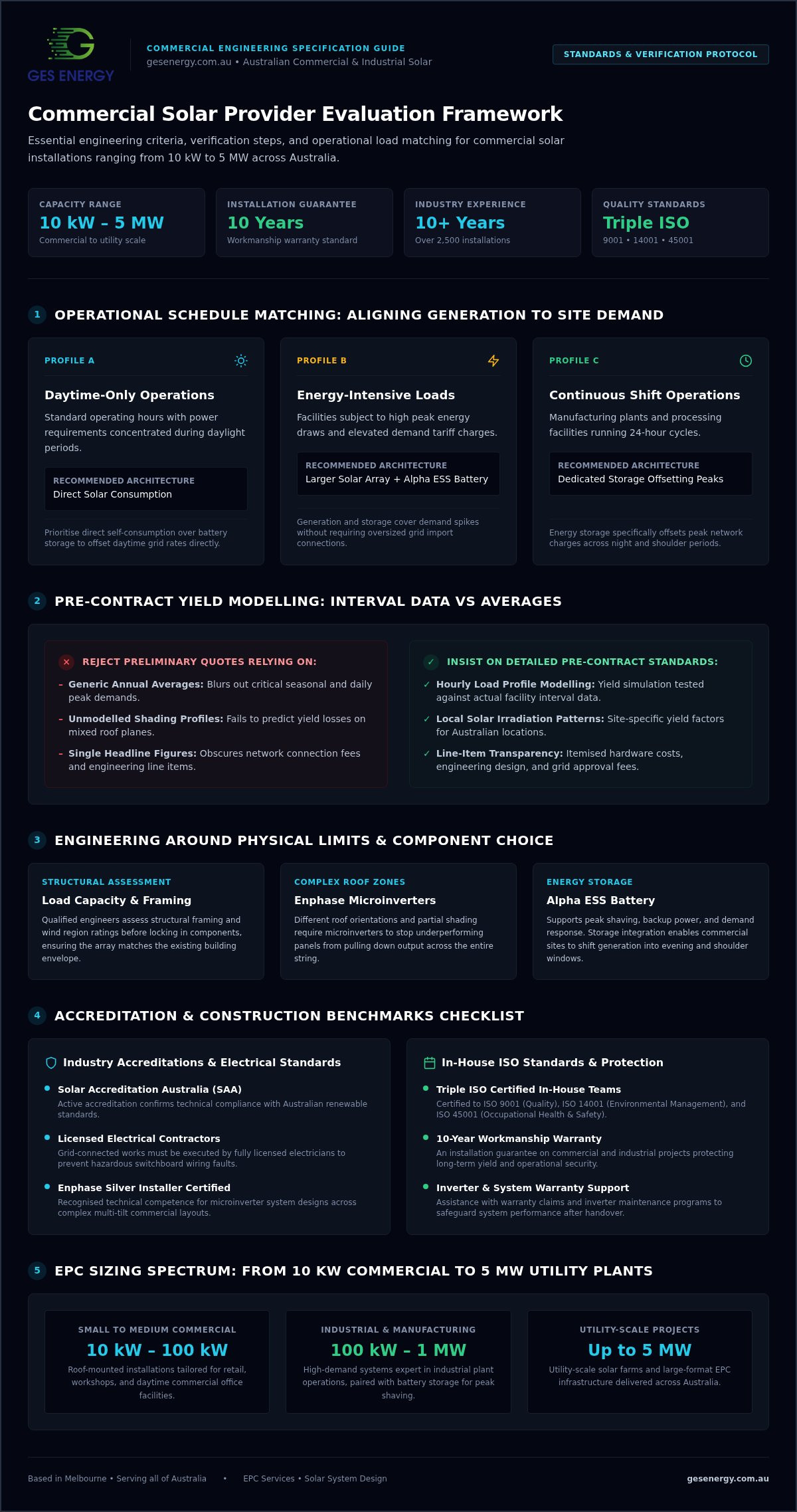
- Daytime-only operations: standard panels cut grid reliance during open hours; prioritise direct solar consumption over storage.
- Energy-intensive loads: pair a larger array with a solar battery (Alpha ESS battery) so generation covers peaks without oversized grid imports.
- Manufacturing on continuous shifts: add energy storage specifically to offset peak demand charges across night and shoulder periods.
We act as an authorised solar company to tailor systems for your load profile. Designing commercial solar systems for projects ranging from 10 kW to 5 MW requires careful load matching. Installing high-efficiency components such as Enphase microinverters keeps performance steady across distinct roof spaces.
Properties with heavy evening usage gain strong cost efficiency by pairing storage with generation. Simple daytime operations build returns through direct solar consumption. You can review tailored options for commercial solar across Australia and align system specs with your business goals.
We deliver guaranteed workmanship on our solar power projects for 10 years. An installation guarantee (workmanship warranty) protects long-term yield and operational security.
Confirm SAA accreditation and licensed electrician standards before you sign
Before you sign, verify the installer holds active accreditation from Solar Accreditation Australia (SAA). Certified professionals keep your site aligned with safety regulations and technical benchmarks.
Licensed electrical contractors must perform all grid-connected works to prevent hazardous wiring faults. Fully credentialed installers protect your capital investment when the design moves from paper to switchboard.
A qualified solar company employs in-house teams with ISO 9001, ISO 14001, and ISO 45001 certifications, which supports consistent construction standards. Demand a ten-year installation guarantee so system performance stays covered after handover. Partnering with GES Energy gives you access to engineers with over a decade of industry experience.
Credentialed teams manage complex solar system design service requirements and keep valid licensing in place for the full project. Ask for proof of SAA status and ISO certificates with your next shortlist review.
Design around your roof limits so every panel earns its keep
Your commercial solar provider must evaluate structural load capacities and physical layout constraints before locking in components. Qualified engineers assess wind region ratings and tilt angles so the array matches the building you already operate.
Unutilised roof zones with varying orientations often need microinverters or optimisers; otherwise underperforming panels drag down the entire string. A tailored solar system design service maps shade profiles and structural limits so yield holds up across mixed planes. GES Energy applies this engineering process on projects ranging from 10 kW to 5 MW.
Fitting panels to a complex roof is like commissioning a suit to measure: standard off-the-shelf layouts leave generation unused. High-efficiency panels help you lift output inside tight square-metre limits without overloading the structural framing.
Working with an accredited solar company keeps the build aligned with local building standards. GES Energy provides an installation guarantee for 10 years on commercial installations so you have a clear performance backstop. Book an engineering site assessment when you want sizing tied to the roof you have, not a generic template.
Insist on a detailed pre-contract yield model before you commit
A reputable solar company should put a detailed, unshaded yield simulation on the table before you sign any commercial contract.
Reject preliminary quotes that rely only on simple annual averages. A professional engineering report models generation against your site's actual load profile hour by hour. Demand line-item visibility on equipment costs, system design fees, and grid connection charges so the financial picture matches the technical one.
High-yield solar system design service models must factor in precise geographic shading if you want the projected return to survive first-year operation. Our team provides comprehensive preliminary modelling for commercial systems ranging from 10 kW to 5 MW. Where you need regional depth, review commercial solar in Perth solutions shaped around local solar irradiation patterns. For stronger self-consumption, pair generation with a solar battery under a 10-year installation guarantee.
A commenter in the cleanenergycouncil.org.au thread "Australian Renewable Energy Events Calendar":
"[The Australian Clean Energy Summit] is a place to put all our brains together and come up with great ideas and solutions." (source)
Industry events give commercial stakeholders a place to compare yield-modelling standards and project engineering practice before capital is committed.
Work through a clear solar system vetting process
Vetting a commercial solar company works best as a fixed sequence of engineering and warranty checks. Use these four stages:
- Check accreditation and certifications. Confirm Solar Accreditation Australia (SAA) credentials and ISO management certifications for safety and quality.
- Review past commercial experience. Ensure the team has completed installations up to 5 MW across regional and urban locations.
- Inspect technical system designs. Verify the proposed solar system design service includes components matched to your load, such as an Alpha ESS battery (solar battery) where storage is required.
- Confirm warranty coverage. Demand a 10-year installation guarantee so long-term capital stays protected.
A provider's track record shows up in energy savings years after commissioning, which is why credential checks sit ahead of price alone.
Among GES Energy's Google reviews, Mustafizur (5★) wrote:
"I recommend Greentech Engineering Solutions for residential solar panel installation. They are professional and effective in recommending and providing the most suitable solution based on requirements."
Cross-check installer credentials and design fit the same way you would any other major plant upgrade, then move only when the paper trail is complete.
Choose hardware that protects long-term solar performance
Component grade sets your energy yield, service life, and day-to-day commercial efficiency. Specify hardware that holds output under Australian heat, dust, and tariff patterns.
| Equipment Type | Key Advantage | Project Application |
|---|---|---|
| Alpha ESS battery | Reliable energy storage | Commercial backup and peak shaving |
| Enphase microinverters | Microinverter efficiency | Mixed-orientation roof output |
| ABB All-in-One High Power Charger | Fast DC vehicle charging | Fleet infrastructure |
Pairing an Alpha ESS battery with a dedicated solar system design service from a qualified solar company protects yield after the first summer of operation. Low-grade alternatives waste electricity as heat and erode the payback you modelled at contract stage.
| Hardware Feature | Capability Range |
|---|---|
| System Capacity | 10 kW to 5 MW |
| Storage Capacity | Starts at 40 kWh |
| Commercial Warranty | 10 years |
GES Energy provides an installation guarantee of 10 years for commercial projects. Certified SAA-accredited installers keep safety compliance in place across Australia, including Victoria. Request a personalised quote when you need figures tied to your meter data.
Weigh typical costs against long-term commercial solar savings
Commercial solar systems cut operational overheads by lowering utility bills. Your return depends on panel capacity, roof layout, and daily consumption, not a single catalogue price.
One path you can recognise in the field: a site carrying heavy grid costs installs 32 kW solar plus battery storage, then watches the tariff exposure fall. A commenter in the getbirdeye.com.au thread "GES ENERGY, 130 Reviews, Solar Installation in Altona, VIC":
"Thank you, GES, for the quick installation of my solar system and battery storage a year ago! I've been able to reduce my bill to almost zero." (source)
That sequence (high bills, solar and storage installed, bill driven down) is the arc you want your own model to test against interval data.
Our solar company designs tailored commercial systems up to 5 MW with ROI as the design target. Installing a solar battery stores surplus energy for evening operations and reduces exposure to expensive peak tariffs. You can also claim incentives under the Small-scale Renewable Energy Scheme; those rebates reduce upfront capital expenditure across Australia. Higher initial component quality tends to mean lower maintenance spend over the asset life. The installation guarantee covers each system for 10 years.
Tip: Always verify that quoted prices include network connection application fees before signing.
For precise financial projections matched to your load profile, request a personalised quote from GES Energy.
Frequently asked questions
So what’s the layperson considering installing good quality solar to do?
Select an accredited solar company that uses certified installers and provides a ten-year installation guarantee for commercial projects. Verified installers assess your site performance metrics, navigate available solar battery incentives, and keep the project aligned with Australian safety standards. Request a custom system assessment when you want those checks applied to your meter data.
Has the installer been reprimanded for advertising?
Check the public registers maintained by Australian consumer protection agencies and regulatory bodies for the installer's compliance history before you sign. Reputable commercial providers keep clean regulatory records, hold current Solar Accreditation Australia credentials, and follow ethical marketing practices.
How many installations have failed government inspections?
Verify audit pass rates through official state reporting bodies, or ask the installer for historical compliance metrics. Providers operating under triple ISO certifications for quality, environmental, and safety management apply the controls that keep inspection outcomes stable.
How is the optimal system size calculated?
Engineers analyse your historical interval meter data, peak demand periods, and physical roof area through a structured solar system design service. That evaluation shows whether a standard 100-kilowatt commercial solar array or a modular battery unit delivers stronger bill reductions for your operating hours.
Final Next Steps for Your Solar Project
The same decision questions you opened with (price transparency, design fit, credentials, and modelled yield) still govern whether the system pays back. The commercial engineering team at GES Energy designs tailored systems for projects ranging from 10 kW to 5 MW across Australia, backed by an installation guarantee of 10 years. In 2026, use of the Small-scale Renewable Energy Scheme can lower your upfront capital commitment. For a site-specific layout and performance projection, request a consultation via solar solutions for your facility.


