

Did you know that simple dust and grime can silently strip away up to 25% of your industrial solar system's energy output? For many Australian businesses, a commercial solar array is a significant capital investment designed to lower overheads and provide long-term energy independence. It's understandable to feel concerned when performance dips or when you're unsure if your system meets the latest safety requirements. You shouldn't have to worry about unexpected downtime or sudden spikes in your energy bills because of a technical fault that went unnoticed. Implementing a robust commercial solar maintenance plan in Australia is the most effective way to protect that investment and ensure your facility remains safe.
We'll show you how a structured operations and maintenance strategy secures your return on investment while ensuring compliance with AS/NZS 5033:2021 and insurance mandates. You'll learn about the critical components of a professional health check performed by SAA-accredited professionals, from inverter diagnostics to thermal imaging. By the end of this article, you'll understand how to transform your solar assets from a passive installation into a high-performance energy plant that delivers predictable results year after year. We will explore the technical requirements and reporting structures that give stakeholders total peace of mind in the harsh Australian climate.
Key Takeaways
- Understand how intense Australian UV radiation and environmental stressors degrade critical system components like cable insulation and conduits over time.
- Learn why a professional commercial solar maintenance plan australia focuses on technical performance auditing and electrical integrity checks rather than just basic panel cleaning.
- Contrast the financial benefits of a preventative O&M strategy against the "run-to-fail" model to secure your industrial energy investment.
- Recognise the importance of detailed maintenance logbooks in meeting updated Australian Standards and securing coverage from commercial insurance providers.
- Discover how bespoke maintenance schedules tailored to specific industrial sectors, such as cold storage or manufacturing, can optimise system uptime and long-term safety.
The Reality of Solar Asset Degradation in the Australian Climate
Commercial solar maintenance isn't merely a cleaning schedule; it's a proactive asset management strategy. Many business owners believe the myth that solar is a "set and forget" technology. This perspective ignores the reality of operating high voltage infrastructure in one of the most demanding environments on Earth. As Solar power in Australia continues to expand, the focus must shift from installation to long term stewardship. Treating your array as a dynamic asset rather than a static fixture is essential for maintaining its value over a twenty year lifespan. High UV intensity is particularly damaging, as it causes cable insulation and conduits to become brittle and eventually crack, exposing live wires to the elements. A dedicated commercial solar maintenance plan australia ensures these physical assets are inspected and secured against environmental wear.
Heat, Dust, and Salt: Australia’s Triple Threat
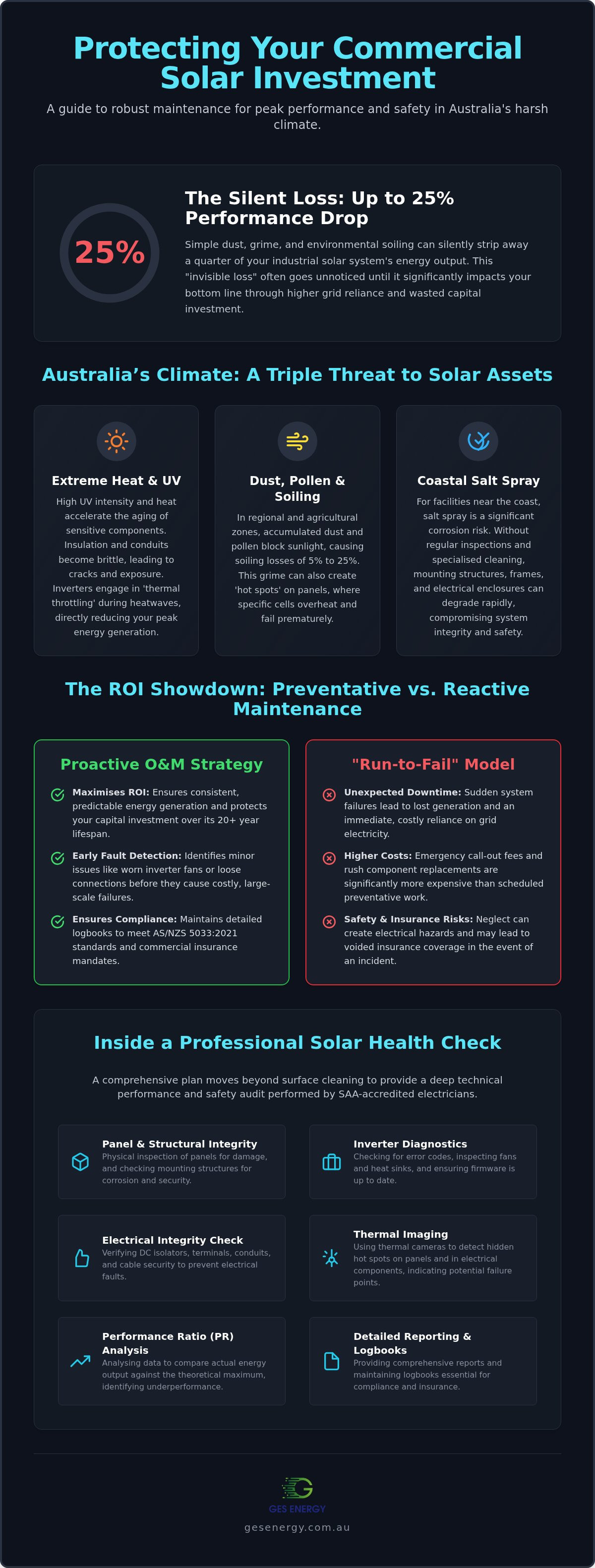
Australia’s climate presents a triple threat to industrial energy systems. Extreme heat accelerates the aging of sensitive inverter components. When temperatures peak, inverters often engage in thermal throttling to prevent internal damage, which directly reduces your peak period energy generation. Coastal facilities face the additional burden of salt spray corrosion. Without regular inspections, mounting structures and electrical enclosures can degrade rapidly. In regional or agricultural zones, dust and pollen accumulation lead to soiling losses, which can reduce energy production by 5% to 25% depending on the location. These layers of grime don't just block light; they can cause hot spots where specific cells overheat and fail prematurely. A professional maintenance schedule accounts for these regional variations, adjusting cleaning frequencies to match local conditions like harvest seasons or dust storms.
The Financial Cost of Neglect
The financial impact of neglect is often hidden. Calculating the "Invisible Loss" involves identifying when a system underperforms by 15% unnoticed, often due to minor faults that haven't triggered a full shutdown. This underperformance results in higher grid reliance and wasted capital. A robust commercial solar maintenance plan australia helps you avoid these pitfalls by providing clear data on system health. Scheduled maintenance allows for the early detection of failing components, such as worn inverter fans or degraded DC isolators. Replacing these parts before they fail prevents the high costs associated with emergency callouts and lost generation. The Performance Ratio (PR) is a key metric for commercial solar health that measures the relationship between actual energy output and the theoretical maximum output based on available sunlight.
What a Comprehensive Commercial Solar Maintenance Plan Includes
A professional commercial solar maintenance plan australia moves beyond simple surface cleaning to involve deep technical performance auditing. While washing away dust and grime is necessary for light absorption, the real value of a maintenance strategy lies in verifying the electrical health of the entire system. Industrial arrays are complex power plants that require specialized oversight to remain efficient and safe. High-level monitoring software serves as your first line of defence, providing real-time data that alerts technicians to anomalies before they escalate into total system failures. For large-scale industrial assets, we recommend a hybrid approach: quarterly remote monitoring and visual inspections, coupled with a comprehensive annual technical audit.
SAA-accredited electricians are essential for these reviews because they possess the technical training to handle high-voltage DC systems. They don't just look at the panels; they scrutinise the balance of system components that often hide brewing faults. If you want to ensure your system is performing at its quoted efficiency, you can request a technical performance audit from our national service team. This proactive approach identifies minor issues like failing inverter fans or loose terminations before they cause significant downtime.
Advanced Technical Diagnostics
Technical diagnostics provide a clear window into the internal health of your solar cells. Thermographic inspections use infrared cameras to detect heat signatures that are invisible to the naked eye. These "hot spots" often indicate internal cell defects or bypass diode failures that could eventually lead to fire risks if left unaddressed. IV Curve Tracing is another critical tool. By measuring the actual current and voltage output against the manufacturer's factory specifications, technicians can precisely quantify any degradation or underperformance. Finally, insulation resistance testing ensures that your system isn't leaking current into the mounting structure, which is a vital safety check for protecting both personnel and the property.
Physical and Mechanical Health Checks
The physical integrity of your array is just as important as the electrical output. Technicians must inspect mounting structures to ensure torque settings remain correct and that wind-load integrity hasn't been compromised by vibration or weather. DC isolators and enclosures are particularly vulnerable to the elements; these are checked for signs of moisture ingress, heat stress, or UV-induced brittleness. Compliance is also a moving target. A thorough plan includes verifying that all safety signage and labelling comply with the latest AS/NZS 5033:2021 standards. This meticulous attention to detail ensures that your energy investment remains a safe, reliable, and compliant asset for its entire operational life.
Preventative vs. Reactive Maintenance: A ROI Comparison
Choosing a "Run-to-Fail" model might seem cost-effective on paper, but it's a high-risk gamble with industrial energy assets. In contrast, a structured commercial solar maintenance plan australia shifts the focus to preventative care, where small interventions prevent catastrophic failures. This approach is particularly vital for inverters, which follow a predictable "Inverter Failure Curve" in Australia's high-heat environments. By proactively replacing fans and filters before they clog or seize, you prevent internal temperatures from soaring and components from degrading. This simple stewardship can extend the total lifecycle of your solar asset by five to ten years, ensuring your capital investment pays dividends for much longer than a neglected system.
Maintaining a detailed service log is also critical for manufacturer warranty claims. Most major inverter and panel manufacturers require evidence of regular professional maintenance to honour their performance guarantees. Without a documented history of SAA-accredited inspections, a legitimate claim could be rejected, leaving your business to foot the bill for expensive replacements. A preventative strategy ensures that you remain in full compliance with these technical requirements, protecting your financial interests if a component does fail prematurely.
Uptime and the Cost of Downtime
The financial impact of a system failure isn't just the cost of the repair; it's the lost generation. For a medium-to-large industrial facility, a 48-hour inverter outage during peak summer can negate an entire month of solar savings. Reactive maintenance often involves waiting days for a technician and paying premium emergency call-out fees. A structured maintenance plan typically includes "Priority Service" clauses, ensuring your facility is at the top of the list when issues arise. This guaranteed response time minimises downtime and provides the predictability required for accurate financial forecasting. It's often the difference between a minor service interruption and a major operational headache.
Optimising Energy Yield
Energy yield is directly linked to the physical condition of your array. When panels are heavily soiled, the reduced DC input can cause the system to fall below the "clipping" threshold of the inverter more frequently, resulting in missed generation opportunities. Regular recalibration of monitoring sensors also ensures that the data you receive is accurate, allowing for precise performance tracking. It's important to remember that the initial commercial solar installation quality dictates your future maintenance needs. A well-engineered system with high-quality cable management and ventilation will naturally require less frequent intervention than a poorly executed project, allowing you to focus your O&M budget on performance optimisation rather than constant repairs.
Compliance, Insurance, and Australian Safety Standards
The insurance landscape for industrial assets has undergone a significant shift. Insurers now frequently demand proof of annual electrical inspections before renewing policies or processing claims for solar-related incidents. A comprehensive commercial solar maintenance plan australia provides the necessary technical documentation to satisfy these rigorous requirements. Without a detailed maintenance logbook, your business faces the risk of claim denial following a technical fault or environmental event. Regular O&M also ensures compliance with the Clean Energy Regulator (CER), which is essential for systems generating Large-scale Generation Certificates (LGCs). Consistent reporting confirms that your data remains accurate and your system continues to meet the eligibility criteria for these valuable financial incentives.
Adhering to AS/NZS 5033 and AS/NZS 4777
Australian Standards are updated regularly to reflect new safety technologies and lessons learned from historical field failures. During a scheduled inspection, older systems must be evaluated against current AS/NZS 5033:2021 requirements to identify necessary safety upgrades or signage corrections. Earth continuity testing is particularly vital in industrial environments where vibration or corrosion can compromise the grounding system over time. Only SAA-accredited labour should perform these critical tests to ensure the system remains safe for both the building and the personnel working within it. If you need to verify your site's compliance with current regulations, you can book a comprehensive safety audit with our national team of specialists.
Risk Mitigation and Fire Safety
Fire safety remains a top priority for facility managers and corporate property owners. Faulty DC isolators and poor cable terminations are the primary causes of solar-related fires in commercial settings, often triggered by moisture ingress or extreme thermal stress. A professional maintenance plan uses thermal imaging to identify "hot spots" that indicate high resistance before they lead to thermal runaway. By detecting these temperature anomalies early, you can replace failing components during a planned outage rather than dealing with a sudden emergency. At the conclusion of each inspection, a "System Health Certificate" is issued to the client. This document serves as a powerful reporting tool for internal stakeholders and ESG committees, proving that your organisation is a diligent steward of its renewable energy infrastructure.
The GES Energy Approach to National Solar O&M
GES Energy acts as a diligent steward of the energy ecosystem, leveraging years of experience as a national EPC provider to deliver superior maintenance services. Unlike basic service providers who focus on surface-level tasks, we apply engineering-grade rigour to every inspection. This technical background allows us to offer a more sophisticated commercial solar maintenance plan australia that addresses the root causes of system inefficiency. We believe that every industrial array deserves professional oversight, which is why we provide technical support for systems regardless of who performed the original installation. Our SAA-accredited professionals bring the same level of precision to a legacy system as they do to a brand-new commissioning project.
Different industrial sectors face unique operational pressures that require customised O&M strategies. For example, cold storage facilities require maximum system uptime during peak summer heat to maintain temperature control and protect inventory. In contrast, manufacturing plants often require maintenance schedules that align with production downtime to avoid any interference with their core operations. We tailor our approach to these specific needs, ensuring that your energy infrastructure supports your business goals rather than complicating them. This comprehensive management now includes battery storage health checks as standard, ensuring your C&I energy storage systems are performing at their quoted capacity.
Portfolio Management for Multi-Site Businesses
Managing solar assets across multiple Australian locations can be a complex logistical task for facility managers. We simplify this process through centralised reporting that standardises safety and performance metrics across your entire energy fleet. This structured approach allows you to:
- Compare site performance through a single, unified reporting lens.
- Ensure consistent safety compliance across state borders.
- Streamline warranty assistance and manufacturer liaisons through one technical partner.
- Track the long-term health of your industrial energy investment.
Future-Proofing Your Energy Ecosystem
The Australian energy grid is in a state of constant transition, with new communications protocols and safety standards emerging regularly. Our maintenance audits go beyond physical checks to include updating firmware and optimising inverter settings for current grid conditions. This proactive approach ensures your system remains a future-ready asset that can adapt to new regulations. During our technical reviews, we also identify strategic opportunities for system expansion or battery retrofitting, allowing your infrastructure to grow alongside your business. You can secure your investment with a GES Energy commercial maintenance plan to ensure your facility remains a high-performance energy plant for years to come.
Securing Your Industrial Energy Future
A solar array is one of the most significant physical assets your business will own. Shifting from a reactive "run-to-fail" mindset to a proactive asset management strategy is the only way to guarantee your long-term return on investment. By prioritising technical diagnostics over basic cleaning, you protect your facility from fire risks and ensure full compliance with updated Australian Standards and insurance mandates. Implementing a structured commercial solar maintenance plan australia transforms a depreciating piece of hardware into a high-performance energy plant that delivers predictable savings for decades.
GES Energy provides the national service coverage and EPC-grade diagnostic equipment required to manage complex industrial systems. Our SAA-accredited technical team is ready to help you identify hidden faults and optimise your system's performance, regardless of who performed the original installation. It's time to take full control of your energy ecosystem and future-proof your infrastructure against the harsh Australian climate. To get started, you can Request a Commercial Solar Audit from GES Energy today. We look forward to helping you maintain a safe, efficient, and profitable energy investment for many years to come.
Frequently Asked Questions
How often should a commercial solar system be serviced in Australia?
A commercial solar system should undergo a comprehensive technical audit at least once every twelve months. While basic monitoring happens daily through software, physical inspections by SAA-accredited professionals ensure electrical integrity. Large-scale industrial arrays often benefit from quarterly visual checks to identify debris or physical damage early. Following a structured schedule helps you stay ahead of the failure curve and maintains compliance with Australian Standards for high-voltage infrastructure.
Do I need to clean my solar panels if it rains frequently?
Rain is rarely sufficient to maintain peak performance for industrial solar arrays. While light rain might rinse away loose dust, it often leaves behind a film of residue or causes mud-caking on the bottom edge of panels. In regional or industrial zones, rain can't remove sticky pollen, salt spray, or bird droppings. Professional cleaning ensures that light absorption remains at 100%, which directly protects the energy yield promised in your original investment.
What is the difference between a solar health check and a maintenance plan?
A solar health check is typically a one-off diagnostic event designed to identify current faults. In contrast, a commercial solar maintenance plan australia is a long-term O&M strategy that provides ongoing stewardship of your energy assets. Plans usually include priority service response, centralised reporting for stakeholders, and scheduled firmware updates. This proactive approach ensures your system transitions from a passive installation into a high-performance energy plant that delivers predictable financial results.
Will a maintenance plan help with my solar manufacturer warranty?
Yes, a structured maintenance plan is vital for processing manufacturer warranty claims successfully. Most major solar component manufacturers require documented evidence of regular professional servicing by accredited technicians to honour their performance guarantees. If a failure occurs and you don't have a recorded history of maintenance, the manufacturer may reject the claim. Our SAA-accredited team provides the technical reports needed to verify that the system was operated according to factory specifications.
Can GES Energy maintain a solar system installed by another company?
GES Energy provides comprehensive technical support and maintenance for solar systems regardless of who performed the original installation. We act as a diligent steward for the entire energy ecosystem, helping businesses manage legacy assets that may no longer be supported by their initial providers. Our national service coverage ensures that multi-site portfolios receive the same high standard of engineering-grade care, standardising safety and performance metrics across your entire energy fleet.
How much does a commercial solar maintenance plan cost in Australia?
The cost of a commercial solar maintenance plan australia varies depending on the system's total capacity in kilowatts and the specific environmental risks at your site. While industry data suggests that professional cleaning alone can range between $5 and $10 per panel in 2026, a technical maintenance plan involves much more than washing. Factors such as the complexity of the inverter setup and the requirement for high-level diagnostics like IV curve tracing influence the total investment.
Is thermal imaging necessary for all commercial solar inspections?
Thermal imaging is a critical component of any professional industrial solar inspection. It allows technicians to identify hot spots and internal cell defects that are completely invisible to the naked eye. These thermal anomalies often indicate high resistance or bypass diode failures that can lead to fire risks if they aren't addressed. Using infrared technology ensures that your maintenance team can pinpoint specific failures before they cause significant system downtime or property damage.
What happens if my solar system fails a safety inspection?
If your system fails a safety inspection, the technician will typically isolate the faulty components to prevent immediate risks such as fire or electrical shock. You'll receive a detailed rectification report that outlines exactly what needs to be fixed to bring the system back into compliance with AS/NZS 5033:2021. GES Energy provides the technical expertise to perform these repairs quickly, ensuring your facility remains safe and your insurance coverage stays valid.


