

Treating a multi-kilowatt energy system as a "set and forget" asset is a gamble that few Australian businesses can afford to lose. While it's easy to assume the sun does all the work, neglecting commercial solar maintenance often leads to unexplained drops in generation and, in some cases, serious safety non-compliance. You've likely invested heavily in your infrastructure to lower overheads, so the last thing you want is an avoidable fault or a voided warranty caused by a simple lack of oversight.
We understand that managing complex energy transitions requires both technical precision and long-term predictability. It's common to feel concerned about electrical fire risks or confused by evolving warranty requirements, but these challenges are manageable with the right expertise. This guide will show you how to safeguard your investment, ensure compliance with the current AS/NZS 5033:2021 standards, and maximise your energy yields through proactive management. We'll examine the specific requirements for bi-annual electrical inspections, the importance of SAA-accredited health checks, and how a diligent maintenance schedule can protect your 25-year asset lifespan while meeting strict insurance obligations.
Key Takeaways
- Discover why commercial solar maintenance is a comprehensive technical audit rather than a simple cleaning task, helping to prevent annual yield losses of up to 15%.
- Identify the critical elements of a professional health check, from inspecting PV arrays for micro-cracks to testing DC isolators for potential heat damage or water ingress.
- Ensure your business meets its legal safety obligations and remains fully compliant with the latest AS/NZS 5033:2021 standards to protect your insurance standing.
- Learn how to transition from costly reactive repairs to predictive monitoring strategies that safeguard your asset’s 25-year lifespan and maximise ROI.
- Understand the benefits of partnering with an SAA-accredited specialist who can provide national support for your system, even if they didn't perform the initial installation.
Beyond Cleaning: Why Commercial Solar Maintenance is Vital in 2026
Many business owners view solar as a passive asset. They assume that once the panels are on the roof, the job is done. However, effective commercial solar maintenance is far more than a simple cleaning chore. It is a systematic technical audit of your entire photovoltaic system, designed to identify electrical faults before they escalate into costly failures. This process involves testing everything from the integrity of the mounting frames to the thermal performance of the inverters.
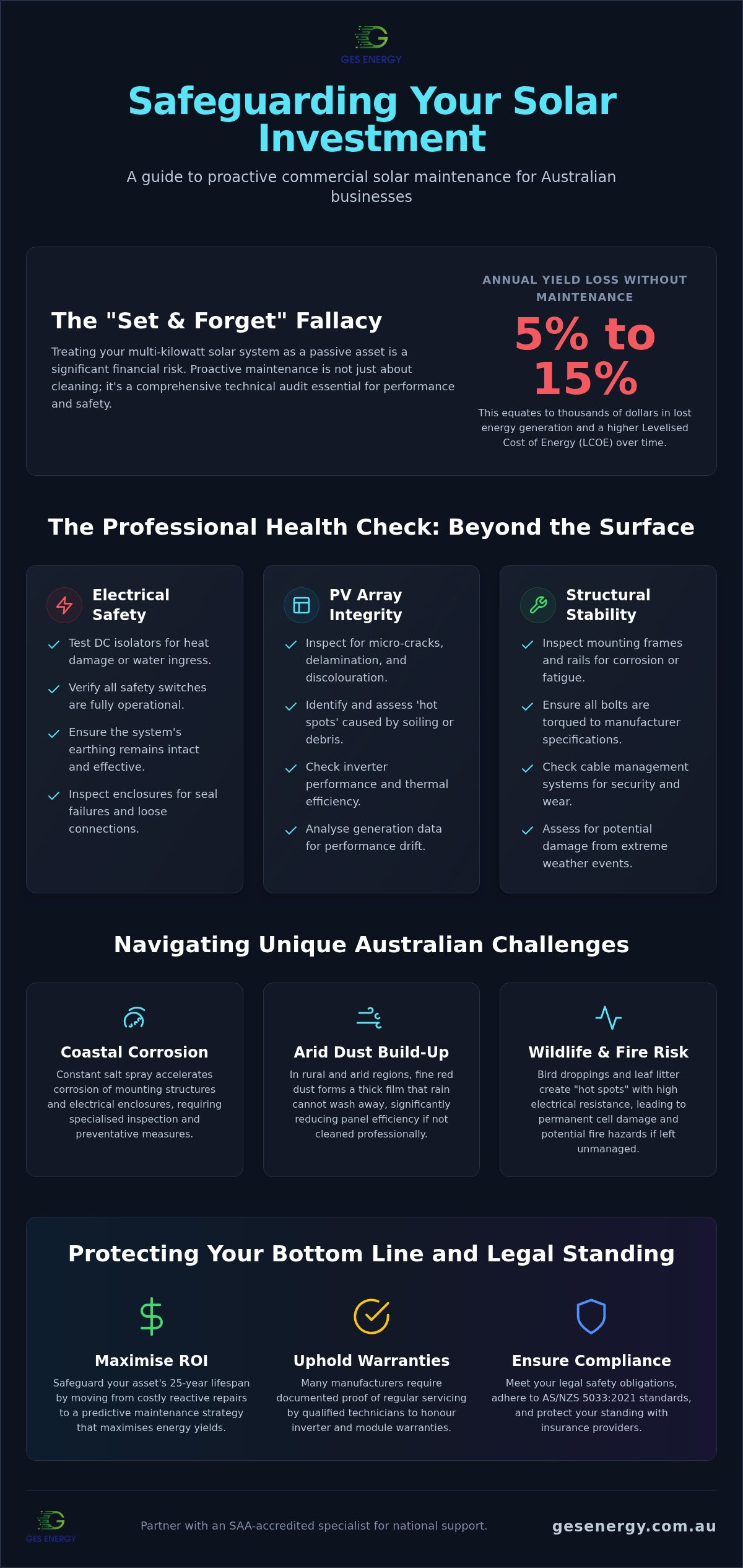
The "efficiency gap" is a real threat to your energy strategy. Industry data indicates that unmaintained systems can lose between 5% and 15% of their energy yield every year. This isn't just about a bit of dust on the glass. It involves micro-cracks in cells, loose wiring connections, and inverter performance drift. Relying on the "maintenance-free" myth is a technical mistake. Every mechanical and electrical component in your plant requires periodic oversight to function at peak capacity. Without this, your commercial solar maintenance strategy is essentially non-existent, leaving your investment vulnerable.
The Impact on Your Bottom Line and ROI
Small generation losses might seem negligible on a daily basis. Over a decade, these losses compound into thousands of dollars in wasted potential. When your system health declines, your Levelised Cost of Energy (LCOE) increases, making your initial investment less effective. Professional oversight is the primary tool for ensuring your asset reaches its full 25-year life cycle. It also ensures you remain compliant with manufacturer requirements. Many inverter and module brands won't honour warranties without documented proof of regular servicing by qualified technicians. By acting as a diligent steward of the system, you protect the financial return you expected on day one.
Environmental Factors in the Australian Landscape
Coastal and rural businesses face unique challenges that standard global manuals don't always cover. Facilities near the ocean deal with constant salt spray, which can lead to rapid corrosion of mounting structures and electrical enclosures. In the Red Centre or arid regions, fine red dust creates a thick film that rain simply cannot wash away. These factors require more than a casual glance to manage effectively.
Local wildlife also plays a significant role in system degradation. Bird droppings and leaf litter can create "hot spots" on panels. These areas of high electrical resistance cause localised heating, which can permanently damage cells or even lead to fire risks if left unchecked. Because Australian weather patterns are becoming more extreme, a custom maintenance schedule tailored to your specific site is no longer optional. It's a requirement for operational stability and long-term peace of mind.
The Technical Checklist: What a Professional Health Check Covers
A rigorous commercial solar maintenance programme moves beyond the surface to evaluate the electrical and structural integrity of your entire energy plant. It begins with a meticulous visual inspection of the PV array. Technicians look for signs of delamination, discolouration, or micro-cracks in the glass that can impede electron flow. These issues often remain invisible from the ground, yet they significantly degrade the system's output over time. Checking the cable management systems and mounting structures is equally vital. Ensuring that every bolt remains torqued to specification and every cable is secured against wind vibration prevents mechanical failures during extreme Australian weather events.
Electrical safety remains the highest priority during a technical audit. Technicians must test DC isolators and electrical enclosures for any evidence of water ingress or heat damage. Because these components handle high-voltage direct current, any seal failure or loose connection can lead to arcing. Adhering to photovoltaic system maintenance best practices involves verifying that all safety switches operate correctly and that the system's earthing remains intact. This level of detail ensures your facility stays compliant with safety regulations while protecting your staff and property.
Inverter and Battery Storage Health
The inverter acts as the brain of your energy ecosystem, making it the most frequent point of failure in commercial systems. Maintenance includes a deep dive into performance data to identify efficiency "drift" and ensuring that firmware is updated to the latest version for security and stability. For businesses utilising C&I energy storage, testing the battery State-of-Health (SoH) is critical. We verify that ventilation and cooling systems in indoor electrical centres are unobstructed, as excess heat is the primary enemy of battery longevity and inverter performance.
Thermal Imaging and Advanced Diagnostics
Advanced diagnostics provide a level of oversight that simple visual checks cannot match. We utilise infrared thermography to identify "hot spots" within the solar cells. These thermal anomalies indicate internal resistance or cell failure, which can become fire hazards if ignored. String testing is another essential step. By measuring the electrical output of each individual string of panels, technicians can ensure every component is contributing its fair share to the total load. If your current monitoring shows a dip in performance, booking a professional solar health check can identify these hidden faults before they cause a total system shutdown.
Compliance and Safety: Navigating Australian Standards (AS/NZS 5033)
Operating a large-scale energy plant carries significant legal responsibilities that extend far beyond simple energy production. In Australia, the primary standard governing these installations is AS/NZS 5033:2021. This standard sets out the mandatory requirements for the installation and safety of PV arrays, ensuring they don't pose a risk to the building's occupants or the surrounding infrastructure. For a business owner, compliance with these standards isn't optional; it's a core component of your legal obligation to provide a safe workplace under Work Health and Safety (WHS) legislation. Neglecting commercial solar maintenance can lead to situations where your facility is operating outside these safety parameters, creating a liability that no board or manager wants to carry.
The Australian solar industry has matured significantly, but many systems still in operation were installed during periods of less stringent oversight. These legacy systems, often the work of short-lived providers or "Solar Cowboys," frequently harbour hidden compliance risks. These can include incorrectly rated DC isolators, poor earthing, or mounting systems that don't meet current wind-load requirements. Regular technical audits are the only way to identify these historical flaws. By uncovering these issues early, you can perform the necessary rectifications to bring the system up to current safety codes, protecting both your staff and your capital investment.
Mandatory Inspections and Reporting
To ensure your records stand up to legal or regulatory scrutiny, all maintenance tasks must be performed by SAA-accredited electricians. These specialists understand the specific nuances of commercial-scale electrical architecture and the latest updates to the 2021 standards. After every visit, you should receive a professional maintenance report that includes specific data on insulation resistance, earth continuity, and thermal performance. For industrial sites and those operating micro-grids, these reports form a vital part of your site's permanent safety record, proving that you've acted as a diligent steward of the technology.
Insurance and Warranty Protection
In 2026, the insurance landscape for commercial property has shifted. Many insurers now view a lack of documented commercial solar maintenance as a significant risk factor, potentially leading to higher premiums or the rejection of claims following a fire or weather event. They require clear evidence that the system has been serviced according to the manufacturer’s guidelines. Furthermore, maintaining your warranty for inverters and modules depends entirely on this paper trail. If a component fails and you can't provide a service history, the manufacturer may void the warranty, leaving you to cover the full cost of replacement. Using original components and accredited labour for all repairs is the only way to ensure your system's integrity and your financial protection remain intact.
Maximising ROI: Predictive Monitoring vs. Reactive Repairs
The financial viability of a large-scale energy investment depends entirely on its operational uptime. Many Australian businesses still rely on a reactive approach, which involves waiting for a component to fail before calling for assistance. This method is often the most expensive way to manage an asset. It leads to unexpected downtime, emergency labour rates, and significant revenue loss during peak sunlight hours. Predictive commercial solar maintenance, however, uses advanced data to identify potential failures before they occur. By intervening early, you can maintain a steady energy yield and avoid the "bill shock" that follows a silent system failure.
Data analytics provide a level of insight that traditional visual inspections simply cannot match. Modern platforms can identify subtle underperformance, such as a single string of panels underperforming due to a faulty connector or localised shading. This allows for surgical repairs rather than broad, expensive troubleshooting. To further protect your ROI, we recommend scheduling major technical audits during low-production months. Performing commercial solar maintenance in late autumn or winter ensures your system is fully optimised and ready to capture maximum value when the high-production spring and summer months arrive.
The Role of Remote Monitoring Platforms
Integrating solar analytics directly with your existing Building Management System (BMS) offers a comprehensive view of your facility's energy health. These platforms provide real-time alerts for issues like inverter clipping or communication drop-outs. This connectivity allows technicians to perform remote diagnostics, often resolving software-based glitches without the need for a physical site visit. By reducing unnecessary call-outs, you keep your operational expenses low while ensuring your energy storage and PV systems remain at peak health.
Strategic Cleaning Schedules
Physical maintenance should be viewed through the lens of a cost-benefit analysis. There is a specific "tipping point" where the cost of a professional clean is outweighed by the immediate increase in energy generation. To protect the longevity of your modules, we always advocate for the use of chemical-free, deionised water. Unlike tap water, which can leave mineral deposits and cause "scaling," deionised water ensures a streak-free finish that maximises light absorption. If you want to move from reactive troubleshooting to a proactive asset strategy, you can book a comprehensive system review to secure your long-term energy yields.
Future-Proofing Your System with GES Energy Maintenance
GES Energy acts as a national partner for businesses seeking stability and technical excellence in their energy infrastructure. We operate as a comprehensive, end-to-end specialist, meaning our team brings an Engineering, Procurement, and Construction (EPC) perspective to every site we visit. This high-level technical proficiency allows us to view your system not just as a collection of hardware, but as a total energy ecosystem. Whether your facility features a utility-scale project up to 5 MW or a complex micro-grid solution, we provide the oversight needed to ensure ongoing health and performance.
One of the most significant challenges for Australian businesses is finding support for systems where the original installer is no longer in operation. We bridge this gap by offering technical support and commercial solar maintenance regardless of who performed the initial installation. We act as a diligent steward of your technology, ensuring that your transition to renewable energy remains a source of value rather than a technical burden. By choosing a long-term service agreement, you move away from the unpredictability of emergency repairs and towards a model of stable, predictable energy costs.
Comprehensive EPC and Maintenance Services
Our expertise extends across the full spectrum of energy infrastructure, from large-scale industrial arrays to C&I energy storage systems. Accessing SAA-accredited labour is essential for complex tasks such as inverter repairs and warranty assistance. Because we understand the intricacies of system design, we can customise maintenance plans that align with your specific industrial energy needs. This methodical approach mirrors the engineering processes we use during new builds, ensuring every component is meticulously planned, managed, and future-proofed against evolving standards.
Starting Your Maintenance Journey
The transition from a neglected system to a high-performing asset begins with a single, thorough step. We perform a comprehensive system audit and health check to establish a performance baseline. This initial audit identifies any immediate safety risks or efficiency gaps that require urgent attention, such as those discussed in earlier sections regarding DC isolators and thermal hot spots. Once these are addressed, we implement a structured schedule of commercial solar maintenance to protect your ROI for the full 25-year lifespan of the asset. If you are ready to secure your energy future and meet your compliance obligations, you can organise a professional health check with GES Energy today.
Securing Your Long-Term Energy Infrastructure
Transitioning from reactive repairs to a structured commercial solar maintenance strategy is the most effective way to protect your capital investment. By moving beyond basic cleaning and embracing technical audits, you ensure your system remains compliant with AS/NZS 5033:2021 standards while safeguarding your insurance standing. Proactive oversight doesn't just prevent faults; it optimises every kilowatt-hour of production to maintain the high ROI you expected at installation. Whether you're managing a rooftop array or a complex micro-grid, consistent technical oversight is the key to asset longevity.
As a national specialist in C&I and utility-scale maintenance, GES Energy provides the technical proficiency required to manage systems up to 5 MW. Our SAA-accredited technicians act as diligent stewards of your asset, offering comprehensive support regardless of your original installer. We help you maintain total control over your energy future through methodical planning and professional diagnostics across our national service network.
Protect your solar investment with a GES Energy health check and gain the peace of mind that comes from knowing your infrastructure is in expert hands. We're ready to help you maximise the lifespan and performance of your energy asset.
Frequently Asked Questions
How often should a commercial solar system be serviced in Australia?
Under Australian Standards, it is recommended that commercial solar systems undergo an electrical inspection twice a year. This bi-annual schedule ensures that all components are checked for signs of degradation and that the system remains safe for operation. Regular oversight helps to identify potential issues like loose connections or water ingress before they lead to significant downtime or safety risks.
Can I just use my regular facility maintenance team to clean the panels?
Cleaning solar panels should be handled by specialists rather than general facility staff to avoid accidental damage to the modules. Professional technicians use deionised water and specific techniques to prevent micro-cracks or "hot spots" caused by incorrect pressure or harsh chemicals. Additionally, a technical team can perform a visual inspection of the PV array while cleaning, which general cleaners are not trained to perform.
Will rain naturally clean my commercial solar panels?
Rain is generally insufficient to remove the heavy accumulation of dust, salt spray, or bird droppings common in the Australian landscape. In many cases, light rain can actually turn dry dust into a sticky film that further reduces light absorption and system efficiency. Professional cleaning is necessary to close the "efficiency gap" and ensure your panels are operating at their rated capacity year-round.
What are the signs that my commercial solar system needs urgent maintenance?
Sudden, unexplained drops in energy generation or visible warning lights on your inverter are the most common signs that urgent commercial solar maintenance is required. You should also look for physical indicators like discoloured cells, cracked glass, or loose mounting hardware. If your monitoring platform alerts you to a string failure or an inverter communication error, it is vital to book a technical audit immediately.
Does maintenance affect my solar panel and inverter warranties?
Documented annual servicing is typically a mandatory requirement to keep manufacturer warranties for inverters and solar modules valid. If a component fails and you cannot provide a service history from an SAA-accredited technician, the manufacturer may void your claim. Regular maintenance ensures you have the necessary paper trail to protect your financial investment over its 25-year lifespan.
What is the average cost of a commercial solar health check?
The cost of a professional health check varies based on the size of your array and the complexity of the site's electrical architecture. Factors such as the total kilowatt capacity, the number of inverters, and the presence of battery storage systems will influence the final scope of work. We recommend requesting a site-specific assessment to ensure all technical requirements and safety checks are accurately covered.
Are there specific Australian Standards for commercial solar maintenance?
The primary standard governing these systems is AS/NZS 5033:2021, which outlines safety and installation requirements for PV arrays. Compliance with this standard is essential for meeting your legal obligations under Work Health and Safety legislation. Adhering to these guidelines through commercial solar maintenance ensures that your facility remains a safe environment for all staff and contractors while protecting your insurance standing.
Can GES Energy maintain my system if they weren’t the original installers?
GES Energy provides comprehensive maintenance and repair services for systems nationwide, regardless of who performed the original installation. We specialise in supporting businesses that have been left without technical support due to installer exits or the need for a more professional service partner. Our team focuses on inverter repairs, warranty assistance, and accredited health checks to ensure your asset continues to perform at peak capacity.


