

What if the true commercial solar inverter repair cost in Australia isn't the technician's invoice, but the thousands of dollars in lost generation while your system sits idle? Many facility managers find themselves in a difficult position when legacy hardware fails, struggling to source SAA-accredited technicians who can manage the complexities of older industrial brands. It's a common concern that the downtime required for parts and warranty assessments might outweigh the benefits of the repair itself, particularly as grid electricity rates stay above 30 cents per kWh through 2026.
We recognise that you need a stable energy infrastructure that delivers long-term predictability. This guide provides a detailed breakdown of current service benchmarks and a clear framework for calculating the ROI of a repair versus a full system replacement. You'll gain a thorough understanding of the latest AS/NZS 4777.1:2024 compliance requirements and how to handle warranty claims on aging units. By the end of this guide, you'll have the technical insight needed to make an informed decision that protects your system's longevity and ensures your business remains energy independent.
Key Takeaways
- Establish a clear benchmark for the commercial solar inverter repair cost australia by evaluating national service averages for industrial-scale systems.
- Apply the 40-50% economic rule to determine whether repairing a legacy unit is a sound investment or if a full replacement is required for long-term stability.
- Identify how site-specific variables, such as system architecture and height access requirements, dictate the total complexity and expenditure of commercial service calls.
- Calculate the true cost of system failure by factoring in lost generation revenue and the potential impact on industrial peak demand charges.
- Understand the importance of engaging SAA-accredited technicians to ensure all repairs comply with the latest AS/NZS 4777.1:2024 safety standards.
Benchmarking Commercial Solar Inverter Repair Costs in 2026
Commercial inverter repair is a specialised Operation and Maintenance (O&M) service designed for systems 30kW and larger. Unlike residential units, industrial systems are complex energy assets that require technical oversight to maintain their output. To understand the commercial solar inverter repair cost australia, facility managers must look beyond simple hardware fixes. Because of the technical role of what a solar inverter does in converting high-voltage DC to usable AC power, any repair involves significant engineering oversight and safety compliance.
Estimating the commercial solar inverter repair cost australia involves accounting for both on-site component swaps and off-site workshop reconditioning. On-site work generally focuses on modular parts like cooling fans or communication cards. In contrast, complex internal faults may require the unit to be sent to a controlled environment for specialist attention. Industrial sites carry higher fixed costs than residential properties because technicians must complete site-specific safety inductions and document Safe Work Method Statements (SWMS) before any work begins. These administrative requirements ensure the safety of the grid and the facility but do impact the initial diagnostic expenditure.
The Reality of Industrial Call-Out Fees
Commercial and industrial (C&I) sites require high-voltage qualified technicians who possess SAA accreditation. These professionals are trained to manage the specific risks associated with large-scale energy infrastructure. In 2026, national averages for industrial call-out fees reflect the increasing demand for these specialised skills. It's common for the first hour of labour to be consumed entirely by site inductions and safety briefings, especially on large manufacturing or logistics hubs. Small commercial systems under 100kW typically fall into a lower service bracket, while industrial-scale systems requiring high-voltage permits command a higher premium for every site visit.
Minor Repairs vs. Major Component Failure
Minor repairs often involve peripheral components that protect the core unit. Replacing external DC isolators or faulty cooling fans are routine tasks that prevent the inverter from overheating or tripping. Communication board failures are also frequent, often requiring firmware synchronisation to ensure the system integrates correctly with modern monitoring platforms. Component-level repair is the technical replacement of internal capacitors or transistors. If these internal components fail, the decision between repair and replacement becomes critical for the overall ROI of your Commercial Solar Installation and its ongoing performance.
The Economics of Repair vs. Replacement for C&I Systems
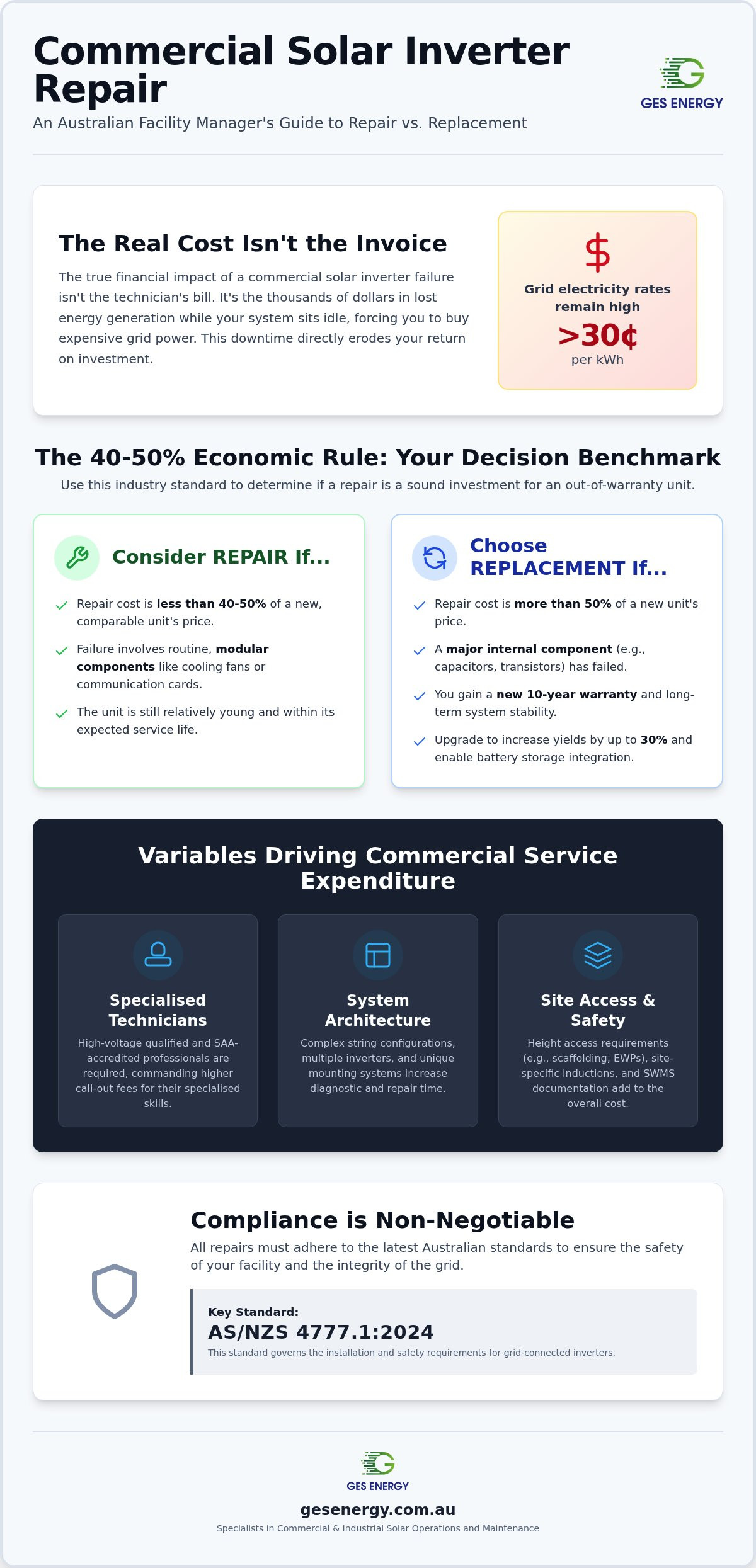
Calculating the total commercial solar inverter repair cost australia requires a strategic look at asset lifecycle rather than just the immediate fix. For commercial and industrial (C&I) assets, the industry standard is the 40-50% rule. If a repair quote for an out-of-warranty unit exceeds half the price of a new, comparable inverter, replacement is usually the superior financial path. While a repair might restore function, it rarely provides the same 10-year security as a new unit. Choosing to replace also allows businesses to capture the efficiency gains of 2026 technology. Modern inverters offer superior maximum power point tracking (MPPT) and cooling efficiency compared to units manufactured a decade ago. According to a Commercial Solar Maintenance Guide, proactive technical oversight can increase yields by up to 30 percent, making the upgrade path highly attractive for underperforming sites.
Calculating Total Cost of Ownership (TCO)
Determining the TCO involves looking at the remaining life of your existing solar panels. If your panels have another fifteen years of productive life, installing a new inverter ensures the power plant remains reliable for that entire duration. Replacing a unit also provides an opportunity to integrate industrial battery storage solutions, transforming a standard solar site into a flexible energy hub. However, businesses must account for the 'Compatibility Tax'. This includes the labour required for mounting adjustments and the re-configuration of string wiring to meet current AS/NZS standards. New inverters often have different physical footprints and DC input requirements than legacy models, which can increase the installation time on-site.
Warranty Assistance and Manufacturer Support
Navigating manufacturer support for industrial string inverters is a complex administrative task. Many manufacturers offer 'Parts Only' warranties, which means the business is still responsible for the labour costs of the swap and the technical re-commissioning. These costs are rarely free and can represent a significant portion of the total commercial solar inverter repair cost australia. Professional engineering teams manage this process by handling all technical documentation and performance logs required to validate a claim. This ensures the manufacturer cannot dispute the fault, providing peace of mind for your operations team. If you're unsure whether your current fault is covered by an existing agreement, a professional technical health check can clarify your standing before you commit to a repair.
Variables Driving Commercial Service Expenditure
The architecture of your energy system dictates the complexity of every service call. Central inverters serve as high-capacity hubs for large-scale arrays; however, their repair often involves more intensive engineering hours than distributed string architectures. While string inverters allow for modular swaps, central units require technicians to troubleshoot complex internal power stacks and cooling systems. When calculating the commercial solar inverter repair cost australia, facility managers must account for these structural differences. Diagnostic time for a single 1MW central inverter is significantly higher than for a cluster of 50kW string units, even if the total system capacity is identical.
Physical location and hardware placement also serve as primary cost drivers. Roof-mounted inverter clusters frequently require specialised access equipment to ensure technician safety and compliance with Australian standards. Beyond the hardware itself, the time required to integrate and re-commission monitoring software can add several hours to a service visit. Ensuring that the repaired unit communicates correctly with your site's energy management system is vital for maintaining accurate performance data and verifying your return on investment.
Access Equipment and Logistics
Logistical planning is essential for minimising operational disruptions. If a central inverter requires a major component swap, an Elevated Work Platform (EWP) or a crane may be necessary to move heavy parts safely. For businesses that cannot afford power interruptions during daylight hours, night-work or weekend call-outs are often required. These after-hours services carry higher labour rates but prevent the far greater cost of a total facility shutdown. Managing these logistics becomes even more critical for a remote off grid solar system, where travel mobilisation fees and part delivery lead times must be carefully coordinated to avoid extended downtime.
Brand-Specific Technical Requirements
The brand of your inverter directly influences the availability and price of spare parts within the Australian market. Tier 1 European and established Asian brands typically maintain local warehouses, ensuring faster turnaround times for critical components. In contrast, 'Grey Market' units imported without official local representation often lead to higher costs because parts must be sourced from overseas. Utilising SAA-accredited labour is a non-negotiable requirement for maintaining system compliance and ensuring your insurance remains valid. These qualified professionals understand the specific firmware and technical nuances of different brands, which helps keep the commercial solar inverter repair cost australia predictable by avoiding repeated call-outs for the same fault.
Calculating the ROI: Downtime vs. Repair Spend
When assessing the commercial solar inverter repair cost australia, the calculation must extend beyond the service invoice. The true expense of a hardware failure includes the cumulative revenue loss every day the system remains inactive. To calculate your daily revenue loss, multiply the system's expected daily kilowatt-hour (kWh) output by your current retail electricity rate. For industrial operations, this figure is often compounded by peak demand charges. If your solar plant fails during a period of high operational activity, your facility will draw its full load from the grid, potentially triggering a significant increase in your monthly demand tariff.
For systems larger than 100kW, downtime also results in the loss of Large-scale Generation Certificates (LGCs). These certificates represent a secondary revenue stream that vanishes the moment production stops. Beyond the financial impact, ignoring inverter faults creates technical risks such as string imbalance. If left unaddressed, these imbalances can lead to DC arcing and potential fire hazards, which jeopardises both the physical asset and the site's insurance standing.
The Cost of Inaction
A 100kW system offline in summer can cost a business over $150 per day in lost savings. This daily erosion of ROI makes rapid detection a financial necessity for modern enterprises. Utilising platforms like Solar Analytics and advanced remote monitoring allows facility managers to identify failures the moment they occur, rather than discovering the issue when the monthly bill arrives. Investing in a rapid response maintenance contract ensures that critical energy infrastructure receives priority attention, effectively capping the total commercial solar inverter repair cost australia by shortening the window of lost generation.
Risk Mitigation and Safety Compliance
Safety compliance is a cornerstone of professional asset management. Faulty DC isolators or aging internal components don't just reduce efficiency; they represent a legal and insurance risk if not maintained to SAA standards. Professional engineering teams use thermal imaging as a cost-effective diagnostic tool to identify hotspots within the inverter and the surrounding switchgear before they escalate into catastrophic failures. Following any technical intervention, a comprehensive commissioning report is essential for your asset register. These reports verify that the system is operating within safe parameters and provide the documentation required for future warranty or insurance claims. To ensure your system is performing at its peak, you should book a technical health check with our engineering team today.
Integrated Asset Management with GES Energy
GES Energy acts as a diligent steward for your energy infrastructure, offering a partnership that extends far beyond the initial Commercial Solar Installation. We focus on long-term O&M strategies that prioritise system health and technical longevity. Our approach integrates predictive maintenance, where we utilise thermal data and continuous performance monitoring to identify anomalies before they escalate into hardware failure. This proactive oversight is essential for managing the commercial solar inverter repair cost australia, as it allows for minor adjustments that prevent catastrophic downtime. By bundling necessary inverter repairs with annual safety inspections and technical audits, we help businesses maintain a streamlined and cost-effective maintenance schedule.
Our national service footprint provides a stable solution for businesses managing national portfolios. We maintain consistent service standards across all Australian sites, ensuring that your facility managers receive the same level of engineering expertise regardless of their location. This structured approach mirrors the meticulous planning required for complex energy transitions, giving you peace of mind that your assets are in capable hands. We don't just provide a service; we remain committed to the ongoing health and performance of your total energy ecosystem.
Technical Health Checks and Performance Audits
A simple error code on a display panel is often just a symptom of a deeper issue within the balance of system. Our technical health checks go beyond the immediate fault to evaluate the integrity of the entire plant, including DC cabling, switchgear, and mounting structures. We use high-resolution thermal imaging to identify micro-cracks and hotspots in the solar array that could be causing electrical strain on the inverter. This level of detail distinguishes a solar performance engineer from a standard repairman. By addressing these underlying stressors, we ensure that the repaired inverter operates in a stable environment, which significantly extends the unit's operational life.
Organising Your 2026 Maintenance Strategy
A successful maintenance strategy for 2026 requires moving away from reactive "break-fix" cycles. We recommend that all commercial clients undertake a pre-summer audit to verify that cooling systems and isolators are prepared for the high thermal loads of the Australian summer. This audit serves as a foundation for a structured O&M budget, allowing you to plan for inverter lifecycles rather than being surprised by sudden capital expenditure. This level of planning is vital for keeping the commercial solar inverter repair cost australia predictable and manageable. Contact GES Energy for a comprehensive commercial solar health check to ensure your system continues to deliver maximum value for your business.
Future-Proofing Your Industrial Solar Performance
Managing a commercial solar asset requires moving from reactive repairs to a strategic lifecycle approach. The true commercial solar inverter repair cost australia involves more than just technician fees; it encompasses lost generation revenue and the technical complexities of AS/NZS 4777.1:2024 compliance. By applying the 40-50% rule and factoring in the efficiency gains of modern hardware, you can make informed decisions that protect your facility's long-term ROI. Professional engineering oversight ensures your system remains a reliable asset rather than a liability.
GES Energy provides the expertise needed to navigate these technical transitions. Our SAA-accredited technical team specialises in C&I and micro-grid O&M, delivering detailed performance and compliance reports that keep your operations running smoothly. Whether you're managing a single site or a national portfolio, we're committed to the ongoing health of your total energy ecosystem. Book a Technical Inverter Diagnostic with GES Energy today to restore your system's output and safeguard your future savings. We're ready to help you maintain a resilient and efficient energy infrastructure.
Frequently Asked Questions
How much does a typical commercial inverter repair cost in Australia?
The total commercial solar inverter repair cost australia depends on the system's capacity and the specific nature of the fault. Initial diagnostic fees for industrial sites generally cover the technician's travel and mandatory site-specific safety inductions. Minor component fixes, such as replacing external isolators or cooling fans, represent the lower end of the expenditure. However, major internal failures or central inverter overhauls require significant engineering hours and specialised parts, which can increase the total investment significantly.
Is it worth repairing a 10-year-old commercial solar inverter?
Deciding to repair a decade-old unit usually depends on the 40-50% rule. If the repair quote exceeds half the cost of a modern replacement, it's often more financially sound to upgrade. Older inverters lack the efficiency gains and advanced monitoring capabilities of 2026 technology. A new unit provides a fresh 10-year warranty, whereas a repair might only offer a limited guarantee on the specific part replaced, leaving other aging components at risk of failure.
What are the most common causes of commercial inverter failure?
Environmental stressors and component fatigue are the primary drivers of failure in Australian industrial settings. High ambient temperatures often lead to the degradation of internal capacitors and cooling fan malfunctions. Power surges from the grid or lightning strikes can also damage sensitive communication boards. Additionally, moisture ingress or salt mist in coastal regions can cause corrosion on DC terminals. Regular technical health checks help identify these issues before they lead to a complete system shutdown.
Does system downtime affect my Large-scale Generation Certificates (LGCs)?
Yes, any period where your system is offline directly reduces the number of Large-scale Generation Certificates you can create. LGCs are generated based on every megawatt-hour of renewable energy produced by systems over 100kW. Because these certificates represent a tangible revenue stream and a tool for meeting corporate sustainability targets, extended downtime has a direct negative impact on your financial returns. Rapid detection and repair are essential to minimise this specific revenue loss.
How long does it take to get spare parts for industrial inverters in 2026?
Lead times for industrial parts depend heavily on the manufacturer's local presence in Australia. Tier 1 brands with established domestic warehouses can often supply critical components within a few business days. However, legacy hardware or brands without local support may require parts to be shipped from overseas, which can lead to weeks of system downtime. We recommend using SAA-accredited technicians who have direct relationships with major manufacturers to expedite the procurement process and reduce wait times.
Can I replace a string inverter with a hybrid model for battery storage?
It is technically possible to upgrade to a hybrid model, but it requires a careful engineering assessment of your existing array. Modern hybrid inverters allow for the seamless integration of industrial battery storage solutions, providing greater energy independence and peak-shaving capabilities. This transition often involves re-configuring string wiring and updating DC protection to meet current Australian standards. It's an excellent opportunity to future-proof your infrastructure while addressing a failed legacy unit.
Do I need to shut down my entire site during an inverter repair?
A total site shutdown is rarely required for a standard inverter repair or replacement. In most commercial installations, the solar system is isolated at the main switchboard, allowing the rest of your facility to operate on grid power. Technicians follow strict Safe Work Method Statements (SWMS) to ensure the work area is safe without disrupting your core business activities. However, brief interruptions might be necessary during the final commissioning phase to verify correct grid synchronisation and safety compliance.
What is the average lifespan of a Tier 1 commercial string inverter?
A high-quality commercial string inverter typically has an operational lifespan of 10 to 15 years in Australian conditions. While premium Tier 1 brands are engineered for durability, their longevity is heavily influenced by maintenance frequency and the installation environment. Units installed in well-ventilated, shaded areas generally outlast those exposed to direct sunlight and extreme heat. Implementing a proactive O&M strategy, including regular thermal imaging, can help extend this lifespan toward the upper end of the range.


