

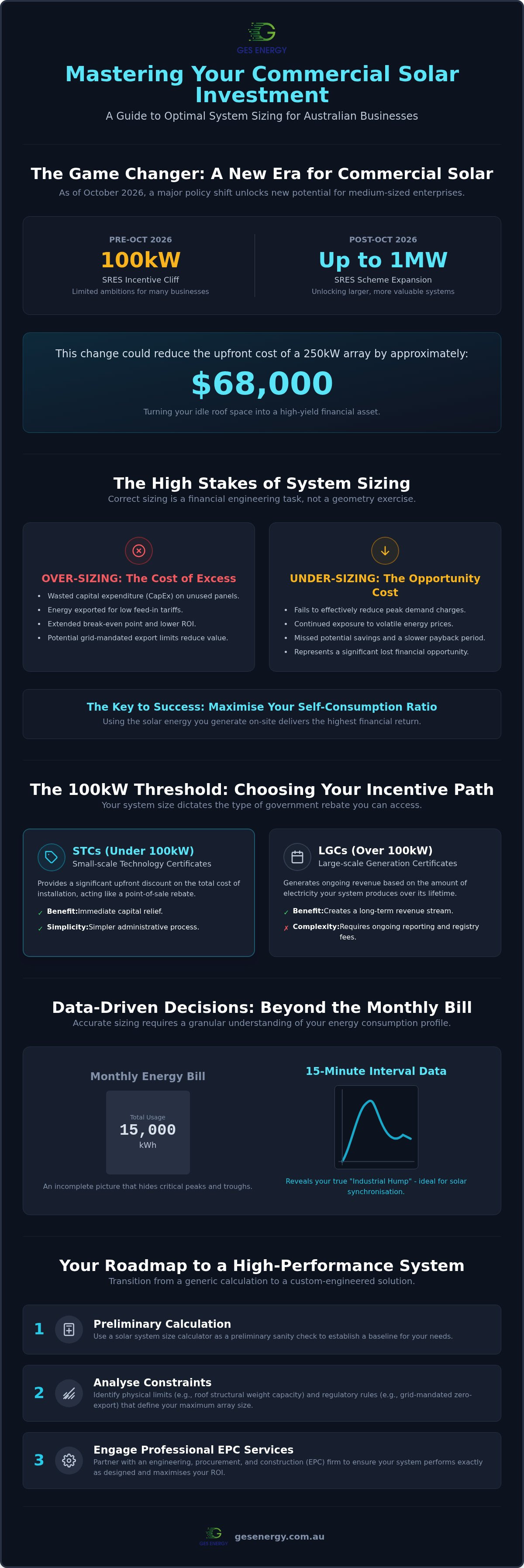
Did you know that as of October 2026, the Australian government has effectively removed the 100kW incentive cliff that once limited the ambitions of medium sized enterprises? With the Small-scale Renewable Energy Scheme now covering systems up to 1MW, the upfront cost of a 250kW array could be reduced by approximately $68,000. It is a significant shift that turns idle roof space into a high yield financial asset for businesses across the country.
You likely recognise the pressure of rising network peak demand charges and the complexity of choosing between STC and LGC rebate paths. It is common to feel uncertain about whether your roof structural integrity can handle a large scale installation. We will help you master these complexities to optimise your ROI and future proof your energy strategy. By using a commercial solar system size calculator effectively, you can move beyond guesswork and secure long term price predictability.
This guide provides a clear understanding of the kW capacity your facility requires and offers confidence in sizing battery storage for load shifting. We will explore the latest 2026 state incentives, such as the NSW Peak Demand Reduction Scheme, and provide a practical roadmap for professional EPC engagement to ensure your system performs exactly as designed.
Key Takeaways
- Learn how to balance energy production with your business's unique consumption profile to maximise ROI and avoid the hidden costs of under-sizing.
- Understand why moving beyond monthly bills to 15-minute interval data is essential for identifying your true base and peak loads during operating hours.
- Discover how to use a commercial solar system size calculator as a preliminary sanity check before accounting for complex DC/AC ratios and hybrid inverter integration.
- Identify the physical and regulatory constraints, such as roof structural weight limits and grid-mandated zero-export rules, that dictate your maximum array size.
- Gain a clear roadmap for engaging professional EPC services to transition from a generic calculation to a custom-engineered industrial energy solution.
Why Correct Sizing is the Foundation of Your Commercial Solar ROI
Sizing a commercial array is much more than a simple geometry exercise on a roof. It represents a sophisticated balance between your site's energy production, your specific consumption profiles, and the constraints imposed by the local grid. While a commercial solar system size calculator provides a useful starting point, the real value lies in aligning the hardware with your long term financial objectives. We view sizing as a financial engineering task where the goal is to maximise every dollar spent on equipment.
A key metric for any Australian business is the self-consumption ratio. This represents the percentage of generated solar energy used directly on-site rather than exported to the grid. Because feed-in tariffs in 2026 remain significantly lower than retail electricity rates, every kilowatt-hour consumed internally is worth more to your bottom line than one sent back to the network. High self-consumption ensures you aren't building a system that serves the grid more than it serves your warehouse or factory.
The Financial Impact of Sizing Errors
Poor sizing creates a direct hit to your return on investment. If you over-size your system, you risk spending capital on panels that produce energy you can't use or export due to network limits. This wasted CapEx extends your break-even point without providing a functional benefit. Conversely, under-sizing is an expensive mistake known as opportunity cost. If the system is too small, it won't effectively lower your peak demand charges, which often make up a massive portion of industrial power bills. In the context of 2026 Australian energy prices, the payback period is the total time required for the cumulative energy savings and rebates to equal the initial net investment of the system.
Understanding the 100kW Threshold in Australia
The 100kW mark has traditionally been a critical pivot point in Australian solar design. Systems below this capacity qualify for Small-scale Technology Certificates (STCs), which provide an upfront discount on the installation. For systems over 100kW, you historically moved into the Large-scale Generation Certificate (LGC) market, where incentives are paid out based on ongoing generation. Many photovoltaic systems in the commercial sector still aim for the 99kW sweet spot to simplify administrative requirements and secure immediate capital relief. Even with 2026 policy expansions, the choice between upfront STCs and long term LGC revenue remains a vital part of your financial roadmap. Moving into the LGC market requires ongoing reporting and registry fees that can be burdensome for smaller enterprises.
Essential Data Inputs for an Accurate Commercial Solar Calculation
An accurate commercial solar system size calculator requires more than a total kilowatt-hour figure from a monthly bill. Commercial operations have unique load profiles that differ significantly from residential patterns. A factory running three shifts has a different base load than a retail office that shuts down at 5 PM. Understanding these specific peaks and troughs is vital before you commit to installing a rooftop solar system. Without granular data, you risk building a system that produces energy when your machines are silent.
We prioritise the use of interval data, which breaks your consumption down into 15 or 30-minute increments. This level of detail allows us to account for weekend versus weekday variances and the impact of 2026 network tariff structures. Modern tariffs often include complex demand charges based on your highest point of usage. If your solar array isn't sized to blunt these specific peaks, your ROI will suffer despite high total generation.
Obtaining and Analysing Your Interval Data
By requesting your National Meter Identifier (NMI) data file from your electricity distributor, you can access a granular view of your facility's energy habits over the past 24 months. This data allows for the visualisation of your load profile. We look for the industrial hump, where usage peaks during daylight hours, making it ideal for solar synchronisation. This is the opposite of the residential duck curve, where usage spikes after the sun sets. Your system must be engineered to shadow your heaviest usage periods to ensure maximum self-consumption and financial performance.
Future-Proofing: EV Charging and Electrification
The Australian commercial landscape is rapidly electrifying. When calculating your required capacity, you must account for the upcoming shift from gas boilers to high-efficiency electric heat pumps and the installation of workplace EV charging stations. To ensure your investment remains relevant for the next decade, add a 20% buffer to your calculated system size to account for inevitable electrification and operational growth. This proactive approach prevents the need for expensive retrofits or system expansions in just a few years. If you need assistance interpreting your NMI data, our commercial and industrial solar experts can provide a comprehensive load profile analysis to guide your design.
Balancing Panel Capacity, Inverter Sizing, and Battery Storage
Once you have analysed your load profile, the next step in using a commercial solar system size calculator is selecting the right hardware mix to meet those requirements. Designing a high performance system is not a simple one to one match between panels and inverters. Modern engineering focuses on balancing these components to ensure the system reaches peak efficiency as early as possible in the morning and maintains it until late in the afternoon.
In the Australian market, it is standard practice to install more panel capacity than the inverter's nominal rating. This is known as the DC/AC ratio. A ratio of 133% is typical for commercial arrays. By oversizing the solar field, you ensure the inverter operates at its maximum capacity for a larger portion of the day. This approach compensates for the inevitable losses caused by Australian heat, dust, and the natural degradation of the solar cells over their twenty five year lifespan.
Maximising Yield with High-Efficiency 2026 PV Tech
By 2026, N-Type TOPCon (Tunnel Oxide Passivated Contact) panels have become the industrial benchmark for yield and reliability. These panels offer superior efficiency and a lower temperature coefficient than older P-type modules, meaning they perform better on hot Australian summer days. For sites with light coloured or reflective roofing, bifacial panels are also worth the investment. These modules capture reflected light on their rear side, which can increase your specific yield by up to 15% depending on the roof's albedo. This extra generation is particularly valuable for businesses with limited roof space but high energy demands.
Sizing the Battery Energy Storage System (BESS)
Integrating a Battery Energy Storage System (BESS) allows a business to move beyond simple generation and into active load shifting. This involves storing excess midday solar energy and discharging it during expensive evening peak periods or when demand charges are highest. To size a battery correctly, you must determine if your facility requires full uninterruptible power supply (UPS) back-up or just peak shaving capabilities. Peak shaving requires less capacity but high power output to blunt those costly network spikes.
When calculating battery capacity, you must also factor in the Depth of Discharge (DoD). While modern lithium iron phosphate (LFP) batteries often support a 95% DoD, maintaining a conservative buffer is a professional way to ensure long term reliability. We generally recommend modular C&I energy storage systems that can grow alongside your business. This modularity allows you to start with a smaller investment and expand your storage capacity as your electrification needs, such as fleet charging, continue to evolve.
Physical and Regulatory Constraints on System Size
A commercial solar system size calculator provides the electrical ideal for your facility, but physical and regulatory boundaries define the final feasible design. Roof structural integrity is the first hurdle to clear. You must assess the dead weight of panels and mounting systems along with the dynamic wind loads specific to your regional climate zone. Fire safety regulations and mandatory setbacks from roof edges and existing equipment further reduce the footprint available for generation. These factors often mean the actual capacity you can install is smaller than what your energy bill suggests you need.
Grid constraints represent the second major boundary. Many Australian Distributed Network Service Providers (DNSPs) now mandate zero export or strict static export limits to protect local network stability. By 2026, dynamic export limits have become the standard in several jurisdictions. These systems allow your array to export more power when the grid has capacity and throttle back during periods of congestion. Understanding these shifting rules is essential to ensure your system isn't constantly curtailed, which would directly undermine the financial projections you calculated earlier.
Roof Area and Shading Analysis
Calculating usable area requires more than a simple tape measure. You have to subtract zones for HVAC units, skylights, and mandatory maintenance walkways required for safe access. Near-object shading from parapet walls or neighbouring buildings can significantly reduce the output of specific panel strings. We utilise LiDAR data and high-resolution drone surveys to create centimetre-perfect models of your roof. This precision ensures that every panel is placed in a high-yield zone, avoiding the performance drag of avoidable shadows that a generic calculator might miss.
Grid Connection and DNSP Approvals
For any system exceeding 30kW, a formal pre-approval process with your local DNSP is mandatory. This is a technical negotiation rather than a simple registration. Large scale arrays often require sophisticated grid protection relays to ensure the system disconnects safely during a network fault. These components add to the initial design complexity and overall project cost. We work closely with network providers to secure the best possible export agreements through the deployment of smart inverters that manage power quality in real time. If you are concerned about grid limitations or roof capacity, our team specialises in commercial and industrial solar engineering to navigate these hurdles on your behalf.
Beyond the Calculator: Custom Engineering for Industrial Performance
A commercial solar system size calculator is an excellent diagnostic tool for providing a high level sanity check. It offers a ballpark figure that helps you understand the scale of investment required. However, a theoretical estimate is not a construction blueprint. Custom engineering is what turns a generic calculation into a high performance industrial asset. This bespoke approach focuses on reducing the Levelised Cost of Energy (LCOE) over the entire twenty five year lifespan of the system. We ensure your solar production is integrated directly into your existing Building Management System (BMS) for seamless oversight and automated load management.
The EPC Lifecycle: From Calculation to Commissioning
The journey from a digital estimate to a live system involves a rigorous Engineering, Procurement, and Construction (EPC) lifecycle. This process begins with a detailed site audit and a comprehensive assessment of your electrical switchboards. We determine if your current infrastructure can support the bidirectional power flow of a large scale array without expensive upgrades. In the 2026 market, sophisticated procurement strategies are vital to bypass supply chain bottlenecks and secure the latest high efficiency modules. You can explore the full technical process in our guide to Commercial Solar Installation: A Strategic Guide for Business. This strategic oversight ensures that the hardware specified in your design is delivered on time and within budget.
Long-Term Maintenance and ROI Protection
Securing your return on investment requires more than just a successful installation. For commercial arrays exceeding 50kW, a structured maintenance schedule is essential to prevent performance degradation. Environmental factors like dust, industrial pollutants, and salt spray can significantly reduce your yield if left unmanaged. We utilise SAA-accredited labour for all commissioning and ongoing maintenance to ensure your manufacturer warranties remain fully protected.
Professional monitoring tools allow us to verify the original projections made by your commercial solar system size calculator. By comparing real time generation data against historical load profiles, we can identify minor faults before they become costly outages. This diligent stewardship ensures that your energy independence remains stable and that your facility continues to operate at peak efficiency for decades to come.
Secure Your Business Energy Independence
Transitioning from a digital estimate to a physical industrial asset requires careful navigation of interval data, hardware ratios, and grid connection rules. A commercial solar system size calculator serves as the vital first step in your feasibility study, but the true value lies in custom engineering that accounts for specific industrial load profiles and future electrification. By aligning your system size with your long term energy strategy, you protect your business against rising peak demand charges and volatile network tariffs.
Our SAA-accredited engineering team specialises in industrial battery storage and complex micro-grid development. We provide national Australian coverage for C&I projects, ensuring your transition to renewable energy is stable, compliant, and highly efficient. Request a Professional Custom Solar Design and ROI Analysis to move beyond generic estimates and start your journey toward total energy control. We look forward to helping you transform your facility into a future-ready energy powerhouse.
Frequently Asked Questions
What is the most common commercial solar system size in Australia?
Historically, 99kW was the most frequent choice to stay below the 100kW incentive threshold. However, following the October 2026 expansion of the Small-scale Renewable Energy Scheme (SRES) to 1MW, many businesses are now sizing systems between 250kW and 500kW. This shift allows larger facilities to utilise more of their available roof space while still receiving significant upfront capital relief. The ideal size depends on your specific load profile.
How do I calculate the payback period for a 100kW commercial system?
To determine your payback period, divide the total net cost of the installation by your projected annual energy savings. You must account for the reduction in both kilowatt-hour charges and peak demand fees. While a commercial solar system size calculator provides a baseline, a professional ROI analysis also factors in 2026 LGC price trends and maintenance costs. Most well-designed 100kW systems achieve breakeven within three to five years.
Can I install a solar system larger than my grid export limit?
You can install a system that exceeds your grid export limit by using smart inverters and export limiting devices. This approach is common when a business has high daytime consumption but faces network restrictions. The extra capacity serves your internal load while the inverter throttles generation to ensure you don't breach DNSP limits. It's a strategic way to maximise self-consumption without requiring expensive grid infrastructure upgrades.
What is the difference between STCs and LGCs for business solar?
Small-scale Technology Certificates (STCs) provide an upfront discount, now available for systems up to 1MW as of late 2026. Large-scale Generation Certificates (LGCs) apply to systems over 1MW and are created based on the actual electricity the system generates over time. LGCs require ongoing reporting and are sold on a market, whereas STCs offer immediate capital relief. Most medium sized businesses prefer the simplicity and cash flow benefits of STCs.
Do I need a battery for my commercial solar system in 2026?
While not mandatory, battery storage is increasingly viable due to new 2026 incentives like the NSW Peak Demand Reduction Scheme (PDRS). Batteries allow for load shifting, which moves excess midday solar generation to expensive evening peak periods. If your business operates outside daylight hours or faces high demand charges, a battery energy storage system (BESS) is essential for maximising your total energy independence and financial returns.
How much roof space does a 50kW commercial solar system require?
A 50kW system typically requires between 250 and 350 square metres of usable roof area. This calculation assumes the use of modern high-efficiency N-Type panels. You must also account for mandatory fire setbacks, walkways, and shading from HVAC units or parapets. Using a commercial solar system size calculator helps estimate the panel count, but a drone survey is required to confirm exactly how much usable space remains after obstacles.
Will a commercial solar system cover my peak demand charges?
A correctly sized solar array can significantly reduce peak demand charges if your highest usage occurs during daylight hours. By serving your load with solar power, you lower the maximum power drawn from the grid during the network's billing window. For businesses with evening peaks, integrating a battery is necessary to achieve the same result. This targeted reduction is often the most valuable part of a commercial solar investment.
How do 2026 interest rates affect the sizing and ROI of solar?
Current interest rates influence the cost of capital for solar projects, making the payback period slightly longer if you are financing the installation. However, because electricity prices continue to rise, the cost of doing nothing is often higher than the interest paid on a green loan. Strategic sizing ensures the system generates enough savings to cover the finance repayments, allowing the project to remain cash-flow positive from the first day.


