

What if the nameplate capacity on your battery spec sheet is actually the least important number you need to know? While a large storage figure looks impressive on paper, a battery for solar energy that fails to handle a 40-degree January afternoon in Queensland or Western Australia quickly becomes an expensive ornament. It's understandable to feel overwhelmed by technical jargon like Depth of Discharge, C-ratings, and the ongoing debate between LFP and NMC chemistries. You want to lower your electricity bills and secure your property against blackouts, but the high upfront cost makes the decision feel high-stakes, especially when longevity is a concern.
This 2026 guide simplifies those complexities, showing you how to master the technical and financial variables required to select a system that truly lasts in our harsh climate. We'll break down thermal resilience, round-trip efficiency, and the real-world ROI of modern storage systems to help you achieve genuine energy independence. Whether you're looking for a residential backup or a complex commercial micro-grid, you'll gain the clarity needed to invest with total confidence in your long-term energy future.
Key Takeaways
- Understand why 2026 is the pivotal year for energy independence and how modern systems provide more than just emergency backup power.
- Compare the thermal stability and longevity of LFP, NMC, and emerging flow technologies to find the safest chemistry for the Australian climate.
- Learn how to accurately size a battery for solar energy by matching your specific evening load with single or three-phase system requirements.
- Master technical specifications like Depth of Discharge and round-trip efficiency to identify the storage solution with the best financial return.
- Discover why custom engineering and professional commissioning are essential for a reliable energy ecosystem that scales with your needs.
The State of Solar Storage in Australia for 2026
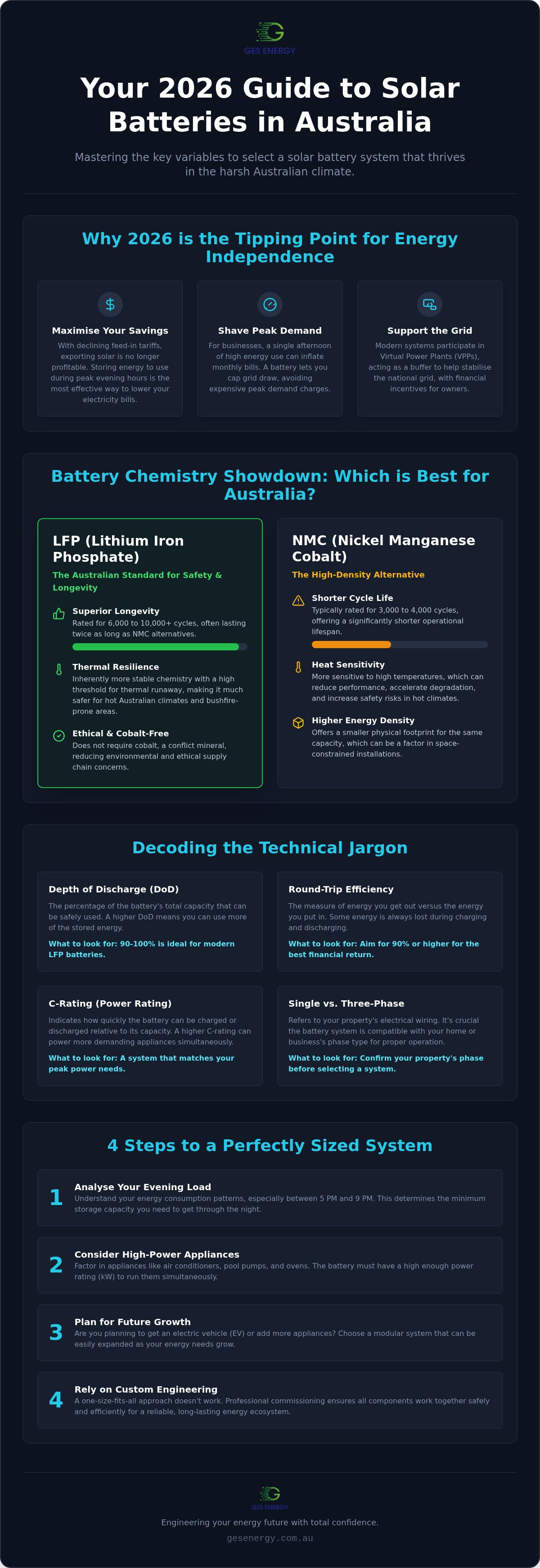
The year 2026 marks a fundamental change in how Australians view domestic and commercial power. A battery for solar energy has evolved from a luxury backup unit into the central hub of a sophisticated energy ecosystem. For years, solar owners focused on the size of their rooftop array, but the focus has shifted toward how much of that energy they can actually keep. This transition is driven by a maturing market where simple storage is being replaced by active grid participation and intelligent energy management.
We have reached a definitive "tipping point" for energy independence. The economic argument for storage is no longer just about environmental stewardship; it's about basic financial survival in a volatile market. As feed-in tariffs continue to decline across the country, exporting excess power to the grid often yields a negligible return. Storing that same energy to avoid high peak-time retail rates is now the most effective way to secure a return on investment. This shift ensures that the power you generate at midday provides the most value when you actually need it at 7:00 PM.
Why Storage is No Longer Optional
For many Australian businesses, escalating peak demand charges have become a significant operational hurdle. These charges are often based on the highest point of energy usage during a billing period, meaning a single afternoon of high air-conditioning use can inflate a monthly bill. Implementing a "Storage First" strategy allows commercial operators to cap their grid draw by using their battery for solar energy to shave those expensive peaks. On a larger scale, these distributed systems are now vital for stabilising the national grid, acting as a buffer that helps manage frequency and voltage fluctuations across the network.
The 2026 Rebate Landscape
Accessing the financial incentives available in 2026 requires a clear understanding of both federal and state-level programs. While the Small-scale Technology Certificates (STCs) primarily reduce the cost of the solar panels, they remain a critical factor in the overall system's financial viability. Current programs like the Cheaper Home Batteries initiative and various state-specific interest-free loans are designed to encourage the adoption of high-performance storage. These incentives are increasingly tied to specific technical requirements, such as Virtual Power Plant (VPP) compatibility, which rewards owners for allowing their batteries to support the grid during emergencies. Navigating these options requires a custom design approach to ensure your system meets the latest compliance standards while maximising available subsidies.
Comparing Battery Chemistries: Which Technology Wins?
Selecting a battery for solar energy involves more than comparing storage capacity. In the Australian climate, where ambient temperatures frequently exceed 40 degrees, the chemical composition of your system dictates its safety and its lifespan. While various lithium-ion technologies exist, the market has largely split into two camps: Lithium Iron Phosphate (LFP) and Nickel Manganese Cobalt (NMC). Understanding the trade-offs between these is essential for long-term reliability.
The choice of chemistry impacts how your system handles the stress of daily cycling. NMC batteries are prized for their high energy density, allowing for a smaller physical footprint. However, they are more sensitive to high temperatures and generally offer a shorter cycle life, often rated for 3,000 to 4,000 cycles. For those managing complex infrastructure in harsh environments, consulting with an engineering specialist ensures the chemistry matches the environmental risk.
LFP: The Australian Standard for Safety
Lithium Iron Phosphate has emerged as the preferred choice for Australian homes and businesses. This chemistry is inherently more stable, with a significantly higher threshold for thermal runaway. This is a critical consideration in bushfire-prone or high-heat regions. LFP systems typically offer:
- Superior Longevity: Most units are rated for 6,000 to 10,000 cycles, often lasting twice as long as NMC alternatives.
- Thermal Resilience: LFP cells maintain performance and safety even when ambient temperatures spike.
- Ethical Sourcing: Unlike NMC, LFP does not require cobalt, reducing environmental and ethical concerns in the supply chain.
Specialised Solutions: Flow and Solid State
While lithium dominates the market, other technologies are carving out niches for specific applications. Flow batteries, which store energy in liquid electrolytes, are gaining traction for industrial micro-grids. They offer virtually unlimited cycle life and can be discharged to 0% without damage, making them ideal for long-duration storage needs. Solid-state technology remains the "holy grail" of storage in 2026. While promising even higher safety and density, it is currently more common in high-end specialised applications than standard residential setups.
For remote, low-maintenance sheds or basic agricultural pumps, traditional Lead-Gel batteries still have a place. They are simple to manage and cost-effective for sites where high-frequency cycling isn't required. However, for most modern energy ecosystems, the transition to advanced lithium or flow technologies provides the efficiency and predictability required for true energy independence.
Residential vs. Commercial Battery Storage Systems
Selecting the right battery for solar energy depends heavily on your site's electrical infrastructure and daily demand profile. While a residential setup usually focuses on evening autonomy, commercial systems are engineered for complex load management and demand reduction. The scale of the hardware changes, but the fundamental goal remains the same: maximising the value of every kilowatt hour generated on-site.
Most Australian homes operate on single-phase power, which dictates the type of inverter and storage system you can install. Larger modern residences and almost all commercial properties use three-phase power. It is a common mistake to install a single-phase battery on a three-phase property without a proper strategy. This often results in the battery only covering loads on one part of the building while you continue to pay for grid power on the others. A balanced three-phase storage solution ensures that your stored energy is distributed across all circuits, covering high-draw equipment like ducted air conditioning or industrial machinery.
Home Energy Independence
For a standard Australian household in 2026, benchmark sizing typically falls between 10kWh and 20kWh. This capacity is generally sufficient to bridge the gap between sunset and sunrise, provided the system is sized to your actual evening load. When planning your installation, you must decide between full-home backup and essential circuit backup. During a blackout, powering the entire home will drain a battery quickly. Many homeowners prefer to isolate essential circuits, such as the fridge, Wi-Fi, and lights, to ensure power lasts for the duration of the outage. Integrating EV charging has also become a priority. A well-sized battery for solar energy can act as a buffer, allowing you to charge your vehicle overnight using the solar harvest from the previous day.
Commercial and Industrial (C&I) Solutions
The business case for a Battery Energy Storage System (BESS) is often driven by peak shaving and load shifting. Many commercial retailers charge significant fees based on your highest point of demand during a billing cycle. By discharging the battery during these peak windows, businesses can "shave" the top off their demand profile and see an immediate reduction in their power bills. For remote industrial sites or agricultural operations, micro-grid development offers a path to reliable power where grid extensions are too expensive. These large-scale deployments require rigorous Engineering, Procurement, and Construction (EPC) oversight. Managing a system that can scale up to 5 MW involves complex thermal management and grid-syncing capabilities that go far beyond standard residential requirements.
Key Technical Specs: Cutting Through the Jargon
Understanding the technical specifications of a battery for solar energy is the only way to move past marketing claims and into real-world performance. While capacity is the most visible number, several other metrics determine how much value you actually extract from your investment over ten or fifteen years. These variables dictate whether your system remains a reliable asset or becomes a maintenance burden.
Depth of Discharge (DoD) is a prime example of where 100% is not always the target. While many modern lithium units allow for full discharge, consistently draining a battery to zero can accelerate degradation. Most manufacturers recommend a usable capacity that preserves a small buffer to extend the total cycle life. Similarly, round-trip efficiency measures the energy lost during the conversion from DC to AC and back again. A system with 90% efficiency is significantly more valuable than one at 80%, as it ensures more of your harvested solar actually reaches your appliances.
The C-Rating is another critical but often ignored metric. This represents the speed at which a battery can be charged or discharged relative to its total capacity. A low C-Rating might mean your battery cannot provide enough power to start a large motor or air conditioner, even if it has plenty of energy stored. Choosing between AC and DC coupling also depends on your strategy. DC coupling is usually more efficient for new installations, while AC coupling offers a simpler path for retrofitting storage to an existing solar array.
Efficiency and Lifecycle
To find the true value of a system, you must calculate the Levelised Cost of Storage (LCOS). This represents the total cost of the battery divided by the total energy it will likely deliver over its warranted life. High-quality thermal management systems are essential here, especially in Australia, as they prevent the internal cells from overheating and voiding your warranty. Professional installation by SAA-accredited labour ensures these systems are commissioned correctly for maximum longevity. If you need a technical review of your site requirements, you can consult with our engineering team for a custom design.
Inverter Integration
Your choice of inverter acts as the brain of the energy ecosystem. Hybrid inverters combine solar and battery management into one unit, reducing complexity and conversion losses. For those with older solar systems, a separate battery inverter allows for storage to be added without replacing the existing hardware. Integrating smart monitoring tools like Solar Analytics provides a transparent view of your energy flows, allowing you to adjust your habits and further reduce your reliance on the grid.
Engineering Your Energy Future with GES Energy
GES Energy acts as a diligent steward for your energy transition. We don't just supply hardware; we design integrated ecosystems. Choosing a battery for solar energy is a significant investment that requires an engineering-led approach to ensure the system performs under pressure. Our process moves methodically from initial site assessment through to procurement and final commissioning. This ensures that every component, from the cells to the switchboard, is perfectly aligned with your operational needs. By focusing on customization rather than off-the-shelf bundles, we provide a level of reliability that matches the specific demands of the Australian environment.
Our expertise extends to complex systems up to 5 MW, making us a preferred partner for large-scale industrial storage and micro-grid development. We understand that energy independence looks different for every client. A remote agricultural site requires a different thermal management strategy than a suburban commercial warehouse. We bridge the gap between visionary energy solutions and practical engineering needs, ensuring your infrastructure remains stable and efficient for its entire service life.
Professional Design and Installation
Engineering-led design provides a level of predictability that standard retail packages cannot match. We believe that a one-size-fits-all approach often leads to inefficient cycling and premature hardware failure. Our SAA-accredited team ensures all installations meet rigorous Australian standards, providing a stable foundation for your energy independence. This meticulous planning process covers everything from site-specific shading analysis to switchboard upgrades. For deeper insights into large-scale applications, you can read our Commercial Solar: 2026 Guide for Australian Businesses. This structured approach minimises technical risks and ensures your infrastructure is future-ready from day one.
Total System Stewardship
Long-term performance relies on ongoing health checks and proactive maintenance. We provide national support for inverter repairs and warranty management, ensuring your peace of mind doesn't end when the installation is complete. Intelligent load management is central to our strategy, helping you maximise ROI by adjusting how and when your stored energy is used. Our expertise in off-grid systems and micro-grid development makes us a reliable partner for remote sites where energy security is non-negotiable. Whether you are looking to stabilise a commercial facility or achieve total off-grid autonomy, we remain committed to the ongoing health and performance of your system. Contact us today for a bespoke energy audit to identify the most efficient path toward your energy goals.
Securing Your Long-Term Energy Independence
Investing in a battery for solar energy is a strategic move toward total energy control. We have explored how prioritising thermal resilience through LFP chemistry and understanding technical metrics like round-trip efficiency are essential for the Australian climate. Whether you are managing a residential property or a complex industrial site, the shift from simple backup to active grid participation offers a clear path to lower bills and long-term stability.
GES Energy has been Australian owned and operated since 2018. We provide the specialised expertise required for off-grid and industrial BESS projects. Our SAA-accredited installers focus on custom engineering rather than generic bundles, ensuring your system is commissioned to meet the highest standards of safety and performance. Taking the next step requires a clear understanding of your site's specific load profile and infrastructure needs.
Request a Custom Energy Storage Audit from GES Energy to begin designing a future-ready power ecosystem that works for you.
Frequently Asked Questions
Is a battery for solar energy worth it in Australia in 2026?
Yes, storage is increasingly viable as feed-in tariffs continue to fall while retail peak rates remain high. By capturing your own solar generation, you avoid paying high prices for grid power during the evening. This shift from exporting power to self-consumption is the primary driver for a positive return on investment in the current energy market.
How long do solar batteries actually last in Australian heat?
Most modern lithium batteries carry a 10-year warranty, but their actual lifespan depends heavily on chemistry and thermal management. Lithium Iron Phosphate (LFP) units are particularly resilient in our climate because they have a higher thermal runaway threshold. Ensuring your battery is installed in a shaded, well-ventilated area will help protect the cells from premature degradation during our summer peaks.
Can I use a solar battery to go completely off-grid?
You can achieve total independence, but it requires a much larger storage capacity and a more robust solar array than a standard grid-connected home. Going off-grid means your system must handle several days of poor weather without grid support. Most off-grid owners also include a backup generator to ensure they aren't left without power during extended periods of low solar harvest.
What is the difference between AC and DC coupled batteries?
DC coupled systems connect the battery directly to the solar panels, while AC coupled systems connect to your home's main electrical switchboard. DC coupling is typically more efficient for new installations because it involves fewer power conversions. AC coupling is often the better choice for retrofitting a battery for solar energy to an existing system, as it works alongside your current solar inverter.
How much does a solar battery cost for a standard 4-bedroom home?
The investment for a standard residence depends on the usable capacity you require and the complexity of your switchboard. While prices have stabilised, you should evaluate the cost based on the total energy the system will deliver over its life. Factors such as whether you want full-home backup or just essential circuit protection will also influence the final design and installation requirements.
Do I need to upgrade my solar panels to add a battery?
What happens to my battery during a blackout?
Your battery will keep your power running if it has been configured with a backup gateway or "island mode" function. Without this specific setup, a standard solar system will shut down during a blackout to prevent power from flowing back into the grid. You can choose to power your entire house or isolate essential loads like the fridge and internet to extend your storage time.
Are there still government rebates available for batteries in 2026?
Yes, several state and federal incentives are available, though the specific programs vary depending on your location. Federal Small-scale Technology Certificates (STCs) still provide a benefit, and some states offer interest-free loans or targeted battery subsidies. It's important to check the current eligibility criteria in your specific region, as these programs are often updated to match new energy targets.


