

What if your property's energy security didn't depend on the stability of the national grid or the volatility of peak electricity tariffs? As Australia moves toward a more decentralised energy landscape in 2026, a battery energy storage system has shifted from a luxury addition to a core strategic asset. You've likely noticed that simply having solar panels isn't enough to protect your bottom line when the sun goes down or the grid falters. It's understandable to feel overwhelmed by the technical jargon surrounding different battery chemistries or the complexity of new 2026 regulations that have simplified certificate requirements for storage operators.
We've designed this guide to cut through the noise and provide a clear path toward energy independence. You'll discover exactly how a battery energy storage system works to stabilise your power supply, the specific financial benefits for Australian commercial and residential properties, and how to choose a technology that fits your unique load profile. We'll also preview the latest federal incentives and grid-forming inverter trends that are currently reshaping the National Electricity Market. By the end of this article, you'll have the technical insight needed to transform your energy setup into a predictable, controlled overhead.
Key Takeaways
- Understand how a battery energy storage system integrates sophisticated modules and power conversion systems to capture and deploy energy with precision.
- Identify the specific advantages for industrial and commercial sites, from managing heavy equipment start-up loads to future-proofing for EV charging infrastructure.
- Learn the mechanics of peak shaving and load shifting to avoid high-tariff periods and maximise the value of your self-generated solar power.
- Discover the essential steps for successful implementation, including how to use 12 months of interval data to correctly size your infrastructure for long-term performance.
- Gain insights into the 2026 regulatory landscape and technical requirements that ensure grid stability and reliable backup power for Australian properties.
What is a Battery Energy Storage System (BESS)?
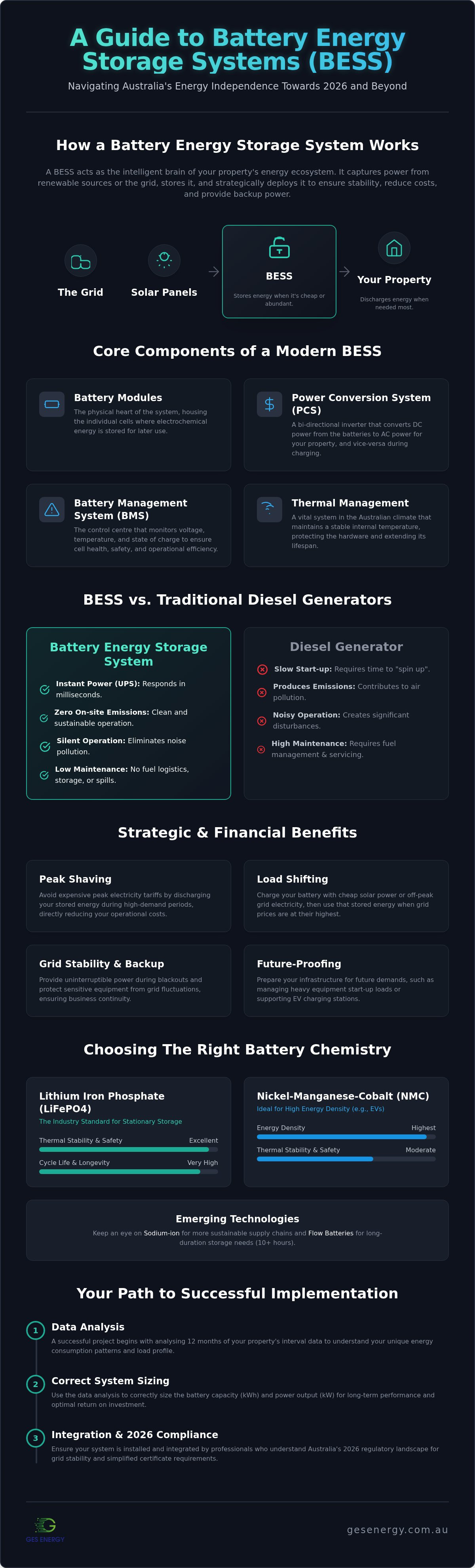
A battery energy storage system is an integrated solution for electrochemical energy storage that captures power from the grid or renewable sources and holds it for strategic deployment. While many people think of batteries as simple backup devices, modern units act as the intelligent brain of a property's energy ecosystem. These systems don't just sit idle; they actively monitor load requirements and market signals to decide when to store energy and when to release it. By 2026, the technology has matured into a sophisticated asset that allows Australian businesses and homeowners to take full control of their power consumption patterns.
To understand What is a Battery Energy Storage System in a physical sense, you have to look at its three primary pillars. The battery modules house the individual cells where the energy resides. A bi-directional inverter, often called a Power Conversion System (PCS), manages the transition between direct current (DC) and alternating current (AC). Finally, a thermal management system ensures the internal environment remains stable. This is particularly vital in the Australian climate, where high ambient temperatures can otherwise impact the performance and longevity of the hardware.
The Core Mechanism: How Energy is Stored
At its heart, a BESS relies on a chemical conversion process. During the charging cycle, electrical energy is converted into chemical energy within the battery cells. When the property requires power, this process reverses to discharge electricity back into the building. The Battery Management System (BMS) oversees this entire cycle. It monitors voltage, temperature, and state of charge to protect cell health and ensure the system operates within safe parameters. One of the most significant advantages of this electrochemical process is speed. A battery energy storage system can respond to grid fluctuations or power outages in milliseconds, providing a level of stability that mechanical systems struggle to replicate.
BESS vs. Traditional Generators
Choosing a battery system over a traditional diesel generator eliminates several operational burdens. You don't have to manage fuel logistics, onsite storage, or the risk of spills. From an environmental perspective, batteries produce zero emissions at the point of use, helping sites meet modern sustainability targets. The functional difference is also stark. While a generator requires time to "spin up" during a blackout, a BESS offers instantaneous uninterruptible power supply (UPS) capabilities. This ensures that sensitive equipment, such as servers or medical devices, continues to run without a second of downtime. In urban industrial centres, the silent operation of a battery is also a major benefit, removing the noise pollution issues associated with combustion engines.
The Components and Technology of Modern Storage
A modern battery energy storage system is far more than a collection of cells. It's a sophisticated assembly of hardware and software designed to manage electrical loads with surgical precision. To ensure long-term reliability on Australian sites, four primary components must work in perfect synchronisation. The battery modules provide the physical capacity, while the Power Conversion System (PCS) acts as a bi-directional gateway between DC and AC power. These are overseen by the Energy Management System (EMS), the software layer that executes complex logic to decide when to charge or discharge based on electricity prices and site demand. In our harsh climate, a dedicated thermal management system is also essential. It maintains the internal environment within a narrow temperature range, preventing the accelerated degradation that often occurs during extreme heatwaves.
Lithium-Ion and Alternative Chemistries
Lithium Iron Phosphate (LiFePO4) has become the industry standard for fixed storage applications across Australia. Its popularity stems from its superior thermal stability and longer cycle life compared to traditional nickel-manganese-cobalt (NMC) variants. While NMC offers higher energy density, which is useful for electric vehicles where space is limited, LiFePO4 provides the safety and longevity required for stationary infrastructure. We are also seeing the rise of emerging technologies like sodium-ion and flow batteries. Sodium-ion offers a more sustainable supply chain, while flow batteries are becoming a viable choice for long-duration storage needs, often exceeding ten hours of discharge. Choosing the right chemistry depends on your specific application; some sites prioritise compact footprints, while others focus on maximising the total number of discharge cycles over twenty years.
The Critical Role of the Smart Inverter
The PCS, or smart inverter, is the mechanical heart of the system. It manages grid synchronisation and provides essential frequency control to maintain the stability of the local network. For remote or off-grid sites, these inverters must possess black-start capabilities, allowing the system to restart the entire micro-grid independently after a total shutdown. Efficiency is significantly improved when these units are designed to work in tandem with a commercial solar installation, allowing for direct DC-coupled charging that minimises conversion losses. As we move into 2026, grid-forming inverters have become a standard requirement, enabling batteries to provide the same "inertia" that was once the exclusive domain of large coal-fired turbines. If you're looking to upgrade your current infrastructure, reviewing our specialised energy storage services can provide a clear view of which inverter technology suits your operational needs.
Applications: Commercial, Industrial, and Off-Grid
The versatility of a battery energy storage system allows it to serve as a modular solution across vastly different environments. While the underlying technology remains consistent, the strategic application changes depending on whether the system is installed in a suburban office block or a remote mining site. In 2026, we're seeing a shift where these systems are no longer just emergency backups. They've become active tools for managing high-cost energy periods and supporting new infrastructure like high-speed EV charging networks. For many Australian properties, the goal is to create a resilient micro-grid that can operate independently when the primary network fails.
Industrial Energy Security and Micro-Grids
Large-scale industrial facilities often deal with significant peak demand charges, where the cost of electricity is determined by the highest point of usage during a billing cycle. By deploying a battery energy storage system, these sites can use stored power to support heavy machinery during start-up, effectively lowering their peak profile. This process, known as peak shaving, provides immediate relief to operational budgets. We've seen systems scaled from modest commercial units up to 5 MW industrial plants, proving that storage is a viable solution for even the most energy-intensive operations. These micro-grid solutions allow businesses to decouple from the main grid during outages, ensuring 24/7 production remains unaffected by external instability.
Remote and Off-Grid Power Solutions
Remote operations in the Australian outback face unique challenges, particularly the high cost and logistical burden of diesel fuel. Integrating a solar and battery setup allows these sites to replace expensive generators with a clean, reliable alternative. Whether it's a remote cattle station or a specialised mining camp, the focus is on durability and performance in high temperatures. Designing these systems requires a deep understanding of local conditions and the use of SAA-accredited labour for commissioning to ensure every component meets rigorous Australian standards. This level of reliability is essential for maintaining infrastructure in areas where the nearest grid connection might be hundreds of kilometres away.
For retail and office spaces, storage is becoming the cornerstone of future-proofing. As more customers and employees transition to electric vehicles, the demand for onsite charging increases significantly. A BESS manages this additional load without requiring expensive grid upgrades, allowing properties to offer EV charging as a standard amenity. This level of energy independence isn't just for heavy industry; it's a practical step for any property owner looking to stabilise their energy costs over the next decade.
Strategic Benefits: Load Shifting and Grid Stability
The strategic value of a battery energy storage system lies in its ability to decouple energy generation from energy consumption. While previous sections focused on hardware and general applications, the true financial return stems from how the system interacts with the Australian energy market. By 2026, the National Electricity Market (NEM) has become increasingly volatile. This makes automated energy management a necessity rather than an option for most property owners. Through intelligent load shifting, properties store cheap solar power or off-peak grid energy for use during expensive evening peaks. By timing energy use to coincide with renewable generation and reducing reliance on fossil-fuel-heavy peak periods, load shifting directly lowers a property's operational carbon footprint.
Peak Shaving and Cost Reduction
Commercial energy bills often include high demand charges based on the single highest point of usage in a month. These demand peaks usually occur when heavy equipment starts up or when cooling systems work hardest during mid-afternoon heat. A battery energy storage system monitors these spikes in real-time. When the system detects that demand is about to exceed a set threshold, it shaves the peak by discharging stored energy to cover the excess. This prevents the business from triggering a higher tariff bracket for the entire billing cycle. This form of tariff arbitrage ensures that your network charges remain at the lowest possible level regardless of occasional high-load events. It provides a level of cost predictability that is impossible with a grid-only connection.
Grid Participation and Revenue Streams
Modern storage systems can also transform from a cost-saving tool into a revenue-generating asset. Through Virtual Power Plants (VPPs), individual batteries are pooled together to support the grid during periods of extreme stress. You can also participate in Frequency Control Ancillary Services (FCAS). This involves the battery providing tiny, rapid injections of power to help the Australian Energy Market Operator (AEMO) maintain a stable grid frequency. As traditional coal-fired power plants continue to retire across the country, these fast-acting services are becoming more valuable. By 2026, the integration of grid-forming inverters has allowed batteries to take on the heavy lifting of grid stability previously handled by spinning turbines. The grid requires this rapid response to prevent blackouts, and battery owners are compensated for providing this stability. If you want to explore how these revenue streams apply to your property, you can consult with our BESS specialists to evaluate your site's potential.
Implementation: Planning Your BESS Project
Successful implementation of a battery energy storage system relies on a methodical design process that accounts for the full lifecycle of the asset. It's not just about the physical installation; it's about ensuring the system performs as expected for the next fifteen years. The first step involves a comprehensive energy audit where you analyse at least 12 months of interval data. This granular data allows for precise modelling of your property's load profile, ensuring the battery is sized to handle your specific peak demand events across all seasons. Following the audit, a physical site assessment evaluates the practicalities of the installation, such as ventilation requirements for thermal management and the capacity of your existing grid connection.
Procurement requires a focus on tier-1 hardware that comes with robust Australian warranty support. Dealing with local representatives ensures that any technical issues or warranty claims are handled promptly without the delays associated with international logistics. This reliability is the cornerstone of a stable energy transition, providing property owners with the peace of mind that their investment is protected by local expertise and accessible service teams.
Sizing and Scalability for Growth
While it might seem counterintuitive, slightly oversizing your battery capacity can often lead to a faster return on investment. A larger system allows for a shallower depth of discharge, which significantly extends the total cycle life of the lithium cells. Modular designs are particularly effective for businesses that anticipate growth, as they allow you to add storage modules as your energy needs expand or as you integrate more onsite EV charging infrastructure. When planning a more complex off grid solar system, consulting with a specialist ensures that the battery bank is perfectly balanced with the solar array to maintain reliability during several consecutive days of poor weather. This careful balancing prevents the system from over-discharging and protects your long-term capital investment.
Maintenance and Long-Term Performance
A battery energy storage system is a long-term infrastructure asset that requires ongoing stewardship to maintain its health. You should expect some natural degradation over time, though most high-quality systems will still retain the vast majority of their original capacity after 3,000 discharge cycles. To manage this effectively, remote monitoring is a necessity. This allows technicians to perform firmware updates and monitor cell balancing in real-time without needing to visit the site for every minor adjustment. Regular physical inspections by SAA-accredited labour ensure that all electrical connections remain secure and that the thermal management system is functioning correctly. This proactive approach to maintenance is what separates a short-term fix from a reliable, decade-long energy solution that remains efficient well into the 2030s.
Securing Your Energy Future with Strategic Storage
Transitioning to a modern energy model requires more than just hardware; it demands a strategic approach to how you capture and deploy power. We've explored how a battery energy storage system acts as the intelligent core of your property, transforming volatile electricity costs into a manageable, predictable overhead. By mastering techniques like peak shaving and load shifting, you can finally decouple your operations from the rising tariffs and instability of the national grid. The key to long-term success lies in precise engineering and selecting tier-1 components that are built to withstand the unique demands of the Australian environment.
GES Energy provides the end-to-end expertise needed to navigate this complex transition. With national coverage for industrial installations and SAA-accredited engineering, our team manages the full EPC lifecycle for projects up to 5 MW. Whether you're looking to stabilise a remote off-grid site or future-proof a commercial hub, we ensure your system is designed for maximum longevity and performance. You can request a custom BESS design and feasibility study from GES Energy to see exactly how these technologies will benefit your specific load profile. Taking control of your energy independence is a practical step toward a more resilient and cost-effective future.
Frequently Asked Questions
How long does a battery energy storage system last in Australia?
A battery energy storage system typically lasts between 10 and 15 years in the Australian climate. This longevity depends heavily on the depth of discharge and the effectiveness of the thermal management system. High ambient temperatures can accelerate degradation, so robust climate control is essential to ensure the system reaches its full operational life.
What is the difference between a BESS and a standard solar battery?
While both store energy, a BESS is a comprehensive, integrated solution that includes sophisticated Energy Management Systems (EMS) and power conversion hardware. Standard solar batteries often focus purely on storage for residential use. A BESS is designed for complex tasks like peak shaving and grid participation in commercial or industrial settings.
Can a BESS help my business go completely off-grid?
Yes, a business can achieve total energy independence by combining a BESS with a correctly sized solar array. This setup creates a self-sustaining micro-grid. It's a common choice for remote agricultural or mining sites where grid connection is either unreliable or non-existent, ensuring 24/7 operational security.
How much space do I need for an industrial battery storage system?
Space requirements depend on the total capacity of your installation. Smaller commercial systems often fit into compact cabinets that take up less than two square metres. However, large-scale industrial systems up to 5 MW are typically housed in 20-foot or 40-foot shipping containers, requiring a dedicated concrete pad and clear access for maintenance.
Are there government rebates for BESS in 2026?
Several incentives are active as of August 2026. The Federal Cheaper Home Batteries Program offers a rebate of approximately $245 to $252 per kWh for the first 14kWh. State-specific schemes like the NSW Peak Demand Reduction Scheme and Western Australia’s Residential Battery Scheme also provide significant discounts or interest-free loans.
What happens to the BESS during a total grid blackout?
During a total grid blackout, a system equipped with grid-forming inverters will automatically "island" your property. This allows the battery energy storage system to provide near-instantaneous backup power to your critical loads. Unlike traditional backup methods, this transition is often so fast that sensitive electronic equipment continues to run without interruption.
Is lithium-ion the only technology used in a BESS?
Lithium-ion, specifically Lithium Iron Phosphate (LiFePO4), is the current industry standard due to its safety and cycle life. However, other technologies are gaining traction. Flow batteries are used for very long duration storage, and sodium-ion systems are emerging as a more sustainable alternative for certain stationary applications.
How quickly can a BESS respond to a power outage?
Response times are measured in milliseconds. A BESS can detect a drop in grid frequency or a total power failure almost instantly. This rapid response is why batteries are superior to diesel generators for protecting sensitive industrial machinery and maintaining the stability of the local network during fluctuations.


