

What if the most expensive line item on your monthly utility bill had nothing to do with the total energy you consumed, but rather the brief moments your operations hit maximum capacity? For many Australian enterprises, peak demand charges represent an unpredictable and significant portion of operational expenditure. Implementing commercial solar battery storage is no longer just an environmental initiative; it's a strategic financial tool designed to buffer your business against these volatile costs and the increasing risk of grid instability.
It's frustrating to watch your solar generation peak at midday while your facility pays a premium for power during the evening ramp-up or early morning starts. We understand the technical complexity involved in coordinating large-scale storage with existing arrays, especially with evolving national regulations and updated battery standards. This article provides a clear roadmap for integrating industrial-scale storage to secure 24/7 resilience and improved ESG ratings. We'll examine how the October 2026 expansion of the SRES to 1 MW systems changes the investment landscape and why moving toward energy independence is the most stable path for your long-term growth.
Key Takeaways
- Understand how a Battery Energy Storage System (BESS) transforms your facility from a passive consumer into an active manager of your energy ecosystem.
- Discover how to utilise commercial solar battery storage as a strategic financial tool to eliminate peak demand charges through effective peak shaving.
- Learn the importance of analysing 12 months of interval data to identify your load profile and avoid the common pitfall of over-sizing your system.
- Explore the five-step implementation roadmap, from initial feasibility and ROI modelling to the custom engineering of your site's electrical architecture.
- Recognise the value of an end-to-end EPC specialist in navigating complex grid standards and ensuring the long-term resilience of your industrial energy assets.
What is Commercial Solar Battery Storage and Why Does Your Business Need It?
A battery energy storage system (BESS) is a sophisticated infrastructure designed to capture energy for use during periods of high demand or low generation. For Australian enterprises, commercial solar battery storage has evolved from a simple backup solution into a primary asset for active energy management. As of 2026, the Australian energy landscape has shifted significantly. Businesses no longer just consume solar; they orchestrate it. This technology acts as a critical buffer between your facility and the volatile wholesale market, where prices spike unexpectedly during peak periods. It also serves as the foundation for achieving 100% renewable energy targets, providing the verifiable data required for modern ESG reporting.
The Core Components of a Commercial BESS
Industrial storage systems are comprised of three primary layers that must work in perfect synchronisation. Lithium iron phosphate (LFP) battery stacks have become the industry standard across Australia. They offer superior thermal stability and a longer cycle life compared to standard cobalt-based alternatives, ensuring your investment remains safe and productive for over a decade. The Power Conversion System (PCS) utilises bi-directional inverters to manage the flow between DC storage and the AC grid. Finally, the Energy Management System (EMS) acts as the brain. It monitors site loads in real-time to decide exactly when to charge from the sun or discharge to avoid high tariff periods. You don't want a system that just sits idle; you need one that actively responds to your facility's needs.
Why Traditional Solar Alone is No Longer Enough
Relying on solar panels without storage often leads to the 'Duck Curve' effect. This occurs when an abundance of solar generation during the day drives down the value of exports while demand peaks in the evening. In states like New South Wales, the benchmark range for feed-in tariffs is now 3.4 to 6.5 c/kWh, which provides a significantly lower return than self-consumption. Additionally, the implementation of the Emergency Backstop Mechanism in 2026 means the grid can remotely curtail solar exports during periods of low demand. Storage ensures your generation remains productive rather than being switched off by the network operator. This shift ensures that your capital investment in solar continues to deliver a strong ROI despite changing market regulations. It's about taking control of your energy destiny rather than remaining at the mercy of grid fluctuations.
How to Use Battery Storage to Slash Operational Energy Costs
To effectively reduce overheads, you must first distinguish between energy consumption and demand. While kilowatt-hours (kWh) represent the total volume of electricity used over time, demand (kW) measures the highest rate of usage during a specific interval. Most commercial retailers charge heavily for this peak capacity. Commercial solar battery storage allows you to manipulate these variables to your advantage, turning a static utility bill into a managed operational expense.
The Power of Peak Shaving for Industrial Facilities
In many Australian industrial sectors, demand charges can account for up to 50% of a monthly energy statement. These fees are based on the single highest point of power draw; this means one heavy machinery start-up can dictate your costs for the entire month. A BESS monitors your facility's load in real-time and automatically discharges power to prevent your grid draw from exceeding a specific, cost-effective limit.
Consider a manufacturing plant that frequently experiences high "kVA penalties" when large compressors or assembly lines initiate. Instead of drawing that massive surge from the grid, the battery provides an instantaneous burst of energy. This action shaves the peak off the demand curve, keeping the facility within a lower tariff bracket and providing immediate relief to the bottom line. It's a proactive way to manage infrastructure that otherwise feels outside of your control.
Arbitrage and Load Shifting Strategies
The Australian energy market frequently sees negative or near-zero wholesale pricing during the middle of the day due to high solar penetration. Load shifting involves capturing this low-cost energy, or your own excess solar generation, and holding it for later use. By storing energy at 12 PM and discharging it during the 6 PM peak window, you avoid the most expensive electricity rates of the day. This strategy effectively bypasses the high-cost periods that typically penalise businesses for operating during standard evening hours.
Sophisticated Energy Management Systems (EMS) now automate this process entirely. These platforms use weather forecasting and historical load data to decide the most profitable times to charge and discharge. This level of precision ensures you aren't just saving money, but maximising every possible cent of ROI. If you're looking to take control of these costs, exploring C&I energy storage systems is the first step toward long-term predictability. Beyond internal savings, these systems allow participation in Demand Response programmes. In these scenarios, grid operators pay you to reduce your draw during network stress events, creating a new revenue stream for your business.
Sizing Your System: How to Determine Your Business Capacity Needs
Sizing commercial solar battery storage requires a methodical approach that balances upfront capital expenditure against long-term operational savings. If you over-size the system, you waste capital on capacity that remains unused. Conversely, an under-sized system fails to capture enough energy to eliminate those expensive peak demand charges discussed earlier. The key lies in analysing 12 months of interval data. This data provides a granular, 30-minute view of your facility's energy consumption. It allows engineers to map your load profile and identify the precise moments your business draws the most power from the grid. Modular battery designs are essential here. They allow your storage capacity to grow alongside your business, ensuring you aren't locked into a static solution as your operations expand.
Conducting a Comprehensive Energy Audit
Critical loads are the heartbeat of your facility. During an audit, we identify which systems must remain operational during a grid outage to prevent costly downtime or stock loss. We also evaluate the performance of your existing commercial solar installation to ensure current inverters are compatible with a new BESS. Another vital metric is the C-rate. This indicates how quickly the battery can discharge its full capacity. For businesses with heavy industrial machinery that requires high start-up currents, a higher C-rate is often necessary to successfully shave those demand spikes without grid assistance.
Environmental and Safety Considerations
Australian standards for commercial solar battery storage are rigorous and must be followed strictly. Compliance with AS/NZS 5139 is mandatory for all installations to ensure the safety of your staff and property. Site-specific constraints, such as thermal management and physical footprint, dictate whether a containerised outdoor solution or an indoor cabinet is more appropriate. Fire suppression systems are a primary consideration, especially for large-scale lithium-ion arrays. Engaging SAA-accredited engineering during the design phase ensures that every component is integrated safely and meets all local regulatory requirements. This level of diligence protects your investment and ensures long-term reliability in harsh Australian conditions.
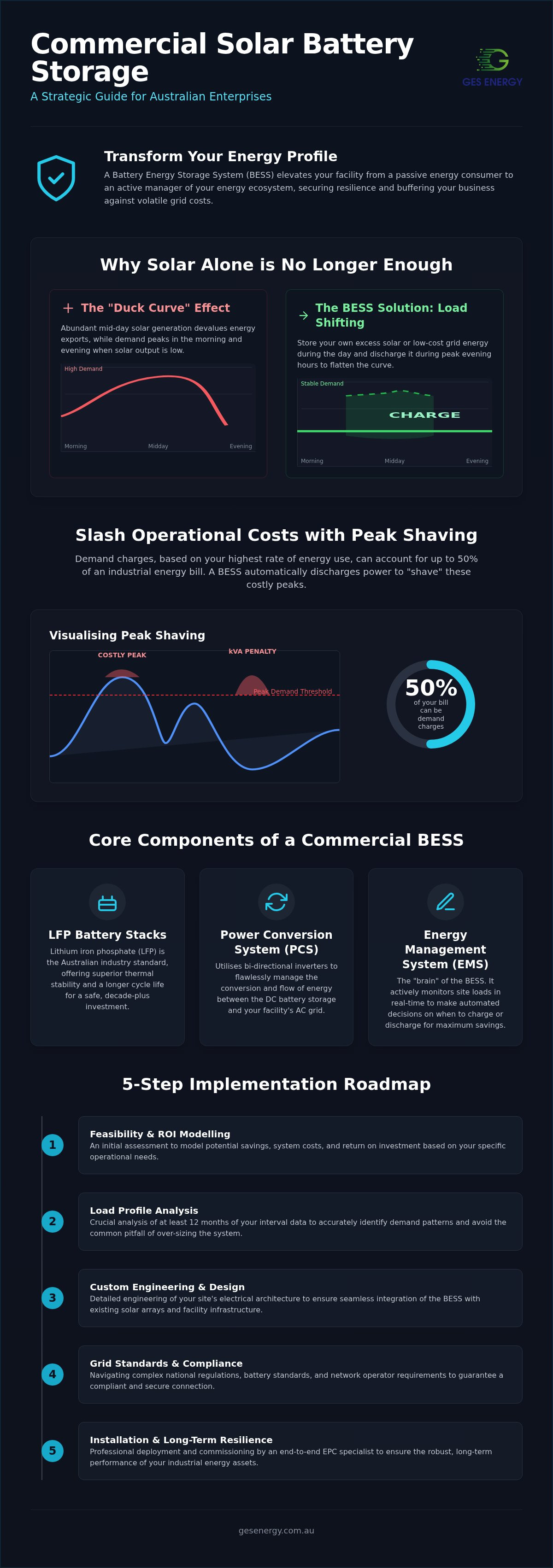
5 Steps to Implementing Commercial Solar Battery Storage
Transitioning to a high-capacity energy system requires more than just purchasing hardware; it involves a methodical engineering process to ensure long-term reliability. Implementing commercial solar battery storage is a journey from data analysis to physical integration. By following a structured roadmap, your business can avoid the common pitfalls of technical misalignment and regulatory delays. This process ensures that your investment provides the specific financial outcomes, such as peak demand reduction, that were identified during the initial planning phase.
- Step 1: Feasibility and ROI Modelling. We use advanced simulation software to analyse your interval data and predict pay-back periods with high accuracy. This stage confirms the financial viability of the project before any capital is committed.
- Step 2: Engineering and Design. Our team customises the electrical architecture for your site. This involves mapping how the battery interacts with your existing switchboards and solar arrays to ensure seamless energy flow.
- Step 3: Procurement and EPC. As an end-to-end provider, we manage the supply chain to secure Tier 1 components. This guarantees that every part of your system meets the highest industrial standards for durability.
- Step 4: Installation and Integration. Our SAA-accredited teams handle the physical build. We coordinate the switch-over meticulously to minimise operational downtime, often performing critical connections during scheduled low-activity windows.
- Step 5: Monitoring and Maintenance. Performance doesn't end at commissioning. Ongoing oversight ensures the system performs to its 10 to 15 year design life, protecting your ROI through proactive health checks.
Navigating Approvals and Grid Connection
The Distributed Network Service Provider (DNSP) application process is often the most complex hurdle in a storage project. We manage these applications on your behalf, ensuring all network protection settings comply with local utility requirements. This level of diligence prevents technical rejections and speeds up your connection timeline. The Commissioning Report serves as the final technical verification required for insurance and warranty activation.
Financing Your Energy Transition
Choosing the right financial structure is as important as the technology itself. While many businesses prefer outright ownership to maximise long-term savings, others opt for Power Purchase Agreements (PPAs) to avoid upfront capital costs. In 2026, the Instant Asset Write-Off remains a powerful incentive for eligible Australian businesses to reduce their tax liability. Additionally, for systems generating Large-scale Generation Certificates (LGCs), the ongoing value of these certificates can significantly improve the project's bottom line. If you're ready to begin this transition, exploring our C&I energy storage systems will help you identify the best path forward for your facility's specific needs.
Why GES Energy is the Preferred Partner for Australian C&I Storage
GES Energy operates as a comprehensive specialist in the Australian energy sector. We provide an end-to-end Engineering, Procurement, and Construction (EPC) service for projects up to 5 MW, meaning we handle every phase of your commercial solar battery storage project. This holistic approach removes the friction of managing multiple contractors and ensures that the initial design intent is perfectly preserved through to the physical installation. By acting as a single point of accountability, we provide the stability and reliability required for high-stakes industrial transitions.
Our expertise extends beyond standard rooftop arrays. We specialise in complex micro-grid and off-grid solutions, which are critical for remote operations where grid stability is often compromised. To ensure these assets deliver value for their full 10 to 15 year lifespan, we provide structured maintenance and repair services. These services aren't just an optional extra; they're a necessity for protecting your long-term ROI and ensuring peak performance in harsh environments. We also integrate future-ready infrastructure, such as EV charging stations, to ensure your facility is prepared for the transport shift already underway. This proactive planning prevents the need for expensive retrofitting as your fleet requirements evolve.
Reliability Through Australian-Led Engineering
System reliability is non-negotiable in a commercial setting. We utilise SAA-accredited labour for all installations, ensuring that every connection meets the highest safety standards and regulatory requirements. Unlike competitors who might offer "off-the-shelf" bundles, our focus is on custom engineering tailored to your specific load profile. This precision ensures that your system handles the unique demands of your machinery without failure. For multisite operations, our status as a national service partner provides a consistent standard of engineering and maintenance across your entire portfolio, giving you a single, reliable point of contact.
Take Control of Your Energy Future
The transition to energy independence begins with accurate data and expert oversight. Our team supports you through the full lifecycle of your energy assets, from the first feasibility study to ongoing performance optimisation. We invite you to request a custom energy audit to see the tangible savings potential for your specific operations. This step provides the clarity needed to move from unpredictable utility costs to a model of financial predictability and operational resilience. Contact GES Energy today for a commercial storage consultation to begin securing your business's energy future.
Future-Proofing Your Business Energy Strategy
Implementing commercial solar battery storage is a strategic move that shifts your facility from a victim of grid volatility to a master of its own energy destiny. By utilising data-driven sizing and expert engineering, you can effectively eliminate peak demand charges and secure operational resilience. We've explored how a methodical implementation process ensures your system meets rigorous Australian safety standards while delivering a tangible ROI.
GES Energy acts as your diligent steward throughout this transition. Our SAA-accredited engineering team and EPC specialists manage projects up to 5 MW, ensuring every detail is handled with professional precision. With comprehensive national maintenance support, we remain committed to the long-term health and performance of your energy assets. Secure your energy independence with a GES Energy commercial storage solution. Taking control of your energy future today ensures your business remains competitive and sustainable for years to come.
Frequently Asked Questions
How long do commercial solar batteries typically last in the Australian climate?
Commercial solar batteries typically have a design life of 10 to 15 years when properly maintained. Most modern lithium iron phosphate (LFP) systems are rated for 6,000 to 10,000 cycles at a specific depth of discharge. In the Australian climate, active thermal management is essential to prevent degradation from extreme heat. Our systems include integrated cooling to maintain optimal operating temperatures, ensuring your storage asset reaches its full performance potential over its decade-long lifespan.
Can we add battery storage to our existing commercial solar system?
Yes, you can integrate storage into an existing array through a process called AC coupling. This involves installing a separate battery inverter that works alongside your current solar infrastructure. It is a common solution for businesses looking to retrofit commercial solar battery storage without replacing their functional solar panels. Our engineering team evaluates your existing switchboard capacity and inverter compatibility to ensure a seamless technical integration that doesn't disrupt your current generation.
What is the typical ROI period for an industrial battery storage solution?
ROI periods generally range between five and eight years, depending on your specific tariff structure and peak demand charges. The primary financial driver is the reduction in high-cost kilowatt (kW) demand fees rather than just energy arbitrage. By using stored power to cap your grid draw during peak periods, the savings on monthly utility bills can be substantial. A detailed feasibility study using your interval data provides the most accurate prediction of your payback timeline.
Is there a federal rebate for commercial solar battery storage in 2026?
As of October 2026, the Small-scale Renewable Energy Scheme (SRES) has been expanded to include solar systems up to 1 MW. This policy change significantly reduces the upfront cost of commercial solar and integrated storage. Small businesses may also access the "Cheaper Home Batteries Program," which offers tiered discounts based on battery size. For larger industrial applications, Large-scale Generation Certificates (LGCs) continue to provide ongoing financial incentives based on the renewable energy your system generates.
What happens to our business operations during the battery installation process?
We coordinate the installation process to ensure minimal disruption to your daily operations. Most of the physical build occurs while your facility is live, with only the final integration requiring a brief, scheduled power outage. We typically perform these critical switch-overs during low-activity windows or after hours to protect your productivity. Our SAA-accredited team manages the entire sequence, ensuring all safety protocols are followed while your business remains operational throughout the project.
How much space is required for a 100kW/200kWh battery system?
A 100kW/200kWh system typically requires a footprint similar to a series of industrial cabinets or a small containerised unit. The exact space depends on whether you choose an indoor rack-mounted solution or a weatherproof outdoor enclosure. Beyond the batteries themselves, we must account for clearance zones required by AS/NZS 5139 standards for safety and ventilation. Our design phase includes a precise site layout plan to ensure the system fits efficiently within your available area.
Do commercial batteries provide full backup power during a grid blackout?
Full backup depends entirely on how the system is engineered and the scale of your critical loads. While a BESS can power an entire facility, many businesses choose to back up only essential systems, such as refrigeration, servers, or security. This approach extends the battery runtime during prolonged outages. During the design phase, we identify your most vital operations to ensure the system provides reliable energy independence and peace of mind when the grid fails.
What maintenance is required for a large-scale battery energy storage system?
Maintenance is relatively low but essential for protecting your long-term investment. It involves regular firmware updates, visual inspections of electrical connections, and checking the HVAC systems that manage battery temperature. We also perform remote monitoring to identify any performance anomalies before they lead to system downtime. Structured maintenance ensures commercial solar battery storage operates at peak efficiency and remains compliant with manufacturer warranty conditions throughout its entire service life.


