

A battery’s value to the grid depends on how well its response matches the service required, not just on how much energy it stores. For project owners, using battery storage for grid stability services can mean supporting frequency control or addressing local network needs. The same battery may also manage solar generation, reduce electricity costs or provide backup, but those uses compete for its available power and energy.
Before investing, ask which services the battery could provide, whether the project can meet technical and connection requirements, and how potential grid-service income compares with on-site savings. In Australia’s National Electricity Market, the Australian Energy Market Operator operates ten Frequency Control Ancillary Services markets to help manage frequency. Participation and returns depend on project capability and market conditions, so revenue should not be treated as guaranteed.
This article explains the main grid stability services batteries may support, how they differ from behind-the-meter applications and what to assess before committing to a project. It also considers Victoria’s network context. GES Energy’s EPC services for solar, batteries and microgrids can bring site load, generation, storage capacity and operating priorities into the project design.
Key Takeaways
- Understand how batteries can support frequency control and local network needs, and why each service has different technical requirements.
- Compare potential grid services with peak shaving, solar self-consumption and backup before setting battery operating priorities.
- Assess how using battery storage for grid stability services could fit your project, while accounting for market, connection and revenue uncertainty.
- Use site load, generation, storage and location to guide battery design, particularly when considering network needs in Victoria.
- GES Energy’s EPC services integrate solar, battery and electrical infrastructure for utility-scale projects up to 5 MW.
What battery storage can do for grid stability in Australia
Electricity supply and demand must remain balanced as generation and customer use change. In the National Electricity Market (NEM), batteries can charge or discharge in response to system needs. However, using battery storage for grid stability services depends on more than having stored energy available: the inverter, controls, connection and operating settings must all suit the intended service.
Grid stability services are actions that help keep the electricity system operating within acceptable conditions. They include managing changes in frequency and supporting local network needs. The same battery may also manage a site’s electricity use or provide backup, but these behind-the-meter outcomes are distinct from services delivered to the grid. A useful first step is to identify the specific system or network need the project is intended to address.
For a general overview of battery functions and grid applications, see What battery storage can do for grid stability.
This video introduces battery energy storage systems and their operation:
What does grid stability mean in the National Electricity Market?
Frequency describes how quickly alternating current changes direction. The NEM operates at 50 hertz. Frequency shifts when electricity supply and demand are out of balance. Voltage is the electrical pressure that moves power through the network, and keeping it within suitable operating limits helps electrical equipment function as intended.
The NEM is the connected wholesale electricity market across eastern and south-eastern Australia, including Victoria. System-wide needs, such as keeping frequency within operating limits, differ from local network needs. A service that helps one part of a distribution network may not address a broader system requirement, so define the intended outcome before selecting equipment or controls.
How does a battery respond to changing grid conditions?
A battery stores electricity when charging and sends electricity out when discharging. Its control system responds to operating instructions or signals and directs the inverter to adjust power flow. Batteries can respond quickly, but their actual response and duration depend on the system design, available energy and operating settings.
Available capacity and state of charge matter. A battery needs room to charge or stored energy to discharge, while the inverter and controls must support the required response. Site priorities can also limit what is available for grid support. For example, reserving energy for critical operations or backup reduces the capacity that can be committed elsewhere at that time.
Technical capability alone does not guarantee market access, dispatch or revenue. Participation depends on applicable requirements and project arrangements, while outcomes can vary with operating conditions. Good project planning separates potential grid support from site savings and backup, then designs around the priorities that matter most.
Which grid stability services can battery storage support in the NEM?
In the NEM, battery grid support includes Frequency Control Ancillary Services (FCAS) and services that address local network needs. These serve different purposes: FCAS helps manage system-wide frequency, while voltage support and congestion relief respond to conditions in a specific part of the electricity network.
How can batteries contribute to frequency control?
AEMO operates ten FCAS markets for raising or lowering frequency. These cover regulation, which involves ongoing adjustments, and contingency response following a major event. A battery can charge or discharge under control-system direction to help respond to a frequency deviation.
Suitability depends on response capability, available energy, telemetry, control arrangements and eligibility under the relevant participation pathway. AEMO’s Market Ancillary Services Specification sets out technical performance and verification requirements. Market participation and payment arrangements depend on the applicable rules and project setup, so assess these alongside the battery’s intended site uses.
When can batteries support voltage or local network needs?
Voltage support is location-dependent. An inverter configured for suitable functions may adjust reactive power to support voltage at a connection point, subject to the network’s needs and technical settings. This differs from FCAS, which addresses frequency across the wider power system.
Network-requested support may also target a local constraint. A battery could help ease congestion or defer an upgrade only if its location, operating profile and response align with the network need and the relevant assessment supports that outcome. AusNet is one Victorian network context, but requirements and constraints vary across distribution areas. Assess the actual connection location rather than assuming conditions are the same across Victoria.
| Service | Battery action | Key constraint | Relevant verification |
|---|---|---|---|
| FCAS | Charges or discharges to support frequency response | Response capability and energy availability | AEMO requirements, control and telemetry arrangements, and eligibility |
| Voltage support | Inverter adjusts output where configured to do so | Location, network conditions and inverter functions | Connection-specific technical assessment |
| Local congestion relief | Changes power flow to address a defined constraint | Timing and location must match the network need | Network assessment and any applicable support arrangement |
In short, FCAS supports system-wide frequency, while voltage support and congestion relief address local network conditions. Using battery storage for grid stability services therefore starts with matching the asset’s capabilities and location to a defined need, rather than assuming every battery can provide every service.
For project planning that brings site requirements, solar and storage design together, explore battery and solar project design.
Grid services or site savings: how to compare battery uses
A battery can serve several purposes, but its operating priorities can conflict. Charging to absorb solar generation, holding capacity for backup and responding to a grid signal all draw on the same system. Compare each use against your site’s needs before estimating the value of using battery storage for grid stability services.
What should a business compare before choosing a battery use case?
Start with interval load data, solar generation, peak demand and critical loads. This information shows when the site uses electricity, when surplus solar is available and how much storage may need to remain reserved for essential operations. Then assess possible external service participation alongside direct site benefits.
Include battery availability, expected cycling, degradation assumptions and control priorities in the assessment. A battery dispatched frequently for one purpose may have less capacity available for another. A coordinated control strategy can assign priorities, but it must reflect operational requirements, system settings and the battery’s usable capacity.
| Battery use | Value source | Operating constraint | Control needs | Uncertainty |
|---|---|---|---|---|
| Grid services | Potential income from external service participation | Available energy and response capability | Controls and any required participation arrangements | Market conditions, eligibility and dispatch outcomes |
| Peak shaving | Lower site demand during selected peak periods | Load peaks must align with stored energy | Site demand monitoring and discharge scheduling | Future load and tariff conditions |
| Solar self-consumption | More on-site solar used rather than exported | Solar surplus and later site demand must align | Charging and discharging matched to generation and use | Weather and changes in site consumption |
| Backup | Continuity for selected critical loads during an outage | Energy must be held in reserve | Backup settings and prioritised loads | Outage duration and energy demand |
How should decision-makers treat grid-service revenue?
Keep contracted revenue, market-based revenue and estimated revenue separate in financial modelling. They are not equivalent: each may depend on different agreements, eligibility, operating conditions and market outcomes. Do not treat a forecast as guaranteed income or assume a battery will always be dispatched when expected.
Test more than one scenario. Vary assumptions about battery availability, cycling, site demand and external service participation, then compare the results with the site’s operational priorities. This makes uncertainty visible and helps decision-makers judge whether the project still makes sense if potential grid revenue changes.
For broader commercial system considerations, read the industrial battery storage guide.
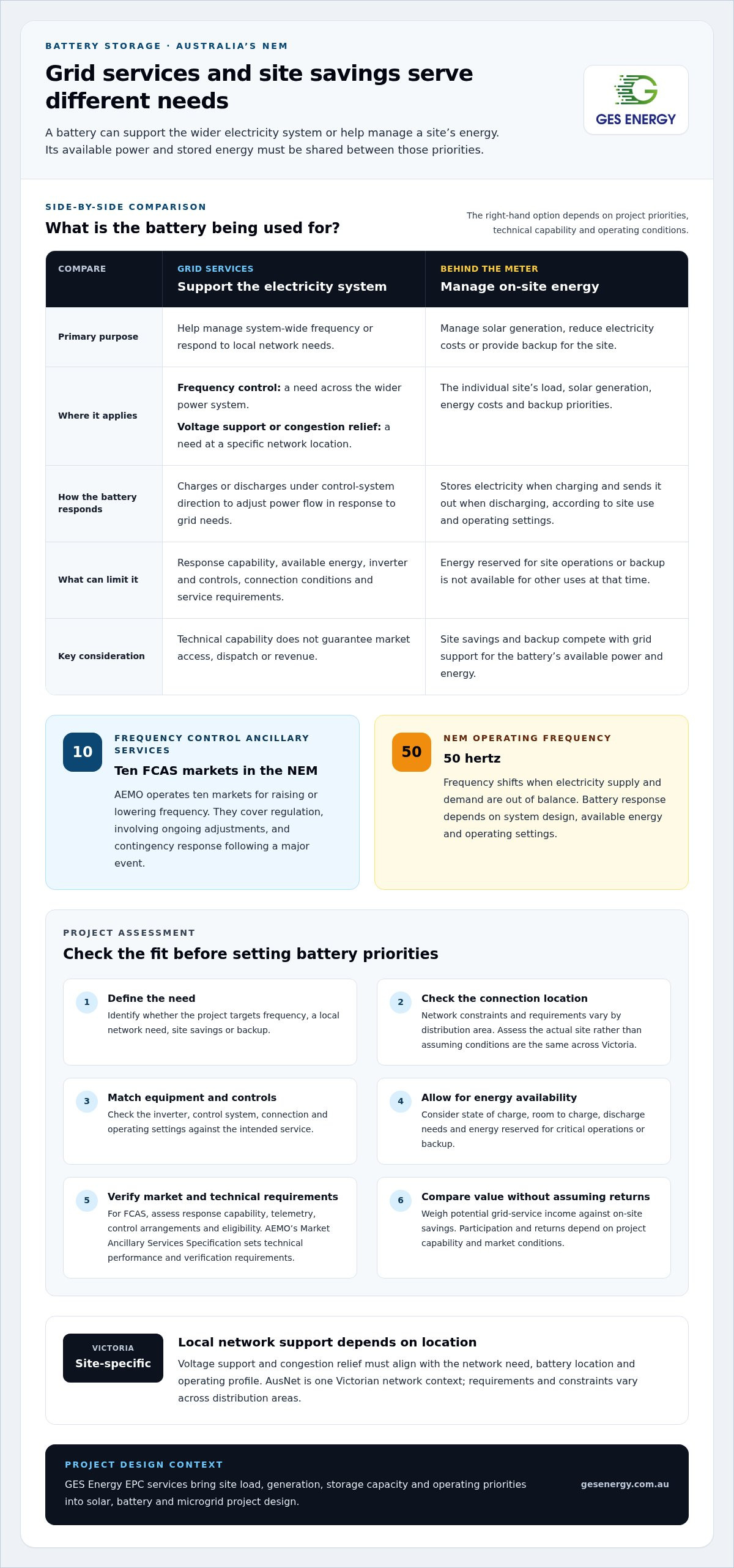
Designing a battery project for grid support in Victoria
A battery project needs to fit both the site and the electricity network. A practical design sequence starts with understanding the site, then develops the battery and control design, assesses connection and participation requirements, and plans commissioning. This helps align grid support with business operations and equipment performance.
Location matters, particularly if the project aims to address a local network need. Constraints differ across Victoria, so a network support case depends on where the battery connects and what that area requires. AusNet is one Victorian network context, but it does not represent every site. Identify the applicable distribution network and its connection conditions before assessing a project.
What technical and site information informs the design?
Begin with interval load data, existing solar or other generation, connection details and operational requirements. Map peak demand and critical loads against generation and storage needs. This gives project engineers a clearer basis for sizing usable battery capacity and matching response capability to the intended service without compromising the site’s priorities.
Assess the solar, battery, inverter and control systems as one integrated design. Communications, protection, monitoring and control settings need to support the intended operation. For example, a site that needs to retain energy for critical loads may have less capacity available for external dispatch at certain times. Using battery storage for grid stability services requires these competing priorities to be addressed in the system design.
What approvals and operating arrangements need assessment?
Review the connection process and technical requirements for the project’s specific network, along with any relevant market participation requirements. These arrangements can change, so assess current requirements during project development rather than relying on assumptions from another site or an earlier project. Connection assessment and market eligibility are separate considerations.
Set out how dispatch will be controlled, who monitors performance and how operating conflicts will be resolved. A clear operating plan can define how the battery responds to site demand, grid-service instructions and reserve requirements. Include maintenance, performance monitoring and fault response in lifecycle planning so the system can be managed beyond commissioning.
- Assess: site load, generation, connection conditions and operating priorities.
- Design: battery capacity, inverter capability, controls, communications and protection.
- Review: current network and market requirements, then plan commissioning and ongoing monitoring.
For broader planning considerations, read the microgrid resilience planning article. GES Energy’s EPC services integrate solar, battery and electrical infrastructure, with utility-scale project delivery up to 5 MW. Plan your battery and solar project around your site’s load, generation and operating requirements.
How GES ENERGY can plan battery storage for grid stability services
Using battery storage for grid stability services takes more than selecting a battery. The project needs to integrate storage with site operations, solar generation, electrical infrastructure and the grid connection. GES Energy provides EPC services for solar and battery projects, coordinating engineering, procurement and construction planning around each site’s requirements. GES Energy delivers utility-scale projects up to 5 MW.
What does an EPC approach contribute to a storage project?
An EPC approach brings the main project elements into a coordinated plan. Engineering considers site load, existing or proposed solar, battery capacity, inverter capability and the grid interface. Procurement and construction planning then follow the designed system, aligning equipment and installation with its intended operating requirements.
This joined-up design process helps businesses assess how storage should work alongside day-to-day operations. For example, a site may need to balance solar use, demand management and reserve capacity while planning for possible grid support. The design can account for those priorities, but it cannot guarantee eligibility for a grid service, dispatch or revenue.
If solar forms part of the project, the commercial solar guide provides further context for Australian businesses.
What should a project assessment establish before investment?
A project assessment should define the intended services and the site outcomes that matter most. It should also identify operating constraints, control priorities and the technical work needed to assess system integration. For businesses considering external service participation, connection discussions and participation arrangements need separate assessment against current requirements.
Clear responsibilities matter, too. The project plan should establish how control and monitoring fit with site operations, and how maintenance and performance assessment will support the system over time. This gives decision-makers a practical basis for comparing project design options without treating potential grid-service income as certain.
GES Energy’s engineering experience spans commercial solar systems from 10 kW to 5 MW, with EPC planning for solar, battery and electrical infrastructure. To discuss a project pathway shaped around your site and operating priorities, talk with GES ENERGY about battery project design.
Plan your battery project around the value it needs to deliver
Battery storage can support frequency control and local network needs, but each service has different technical and operating requirements. The right design starts with your site’s load, solar generation, connection and operational priorities. Compare potential grid-service participation with direct benefits such as peak management, solar self-consumption and backup, and treat external revenue as uncertain rather than guaranteed.
For Victorian projects, location matters. Network conditions and connection requirements vary, so assess the specific site before settling on a system design or operating strategy. Coordinated engineering, procurement and construction planning can help align the battery, inverter, controls and electrical infrastructure with your project objectives.
GES Energy delivers utility-scale projects up to 5 MW, with more than 10 years in renewable energy and over 2,500 successful installations. Its in-house teams hold certifications to ISO 9001, ISO 14001 and ISO 45001. For a commercial battery and EPC project designed around your site’s needs, talk with GES ENERGY about your project.
Frequently Asked Questions
How can battery storage help stabilise the electricity grid?
Battery storage can help stabilise the grid by charging or discharging in response to changing electricity conditions. Controlled by an inverter and battery management system, it can adjust power flow to support frequency control or, where configured and needed, local network conditions. The type of support depends on the battery’s design, controls, available energy and connection. These grid functions are separate from a battery’s on-site uses, such as bill management or backup.
What grid stability services can batteries provide in Australia?
In Australia’s National Electricity Market, batteries may provide Frequency Control Ancillary Services (FCAS) to help manage frequency through raising or lowering power. AEMO’s FCAS markets include regulation for ongoing adjustments and contingency responses to major events. Batteries may also support local network needs, such as voltage support, when their location and inverter functions suit the requirement. These services have different purposes, technical conditions and participation arrangements, so assess each one for the specific project.
Can a commercial battery earn revenue from grid services?
A commercial battery may earn revenue through grid-service participation, but income is not guaranteed. Using battery storage for grid stability services depends on factors such as technical capability, eligibility, operating arrangements, dispatch and market conditions. Separate contracted amounts from market-based income and forecast estimates in your project assessment. Test several scenarios rather than relying on one revenue forecast, and compare possible income with the battery’s site benefits, operating constraints and costs.
How is grid support different from peak shaving?
Grid support responds to electricity-system or network needs, while peak shaving targets a site’s own demand peaks. For example, a business may discharge its battery during a high-demand period to reduce its site’s peak draw. A grid service instead requires a response that meets an external system or network need. These uses can compete for available battery capacity, so controls and dispatch priorities should account for site load, stored energy and operating requirements.
What size battery is needed for grid stability services?
There is no single battery size that suits every grid service or site. Design depends on the required power response, usable energy, duration, inverter capability, connection conditions and the business’s own load and reserve needs. A project assessment should use interval load data and the intended operating priorities to determine suitable capacity. Battery size alone does not establish service capability or eligibility; controls, technical configuration and applicable participation requirements also matter.
Do Victorian businesses need network approval for a grid-connected battery?
A grid-connected battery needs a connection assessment for the specific site, and the applicable process and technical requirements depend on its distribution network and project configuration. GES Energy’s Victorian focus includes projects in Melbourne, Geelong, Ballarat, Bendigo, Shepparton, Shepperton, Melton, Mildura, Wodonga, Traralgon, Wangaratta, Horsham, Sale, Colac, Echuca, Ararat, Portland, Swan Hill, Benalla and Maryborough. Identify the network serving the project location. AusNet is one Victorian network context, not a guide to every connection.
Can a battery provide grid services and backup power at the same time?
A battery can be designed with both grid support and backup in mind, but its available energy cannot always serve both purposes at once. Backup settings may reserve capacity for critical loads, leaving less energy available for external dispatch. The design and control strategy should set clear priorities for site operations, reserve levels and any grid-service response. This approach clarifies the trade-offs without assuming simultaneous availability or guaranteed grid-service performance.


