

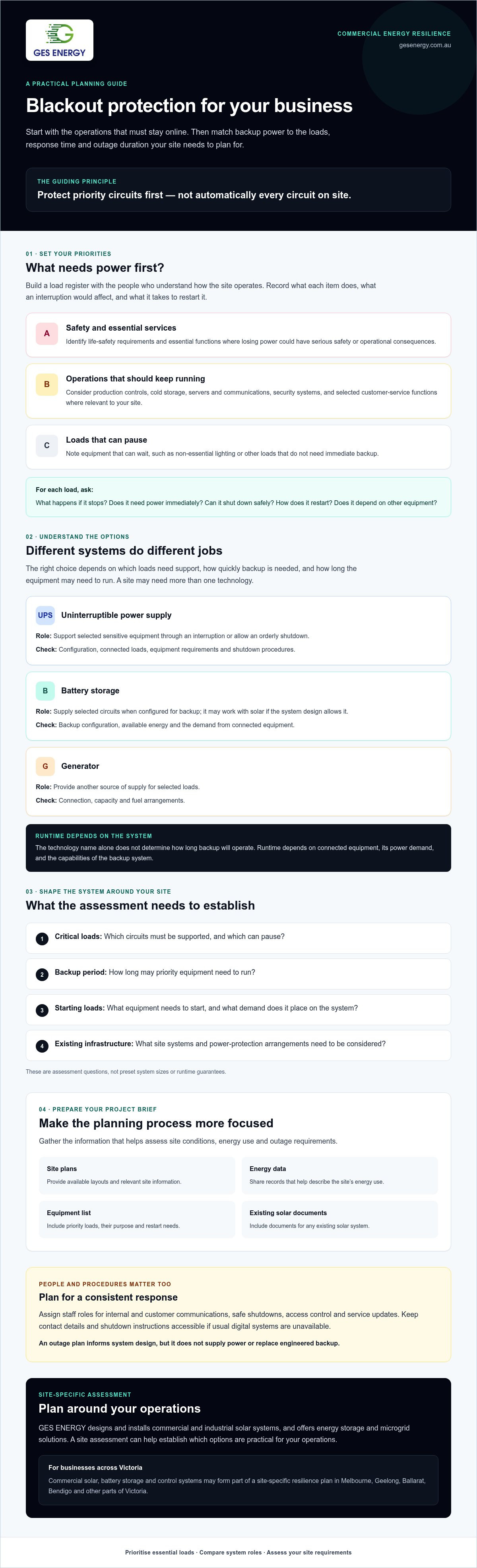
What does effective blackout protection for my business actually need to cover? It may not need to power every circuit. Start by identifying the operations that must stay online to protect people, equipment and essential services, then design around those priorities.
Choosing between batteries, a UPS, a generator, solar or a microgrid can feel complicated because each option serves a different purpose. The right fit depends on your critical loads, how quickly they need backup power and how long they may need to run.
This guide explains how to prioritise equipment, compare backup options and plan a system around your site’s energy use and outage requirements. It also covers practical considerations for system design, installation, safety and maintenance. For businesses in Melbourne, Geelong, Ballarat, Bendigo and other parts of Victoria, commercial solar, battery storage and control systems may form part of a site-specific resilience plan. GES ENERGY designs and installs commercial and industrial solar systems, and offers energy storage and microgrid solutions. A site assessment can help establish which options are practical for your operations.
Key Takeaways
- Map how an interruption could affect production, refrigeration, communications, security and customer service before choosing blackout protection for my business.
- Compare batteries, UPS systems and generators by the loads they support and the role each can play, from bridging interruptions to supporting longer outages.
- Assess critical loads, the required backup period, equipment starting loads and existing site infrastructure to narrow down suitable system configurations.
- Gather site plans, energy data, equipment lists and documents for existing solar systems to make a project assessment more focused.
- Use a site-specific solar system design assessment to consider feasibility, site conditions and engineering requirements for commercial solar, storage or microgrid projects.
Blackout protection for your business starts with identifying critical operations
A brief interruption may reset controls or disrupt a transaction. A longer outage could halt production, put refrigerated stock at risk or affect communications, security and customer service. Before choosing blackout protection for my business, identify which functions must keep running, which can pause and what the consequences would be if each lost power.
Build a load register with the managers who know how the site operates. For each item, record its purpose, the impact of an interruption, whether it needs power immediately and what is involved in restarting it. This turns general concerns about downtime into a useful brief for comparing backup options.
This video offers another perspective on preparing for outages:
Which business operations need power first?
Critical loads are the equipment and systems a business prioritises during an outage because losing them could have serious safety or operational consequences. Separate life-safety and essential operational loads from equipment that can pause. Depending on the site, priorities might include servers and communications equipment, cold storage, production controls, security systems or selected customer-service functions.
Rank each load by safety impact, operational necessity and the consequences of interruption. Note whether it can shut down safely, how it restarts and whether it depends on other equipment. A production control system may be needed to prevent disruption, while non-essential lighting or equipment could wait. Confirm the final list with the people responsible for site operations and technical systems.
Build a practical outage plan for a Victorian business
Assign staff roles for internal and customer communications, safe shutdowns, access control and service updates. Keep contact details and shutdown instructions accessible if usual digital systems are unavailable. If AusNet Services distributes electricity to your site, consult its outage preparedness advice and check which guidance applies to your distribution area.
An outage plan helps staff respond consistently, but it does not supply power or replace engineered backup. Use the plan and load register to inform the system design, including which circuits need support and how equipment will be shut down or restarted. A Uninterruptible power supply (UPS) can support selected equipment, depending on its configuration and connected loads. Prioritise the functions that matter most instead of assuming the whole site needs to stay powered.
How batteries, UPS systems and generators protect business power
These technologies do different jobs, and a site may need more than one. A UPS can respond to an interruption by supporting sensitive equipment or allowing an orderly shutdown. Battery storage can supply selected circuits when configured for backup, and may work with solar if the system design allows it. A generator can provide another source of supply, subject to its connection, capacity and fuel arrangements.
A UPS can bridge an interruption or support a safe shutdown; batteries and generators can supply selected loads for longer, depending on system design, available energy or fuel, and demand. The name of a technology alone does not determine how long it will operate. Runtime depends on the connected equipment, its power demand and the capabilities of the backup system.
When does a business need a UPS?
A UPS may suit equipment that cannot tolerate an interruption, such as sensitive IT or control equipment, or equipment that needs time for a safe shutdown. Performance depends on the configuration and connected load. Check equipment requirements, existing power-protection arrangements and shutdown procedures with a suitably qualified specialist. A UPS may complement battery storage or generation rather than replace backup for other site circuits.
What can solar and battery storage do during a blackout?
Ordinary grid-connected solar does not automatically keep a site powered when the grid fails. Backup depends on compatible equipment and system design, including which circuits are protected and how the system switches to supply them. Ask the designer to confirm inverter compatibility, backup capability and the loads supported. For further background, consult the industrial battery storage guide alongside your site-specific assessment.
Think of the options as parts of a coordinated arrangement, not competing products. A UPS may protect a control system while a battery supports selected site circuits; a generator may be considered for other supply needs. Whether these components can work together depends on the equipment and electrical design, so have the proposed configuration checked before relying on it. Your priority load list is a practical starting point for blackout protection for my business.
GES Energy designs commercial and industrial solar systems and offers energy storage and microgrid solutions. If you are assessing a site in Melbourne or elsewhere in Victoria, explore commercial energy storage options as part of planning a suitable backup arrangement.
Compare blackout protection options against your site requirements
The right system depends on what must stay powered, for how long and how your site is set up. Battery capacity alone does not determine whether a system is suitable. The inverter, backup configuration, protected circuits and loads operating at the same time all affect what it can support.
Compare approaches against your critical load list, required backup period, equipment starting loads and existing infrastructure:
- Battery-only: May supply selected loads if designed for backup. Check usable energy, power output and how the system handles equipment that draws more power when starting.
- Solar-plus-battery: May combine stored energy with solar generation during an outage if the equipment and controls support it. Ask how the design accounts for changes in solar availability.
- UPS-supported: Can protect sensitive equipment or support an orderly shutdown, while another source supplies wider site loads if needed.
- Hybrid: May coordinate storage, solar, a UPS and a generator interface. The design needs to specify how sources and loads interact rather than assume they will work together automatically.
Each approach has operating and maintenance requirements. For a generator, discuss fuel arrangements, maintenance and safe connection with the project specialists. For batteries and UPS equipment, ask about inspection, testing, monitoring and replacement planning. These requirements matter alongside the initial design.
What should a business ask before selecting a backup system?
Ask which circuits receive backup power, how the system prioritises loads and what happens when it changes operating modes. Request documented design assumptions for expected load, backup period, solar contribution and any generator interface. Confirm how the system will be monitored, tested and maintained, and whether the design can accommodate future capacity changes.
For a Victorian site, ask the designer to consider the local electricity network and your site-specific outage plan. Your distribution area and existing electrical infrastructure can inform the assessment, but they do not determine a solution on their own.
When might a microgrid or integrated system make sense?
A microgrid may suit a complex site with several energy sources, storage, controllable loads and clear operating priorities. It is not a default requirement for every business. The design should explain how components coordinate, which loads take priority and what operating arrangements apply during an outage. For more context, read the published microgrid resilience planning article alongside a site assessment.
When assessing blackout protection for my business, compare the full design against actual loads and operating needs, not a single battery-capacity figure. This gives you a clearer basis for weighing reliability, maintenance and future site requirements.
Plan a business blackout protection project in clear steps
A clear project sequence turns operating priorities into a system brief that can be assessed, designed and tested. For blackout protection for my business, work through these stages with the people responsible for site operations and qualified energy professionals:
- Review outage risks. Consider how an interruption could affect people, equipment, stock and essential services at your site.
- Audit loads and circuits. Confirm which equipment needs backup, its electrical demand and any starting loads. Identify circuits that can be excluded or shut down safely.
- Assess the site and design options. Review existing electrical infrastructure, solar equipment and the backup period you need. Have qualified professionals confirm the electrical design, connection requirements and safety considerations.
- Install and test. Confirm the proposed equipment and installation scope, then require documented testing of the agreed backup functions and operating modes.
- Maintain and review. Set out monitoring, inspection and maintenance responsibilities. Reassess the design when equipment or site operations change.
What information should you prepare for a site assessment?
Gather site plans, operating hours, a list of critical equipment, priority circuits and notes on known outage impacts. Available interval energy data and electricity bills can help the project team understand how the site uses energy. Include switchboard details and documents for existing solar, batteries or other energy equipment. Record planned changes, such as new machinery or an expanded operating area, that could affect future loads or resilience needs.
What should happen during design and commissioning?
A site assessment should inform the engineering design and equipment selection before installation. Ask the project team to explain the system’s operating limits, which loads it supports and the procedures staff should follow during an outage. Commissioning should include documented testing of the agreed functions so you can see how the system is intended to operate. Before handover, confirm who is responsible for maintenance and how warranty claims will be supported.
Keep the outage plan and system records together. Review them when critical equipment, site operations or electrical infrastructure changes. Otherwise, a load you now rely on may fall outside the original backup design. For Victorian businesses considering commercial solar, storage or microgrid options, discuss a site-specific energy assessment to establish the engineering requirements for your site.
How GES ENERGY can assess blackout protection for your business
Choosing blackout protection for my business starts with understanding the site, its priority loads and the role each energy asset needs to play. GES Energy works with commercial and industrial solar, energy storage, off-grid systems and microgrid solutions. A site-specific assessment can help establish whether solar and storage may support selected operations during an outage and what engineering the project requires.
GES Energy’s solar design service assesses feasibility, site conditions and design requirements before equipment is selected. An assessment can consider existing electrical infrastructure, solar assets, energy use and the circuits you want to prioritise. For larger projects, EPC services cover engineering, procurement and construction, including microgrid projects. The system’s backup capability depends on its equipment, controls and site design, so confirm it through engineering rather than making assumptions.
What experience and support can GES ENERGY bring to a project?
GES Energy provides commercial and industrial solar design and installation, as well as EPC services for utility-scale and microgrid projects up to 5 MW. SAA-accredited labour is included for system commissioning. Ongoing maintenance and warranty assistance for solar systems can also form part of planning beyond installation and handover.
What should you expect from an initial conversation?
Be ready to discuss your site location, outage risks, priority loads and existing energy assets, such as solar or storage. Explain which operations must continue, which equipment can shut down and any planned site changes. This gives the project team useful context for a site assessment and helps identify what technical information is still needed.
Equipment selection, protected circuits and expected backup operation depend on site conditions and engineering. An initial discussion can help define the next assessment steps, but it will not establish a guaranteed runtime, savings figure or project outcome before the design work is complete.
For a practical next step, talk with GES ENERGY about business backup power and the assessment your site may require.
Build a backup plan around your business priorities
Effective blackout protection for my business starts with identifying the operations that matter most, then designing around their electrical loads and backup needs. Batteries, UPS systems, solar and generators each have different roles. A site-specific design can show whether one option or an integrated approach suits your infrastructure and outage plan.
Before seeking a proposal, prepare a prioritised equipment list, available energy data and information about existing solar or electrical systems. Ask how the proposed design will protect selected circuits, what its operating limits are and how it will be tested and maintained. This gives you a clearer basis for comparing solutions without assuming the whole site needs backup.
GES Energy designs and installs commercial and industrial solar systems and offers maintenance support for solar installations. A site assessment can help establish feasibility and engineering needs without promising uninterrupted supply or a set backup duration. To discuss a solution shaped around your site, discuss blackout protection for your business with GES ENERGY. A considered plan is a practical step towards greater confidence in your business’s energy resilience.
Frequently Asked Questions
Can solar panels power my business during a blackout?
Yes, solar panels can contribute to backup power if the system is designed and configured to supply selected circuits during an outage. Solar panels alone may not keep your business running: the inverter, control equipment and backup arrangement all matter. Ask a qualified designer to confirm which loads the system can support, how it operates during an outage and how solar generation contributes under site conditions.
How long can a commercial battery provide backup power?
There is no fixed backup duration for a commercial battery. Runtime depends on the available energy, the power demand of connected loads, system configuration and whether solar contributes during the outage. A system supporting a few priority circuits may operate differently from one supplying larger loads. Ask for a site-specific estimate based on measured or documented loads, and clarify the assumptions behind it rather than relying on battery capacity alone.
Is a UPS or battery better for business blackout protection?
Neither is universally better. A UPS suits sensitive equipment that needs continuity through an interruption or time for an orderly shutdown. Battery storage can supply selected circuits as part of a system designed for backup. For blackout protection for my business, compare the equipment each option supports, its role and operating limits, and how it integrates with other backup sources. A specialist can assess whether one or both suit your site.
What equipment should a business keep running during a power outage?
Prioritise equipment according to safety, operational need and the consequences of losing power. Depending on your site, this could include essential communications, servers, refrigeration, security systems or production controls. Record what happens if each load stops, whether it can shut down safely and what restarting it involves. This prioritised list helps a designer identify circuits for backup instead of assuming every part of the site needs power.
Can a business combine solar, battery storage and a generator for backup power?
Yes, a business may combine these sources if the system is designed to coordinate them. Solar and battery storage may support selected loads, while a generator can provide another source of supply. The equipment, controls, electrical design and generator connection all need assessment. Ask the project team to document which loads are supported, how the sources operate together and what maintenance, fuel and operating procedures the arrangement requires.
Does a grid-connected solar system automatically work during a blackout?
No. A standard grid-connected solar system should not be assumed to power your site during an outage. Backup operation depends on compatible equipment and a design that can supply designated circuits when grid power is unavailable. Ask the designer to confirm inverter compatibility, backup functions, protected circuits and operating limits for your specific system. Existing solar equipment may need to be assessed before it can form part of a backup plan.
How can a Victorian business prepare for a power outage?
Prepare a written outage plan, assign staff responsibilities and list priority equipment, shutdown procedures and key contacts. Gather site plans, available energy data and details of existing solar or storage for a professional assessment. Check outage advice relevant to your electricity distribution area. GES Energy works with businesses in Melbourne, Geelong, Ballarat, Bendigo, Shepperton, Melton, Mildura, Wodonga, Traralgon, Wangaratta, Horsham, Sale, Colac, Echuca, Arrarat, Portland, Swan Hill, Benalla and Maryborough.


