

A battery isn’t automatically the better choice, even when export credits are low. The decision in feed-in tariff vs battery storage depends on when your site uses electricity, how much solar it exports and what your retailer pays for exported energy. A feed-in tariff credits surplus sent to the grid; a battery stores some of that solar for later use.
Comparing retailer plans with the cost and performance of a battery can feel difficult. You may be unsure how much daytime solar your home or business can use after sunset, or whether your consumption pattern supports storage. The key is to compare the value of exporting surplus with the value of using stored energy to reduce later grid purchases.
This guide explains how each option changes energy flows and bills, and gives you a practical framework for assessing your site’s generation, load profile, tariff and storage needs. GES Energy’s solar system design service can compare export, self-consumption and battery scenarios using your energy data, helping you identify a practical next step.
Key Takeaways
- Compare export credits with the value of using stored solar later, rather than judging either option in isolation.
- Your retailer’s plan, solar generation and the timing of your site’s energy use can change the outcome of feed-in tariff vs battery storage.
- Use bills and load data to model export-only and battery scenarios on the same assumptions.
- Sites with steady daytime demand may benefit from direct solar use, while sites with more surplus may have different storage opportunities.
- A tailored system design can assess solar generation, site loads and battery integration before you choose a practical next step.
Feed-in tariff vs battery storage: what each option does with surplus solar
When your solar system produces more electricity than your site is using, the surplus can follow two paths: export it to the grid for a credit, or store some in a battery for later use. This is the practical difference behind feed-in tariff vs battery storage. A feed-in tariff (FIT) is a payment or credit for eligible electricity supplied to the grid. In Australia, the rate and conditions depend on your electricity retailer’s plan, so review the plan terms for your site.
The choice changes where your solar energy goes, not how much your panels generate. Following the energy flow helps you interpret your bill and assess whether export credits or later onsite use better match your energy profile.
For a visual overview of factors that can shape a battery decision, watch this video:
How feed-in tariff credits appear on an electricity bill
A feed-in tariff credit applies to eligible electricity your system exports. Retailers set their own plan terms, and export credits can vary by offer and location. Review how your plan measures and credits exports rather than assuming one rate applies across Victoria or Australia.
Your bill also records electricity imported from the grid. For example, your site might export surplus solar during the day, then import electricity in the evening when solar generation has dropped. The export credit and charge for imported electricity are separate bill items. One does not automatically cancel out the other.
An export credit compensates you for electricity sent to the grid; stored solar can help you avoid buying electricity later.
How battery storage changes solar self-consumption
When solar generation exceeds immediate demand, a battery can charge with available surplus, subject to system design and settings. Later, when the site needs electricity and solar output is lower, the battery can discharge to supply some of that demand. This shifts when generated energy is used; it does not create additional electricity.
The energy available for later use depends on the battery’s specifications, system configuration and site demand. GES Energy can assess solar generation, site demand and storage together, so the comparison reflects actual energy flows rather than broad assumptions.
How tariff terms, solar generation and energy use shape the comparison
A system’s value depends on more than how much solar it generates. Your retailer’s export terms, the timing of your site’s demand and the amount of surplus available all affect the comparison. The same solar and battery equipment can produce different bill outcomes under different plans because export credits and import charges vary by offer.
Compare the value of exported energy with the cost of later imports. An export credit rewards energy sent to the grid, while using stored solar may reduce the electricity you need to buy later. The table summarises the main factors to assess.
| Factor | Export credits | Battery storage |
|---|---|---|
| Value | Credit for eligible electricity exported under your plan | Potentially avoids some later grid imports |
| Timing | Depends on when surplus is exported and plan terms | Shifts available solar energy to a later period of demand |
| Flexibility | Follows the retailer’s export conditions | Depends on battery capacity, system settings and site demand |
| Project complexity | Requires understanding export rates and bill calculations | Also involves system design, integration and storage assessment |
Which electricity bill and interval data should you review?
Gather recent electricity bills, your current retailer plan details and available interval consumption data. Keep imported electricity separate from solar generation exported to the grid: they occur at different times and represent different energy flows. For a business, add operating hours, seasonal changes and major load patterns, such as equipment that runs during the day or evening. These details show whether solar is used onsite, exported or potentially available for storage.
Assess four inputs together: solar output, site load, export volume and evening demand. If generation peaks while the site is quiet, exports may be high. If demand continues after solar output falls, storage may have a role, subject to system design and the site’s usage profile.
Why the Victoria and wider Australian context matters
Retailer offers and tariff arrangements vary across Australia, so don’t apply one Victorian rate to every customer or location. In Victoria, check current guidance from the Essential Services Commission Victoria and review your retailer’s plan terms. The U.S. Energy Information Administration’s discussion of feed-in tariffs as a policy tool for renewable energy offers broader context, but it does not set Australian tariffs.
GES Energy’s solar system design service assesses generation, loads and storage scenarios together for a site-specific comparison.
When feed-in tariff credits or battery storage may suit your site better
There’s no single winner in the feed-in tariff vs battery storage comparison. A site with steady daytime demand may use much of its solar as it is generated. Another may regularly export surplus and need more electricity after solar output falls. The better fit depends on actual energy use, current retailer terms and what a battery can practically supply.
Use this decision matrix to identify what to investigate, not to predict guaranteed savings:
- Consider export credits: Your site often exports solar, has limited demand later and prefers a simpler system configuration. Compare the actual export credit with the plan’s import charges and conditions.
- Assess battery storage: Your site has recurring demand after solar generation drops, and stored energy could serve that load. Check storage capacity, system integration and how much energy can be shifted to those periods.
- Investigate both options: Demand changes by season or operating schedule, or the site both exports surplus and imports electricity later. Model each pathway using the same generation and consumption assumptions.
When feed-in tariff credits may remain a practical option
Exporting can remain practical for a site that sends surplus solar to the grid but has little later demand for stored energy. It may also suit a project where simpler system requirements are a priority. Review the retailer’s export credit, import charges and plan conditions together. A credit for exported power alone does not show the overall effect on your bill.
When battery storage may add value
A battery may be worth assessing when consumption data shows demand continuing after solar generation falls. Its potential value depends on how much energy can be stored and used at those times, as well as the equipment and integration required. For a commercial site, include operating hours, load patterns and system compatibility in the assessment before estimating savings.
Storage can also support resilience or greater energy independence, but only if the system is designed for those goals. A battery does not automatically provide backup power for every load or operating condition. Its role depends on system configuration and the site’s requirements.
For a sound decision, assess daytime self-consumption, surplus exports and later demand as connected parts of the site’s energy profile. GES Energy designs and installs solar and battery systems for commercial and industrial sites, tailoring project design to generation, loads and storage integration.
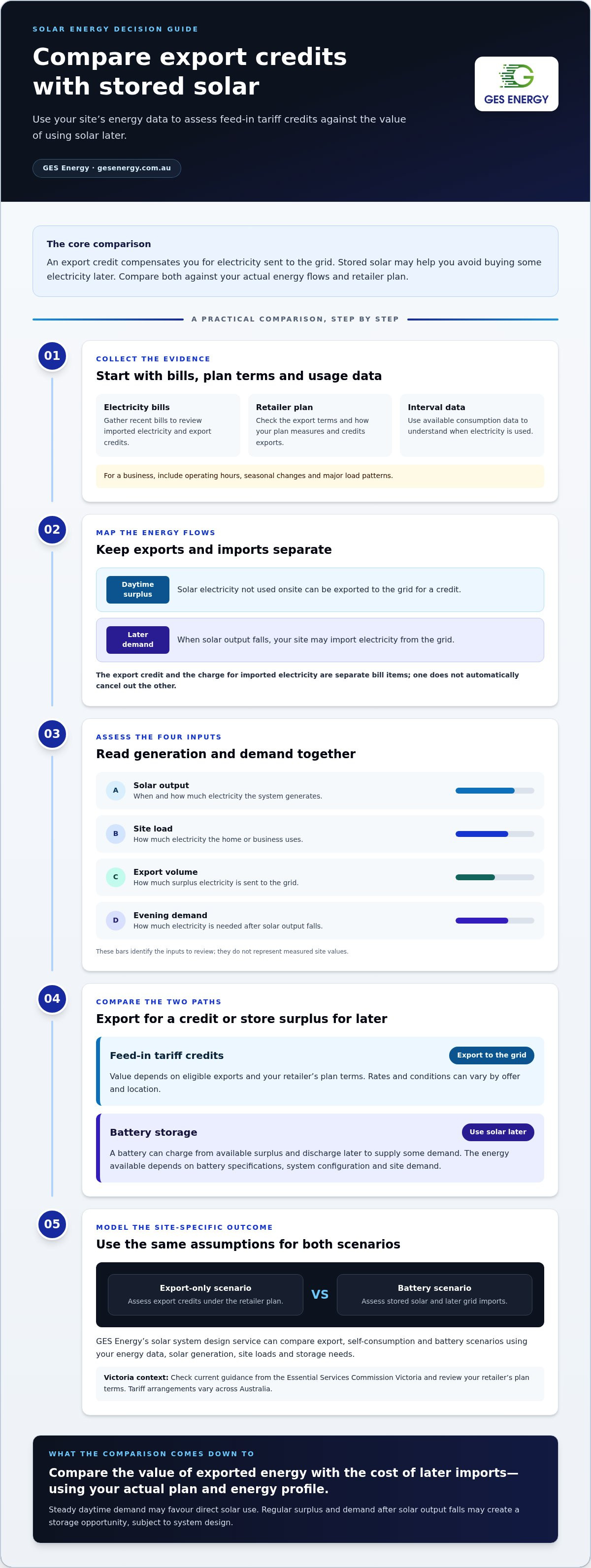
How to compare feed-in tariffs and battery storage with your own data
A useful comparison starts with your site’s energy records, not a generic estimate. To assess feed-in tariff vs battery storage, compare an export-only scenario with a battery scenario using the same period, solar generation and consumption assumptions. This shows whether storage could shift energy to times your site needs it and which inputs still need verification.
- 1. Gather your records. Collect recent electricity bills, current retailer plan details and available interval consumption data. Include solar generation and export records if available.
- 2. Map site loads. Note when electricity is used, including business operating hours, seasonal changes and major equipment patterns. Identify demand that continues after solar generation falls.
- 3. Review tariff terms. Record export credits, import charges and relevant plan conditions. Use current retailer terms for your location rather than assuming one rate applies to every site.
- 4. Model both scenarios. Compare export-only and battery options using identical generation and consumption assumptions. Include battery capacity, system integration requirements and maintenance needs in the storage case.
- 5. Check the assumptions. Mark unknown or estimated inputs clearly. Verify figures and plan conditions before relying on projected bill impacts.
Build an apples-to-apples energy scenario
Use a consistent assessment period and the same solar generation assumptions in each scenario. Track imported electricity, exported solar, energy used directly onsite and energy shifted through a battery as separate quantities. This makes it easier to see where each unit of generated electricity goes and which grid imports a battery might offset. If interval or generation data is missing, label that gap instead of treating an estimate as a confirmed result.
Account for incentives, system design and maintenance
Check current solar battery incentives and eligibility rules before including an incentive in your comparison. Then assess how the site, existing equipment and proposed battery affect system configuration. For a commercial or industrial project, site assessment and engineering help define integration requirements and inform the scenario modelling.
Include maintenance planning and warranty conditions in your long-term ownership assessment, alongside the energy flows in the model. These factors do not change the site’s consumption profile, but they belong in a sound project assessment.
For a site-specific comparison of solar generation, loads and storage scenarios, explore GES Energy’s solar system design service.
Plan a solar and battery solution around your site’s energy profile
Once you’ve compared retailer terms, site loads and storage scenarios, system design is the practical next step. It brings those inputs together to assess how solar generation, onsite demand and battery storage could work as one system. This turns the feed-in tariff vs battery storage comparison into a site-specific plan, with assumptions decision-makers can review before progressing.
What a site-specific solar and battery assessment considers
A useful assessment matches estimated solar generation to operating hours and load profiles, then accounts for site constraints and existing electrical infrastructure. It considers how solar PV and storage could integrate with the site, including the timing of demand and available surplus.
Export and battery scenarios should use clear assumptions. For example, decision-makers can review how much generated electricity is expected to be used onsite, exported or shifted through storage, and how those flows relate to site demand. This helps identify design requirements without treating projected outcomes as guaranteed.
How GES ENERGY supports commercial and industrial projects
GES Energy designs and installs solar and battery systems for commercial and industrial sites, with EPC services and ongoing maintenance supporting project delivery and system care. Its EPC services cover large-scale energy projects up to 5 MW.
System commissioning uses SAA-accredited labour. Maintenance planning can also form part of a project, helping owners consider system care over time alongside initial design and integration.
A tailored assessment connects generation estimates, operating patterns and electrical infrastructure with the site’s objectives. That gives your team a clearer basis for deciding whether to prioritise direct solar use, export credits, battery storage or a mix of these options.
Explore solar and battery design options with GES Energy for a system suited to your site’s energy profile.
Make your next energy decision with confidence
The right choice in feed-in tariff vs battery storage depends on your site’s energy profile, retailer plan and when electricity is used. Export credits may suit a site with surplus solar and limited later demand, while a battery may be worth assessing if the site regularly needs power after generation falls. Compare both options using the same generation and consumption data, and check tariff terms and modelling assumptions before acting.
A site-specific design can bring solar generation, operating loads and storage requirements into one assessment. GES Energy designs and installs solar systems for residential, commercial and industrial customers, and provides maintenance for solar installations.
Discuss a site-specific solar and battery assessment with GES Energy to identify a practical next step for your site. Clear data and considered system design can give you a stronger basis for your energy decision.
Frequently Asked Questions
What is the difference between a feed-in tariff and battery storage?
A feed-in tariff credits eligible solar electricity exported to the grid, while a battery stores some generated electricity for later onsite use. The feed-in tariff vs battery storage comparison depends on your retailer’s export terms, the cost of imported electricity and when your site uses power. Review recent bills and interval data, then compare export credits with the potential value of using stored energy later.
Is a battery better than a feed-in tariff in Australia?
No, a battery isn’t automatically better. It may suit a site with recurring electricity demand after solar generation falls, while export credits may remain relevant if surplus solar exceeds later onsite demand. Compare your import charges, export credits, interval consumption and battery system assumptions. In Victoria, check current tariff guidance and your retailer’s plan conditions, as offers and arrangements can vary between customers and locations.
Can I keep receiving a feed-in tariff if I install a battery?
Possibly. Installing a battery does not by itself determine whether exported electricity earns a credit. The outcome depends on how the system operates and the retailer’s plan terms. Solar may still be exported when the battery is full or cannot charge, depending on system configuration. Review the retailer’s export conditions and model expected exports for the proposed setup before estimating how the battery could affect your electricity bill.
How much can a battery save compared with feed-in tariff credits?
There’s no single savings figure that applies to every site. The result depends on solar generation, when and how much electricity you use, import charges, export credits, battery specifications and project costs. Use recent bills and interval data to model export-only and battery scenarios on consistent assumptions. Treat the result as a site-specific estimate, not a guaranteed saving, and identify any unverified inputs before relying on the projection.
What happens if my battery is full and my solar panels keep generating?
The system’s controls determine how excess generation is managed when the battery reaches its operating limit. Depending on system design and site conditions, electricity may be used onsite, exported where permitted or curtailed. Any export credit depends on your retailer’s plan terms and system configuration. Ask for the operating assumptions to be clearly documented in the assessment, including how the system is expected to handle surplus generation.
How do I compare a feed-in tariff with battery storage for a business?
Gather electricity bills, retailer plan details and interval data, then map operating hours, seasonal changes and major loads. Compare export credits with the potential value of shifting solar to later demand, and include integration, maintenance and applicable incentive rules. GES Energy designs and installs systems across Melbourne, Geelong, Ballarat, Bendigo, Shepperton, Melton, Mildura, Wodonga, Traralgon, Wangaratta, Horsham, Sale, Colac, Echuca, Ararat, Portland, Swan Hill, Benalla and Maryborough.
Are solar battery incentives available in Victoria in 2026?
Eligible Victorian customers may be able to access current solar battery incentives, but program rules and eligibility depend on the customer and system. The federal Cheaper Home Batteries Program is one incentive to investigate for eligible battery systems connected to solar PV. Don’t assume a household incentive applies to a commercial or industrial project. Check current official Australian and Victorian program information, and model the decision without an incentive until eligibility is established.


