

What if the most dependable power plan for a remote mine isn’t a single source of generation? Reliable power for remote mining operations depends on more than whether the grid is nearby. Your site’s operating loads, access to fuel and renewable resources, storage needs, and distance from maintenance support all affect which system is practical.
It’s understandable to want a clear answer before committing to a power project. Grid-connected, standalone and hybrid systems each involve different trade-offs. A design that doesn’t match your site’s load profile can create avoidable operating challenges. Solar, battery storage, generators and microgrids may all be options to assess, but the right mix depends on your requirements.
This guide compares those power architectures and explains how to assess generation and storage against variable mining loads. It also covers integration and maintenance questions to consider when planning for a remote location. Before requesting a project assessment, gather information about load data, grid access, site conditions, fuel logistics and support requirements. This helps ensure the next steps are based on your operation rather than assumptions.
Key Takeaways
- Assess grid access, site conditions and support distance before narrowing down a power system.
- Compare grid-connected, standalone and hybrid configurations to understand their fit and reliance on external supply.
- Reliable power for remote mining operations starts with matching generation and storage to your actual load profile.
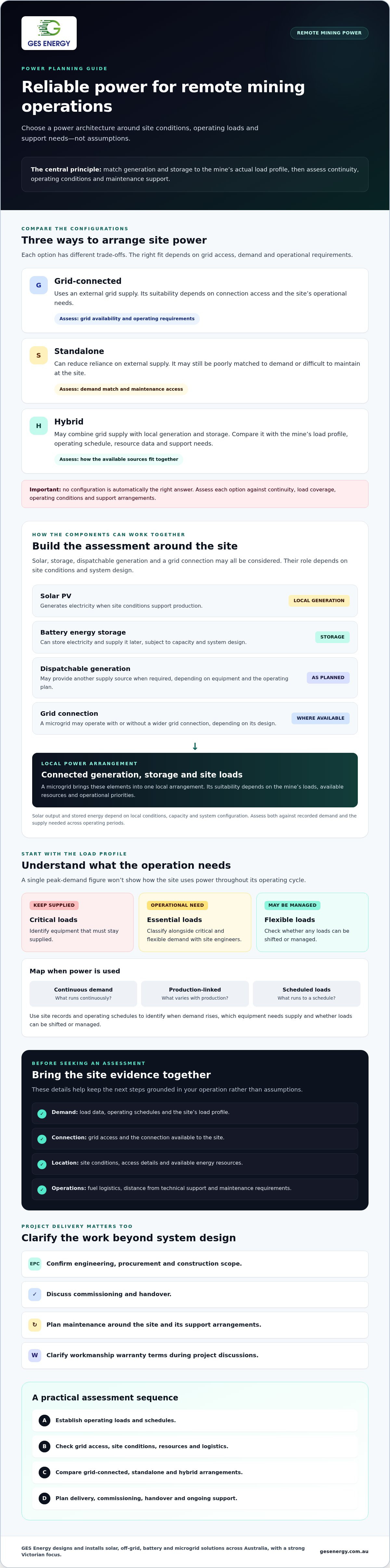
- Prepare load data, operating schedules, site access details and information about available energy resources before seeking an assessment.
- Clarify EPC scope, commissioning, handover, maintenance planning and workmanship warranty terms during project discussions.
What reliable power means for a remote mining operation
Reliable power for remote mining operations isn’t defined by a single uptime target or by being disconnected from the grid. It means the system can meet the site’s operational needs under expected conditions, supply the loads that matter, and support planned maintenance without causing unacceptable disruption.
Energy independence and dependable power are related, but they aren’t the same. A standalone system may reduce reliance on external supply, yet still be poorly matched to demand or difficult to maintain at the site. A grid connection can provide external supply, but its suitability depends on access and operational needs. Assess each option against continuity, load coverage, operating conditions and support arrangements.
Which operational loads need dependable power?
Work with site engineers to classify loads as critical, essential or flexible. Then distinguish continuous demand from loads that vary with production or run to a schedule. Review site records and operating schedules to identify when demand rises, which equipment must stay supplied and whether any loads can be shifted or managed. This profile informs generation and storage design. A single peak-demand figure won’t show how the site uses power throughout its operating cycle.
What makes remote sites different from grid-connected facilities?
Grid availability, distance from technical support and local energy resources vary from site to site. Check what connection is accessible, which resources could support generation, and how maintenance personnel and equipment could reach the location. Road access, weather impacts and other logistical constraints may matter, but confirm them for the specific project rather than assuming they apply to every mine.
Reliable site power is a system’s ability to supply the loads an operation requires under expected conditions, with maintenance and support planned around the site. This definition keeps the assessment grounded in operating requirements instead of a universal uptime claim. A microgrid is one possible arrangement. It can connect local generation and loads, and may operate with or without a wider grid connection, depending on its design.
For Australian operations, including projects in Victoria, assessment starts with the site rather than a standard package. GES Energy designs and installs solar, off-grid, battery and microgrid solutions across Australia, with a strong Victorian focus. First establish the site’s demand and constraints, then compare power system options against its priorities.
How solar, batteries and microgrids work together at remote sites
A remote power system can combine several energy sources rather than rely on one supply alone. Solar PV generates electricity when site conditions support production. Battery energy storage can store electricity and supply it later, subject to its capacity and system design. Dispatchable generation may provide another source when required, depending on the equipment and operating plan.
A microgrid brings connected generation, storage and site loads into one local power arrangement. Depending on its design, it may operate alongside a grid connection or independently. The alternative power supply discussion in Mining Technology reflects the industry’s interest in on-site power options for remote mining. A microgrid isn’t automatically the right answer. Its suitability depends on the mine’s loads, available resources and operational priorities.
What role can solar PV and battery storage play?
Solar PV can contribute to a site’s supply, but output depends on local conditions and system design. Storage can shift some available energy to another time, but the amount it can store and deliver depends on its capacity and configuration. While large-scale mining relies on distinct industrial infrastructure, commercial solar and battery specialists such as zonnepanelen-brabant.nl illustrate similar principles in pairing PV generation with storage to stabilise on-site power. Neither component alone proves that a site can operate independently or reduce fuel use. Assess both against recorded demand and the supply needed across operating periods.
When should a site assess a microgrid or hybrid system?
Consider a standalone arrangement where grid access is unavailable or doesn’t meet operational needs. A hybrid system may be worth assessing where a site can combine grid supply with local generation and storage. Compare either option against the mine’s load profile, operating schedule, resource data and support requirements. GES Energy designs and installs off-grid, battery and microgrid solutions, but a site assessment is needed to determine what may suit.
Assess generation, storage and demand together because each affects how the power system can serve the operation. Sizing requires engineering and site information, including demand over time, expected solar resource, existing supply arrangements and loads that need priority. Avoid choosing equipment based on capacity figures alone. The design needs to account for how the components work as a system.
If you’re establishing the fundamentals of standalone supply, read the off-grid solar systems guide. For a project-specific discussion, you can also review GES Energy’s off-grid and microgrid solutions and consider whether they align with your site requirements.
Compare remote mining power options by reliability and site fit
Grid-connected, standalone and hybrid systems can each support a mining operation, but their suitability depends on the site. Compare how each configuration matches your loads, access to supply, storage requirements and ability to maintain equipment. This helps you assess reliable power for remote mining operations without assuming one architecture suits every mine.
Grid-connected, standalone or hybrid: what should you compare?
A grid-connected system may suit a site where the connection is accessible and has capacity to meet operational requirements. A standalone system is an option to assess where suitable grid access isn’t available. A hybrid arrangement may combine grid supply or dispatchable generation with on-site solar and storage, but it isn’t a default recommendation. Confirm the design against site conditions and operating needs.
| Configuration | Potential site fit | External supply and storage | Support questions |
|---|---|---|---|
| Grid-connected | Sites with accessible grid supply and capacity suited to demand. | Relies on the grid. Storage may be assessed for the site’s specific requirements. | What support is available for the connection and on-site equipment? |
| Standalone | Sites without suitable grid access, subject to engineering assessment. | Doesn’t depend on a grid connection. Storage may help balance supply and demand, depending on design. | How will equipment, maintenance and contingency plans be managed at the location? |
| Hybrid | Sites where a combination of available supply sources may meet operational priorities. | May combine external supply, on-site generation and storage. The role of each depends on the design. | Can the site access the parts, technical support and maintenance the chosen components require? |
How should decision-makers assess reliability trade-offs?
Renewable generation alone may not match every site’s reliability needs. Solar output varies with site conditions, while operational demand can change across shifts and production schedules. Assess how the proposed system would serve required loads across those conditions, and identify what other supply or storage the design may need. The industrial battery storage guide can help you consider storage’s role and the questions to raise during project planning.
Work with operational and engineering teams to assess the consequences of a supply interruption for different loads. Then compare maintenance access, component support and contingency arrangements for each option. For a remote site, a system that meets demand on paper may still be a poor fit if its support plan doesn’t account for access constraints.
Record the assumptions behind each configuration, including grid capacity, load requirements, expected resources and maintenance arrangements. This gives project teams a clearer basis for comparing options without relying on unverified uptime, fuel savings or return-on-investment claims.
Assess site requirements before choosing a mining power system
A useful power assessment starts with the operation, not a preferred technology. Set out what the mine needs to run, document site conditions, then compare system options and supplier proposals against the same information. This gives engineering and operations teams a clearer basis for planning reliable power for remote mining operations.
What information should a mine prepare for a feasibility assessment?
Bring together records that show how the site uses power now and how its needs may change. Include:
- Load data: Demand profiles, critical equipment requirements and any known load peaks.
- Operating schedules: Shift patterns, planned shutdowns and equipment that runs continuously or at set times.
- Future requirements: Anticipated changes to production, equipment or site infrastructure that could affect demand.
- Site details: Location, access conditions, existing electrical infrastructure and available energy resource data.
- Support arrangements: Maintenance responsibilities, the people who make energy decisions and any constraints on getting equipment or technical support to site.
Ask qualified project professionals to assess applicable compliance, electrical safety and approval requirements. These can depend on the site and project scope, so confirm them rather than assuming a standard set applies everywhere.
How can a project team compare proposals fairly?
Give each supplier the same load assumptions, operating requirements and project boundaries. Then compare what each proposal includes, what it excludes and how its design responds to the information supplied. This makes differences easier to identify and reduces the risk of comparing options based on different assumptions.
Ask suppliers to document key design assumptions, equipment and work included, exclusions, maintenance scope and warranty terms. Check that the proposal addresses site access and identifies who is responsible for project interfaces. Clarify commissioning and handover requirements so your team understands what information and operational guidance it will receive.
For projects involving solar, batteries or related infrastructure, this solar EPC services guide explains how engineering, procurement and construction can be coordinated as part of project delivery. GES Energy delivers EPC projects up to 5 MW. Confirm project scope and site suitability during assessment.
Once your site information is ready, discuss a site-specific solar or off-grid assessment with GES Energy. Provide load and access details early to help frame a practical discussion about project requirements and next steps.
Plan delivery and ongoing support for reliable remote site power
A well-planned power system needs clear delivery responsibilities and an ongoing support plan. EPC services can coordinate engineering, procurement and construction for an energy project, helping define how its design, equipment and site works fit together. For reliable power for remote mining operations, plan these responsibilities alongside the system design, not as an afterthought.
What should EPC scope and handover cover?
Before work begins, confirm who is responsible for design, equipment procurement and construction, including the boundaries between the EPC provider, site team and other contractors. Agree how commissioning will be documented, what operating information will be handed over, and who accepts each part of the completed system. These details give your team a clearer basis for operating the installation and managing follow-up work.
GES Energy provides EPC services and delivers projects up to 5 MW. Confirm the proposed scope, site requirements and suitability for your project directly with the provider. Project capacity alone doesn’t establish that a project is a fit.
How should ongoing maintenance and warranty be evaluated?
Ask for a maintenance plan that reflects the site’s access conditions, equipment and available support. Compare which inspections and maintenance tasks are included, how service requests are handled, and what arrangements apply if a technician or replacement component needs to reach the location. Confirm any response arrangements in writing rather than assuming they’re part of the project.
Request the workmanship warranty terms in writing. Check which work and components it covers, the period that applies to your project, and any conditions the site must meet. Verify claims about certifications, installation history and warranty duration against current documentation, and confirm whether they apply to the specific mining project.
GES Energy designs and installs off-grid solar systems, battery storage and microgrids, and provides EPC services and maintenance. These capabilities may be relevant when assessing a remote energy project, but confirm the proposed scope and support arrangements for your site. A clear handover and agreed maintenance responsibilities help your team understand who manages each part of the system over time.
Before selecting a provider, document your expectations for commissioning, operating information, service access and warranty coverage. Then compare each proposal against those requirements, not just the equipment list.
Talk with GES Energy about remote site power requirements and the project scope your operation needs assessed.
Build a power plan around your site
Reliable power for remote mining operations starts with a clear picture of site demand, grid access, available energy resources and operating priorities. Grid-connected, standalone and hybrid systems each have trade-offs, so assess generation and storage against your mine’s actual load profile rather than selecting a configuration based on assumptions.
Before seeking a project assessment, gather load data, operating schedules, site access details and information about existing infrastructure. Compare proposals using consistent assumptions, then confirm delivery responsibilities, commissioning and handover requirements, maintenance arrangements and warranty scope. These steps help your team plan for the system’s full operating life, not just installation.
GES Energy’s capabilities include solar, battery storage, off-grid systems, microgrids, EPC services and maintenance. The business delivers EPC projects up to 5 MW, with project fit to be confirmed. It serves customers across Australia, with a strong Victorian focus. Confirm service coverage for your site.
Bring your site requirements into a practical project discussion. Discuss your remote site's power requirements with GES Energy and take the next step towards an energy plan suited to your operation.
Frequently Asked Questions
What is the most reliable power system for a remote mining operation?
There’s no single system that suits every remote mine. Reliable power for remote mining operations depends on site loads, grid access, available energy resources, operating schedules and maintenance access. Compare grid-connected, standalone and hybrid designs against critical loads and the consequences of supply interruptions. Request an engineering assessment using site data, and don’t choose a system based on headline capacity alone. The design should reflect how the operation uses power.
Can solar and batteries reliably power a remote mine?
Solar and batteries may form part of a power system designed for a remote mine, but their suitability depends on demand, solar resource, storage design and other generation or supply options. Don’t assume they can meet every site’s needs on their own. Before procurement, ask an engineer to assess load profiles, operating conditions, contingency requirements and maintenance access. This helps identify where additional supply or generation may need consideration.
How do mining operators choose between off-grid and hybrid power?
Start by confirming whether grid supply is available and whether its capacity suits the operation. Then compare standalone and hybrid options against load profiles, site resources, storage requirements and support arrangements. Ask each supplier to document the assumptions and exclusions behind its proposal. A site-specific engineering assessment is essential. No single configuration suits every remote operation, and a hybrid design should be considered as an option, not a default.
What information is needed to design power for a remote mining site?
Prepare load profiles, critical equipment requirements, operating schedules, site location and access conditions. Include information about existing electrical infrastructure, available energy resources and planned maintenance arrangements. These records give the project team a starting point for comparing system options and identifying gaps in the available data. The design team should confirm what further technical, electrical safety or compliance information it needs for the particular site.
What does EPC mean for a remote mining power project?
EPC means engineering, procurement and construction. For an energy project, the agreed scope may coordinate design, equipment procurement and construction, but responsibilities depend on the contract. Check what the proposal includes and excludes, who manages commissioning and handover, and how maintenance is handled. GES Energy offers EPC services for solar, battery and EV charging projects. Confirm the scope and suitability for your mining site before proceeding.
How can a mining operation plan maintenance for a remote power system?
Set out maintenance responsibilities, site access arrangements, inspection requirements and warranty terms before approving the project. Confirm which components and activities are covered by any maintenance plan and how support is arranged for the location. Make sure the plan reflects site operations and agreed supplier commitments. Don’t assume a particular response time or emergency service is included unless the provider has confirmed it in writing.
Does GES Energy deliver power projects across Australia?
GES Energy describes its service coverage across Australia, with a strong focus on Victoria, and states EPC project delivery capacity up to 5 MW. Confirm coverage, project capacity and suitability for your mining site directly. Its Victorian service focus includes Melbourne, Geelong, Ballarat, Bendigo, Shepperton, Melton, Mildura, Wodonga, Traralgon, Wangaratta, Horsham, Sale, Colac, Echuca, Ararat, Portland, Swan Hill, Benalla and Maryborough. Share your location, load data and requirements for assessment.


