

The best solar system for a cold store isn’t necessarily the one with the most panels. Solar power for cold storage facilities needs to match refrigeration demand, which continues after daylight hours. Solar can offset daytime electricity use, while a battery and grid supply may help meet demand when generation falls. The right balance depends on how your site operates.
It’s reasonable to ask whether solar alone can support essential refrigeration, or whether batteries are necessary. Solar-only systems can reduce daytime grid use, but they don’t generate electricity overnight. A site-specific assessment can show how solar, storage and grid supply may work together, and how installation can be planned around facility operations.
This guide explains what to assess before choosing a system, from refrigeration loads and energy-use patterns to site conditions and grid constraints. It also covers the information needed for a feasibility assessment, how EPC services can coordinate project stages, and which responsibilities to clarify before work begins. The aim is to help you plan around your facility’s operating needs.
Key Takeaways
- Plan solar power for cold storage facilities around refrigeration loads, temperature requirements and operating schedules, not panel capacity alone.
- Compare grid-connected solar, battery storage and off-grid options against your facility’s energy needs and resilience priorities.
- Gather electricity bills, interval data, refrigeration loads and operating schedules for a site-specific feasibility assessment.
- Ask qualified professionals to assess roof or ground-mount options, available space and existing electrical infrastructure.
- Clarify project stages, site responsibilities and work sequencing so EPC coordination can help limit disruption to operations.
Why solar power for cold storage facilities starts with refrigeration demand
Solar power for cold storage facilities is designed to supply part of a facility’s electricity demand using solar generation. The design depends on load data, site conditions and operating needs. To assess suitability, look at how much electricity the site uses, when it uses it, and how consistently refrigeration and temperature management need to operate.
Timing matters. Solar panels generate electricity during daylight, while refrigeration may need to maintain required conditions in the evening, overnight and across changing operating schedules. A useful energy brief therefore looks beyond panel capacity. It identifies which loads solar may serve as it is generated and how the facility will meet demand when solar output is lower.
For an introduction to the basic technology, see how a solar-powered refrigerator uses solar energy for cooling. An industrial cold store has different loads and operating demands, so its system needs a site-specific assessment.
To see an Australian example of solar supporting food-related operations, watch this SolarQuotes video:
Which cold-store operations shape the energy profile?
Start by mapping refrigeration equipment, storage zones and operating schedules. Compressors, condensers, fans and pumps can have different run patterns, while separate zones may have distinct temperature requirements. Product types, deliveries, stock movement and seasonal changes can also affect when equipment runs and how much electricity the site needs.
Separate essential refrigeration loads from other uses, such as lighting, offices and general processing equipment. This helps identify the demand that must be prioritised to maintain temperature conditions and the loads that may be more flexible. Involve operating and maintenance teams so the assessment reflects actual site practice, not just equipment nameplate details. Beyond energy management, overall hygiene and maintenance remain fundamental to cold storage performance; to explore professional warehouse standards, discover Distribution Hygiene Services Limited for an example of specialist industrial cleaning.
Why solar capacity alone cannot determine suitability
A proposed system’s panel capacity doesn’t show how much of your total demand it can serve. The key is the relationship between solar output and electricity use over time. Interval electricity data can show when demand rises or falls, while equipment information and operating schedules help explain those patterns.
Use these records to assess the likely match between daytime generation and facility loads, then consider how the site will manage any mismatch. For broader context on planning a business installation, read the commercial solar guide. A clear load picture gives your designer a stronger basis for assessing system options and site suitability.
How solar generation can work alongside refrigeration loads
Solar can supply electricity to cold-store equipment and other facility loads while panels are generating, subject to system design and the site’s demand at that time. If refrigeration demand continues after solar output drops, grid supply can cover the difference. A battery may shift some solar energy for later use, but its role depends on its capacity, operating settings and the facility’s requirements.
Interval load data helps you compare solar generation with refrigeration demand and identify when grid supply or battery storage may be needed. This comparison is central to designing solar power for cold storage facilities. It shows how generation may align with actual operations, rather than relying on panel capacity alone.
Matching generation patterns with operating schedules
Ask your designer to compare the facility’s demand profile with expected solar generation at the site. The assessment should consider operating hours, seasonal variation and refrigeration cycles. A site with substantial daytime demand may use solar as it is generated. Other operating patterns may create a larger gap between generation and demand. Modelling with verified site data is needed to estimate the solar contribution.
Include more than the refrigeration plant’s overall electricity use. Compressor operation, defrost cycles, stock movement and changes in how storage zones are used may affect demand across the day or year. Reviewing these factors alongside interval data can help your energy team distinguish recurring load patterns from short-term operating changes. For expertise in commercial cooling, chillers and system efficiency, discover Abbott Mechanical Services LLC to see how industrial HVACR equipment is serviced and managed.
When battery storage may enter the design
A battery can store some energy generated by solar and discharge it later, depending on system design and operating requirements. This may help shift energy use beyond solar-generation hours. The assessment should account for when the battery can charge, when the facility needs stored energy and how the battery will operate alongside grid supply and refrigeration equipment.
Storage does not automatically provide uninterrupted refrigeration or guaranteed backup during an outage. Backup depends on system configuration, the loads supported, available stored energy and operating conditions. If continuity is a priority, ask a qualified designer to assess what the proposed system can support and what happens when solar or grid supply is unavailable.
For more detail on design considerations, read the industrial battery storage guide. A site assessment can then compare solar and storage options against your facility’s measured loads and operating priorities.
Compare solar-only, battery-supported and grid-connected options for Victorian cold stores
No single configuration suits every cold store. The right choice depends on your load profile, grid conditions and continuity requirements. When comparing solar power for cold storage facilities, consider how each option fits refrigeration demand, operating schedules and your business’s resilience priorities. Don’t choose by panel or battery capacity alone.
| Configuration | Potential operational fit | Key considerations |
|---|---|---|
| Grid-connected solar, without a battery | Solar may supply facility loads while generating; the grid supplies electricity when demand exceeds solar output. Outcomes are site-dependent. | Assess daytime load, grid connection conditions and site constraints. Bill benefits depend on the facility’s energy use and electricity arrangements. |
| Grid-connected solar with battery storage | A battery may shift some stored solar energy to later periods, subject to design and operating requirements. Outcomes are site-dependent. | Assess whether energy timing or resilience objectives justify storage, including how it will operate with grid supply and refrigeration loads. |
| Off-grid solar and storage | Designed to operate without relying on grid supply. Whether it can meet facility needs is site-dependent. | Requires careful review of demand, storage, system design and reliability needs. Project complexity and operating requirements need detailed assessment. |
When grid-connected solar may suit the facility
A grid-connected system can complement refrigeration and other loads during periods of solar generation, with grid electricity available when generation and demand don’t align. This may suit a site seeking to reduce grid use without designing for full independence. Available connection capacity and other site constraints need professional assessment. Treat bill savings as a potential benefit to model, not a guaranteed outcome.
When to assess storage or off-grid design
Consider battery storage if demand extends beyond solar-generation hours or your resilience objectives warrant further technical and financial analysis. Storage can shift some energy use, but it doesn’t by itself guarantee uninterrupted refrigeration. Confirm which loads a proposed system can support and how it would respond to changing conditions.
Off-grid design needs a facility-specific review of demand and reliability requirements, including how the system will serve essential refrigeration when solar generation is limited. For context on standalone systems, read the off-grid solar systems guide. A site assessment can help narrow the options; explore GES Energy’s commercial solar systems as a starting point for project discussions.
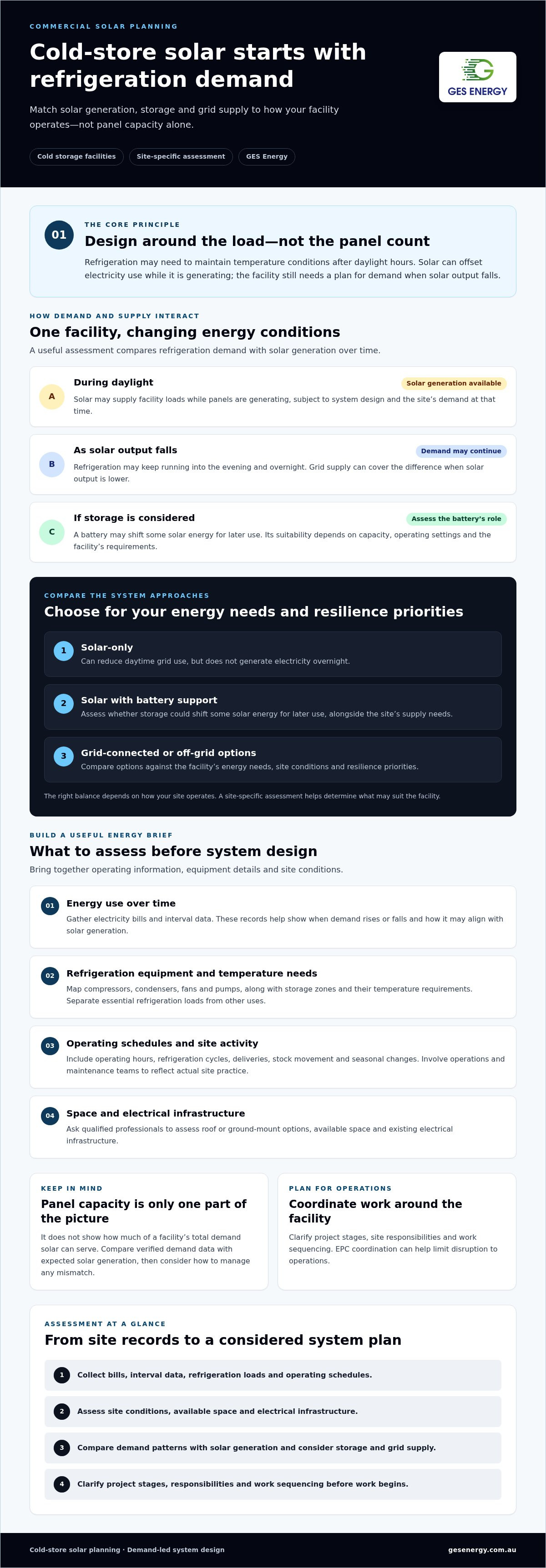
What to assess before planning solar for an Australian cold storage facility
A sound feasibility assessment starts with your facility’s measured electricity use and refrigeration requirements. Collect the information below before comparing system proposals. It helps a designer assess how solar power for cold storage facilities could fit your site, operating schedule and continuity needs.
Facility and energy information to gather
- Electricity use: Gather recent electricity bills and interval data, if available. These records help show how much electricity the facility uses and when demand occurs.
- Refrigeration loads: List refrigeration equipment, storage zones, operating schedules and essential loads. Include equipment details and any known seasonal changes in how the facility operates.
- Operating needs: Record operating hours, planned expansions, critical loads and any constraints that could affect project staging or access. Note which activities must continue during installation.
- Potential installation areas: Identify possible roof or ground-mount locations, available space and site access requirements. A professional must review the suitability of these areas and the existing electrical infrastructure.
Keep the information current and involve staff who understand refrigeration operations. Their input can help explain unusual demand patterns and identify practical limits on access, shutdowns or work sequencing.
Safety, compliance and project continuity
Ask qualified professionals to assess electrical design, safety and applicable compliance requirements for your site. Victorian facilities should also verify site-specific grid connection, planning and compliance requirements with the relevant professionals. Don’t assume a proposed system can connect or be installed without further review.
Plan the work around refrigeration operations. Ask prospective providers how they will sequence site activities, manage access, coordinate commissioning and communicate any proposed changes that could affect facility operations. Confirm who is responsible for each project stage, including decisions and communication with your operations team.
Before selecting a provider, clarify how ongoing maintenance and warranty support will be managed. Ask what commissioning information you’ll receive, how to raise warranty questions and what maintenance arrangements apply to the proposed system. Clear responsibilities help your team plan beyond installation day.
If you’re considering government incentives, verify current eligibility, program conditions and application requirements through official Australian or Victorian government sources before including them in your financial assessment. Eligibility can depend on the project and program rules, so don’t base a decision on an unconfirmed rebate.
Use your collected data to request a site-specific assessment from GES Energy’s commercial solar team.
How GES Energy can support a cold storage solar project
Cold-store solar needs to reflect the actual site, including refrigeration loads, energy-use patterns, available installation areas and continuity requirements. GES Energy designs and installs commercial and industrial solar systems, and also offers solar battery storage, off-grid solutions, micro-grid development and ongoing maintenance. Its local service locations include Melbourne, Geelong, Ballarat, Bendigo, Shepperton, Melton, Mildura, Wodonga, Traralgon, Wangaratta, Horsham, Sale, Colac, Echuca, Arrarat, Portland, Swanhill, Benalla and Maryborough.
For a cold-storage project, the first practical step is to assemble the site data and discuss which system configurations warrant further assessment. GES Energy’s EPC services cover engineering, procurement and construction for utility-scale and micro-grid projects up to 5 MW. Project scope and suitability depend on the site and its requirements.
From feasibility assessment to project delivery
A site assessment and system design review can consider facility demand, refrigeration operations, site conditions and potential system options. This provides a basis for discussing how solar, battery storage and grid supply might fit your operating needs. Final system sizing, expected performance and potential savings must be checked against verified site data.
For projects that need coordinated delivery, EPC services can support engineering, procurement and construction. Clarify project responsibilities, work sequencing and communication with facility staff early. Ask how installation activities will account for site access and ongoing refrigeration operations.
Include maintenance in the project plan, not just the installation scope. Confirm what maintenance arrangements are available, how system condition will be reviewed and how warranty support is handled. This helps your team understand its ongoing responsibilities for the proposed system.
Prepare for a project discussion with GES Energy
Bring information that helps the project team understand your facility and assess its requirements. Useful items include:
- Electricity bills and interval data, if available.
- Refrigeration equipment details, operating schedules and essential loads.
- Site plans showing possible roof or ground-mount areas, available space and access.
- Continuity requirements, operational constraints and planned facility changes.
Flag any requirements for maintaining refrigeration during project work, along with anticipated changes to site demand. A well-prepared discussion can help identify what further assessment is needed before system options are developed.
Prepare your site and energy information, then discuss a commercial solar project with GES Energy.
Take the next step towards a site-fit solar plan
Solar can help offset daytime electricity use, but a cold store’s refrigeration demand continues beyond solar-generation hours. The right system depends on your load profile, site conditions, grid supply and continuity requirements. Compare solar-only, battery-supported and grid-connected options using interval data and a professional assessment, rather than relying on panel capacity alone.
For solar power for cold storage facilities, start by gathering electricity bills, interval data, refrigeration equipment details, operating schedules and site plans. This information helps shape a project around your facility’s needs and supports a clearer discussion about installation staging, ongoing maintenance and responsibilities.
GES Energy designs and installs commercial and industrial solar systems, with EPC services for utility-scale and micro-grid projects up to 5 MW. Project suitability and outcomes depend on a site-specific assessment.
Prepare your facility information and discuss a commercial solar project with GES Energy.
Frequently Asked Questions
Can solar power run a cold storage facility?
Solar can supply some of a cold storage facility’s electricity demand when panels are generating, but the useful contribution depends on the site. Refrigeration runs beyond daylight hours, so assess interval electricity data, refrigeration equipment and operating schedules before deciding on system size. Solar power for cold storage facilities is generally planned alongside grid supply or storage, with the design based on measured loads and continuity requirements.
Is battery storage necessary for solar power at a cold store?
No, a battery isn’t necessary for every cold store. A grid-connected solar system can supply electricity during generation periods, while the grid supplies power when demand exceeds solar output or solar generation is unavailable. Storage may suit a facility that wants to shift some solar energy to later use or assess resilience objectives. Its value depends on the load profile, system design and operating requirements, so compare options using site data.
How do you size a solar system for a cold storage facility?
Use interval electricity data, bills, refrigeration equipment details and operating schedules, then have a qualified professional assess site conditions and grid constraints. The design should compare expected solar generation with demand across operating periods and seasons. Include essential refrigeration loads, other facility electricity use and planned changes to operations. Panel capacity alone can’t establish how much demand solar will serve or predict savings.
Can a grid-connected solar system support refrigeration loads at night?
Solar panels don’t generate electricity at night. A grid-connected system can still support a cold store’s overnight refrigeration indirectly by reducing electricity drawn from the grid during daylight, but grid supply meets demand when solar generation is unavailable. A battery may store some solar energy for later use, subject to system design and operating requirements. Don’t assume a grid-connected solar system provides backup during an outage; check the proposed configuration with a qualified professional.
What happens to cold storage operations when solar generation is low?
When solar output falls, the facility draws on its other available electricity supply, commonly the grid in a grid-connected design. A battery may discharge stored energy if the system is designed and configured to do so. The effect on refrigeration depends on the system, available supply and which loads it supports. If continuity is critical, ask a qualified professional to assess operating requirements and what the system can support under different conditions.
Are there government incentives for commercial solar or battery storage in Victoria in 2026?
Victoria’s Energy Upgrades (VEU) program supports eligible commercial solar PV systems from 30 kW to 200 kW, with discounts provided through accredited providers. The federal Small-scale Renewable Energy Scheme expansion to solar PV systems from 100 kW up to 1 MW applies to systems installed on or after 1 October 2026. Check current eligibility and conditions with official program sources before relying on an incentive; don’t assume a battery is covered.
What information is needed to assess solar for a cold storage facility?
Prepare electricity bills, interval data, refrigeration equipment details and operating schedules. Include essential loads, operating constraints, expansion plans, site plans and possible roof or ground-mount areas, plus information about electrical infrastructure and site access. For Victorian sites, note the location, such as Melbourne, Geelong, Ballarat or Bendigo, so grid and site conditions can be assessed. This information helps a qualified professional review system options and installation staging.


