

Could a basic solar setup leave your farm exposed when electricity demand shifts or the grid drops out? Choosing agricultural solar power solutions australia starts with a practical question: when does your operation use electricity, and which loads need to keep running? Pumps, cool rooms, irrigation and seasonal processing create different energy patterns, so a system that suits one property may not suit another.
It makes sense to compare solar panels, batteries and off-grid supply when reliability matters, particularly at a remote site. The right configuration depends on grid access, daily and seasonal demand, and the needs of essential equipment. Batteries can add flexibility, but they are not necessary for every farm.
This guide compares grid-connected, hybrid and off-grid options for Australian agricultural operations, including farms across Victoria. It explains what each configuration can and cannot do, what site and load information to gather, and how a solar system design service can help shape a project around your needs. You’ll also find practical steps for planning engineering, installation and ongoing maintenance, so you can assess reliability and long-term value before committing.
Key Takeaways
- Choose agricultural solar power solutions australia based on your farm’s energy use, site conditions and essential loads, not a one-size-fits-all package.
- Compare grid-connected, hybrid and off-grid systems to understand the trade-offs in grid access, storage, flexibility and backup power.
- Review electricity bills and equipment schedules to map seasonal demand before settling on a system design.
- Prepare site plans and details of planned operational changes to support a more accurate project assessment.
- Clarify how solar system design and coordinated project delivery can define the scope, installation and ongoing maintenance responsibilities.
Agricultural solar power solutions in Australia start with farm energy needs
Agricultural solar power solutions australia are solar and storage systems designed around a farm’s electricity demand, operating schedule and site conditions. Unlike a standard residential installation, a farm system needs to account for agricultural equipment, changing workloads and the locations of buildings and infrastructure across the property.
A farm solar system should match the timing and demands of agricultural work, not just household electricity use. Pumps, irrigation, refrigeration and workshop equipment draw power at different times and rates. Seasonal tasks can shift demand, too, so annual electricity use alone may not show when the system needs to supply the most power.
Grid access varies between properties. Some farms can connect a solar system to an existing network, while remote sites may have limited access. Base the design on the actual site and the loads that matter to your operation, rather than assuming every Australian farm has the same conditions.
Which agricultural loads should a farm assess first?
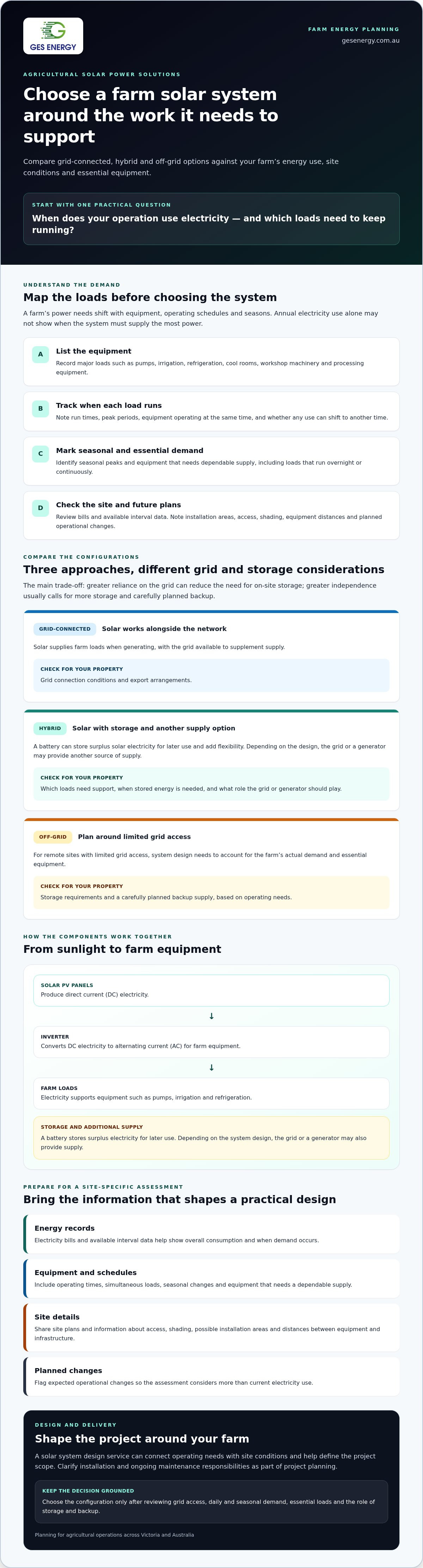
Start with an equipment and operating schedule. Record what runs, when it runs and whether it can be paused or shifted to another time. Separate daytime demand from overnight or continuous loads, then identify the equipment that needs a dependable supply to support essential operations.
- Major equipment: Pumps, irrigation systems, refrigeration, cool rooms, workshop machinery and other significant electrical loads.
- Operating schedules: Typical run times, peak periods and whether several pieces of equipment operate at once.
- Seasonal changes: Periods when irrigation, processing or other farm activities increase or reduce electricity use.
- Essential loads: Equipment that needs a dependable power supply, including loads that operate overnight or continuously.
Review electricity bills and available interval data before choosing a system capacity. Interval records help show when demand occurs, while bills provide a broader view of consumption. If planned changes could alter your energy use, include them in the assessment rather than sizing a system only for current operations.
How do location and farm operations affect system design?
Check potential installation areas, site access, shading and the distance between solar equipment, buildings and electrical infrastructure. These details affect where equipment could go and what the project needs to account for. Where land must continue supporting agricultural activity, agrivoltaics describes approaches that combine solar generation with agricultural land use. Suitability depends on the site and operation.
GES Energy has a Victorian service focus, including Melbourne, Geelong, Ballarat, Bendigo, Shepperton, Melton, Mildura, Wodonga, Traralgon, Wangaratta, Horsham, Sale, Colac, Echuca, Ararat, Portland, Swan Hill, Benalla and Maryborough. Farm energy projects also arise elsewhere in Australia. Conditions vary between properties, so avoid assumptions about climate, crops, livestock or grid reliability. A site-specific assessment connects operating needs with practical installation constraints and provides a basis for system design.
How agricultural solar systems combine panels, batteries and grid power
Farm solar systems combine components to generate, convert, store or supply electricity. Solar PV panels produce direct current (DC) electricity, and an inverter converts it to alternating current (AC) for farm equipment. A battery stores surplus electricity for later use. Depending on the design, the grid or a generator may provide another source of supply.
The main trade-off is that greater reliance on the grid can reduce the need for on-site storage, while greater independence usually calls for more storage and carefully planned backup. A battery can shift solar energy to a later time and support selected loads, but its role and capacity need to match the farm’s actual requirements.
| System type | How it works | Key consideration |
|---|---|---|
| Grid-connected | Solar supplies farm loads when generating, with the grid available to supplement supply. | Confirm connection conditions and export arrangements for the site. |
| Hybrid | Solar and grid supply work with battery storage; the system can be designed to support selected loads. | Assess which loads need backup and when stored energy should be available. |
| Off-grid | Solar, batteries and, where included in the design, generator backup supply the site without relying on a grid connection. | Plan for the full demand profile and the times solar generation may not meet demand. |
When could grid-connected agricultural solar suit a farm?
If farm activities use electricity during daylight hours, solar generation may coincide with some of that demand. A grid-connected system may be worth assessing, particularly where the farm already has a suitable connection. Actual outcomes depend on system design, usage patterns and retailer arrangements. Confirm the property’s connection conditions and export limits rather than assuming surplus power can be exported on particular terms.
When should a farm compare hybrid and off-grid options?
A hybrid configuration may suit a site where grid supply is available but storage could help meet particular timing or backup needs. An off-grid system is worth assessing when a property lacks suitable grid access. In either case, consider battery storage and generator backup against the loads they need to support. They are not automatic additions. For more detail on standalone systems, see Off Grid Solar Systems: The 2026 Guide to Standalone Power in Australia.
For farms considering solar alongside ongoing agricultural activity, the Clean Energy Council’s Australian guide to agrisolar provides further context. Comparing agricultural solar power solutions australia starts with the role each energy source needs to play at your site. A solar system design service can help assess project requirements before equipment is selected.
Compare agricultural solar solutions by reliability, flexibility and project fit
The best fit depends on more than how much electricity your farm uses. Consider when demand occurs, whether the site has suitable grid access, which operations need continuity and whether the system may need to expand. The intended reliability and financial value depend on a design that reflects actual loads and operating conditions.
Use this comparison to narrow the options for agricultural solar power solutions australia. The benefits and limitations are starting points for assessment, not guarantees of performance.
| System type | Potential fit and benefit | Limitations to consider | Questions to resolve |
|---|---|---|---|
| Grid-connected | May suit a farm with an appropriate grid connection and electricity demand that overlaps with solar generation. | Supply remains linked to the grid, and connection or export conditions can affect the project. | When does the farm use power? What connection and export arrangements apply at the site? |
| Hybrid | May suit a farm that has grid access but wants to assess storage for shifting energy use or supporting selected loads. | Battery size and backup capability depend on system design and operating priorities. | Which loads need support, and for how long? When should stored energy be available? |
| Off-grid | May suit a remote site without suitable grid access, where on-site generation and storage form the main supply. | System design must account for changing demand and periods when solar generation is limited. Generator backup may be considered for the project. | What loads must be supplied, how do they vary, and what backup approach is appropriate? |
How should reliability requirements influence the comparison?
Separate operations that need continuity from those that can be scheduled around available generation. For example, a farm may prioritise particular control or refrigeration loads while shifting flexible tasks to other periods. Batteries or backup generation may help address specific supply needs, but neither is essential for every property. Resilience planning can reduce exposure to some interruptions, but it is not a promise of uninterrupted power.
What should farms consider before adding battery storage?
Assess load timing, backup priorities, existing generation and likely changes in demand before specifying storage. Battery capacity and configuration need engineering assessment against those requirements. For more business-value context, see Commercial Solar Return on Investment Australia: 2026 ROI Guide. For storage planning, refer to Industrial Battery Storage: 2026 Australian Enterprise Guide. Base any savings estimate on site-specific design, usage and operating conditions, not assumed export income or a generic payback figure.
Plan an agricultural solar project with the right site and design checks
A clear project plan turns farm energy data into a scope that can be checked, designed and delivered. Review electricity bills and available interval data, then document equipment use, seasonal schedules and essential loads. Follow with a site assessment, system design, checks on relevant approvals and grid requirements, and commissioning by qualified professionals. This process helps you compare options against operating needs before selecting equipment.
What information belongs in a farm solar site assessment?
Prepare recent electricity bills, available interval data and an equipment schedule showing operating hours, peak demand and seasonal changes. Mark critical equipment and note which loads run overnight or continuously. Add site plans showing existing buildings, electrical infrastructure and possible installation areas, along with access constraints, grid connection details and plans for future expansion. These records help inform feasibility, system design and project scope.
A practical planning sequence is:
- Review energy use: Map consumption, peak demand and seasonal operating patterns.
- Assess the site: Record usable areas, access, shading and existing infrastructure.
- Develop the design: Match solar, storage or off-grid options to the farm’s loads and priorities.
- Check project requirements: Have qualified professionals assess electrical, structural, grid and safety considerations, and confirm relevant approval requirements for the site.
- Commission and plan ahead: Confirm system operation and maintenance responsibilities, while allowing for expected changes in farm activity.
Ask appropriately qualified professionals to assess electrical and structural work, grid connection requirements and safety matters. Requirements can vary by project and location, including between Victorian sites and other parts of Australia. Check current solar battery incentives or other government support with the relevant government source before including a potential benefit in your project economics. Eligibility and application conditions can change.
How do EPC services support agricultural energy projects?
EPC services bring engineering, procurement and construction together in a coordinated project delivery approach. This can help clarify scope, interfaces and responsibilities for projects involving solar, storage or microgrids. Confirm who is responsible for design decisions, equipment procurement, site work, commissioning and ongoing maintenance planning. For further detail, see Solar EPC Australia: The Complete 2026 Guide to Engineering, Procurement, and Construction.
GES Energy’s solar system design service can help assess agricultural loads and site conditions before the project scope is set. To discuss your farm’s design requirements, talk through your agricultural solar project.
How GES Energy can support agricultural solar power solutions in Australia
Farm energy projects need a scope that reflects the loads, site and operating priorities, not a preset system choice. GES Energy designs and installs solar power systems for residential, commercial and industrial customers across Australia, with a Victorian service focus. For farms, an assessment of site conditions and energy use can help establish a suitable project scope before equipment is selected.
For agricultural solar power solutions australia, start by assessing how and when your farm uses electricity. That information can guide whether the project should focus on solar PV, battery storage, an off-grid system or a microgrid. Define the project scope before selecting equipment or making assumptions about reliability and savings.
What can GES ENERGY’s design and delivery work cover?
Relevant capabilities include commercial and industrial solar, off-grid systems, battery storage and microgrids. GES Energy also offers EPC services for utility-scale and microgrid projects, covering the lifecycle of projects up to 5 MW. These capabilities can support different project requirements, but not every farm needs storage or off-grid supply. The appropriate combination depends on the site assessment, energy data and operating priorities.
Plan for ongoing care as well as system design and commissioning. Discuss what maintenance may be appropriate, who will be responsible for it and how responsibilities will be documented. A clear scope helps you understand what to expect after installation without treating maintenance as a guarantee of performance.
What should a farm prepare before requesting a project discussion?
Bring recent electricity bills and any available interval data, along with equipment schedules showing operating times and seasonal changes. Note which equipment is essential, any known grid constraints and possible locations for solar or other equipment. Include planned changes to farm operations, such as new loads or expanded activity, so the initial discussion can account for future demand as well as current use.
- Energy information: Bills, interval data, peak demand and seasonal patterns.
- Site details: Site plans, potential installation areas, access and grid connection information.
- Project priorities: Essential loads, desired outcomes, storage or backup considerations, and future changes.
GES Energy’s design and delivery capabilities may suit agricultural projects ranging from commercial solar to off-grid or microgrid systems. Confirm the relevant design scope, delivery arrangements and site requirements during project discussions. To share your site details, energy data and requirements, Discuss your agricultural solar project.
Plan your farm’s next energy step
The right solar project starts with your farm’s energy data, essential equipment and site conditions. Compare grid-connected, hybrid and off-grid options against your operating schedule and reliability priorities. Batteries may help shift energy or support selected loads, but their role and capacity need to suit the project.
These are the practical foundations of agricultural solar power solutions australia: a site-specific design, clear project responsibilities and realistic checks on connection requirements and incentive eligibility. GES Energy offers commercial and industrial solar, off-grid systems, battery storage, microgrid development, EPC services and ongoing maintenance. Confirm the project scope and suitability for your site during project discussions.
To get started, gather your electricity bills, equipment schedules, site details and planned operational changes. Then discuss your agricultural solar project with GES Energy. A clear brief can help shape a considered next step, whether you’re assessing solar, storage or off-grid supply.
Frequently Asked Questions
What are agricultural solar power solutions?
Agricultural solar power solutions are systems designed around a farm’s electricity use, operating schedule and site conditions. They may combine solar PV panels and inverters with grid power, battery storage or off-grid supply. The right configuration depends on the loads the farm needs to run, such as pumps, refrigeration or workshop equipment, and when those loads operate. Reviewing bills and available interval data helps inform system design.
Which type of solar system is best for a farm?
The best system depends on your farm’s grid access, demand patterns and reliability priorities. Grid-connected solar may suit a property with an appropriate connection and daytime electricity use. A hybrid system adds battery storage for specific timing or backup needs. An off-grid system may be worth assessing where suitable grid access isn’t available. Compare options using site-specific design information rather than assuming one configuration suits every farm.
Can solar power run farm irrigation pumps?
Yes, a suitably designed solar system can supply electricity to irrigation pumps. The assessment should account for pump operating times, electrical demand, starting requirements and seasonal irrigation schedules. Consider whether the pump can operate during solar generation or whether the project needs storage or another supply option. A qualified professional should assess the pump and electrical system before sizing equipment, so the design reflects the farm’s actual irrigation requirements.
Do agricultural solar systems need batteries?
No. A farm solar system doesn’t always need a battery. If electricity use overlaps with solar generation and the site has a suitable grid connection, grid-connected solar may be worth assessing without storage. A battery can store surplus solar energy for use later or support selected loads, but its capacity and role need project-specific assessment. Review load timing, backup priorities and existing supply before deciding whether storage is appropriate.
Is off-grid solar suitable for a farm in Australia?
Off-grid solar may suit a farm where a suitable grid connection isn’t available, but the system needs to be designed around the site’s full electricity demand. Assess seasonal changes, overnight and continuous loads, essential equipment, battery storage and whether generator backup is appropriate. Australian farm conditions vary, so don’t assume a system that suits one property will suit another. A site assessment helps establish the right scope and reliability expectations.
How do I compare quotes for a farm solar system?
Compare quotes against the same project requirements. Check the proposed system capacity, equipment and design assumptions, how the system is intended to meet your loads, and whether battery storage or backup is included. Confirm who is responsible for site assessment, grid and approval checks, installation, commissioning and maintenance planning. Ask about exclusions, warranties and applicable compliance requirements. A clear scope makes it easier to compare value, not just the quoted total.
Are there government incentives for agricultural solar in Australia?
Some farms may be eligible for government incentives, but eligibility depends on the current scheme and project details. The Small-scale Renewable Energy Scheme provides certificates for eligible installations, and other programmes may apply to solar or battery projects in particular locations. Check current eligibility, system requirements and application steps with the relevant government source before including an incentive in project economics. Don’t assume every farm or system qualifies.
Does GES ENERGY design solar systems for agricultural businesses?
Yes. GES Energy designs and installs solar power systems for residential, commercial and industrial customers, and can assess agricultural loads and site conditions to inform a suitable project scope. Its Victorian service focus includes Melbourne, Geelong, Ballarat, Bendigo, Shepperton, Melton, Mildura, Wodonga, Traralgon, Wangaratta, Horsham, Sale, Colac, Echuca, Ararat, Portland, Swan Hill, Benalla and Maryborough. Confirm delivery arrangements for your site.


