

What if the best battery for your home isn’t the one with the largest single-unit capacity? In the enphase iq battery vs tesla powerwall comparison, the right choice depends on your solar setup, backup priorities and plans for adding storage.
It’s easy to focus on headline capacity, but the systems are designed differently. The Enphase IQ Battery 5P provides 5.0 kWh of usable storage per unit, while the Tesla Powerwall 3 provides 13.5 kWh. Those figures alone don’t show how each battery will work with your inverter, support essential circuits or meet your household’s energy needs.
This guide compares Australian specifications and explains what to consider for an existing or planned solar system, backup requirements and installation support. You’ll also find questions to ask an installer before requesting a site-specific design. GES Energy designs and installs residential solar and battery systems, including across Victoria.
Key Takeaways
- The enphase iq battery vs tesla powerwall decision starts with your household’s energy use, existing solar equipment and backup priorities, not brand name alone.
- Compare the Australian Enphase IQ Battery 5P and Tesla Powerwall 3 using usable capacity and power output, then check how each configuration supports your backup needs.
- Confirm inverter compatibility and installation requirements before choosing a battery, especially if you’re adding storage to an existing solar system.
- Use a checklist to prepare system details, assess your site and compare installer proposals. Victorian homeowners should verify current battery incentive eligibility and terms through official sources.
- GES Energy can assess your site and solar system to help compare options suited to your household loads and backup needs.
Enphase IQ Battery vs Tesla Powerwall: what should Australian homeowners compare first?
Start with your household’s energy use, existing or planned solar equipment, and backup priorities. The enphase iq battery vs tesla powerwall decision isn’t simply about choosing a familiar brand. The battery needs to work with your solar system and suit the way your home uses electricity.
A home battery stores electricity generated or supplied at one time so it can be used later. With rooftop solar, stored energy may support household use when solar generation falls, such as after sunset. The benefit depends on your system design, household consumption and battery operating settings, so advertised savings aren’t a substitute for a site-specific assessment.
For background on the product’s history and different generations, see this Tesla Powerwall overview. Treat general information as context, then check the manufacturer’s Australian documentation for the model and configuration being proposed.
The following video offers commentary on a battery comparison. Its discussion may cover products or configurations that differ from those available in Australia, so use it as background rather than as confirmation of local specifications.
What does a home battery do with rooftop solar?
A battery can store some solar electricity for later, shifting energy from periods of stronger generation to times when panels produce less. Two measurements help explain what a system can do:
- Capacity, measured in kWh, describes how much energy the battery can store.
- Power output, measured in kW, describes how quickly it can supply energy to household appliances.
Neither figure alone predicts your bill savings or backup performance. Household demand, solar production, system configuration and operating settings all affect the result.
Why the exact Enphase IQ Battery or Powerwall model matters
Product names can cover different generations and configurations. This comparison focuses on the Australian Enphase IQ Battery 5P and Tesla Powerwall 3, but confirm the exact model in any proposal. Specifications, compatibility and features can vary by market and installation. Check current Australian manufacturer documentation for usable capacity, output and backup requirements. If a detail isn’t confirmed for the proposed setup, ask the installer to verify it before comparing offers.
Keep the comparison grounded in confirmed specifications and your home’s needs, not unverified savings estimates or broad brand claims. That gives you a clearer basis for the system and backup design considered in the next section.
Enphase IQ Battery vs Tesla Powerwall: compare capacity, output and backup
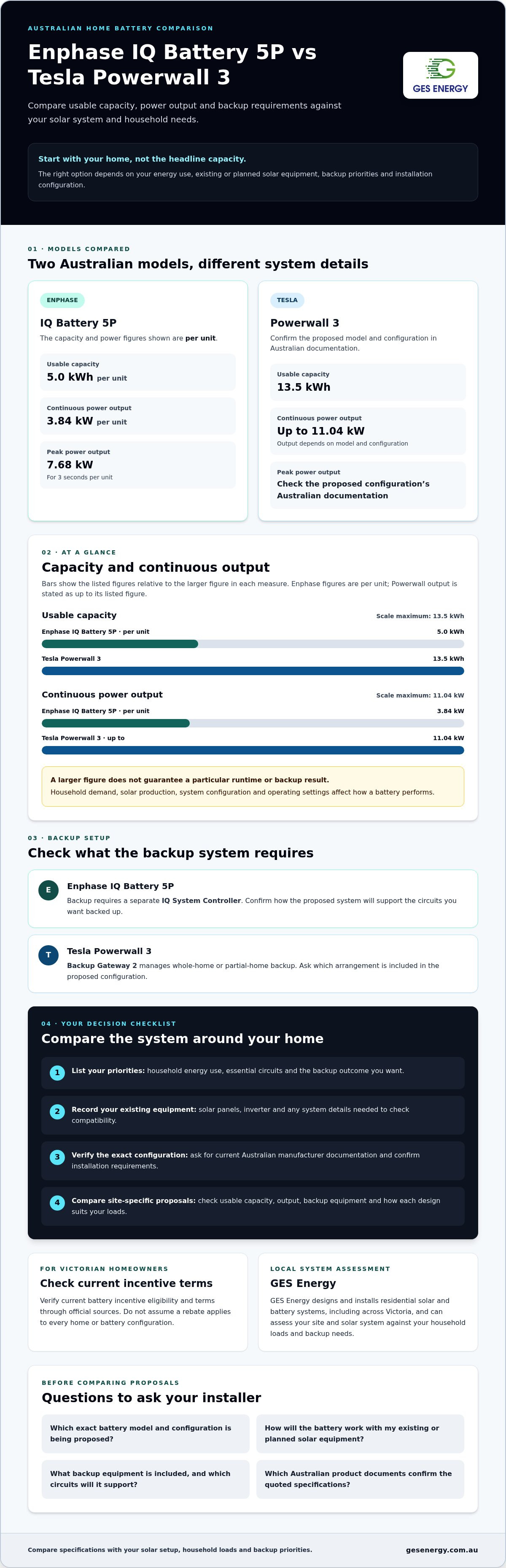
The specifications below compare two named Australian models: Enphase IQ Battery 5P and Tesla Powerwall 3. Capacity tells you how much energy a battery can store; power output indicates how quickly it can supply that energy. These figures help frame the enphase iq battery vs tesla powerwall comparison, but they don’t guarantee a particular runtime or backup result.
| Specification | Enphase IQ Battery 5P | Tesla Powerwall 3 |
|---|---|---|
| Usable capacity | 5.0 kWh per unit | 13.5 kWh |
| Continuous power output | 3.84 kW per unit | Up to 11.04 kW, with output dependent on model and configuration |
| Peak power output | 7.68 kW for 3 seconds per unit | Check the proposed configuration’s Australian documentation |
| Backup dependency | Requires a separate IQ System Controller for backup | Backup Gateway 2 manages whole-home or partial-home backup |
Check manufacturer specifications against the actual installation configuration before relying on any figure. Ask your installer for current Australian product documentation for the proposed models and an explanation of how the figures apply to your home.
How much energy can each battery store and deliver?
The Enphase 5P stores 5.0 kWh per unit, while one Powerwall 3 stores 13.5 kWh. Their output figures describe a different measure: 3.84 kW of continuous output per Enphase unit, compared with up to 11.04 kW for Powerwall 3, depending on model and configuration. Enphase also lists 7.68 kW peak output for three seconds per unit. Higher output can support a greater combined load at a given moment, but it doesn’t indicate how long the battery will run appliances. That depends on available energy and what your home is using.
What happens to power during an outage?
Let your backup needs shape the design. Decide whether you want whole-home backup or selected circuits, such as lighting, refrigeration and communications. The Powerwall 3 can be configured for whole-home or partial-home backup through Backup Gateway 2. Enphase 5P backup requires an IQ System Controller, and the supported loads depend on the system configuration.
Both capacity and available output can affect which appliances operate together during an outage. Actual performance also depends on household load, system design and operating conditions. Ask the installer to identify the backed-up circuits, explain any load limits and confirm the applicable Australian model documentation. For a site-specific assessment, consider residential solar and battery system design from GES Energy.
Which battery integrates better with your solar system and home?
Compatibility depends on the equipment already installed and the battery configuration being proposed. The Enphase IQ Battery 5P is an AC-coupled system with integrated microinverters. Tesla Powerwall 3 has an integrated solar inverter and uses a DC-coupled design. These differences can affect how a battery connects to your solar panels and inverter, particularly in a retrofit.
Neither option is automatically compatible with every home. The enphase iq battery vs tesla powerwall choice should follow a check of your existing system and the manufacturer’s requirements for the exact Australian models. For broader context on planning a home energy system, refer to Solar and Battery Systems: The Complete 2026 Guide to Energy Independence.
Can you add either battery to an existing solar system?
Gather your inverter make and model, solar panel configuration, switchboard details and system documents before seeking a proposal. If you have Enphase microinverters, an Enphase battery may be a natural system match, but the installer still needs to check model compatibility and site requirements. Powerwall 3’s integrated solar inverter may suit some designs, but don’t assume it can simply replace or connect to existing equipment without changes.
Ask the installer to confirm the proposed connection method, any equipment that needs to remain or change, and whether the system can operate as intended with your current solar setup. A brand name alone can’t confirm retrofit suitability.
Which system fits your household’s energy and backup priorities?
Look at when your home uses electricity. If daytime solar generation already covers much of your use, consider how much energy you want to shift into evening consumption. If backup is your priority, identify the circuits and appliances you want supported, then ask how the proposed system will manage them during an outage.
Also consider where the equipment can be installed, whether you may change your solar system later, and how you want to monitor energy use. App access and energy-management features can depend on the product, configuration and associated equipment. Ask the installer to demonstrate which functions apply to your specific design rather than relying on general product descriptions.
A useful proposal should explain how the battery, inverter, solar array and backup equipment work together in your home. GES Energy designs and installs residential solar and battery systems across Australia, with a focus on Victoria. Its team can assess your existing equipment and household priorities as part of a site-specific comparison.
How to choose between Enphase IQ Battery and Tesla Powerwall in Victoria
A clear comparison starts with your household’s priorities and the details of your solar system. Use this checklist to prepare for installer discussions and assess proposals on the same basis.
- Define your priorities. Decide whether you want to store more daytime solar for evening use, back up selected circuits or support more of your home during an outage.
- Gather your system details. Collect recent electricity bills, solar panel and inverter information, system documents and any records of previous upgrades.
- Verify the proposed models. Ask each installer to name the exact Australian battery model, generation and configuration in writing. Check specifications against current manufacturer documentation.
- Assess your site. Have the installer check the existing equipment, switchboard, available installation space and requirements for your preferred backup arrangement.
- Compare proposals. Review usable capacity, power output, compatibility, backup circuits, installation scope, warranty terms, maintenance arrangements and exclusions.
This process makes the enphase iq battery vs tesla powerwall decision specific to your home, rather than relying on brand claims or headline figures. It also helps you spot differences in what each proposal includes.
What information should you prepare before requesting a quote?
Recent bills can help installers understand when your household uses electricity. Add details of your solar panels and inverter, plus any system documentation you have. If backup matters, list the appliances or circuits you want to keep running during an outage and explain the outcome you expect. Ask the installer to record the exact battery model and proposed configuration so you can compare like with like.
What should a battery proposal confirm?
Request written answers on usable capacity, continuous and peak output where defined, solar-system compatibility and the backup arrangement. Check which circuits are included, what installation work is covered, and what warranty and maintenance terms apply. Note any exclusions or conditions, and ask the installer to explain how the proposed equipment will work with your existing or planned solar system.
If a proposal includes a solar battery incentive, ask which programme it refers to and how it affects your specific design. Eligibility, approved products and application terms can change. Victorian homeowners should check current requirements directly with the relevant Australian or Victorian government source before relying on an incentive in their decision.
For a site-specific comparison, request a solar system design assessment from GES Energy. The team designs residential solar and battery systems across Australia, including Victoria.
Get a site-specific Enphase IQ Battery vs Tesla Powerwall design
The right battery choice depends on more than headline capacity. Before deciding on the enphase iq battery vs tesla powerwall, confirm the Australian model, check how it will connect to your existing or planned solar equipment, and match its storage and backup configuration to your household’s energy use.
A tailored assessment can turn those priorities into a clear system proposal. It should identify the battery model and configuration, explain how it integrates with your solar system, and set out which household loads the backup design is intended to support. Any assumptions or specifications that still need confirmation should be made clear before you approve the work.
What a tailored battery assessment should resolve
Ask the designer to assess your property, solar equipment and household requirements together. The proposal should confirm:
- Which Australian battery model or models suit your site and existing solar equipment.
- The proposed storage capacity and power output, with figures tied to the specific configuration.
- Whether backup is included, which circuits it covers, and what equipment the design requires.
- The installation scope, relevant warranty conditions, maintenance arrangements and any exclusions.
This detail helps you compare suitable options on consistent terms. It also gives you a chance to resolve uncertainties about compatibility, backup loads or product specifications before making a decision.
Why consider GES ENERGY for battery system design?
GES Energy designs and installs residential solar and battery systems across Australia, with a focus on Victoria. Its services include system maintenance, inverter repairs and warranty assistance. The scope of support depends on the system and work required.
If a battery is part of a wider home energy plan, consider how your solar, storage and other planned equipment need to work together. For example, if you’re also planning an EV charging station, include its expected use in the system discussion.
Share your property details, current solar equipment, electricity use and backup priorities with GES Energy. Request a tailored battery assessment to compare suitable options for your home.
Choose the battery that fits your home’s energy plan
The enphase iq battery vs tesla powerwall choice comes down to your solar equipment, household energy use and backup priorities. Compare the exact Australian models and configurations, then check usable storage, power output, compatibility and which circuits the proposed system can support during an outage.
A site-specific design helps connect those details to your property rather than relying on headline specifications alone. GES Energy designs and installs residential solar and battery systems, and can assess your equipment and household requirements as part of a tailored proposal.
Discuss your solar system, energy priorities and backup needs with GES Energy. Request a site-specific solar and battery assessment to compare options for your home.
Frequently Asked Questions
Is the Enphase IQ Battery better than the Tesla Powerwall?
Neither is automatically better for every home. The enphase iq battery vs tesla powerwall choice depends on your existing or planned solar equipment, energy use and backup priorities. The Enphase IQ Battery 5P is modular, while the Tesla Powerwall 3 combines storage with an integrated solar inverter. Compare the exact Australian models, system compatibility and proposed configuration rather than relying on brand claims alone.
Can an Enphase IQ Battery or Tesla Powerwall work with my existing solar system?
Either may suit an existing system, but compatibility needs a model and site-specific check. Your inverter type, solar configuration, switchboard and proposed battery arrangement all matter. Enphase microinverters may make an Enphase battery a natural system match, but don’t assume compatibility without confirmation. Give an installer your system documents and inverter details, then ask them to confirm the proposed connection and any equipment changes in writing.
How much usable storage do the Enphase IQ Battery and Tesla Powerwall provide?
The Australian Enphase IQ Battery 5P provides 5.0 kWh of usable capacity per unit. The Tesla Powerwall 3 provides 13.5 kWh. These figures describe stored energy, not how quickly the battery can supply it or how long it will run your home. Actual use depends on household loads, solar generation, system configuration and operating settings. Confirm the exact model and proposed setup before comparing specifications.
Can a Tesla Powerwall or Enphase IQ Battery power a home during an outage?
Both can be configured for backup, but the design determines which loads receive power. Tesla Powerwall 3 backup uses a Backup Gateway 2 and can be set up for whole-home or partial-home backup. Enphase IQ Battery 5P backup requires a separate IQ System Controller. Ask which circuits the proposal covers and how the system is designed to manage your appliances during an outage.
Which battery is better for backup power in Victoria?
The best fit depends on the backup outcome you need, not your postcode alone. A single Powerwall 3 has a higher stated continuous output than one Enphase IQ Battery 5P, but system configuration and household loads affect performance. Ask installers to design for your essential circuits or whole-home backup needs and confirm the Australian model specifications. Compare proposals for your property in Melbourne or regional Victoria.
Are Enphase IQ Battery or Tesla Powerwall installations eligible for Australian battery incentives in 2026?
Some installations may qualify for the federal Cheaper Home Batteries Program, which is active in Victoria, but eligibility isn’t automatic for every household, battery or configuration. Product approval, installer accreditation and other programme conditions may apply. Check current requirements and application terms through official government sources before including an incentive in your budget. Don’t assume an older Victorian battery loan is available to new applicants.
How do I compare an Enphase IQ Battery and Tesla Powerwall quote?
Ask each installer to identify the exact battery model and configuration, usable capacity, power output, compatibility, backup circuits, installation scope, warranty conditions and exclusions. Check any incentive assumptions separately. GES Energy designs and installs solar and battery systems for residential customers. Homeowners in Melbourne, Geelong, Ballarat, Bendigo, Shepperton, Melton, Mildura, Wodonga, Traralgon, Wangaratta, Horsham, Sale, Colac, Echuca, Ararat, Portland, Swan Hill, Benalla and Maryborough can request a site-specific assessment.


