

The most capable-looking microgrid may not be the right fit for your site. A microgrid feasibility assessment tests the whole energy system before equipment is sized, helping you determine whether a grid-connected, islandable or off-grid concept matches your energy use, operating priorities and reliability needs. Costs, network constraints and approval pathways vary by location, including across Victoria.
Before committing to a design, you need site-specific evidence. This guide explains how to assess technical, operational and commercial feasibility, compare options and reach a clear go, refine or no-go decision. It covers the information an assessment needs, from load data and existing electrical infrastructure to local network conditions, available space and renewable resources. You’ll also see how findings can shape system sizing, operating strategy, risks and costs, then guide the next steps into design and delivery. GES Energy provides microgrid development and EPC services across Australia, with commercial and industrial solar design for projects from 10 kW to 5 MW.
Key Takeaways
- A microgrid feasibility assessment supports an evidence-based go, refine or no-go decision. It does not guarantee a particular project outcome.
- Use interval energy data and critical-load profiles to understand demand and inform system sizing and operating scenarios.
- Compare grid-connected, islandable and off-grid concepts against your site’s resilience goals, grid dependence and operational needs.
- Record assumptions, constraints, risks and information gaps as you move from project objectives and data collection to options analysis and recommendations.
- GES Energy connects feasibility findings with microgrid development and EPC services, delivering utility-scale projects up to 5 MW across Australia.
What does a microgrid feasibility assessment determine?
A microgrid feasibility assessment evaluates whether a site’s energy needs, operating requirements and commercial case support a proposed microgrid. It gives decision-makers a clear go, refine or no-go recommendation, rather than guaranteeing a project outcome.
The assessment considers how generation, battery storage, control systems and grid supply could work together at your site. A Microgrid can operate in different ways, so the review needs to test the proposed configuration against site-specific conditions. It identifies what appears practical, what needs further investigation and which assumptions could change the decision.
Feasibility is an early project stage. It informs next steps, but it is not detailed engineering and design, procurement, construction or ongoing system maintenance. Those stages need their own planning and delivery work. A well-scoped assessment gives your organisation a sound basis for deciding whether to proceed and what to investigate next.
What questions should the assessment answer?
The assessment should establish how much energy the site uses, when demand peaks and which loads are critical to safe or continuous operations. At an industrial site, this could mean identifying processes that cannot easily pause. At a commercial facility, it might mean prioritising essential services during an outage.
It should also examine how solar generation, battery storage, controls and grid supply could meet those needs during normal operation and, where required, an interruption. The review can flag gaps such as incomplete load records, unknown network capacity, limited equipment space or operating requirements that need investigation before a decision.
Which sites may benefit from investigating a microgrid?
Industrial and commercial sites may have reason to investigate a microgrid if they have high or variable energy demand, critical loads, clear resilience priorities, or an opportunity to coordinate on-site generation and storage. Infrastructure sites with essential operating functions may also need to assess how energy supply can support those functions.
Remote and regional Victorian sites may face different network conditions from sites closer to major centres, but location alone does not determine suitability. Grid capacity and connection requirements are specific to each site and project. Physical conditions, operational priorities and the commercial case also matter. A feasibility review brings these factors together so your organisation can weigh the opportunity against the constraints before committing to a design.
What technical and site data does a microgrid assessment need?
A useful assessment brings several types of evidence together. The quality of the inputs affects how confidently the findings can be used and how useful the subsequent design work will be. Incomplete or outdated information can leave important operating conditions and constraints unclear.
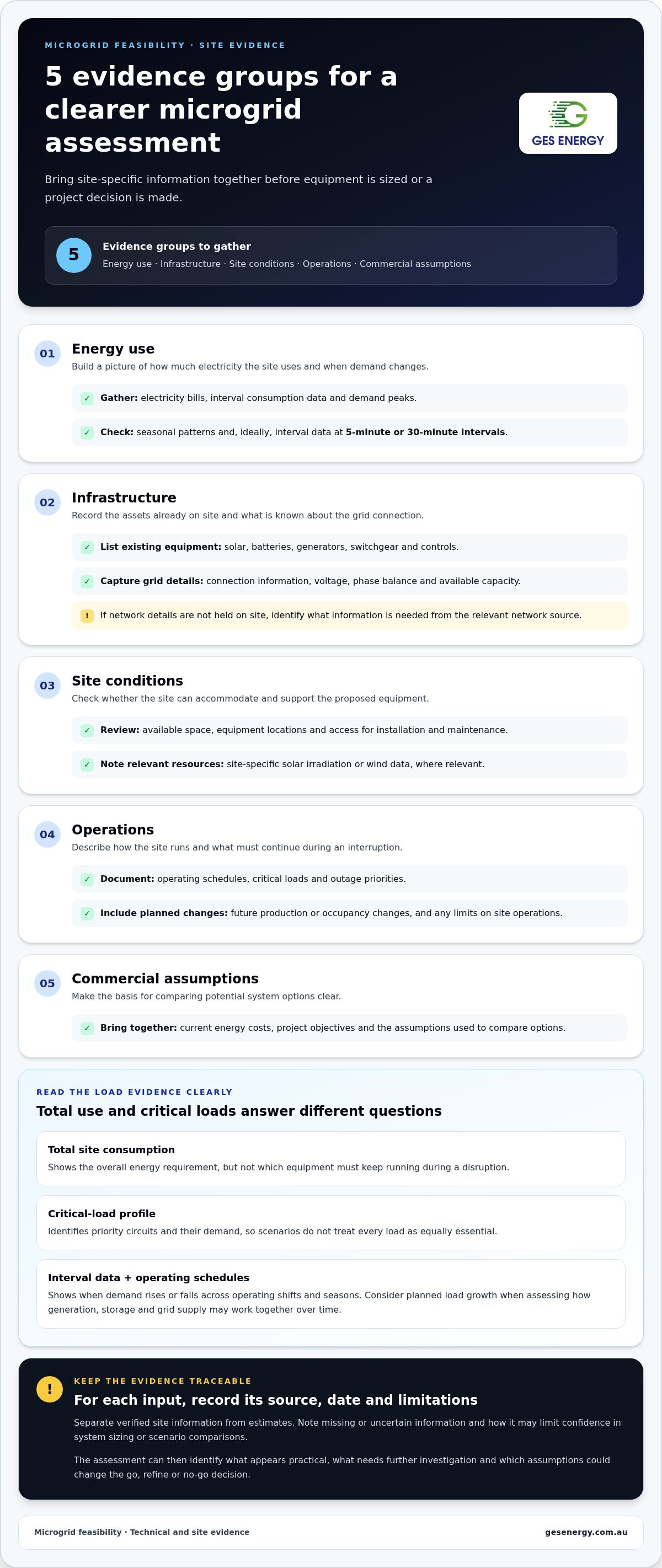
Gather information across five areas:
- Energy use: electricity bills and interval consumption data, ideally at 5-minute or 30-minute intervals, as well as demand peaks and seasonal patterns.
- Infrastructure: details of existing solar, batteries, generators, switchgear, controls and the grid connection. Network information such as voltage, phase balance and available capacity can help identify connection constraints.
- Site conditions: available space, equipment locations, access for installation and maintenance, and site-specific solar irradiation or wind data where relevant.
- Operations: operating schedules, critical loads, outage priorities, planned changes to production or occupancy, and any limits on how the site can operate.
- Commercial assumptions: current energy costs, project objectives and the assumptions used to compare potential system options.
For each input, record its source, date and any limitations. This makes it easier to distinguish verified site information from estimates and to identify gaps that need attention before a decision.
How do load profiles and critical loads shape the assessment?
Total site consumption shows the overall energy requirement, but not which equipment must keep running during a disruption. A separate critical-load profile identifies priority circuits and their demand. This helps the assessment test different operating scenarios without treating every load as equally essential.
Interval data shows when demand rises or falls across operating shifts and seasons. Pair it with operating schedules and planned load growth to assess how generation, storage and grid supply may need to work together over time. If records are missing or a future load is uncertain, document the gap and explain how it limits confidence in system sizing or scenario comparisons.
What site and infrastructure conditions need review?
Review the site layout, available equipment areas, access routes and existing electrical infrastructure. Document the capacity and condition of known assets, including generation, storage, switchgear, controls and the grid connection. For network details not held on site, identify the information needed from the relevant network source instead of making assumptions.
Australian and Victorian connection, planning and compliance requirements can depend on the project and location. Flag them for project-specific verification during assessment and design, rather than assuming one set of conditions applies everywhere. GES Energy supports microgrid development and EPC services for projects across Australia, from its Melbourne base.
How do grid-connected, islandable and off-grid microgrids compare?
The main difference is how each configuration relates to the electricity grid and what happens if grid supply is unavailable. None is automatically the right choice. A microgrid feasibility assessment compares each concept with your site’s energy needs, resilience objectives and operating capacity.
| Configuration | Grid dependence | Resilience objective | Controls and storage considerations | Operating complexity |
|---|---|---|---|---|
| Grid-connected | Connected to the local grid during normal operation. | May support energy management and flexibility. It does not necessarily provide backup during an outage. | Generation and storage operate alongside grid supply. Any backup function depends on the system design and controls. | Depends on how generation, storage and site loads are coordinated. |
| Islandable | Normally connected, with the capability to separate from the main grid if designed to do so. | Can be planned to supply defined critical loads while operating separately from the grid. | Controls must manage the transition and balance available generation, storage and critical demand. | Requires careful coordination across grid connection, controls and site loads. |
| Off-grid | Operates without a grid connection as its supply source. | Designed to meet site demand from on-site energy resources. | Generation, storage and controls need to be assessed together against demand and available energy. | Requires planning for changing supply and demand without grid support. |
Resilience depends on the system design, controls, available energy and the critical loads the site needs to maintain, not just the configuration name. A battery can support an operating strategy, but its presence alone does not establish which loads can be supplied or for how long.
When might a grid-connected microgrid fit?
A grid-connected concept may suit a site aiming to coordinate on-site generation and storage with its existing supply. Depending on the design, this can support energy management, operational flexibility or a defined resilience plan. For a Victorian business, assess the relevant network conditions and connection requirements for the specific project. The site’s existing connection and local network capacity can affect which options are practical.
What changes when a site needs islanding or off-grid operation?
Islanding means operating separately from the main grid when the system has been designed to do so. The assessment must define which loads matter, then test how controls, generation and storage can serve them under the intended operating conditions. Off-grid planning also needs to account for the site’s energy requirements without relying on grid supply. For storage fundamentals, see the guide to industrial battery storage.
What stages turn a feasibility assessment into a project decision?
A microgrid feasibility assessment should leave your organisation with a decision path, not just a preferred technology. A clear process connects project objectives and site evidence to options, risks and practical next steps.
- Set objectives. Define what the project needs to achieve, such as managing energy use, supporting critical operations or supplying a site with limited grid access. Record the outcomes that matter and how they will guide the comparison.
- Collect and review data. Bring together site load, infrastructure, operating and commercial information. Note each input’s source and date, then list gaps that could affect the findings.
- Develop and compare options. Test suitable configurations against energy needs, resilience objectives, constructability and operational requirements. Include grid-connected, islandable or off-grid concepts where relevant to the site.
- Assess risks and commercial assumptions. Compare options using stated assumptions about system operation, asset life and ongoing requirements. Separate evidence-based findings from estimates that need further engineering. Document constraints such as network conditions or site access.
- Recommend a decision and next steps. Present a go, refine or no-go recommendation, along with the preferred concept, alternatives and unresolved questions. If proceeding, identify the further design, project-specific approvals and delivery planning required.
How should assessment options be evaluated?
Apply the same criteria to each concept so the comparison is fair. Check whether an option can meet the site’s energy and resilience objectives, how it fits operating schedules, and whether the physical site and existing infrastructure can support it. Make lifecycle considerations and commercial assumptions visible rather than hiding them in a single headline result. Label estimates that depend on detailed engineering.
What should a useful feasibility report contain?
A decision-ready report summarises the preferred concept and alternatives, the evidence used, key assumptions, constraints, risks and information gaps. It may include an indicative system concept showing how generation, storage, controls and grid supply could work together. Make clear that this is not final engineering design. Set out the next investigations and project stages, with Australian and Victorian requirements verified for the specific site.
When the assessment supports moving forward, detailed design can inform procurement and construction through EPC services. GES Energy’s guide to solar EPC services in Australia explains how those delivery stages fit together. To progress a site-specific microgrid concept, explore GES ENERGY microgrid solutions.
How can GES Energy support microgrid feasibility and delivery?
A feasibility assessment connects your site’s energy requirements with a project concept that can be developed further. GES Energy provides microgrid development and EPC services, linking assessment findings with the next stages of engineering, procurement and construction. The findings can help define the system concept, highlight design questions and identify project-specific requirements for further review.
GES Energy delivers utility-scale projects up to 5 MW and serves projects across Australia from its Melbourne base. With over 10 years in renewable energy and more than 2,500 successful installations, the business brings experience in solar and energy systems to projects where those technologies form part of a microgrid. Assessment findings guide the next steps, while final specifications and delivery scope are developed for the individual project.
How does feasibility connect with engineering and construction?
Feasibility findings can inform engineering decisions about system configuration, generation, storage, controls and connections to existing infrastructure. They also help shape procurement and construction planning by identifying equipment needs, site constraints and unresolved technical questions. This early work does not replace detailed design, which develops the specifications and delivery scope for the project.
Where commercial solar is part of the proposed system, its generation profile and integration with storage and site operations need to align with the wider microgrid concept. GES Energy designs commercial and industrial solar systems, and the commercial solar installation guide explains key considerations for Australian businesses.
What delivery credentials help build confidence?
Project delivery depends on more than a sound concept. GES Energy’s in-house teams are certified with ISO 9001, ISO 14001 and ISO 45001, and the business is a Solar Accreditation Australia-accredited installer. These credentials are relevant as technical, quality, environmental and safety considerations move into delivery planning.
For commercial and industrial projects, GES Energy provides a 10-year workmanship warranty covering workmanship on those projects. The project experience, stated credentials and defined warranty give organisations clear information to consider as they plan the move from feasibility into delivery.
If your assessment points towards a project, discuss a microgrid project with GES Energy and connect the findings with a practical pathway for engineering and delivery.
Turn your feasibility findings into a clear next step
A sound microgrid feasibility assessment gives your organisation a site-based foundation for choosing whether to proceed, refine the concept or pause. Strong load data, a clear understanding of critical operations and a fair comparison of grid-connected, islandable and off-grid options help turn uncertainty into a practical project decision.
When the evidence supports moving forward, GES Energy can connect feasibility findings with microgrid development and EPC services. The team delivers utility-scale projects up to 5 MW and serves projects across Australia. GES Energy brings over 10 years in renewable energy, more than 2,500 successful installations, and in-house teams certified with ISO 9001, ISO 14001 and ISO 45001.
Take the next step with a project pathway shaped around your site’s energy needs and operating priorities. Discuss your microgrid project with GES Energy and move towards a well-informed design decision.
Frequently Asked Questions
What is included in a microgrid feasibility assessment?
A microgrid feasibility assessment reviews whether a site’s technical, operational and commercial needs support a microgrid concept. It considers energy demand, critical loads, existing infrastructure, possible generation and storage, controls, grid conditions and project assumptions. The findings help you compare options and make a go, refine or no-go decision. They are not a guarantee of project outcomes or a substitute for detailed engineering, approvals, procurement, construction or ongoing maintenance.
How long does a microgrid feasibility assessment take?
The time required depends on the site, assessment scope and how much reliable information is available. Complete interval energy data, infrastructure records and clear operating requirements can help the assessment progress efficiently. Missing load records, unresolved network questions or uncertain future demand may require further investigation. The assessment should make information gaps visible rather than imply a fixed timeline or present early estimates as confirmed findings.
Is a microgrid suitable for a grid-connected site?
Yes. A grid-connected site can be suitable for a microgrid, depending on its energy needs, operating priorities, network conditions and project economics. On-site generation and storage may operate alongside grid supply, while an islandable design may be assessed if the site has defined resilience objectives. A site-specific review is needed to understand connection conditions and whether a proposed configuration fits the way the organisation operates.
What data do I need for a microgrid assessment?
Start with electricity bills and interval consumption data, ideally recorded at 5-minute or 30-minute intervals. Provide operating schedules and a separate profile of critical loads, then gather details of existing solar, batteries, generators, switchgear, controls and grid connection. Site layout, available space and access information also help. Include planned changes to demand and relevant commercial assumptions, and note where records are incomplete or estimated.
What is the difference between a microgrid feasibility study and detailed design?
A feasibility study compares concepts and tests whether the site’s needs, constraints and commercial assumptions support proceeding. It can recommend a preferred option and identify further work, but its indicative system concept is not a final specification. Detailed design develops the engineering information needed to define the project’s equipment, configuration and delivery scope. Procurement and construction follow as later project stages, informed by that detailed work.
Can a microgrid operate when the main grid is unavailable?
It can, if the microgrid is designed and controlled to operate separately from the main grid. This is known as islanding. Whether the system can supply the site during an interruption depends on its controls, available generation and storage, and the critical loads it is intended to support. A feasibility assessment should define those loads and examine operating conditions rather than assume a battery or solar system alone provides backup.
Does a microgrid feasibility assessment include solar and battery options?
Yes. The assessment can examine how solar generation and battery storage may work with site demand, controls and grid supply. Compare options against operating schedules and critical-load priorities, rather than sizing equipment in isolation. GES Energy provides microgrid development and EPC services across Melbourne, Geelong, Ballarat, Bendigo, Shepperton, Melton, Mildura, Wodonga, Traralgon, Wangaratta, Horsham, Sale, Colac, Echuca, Ararat, Portland, Swan Hill, Benalla and Maryborough.


