

What if your industrial microgrid needs to be designed around when, where and how your business uses energy, rather than simply adding more generation? Industrial microgrid design should start with actual operating loads and priorities, not a standard equipment package. A system that doesn’t reflect production patterns, critical loads or grid connection requirements may not support the outcomes your site needs.
To assess your options, weigh reliability, energy cost management and system configuration together. This guide explains the main components of an industrial microgrid, including generation, battery storage, controls and the grid connection. It also outlines how site conditions shape design decisions and which engineering, connection and delivery steps can move a project forward. GES ENERGY designs commercial solar systems from 10 kW to 5 MW and delivers solar, battery and microgrid projects across Australia, with a strong focus on Victoria. Starting with your site’s needs helps you make informed decisions about a system designed to support the way your operation runs.
Key Takeaways
- Start industrial microgrid design with interval load data, demand peaks, operating schedules and critical loads to shape a system around actual site needs.
- Compare grid-connected, islandable and off-grid configurations against your operating priorities. Islanding requires coordinated controls and project-specific engineering.
- Move through a clear project sequence, from objectives and site data to feasibility, design, delivery and ongoing maintenance.
- Account for Australian connection requirements and local site conditions, including Victoria-specific considerations where relevant.
- GES ENERGY’s microgrid development and EPC services can coordinate solar, battery storage and EV charging for projects across Australia.
What industrial microgrid design means for an energy-intensive site
An industrial microgrid coordinates energy resources to serve a defined site or group of loads. It can combine generation, battery storage, controls and a grid connection to meet the site’s operating needs. A microgrid may remain connected to the electricity network, while some designs can also operate separately from it. The foundational What is a microgrid overview explains these operating modes.
This involves more than installing solar panels or adding battery capacity. Those assets can reduce grid electricity use or store energy, but microgrid design also considers how they work together, how energy is managed across the site and which loads take priority. The controls and connection arrangement need to support the intended operating mode, rather than treating each asset as a separate upgrade.
“The site load profile is the starting point for industrial microgrid design because it shows when energy is needed, how demand changes and which operations matter most.”
Which industrial sites may consider a microgrid?
A microgrid may suit sites with demanding, variable or operationally critical electricity needs. For example, production equipment at a manufacturing site may create sharp demand peaks, while a food processor may have refrigeration and processing loads that follow different schedules. These examples don’t mean every factory needs a microgrid. The case depends on the site’s load profile, operating priorities, existing energy assets and grid connection.
Manufacturing and processing businesses in Victoria can use this approach to assess how on-site energy resources might support their operations. The same principles apply across Australia, but every project needs to account for its own site conditions and connection requirements.
What outcomes should the design account for?
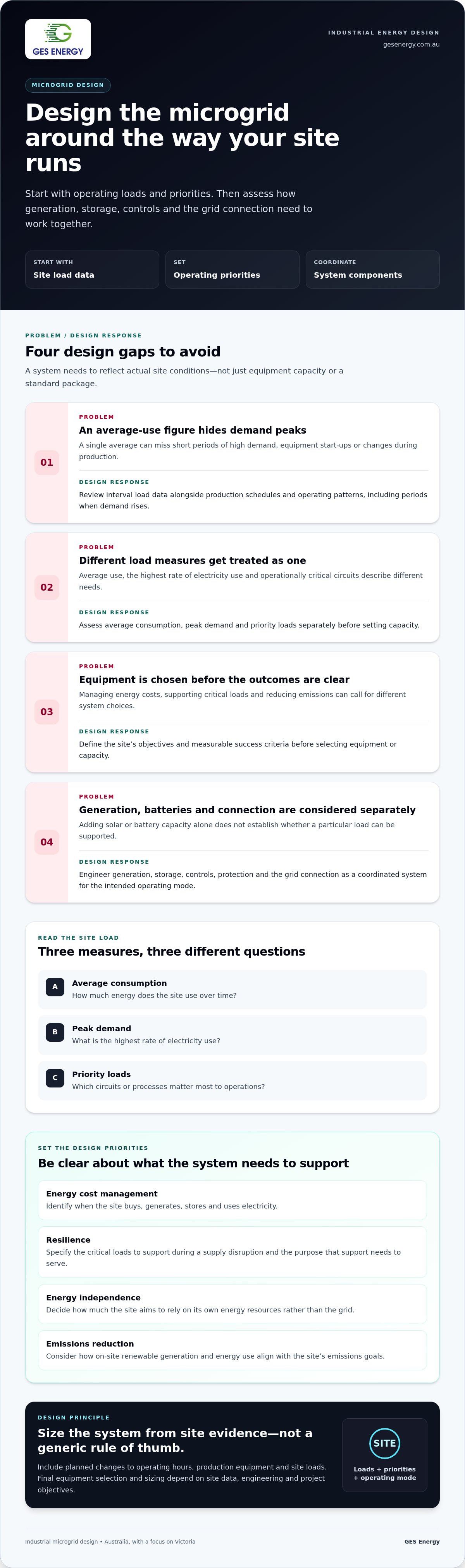
Set clear objectives before selecting equipment or capacity. Different priorities can lead to different system choices:
- Energy cost management: Identify when and how the site buys, generates, stores or uses electricity.
- Resilience: Specify which critical loads should receive support during a supply disruption and the operating purpose that support needs to serve.
- Energy independence: Decide how much the site aims to rely on its own resources rather than the grid.
- Emissions reduction: Consider how on-site renewable generation and energy use align with the site’s emissions goals.
These outcomes can overlap, but they aren’t interchangeable. A design focused on managing energy costs may differ from one intended to support selected loads during an outage. Define measurable success criteria first, then assess the generation, storage, controls and grid arrangement that fit your priorities.
The core components and design inputs behind an industrial microgrid
Good design connects what a site uses with what its energy system can supply and control. Engineering starts with operational evidence, then assesses how generation, storage and controls can work within the site’s electrical infrastructure and connection requirements. This helps prevent equipment selection based on nameplate capacity alone.
How load profiles shape microgrid capacity
Review interval load data alongside production schedules and site operating patterns. Compare representative periods, including shifts when equipment starts, production changes or demand rises. A single average consumption figure can hide short periods of high demand that affect system design.
Separate three measures: average consumption, which shows energy used over time; peak demand, which shows the highest rate of electricity use; and priority loads, which are the circuits or processes that matter most to operations. A site may have modest average use but sharp peaks, or a critical process that needs different support from the rest of the facility.
Include planned changes to operating hours, production equipment or site loads in the assessment. Set capacity after analysing this information and the project’s objectives, rather than applying a generic rule of thumb.
How generation, storage and controls work together
Solar PV can supply part of a site’s electricity when generation is available. Battery energy storage can store energy for later use, support energy shifting or contribute to continuity objectives, depending on its design and control settings. Other suitable generation may also form part of the energy mix where site conditions and project goals support it.
A microgrid controller coordinates these resources in response to site demand and the intended operating mode. Its control logic determines how system components respond as generation and loads change. Monitoring helps operators understand system performance, while protection and control arrangements need engineering to suit the electrical system and operating requirements.
Consider generation, storage and controls as a connected system. Adding battery capacity alone won’t establish whether the system can support a particular load or operating period. The design needs to account for required power, stored energy, intended use and interaction with other equipment. Final equipment selection and sizing depend on site data, engineering and project objectives.
In Victoria and elsewhere in Australia, the site’s existing electrical infrastructure and grid connection are important design inputs. Assessing them alongside operational data helps define a system that fits the facility. Explore GES ENERGY’s microgrid solutions for support aligning site requirements, generation and storage.
Grid-connected, islandable or off-grid: compare microgrid design options
A microgrid doesn’t have to disconnect from the main grid during normal operation. A grid-connected system can coordinate on-site generation, storage and loads while remaining connected. Islanding is a separate capability: the system is designed to disconnect and operate independently when required. Off-grid systems operate without a grid connection.
The operating mode sets design priorities: grid-connected systems coordinate on-site energy with the network, islandable systems add a planned transition to independent operation, and off-grid systems must meet site demand without grid supply. None is automatically the best choice. The right industrial microgrid design depends on the site’s objectives, connection conditions and operating requirements.
When does a grid-connected microgrid fit?
A grid-connected arrangement may suit a facility looking to manage how on-site solar and storage work alongside electricity imported from the network. It can support energy management objectives while the site retains its grid connection. The design still needs to account for connection conditions and how on-site resources interact with the network.
Connection requirements depend on the relevant network and the rules that apply to the project. Assessing these early helps shape a feasible system arrangement, including how generation and storage can operate at the site.
When might islandable or off-grid operation matter?
An islandable microgrid is designed to separate from the grid and continue supplying some or all site loads independently. This may support resilience objectives, but it doesn’t mean every load will keep operating in every circumstance. The design needs to define which loads are prioritised and how available generation and storage support them.
Islandable operation requires coordinated controls and engineering for both the transition between connected and islanded modes and operation while separated. The system needs to manage its resources and loads in each mode. Islandability is therefore a design decision, not simply an extra setting on a battery.
An off-grid arrangement may be considered where a grid connection is unavailable or unsuitable. Without grid supply, the system must be designed around site demand and available generation and storage. This calls for careful attention to operating schedules, critical loads and energy management. Weigh resilience and independence goals against the additional equipment, control and engineering requirements involved.
Compare the options against your site’s connection conditions and required outcomes. An early engineering assessment helps clarify the appropriate operating mode and its design implications.
How to plan an industrial microgrid design project in Australia
A clear project sequence helps move an operational need towards a system that can be engineered, connected and maintained. For industrial microgrid design, treat early information as a starting point, not a substitute for formal site studies or project-specific engineering.
What information should a site assemble first?
Gather available electricity bills, interval data, operating schedules and site plans. Add a list of critical loads, planned electrification and expected changes to production or operating hours. These records help shape the project brief and reveal what further assessment is needed.
Preliminary information can guide feasibility work, but it doesn’t establish final equipment sizes, electrical arrangements or connection suitability. Those require detailed assessment and engineering.
How feasibility and engineering refine the concept
Site assessment helps determine how generation, storage, controls and the grid connection can work together. It also tests the concept against site constraints, operating goals and relevant connection requirements. For a Victorian plant, the design needs to reflect its location and the requirements of the relevant distribution network service provider (DNSP). Projects elsewhere in Australia have their own network and site conditions.
Applicable Australian standards, connection requirements, compliance and safety considerations need project-specific review. Don’t assume that a design or connection approach used at one site will suit another.
GES ENERGY’s EPC services bring engineering, procurement and construction together for coordinated project delivery. This connects technical design with equipment selection and construction planning. Explore the related guidance on industrial battery storage solutions and solar EPC services as you develop your project brief.
A practical project sequence
- 1. Set objectives: Define the outcomes the project needs to support, such as managing energy use or providing for selected operational loads.
- 2. Assemble site data: Collect bills, interval data, schedules, site plans and information about critical loads and future changes.
- 3. Assess feasibility: Review site conditions, existing infrastructure, possible energy resources and the connection context.
- 4. Complete engineering and design: Develop the generation, storage, control and connection arrangements, including project-specific standards, safety and compliance reviews.
- 5. Plan delivery and maintenance: Coordinate procurement and construction, then establish an approach to maintaining the system over time.
For a project-specific assessment and delivery pathway, discuss your microgrid project with GES ENERGY.
How GES ENERGY supports industrial microgrid design and delivery
Industrial microgrid design brings together site requirements, energy assets and operating priorities. GES ENERGY develops and delivers microgrid projects in Australia, with a strong focus on Victoria. Its EPC services cover solar, battery storage and EV charging projects, coordinating engineering, procurement and construction as parts of a connected delivery pathway.
GES ENERGY’s commercial solar system design experience covers projects from 10 kW to 5 MW. This range applies to commercial solar design, not to every microgrid project. Each microgrid is shaped around its site data, objectives and engineering requirements. GES ENERGY has more than 10 years of renewable energy experience and over 2,500 successful installations. Commercial and industrial projects include a 10-year workmanship warranty.
What integrated project delivery can cover
Integrated delivery helps keep design decisions connected to procurement and construction planning. Engineering assesses how the site’s energy resources and electrical requirements fit together. Procurement follows the project specifications, and construction puts the designed system in place.
The right combination of solar PV, battery storage and EV charging depends on what your site needs to achieve. Solar may support on-site generation; storage can contribute to energy management or resilience objectives when designed for that role. EV charging can form part of the project when it aligns with transport and operational plans. A tailored design helps avoid treating each technology as an isolated addition.
After installation, a planned maintenance approach can help support system performance over time. Maintenance needs depend on the equipment and project, so include them in the wider delivery plan rather than waiting for an issue to arise.
What to prepare for an initial project discussion
Useful starting information includes your site location, operating profile, available energy data and priority outcomes. Outline planned operational changes, such as new equipment or electrification, that may affect future demand.
Be clear about whether the project aims to manage energy costs, improve resilience, increase energy independence or meet a combination of objectives. This context helps guide a project-specific assessment and ties early design decisions to the way your facility operates.
To discuss an industrial microgrid project with GES ENERGY, share your site requirements and project objectives.
Plan your next energy project with confidence
Effective industrial microgrid design starts with your site’s energy data and operating priorities. Use these to assess generation, storage and control requirements, then compare grid-connected, islandable or off-grid arrangements against your objectives and connection conditions. A considered design helps you make informed decisions about energy cost management, resilience and future operational needs.
GES ENERGY brings over 10 years in renewable energy and more than 2,500 successful installations to projects across Australia. The business delivers utility-scale projects up to 5 MW, with a 10-year workmanship warranty for commercial and industrial projects. Each project is shaped around its site and requirements.
Prepare a brief covering your location, load profile and priority outcomes. Discuss an industrial microgrid project with GES ENERGY to plan an energy system around your operation.
Frequently Asked Questions
What is industrial microgrid design?
Industrial microgrid design is the engineering process of planning coordinated energy resources to serve a defined site or group of loads. It connects generation, storage, controls and the grid connection to operational requirements. Rather than simply adding solar panels or a battery, the design considers how those assets work together, which loads matter and whether the system should remain grid-connected, operate islanded or run off-grid.
How does an industrial microgrid work?
An industrial microgrid coordinates energy sources and loads within a site. Solar PV or other suitable generation can supply electricity, while battery storage can shift energy use or support selected operating goals, depending on the design. A controller manages how resources respond to site demand and the chosen operating mode. The arrangement may work alongside the grid or, if designed for it, operate separately.
Can an industrial microgrid operate independently from the grid?
Yes, if it’s specifically designed for islandable or off-grid operation. An islandable microgrid can disconnect from the grid and continue supplying some or all designated loads, subject to available generation, storage and operating conditions. Controls and engineering need to support the transition and operation in island mode. An off-grid system has no grid supply, so its design must address the site’s energy needs without relying on the network.
What information is needed to design an industrial microgrid?
Start with available electricity bills, interval load data, operating schedules and site plans. Identify demand peaks, critical loads, planned electrification and expected operational changes. Also define your desired outcomes, such as energy cost management, resilience, energy independence or emissions reduction. This information helps shape an initial assessment, but doesn’t replace detailed site investigations, engineering or project-specific connection reviews.
How do you choose between grid-connected and off-grid microgrid design?
Base the choice on your site’s connection conditions and operating objectives. A grid-connected microgrid coordinates on-site resources while retaining the network connection. Off-grid design may suit a site without an available or suitable grid connection, but it must meet demand without grid supply. Islandable systems offer another option if independent operation is a project goal. Each configuration has different equipment, control and engineering needs.
What should Australian businesses consider before a microgrid project?
Define project goals, gather energy and operating data, assess site conditions, and review relevant DNSP connection requirements, Australian standards, compliance and safety needs for the specific project. Conditions vary across Australia. GES ENERGY serves Victorian businesses in Melbourne, Geelong, Ballarat, Bendigo, Shepperton, Melton, Mildura, Wodonga, Traralgon, Wangaratta, Horsham, Sale, Colac, Echuca, Ararat, Portland, Swan Hill, Benalla and Maryborough.


