

TL;DR: Industrial battery storage solutions utilize modular LFP chemistry to reduce operational costs by automating peak shaving and load shifting against high-capacity grid tariffs.
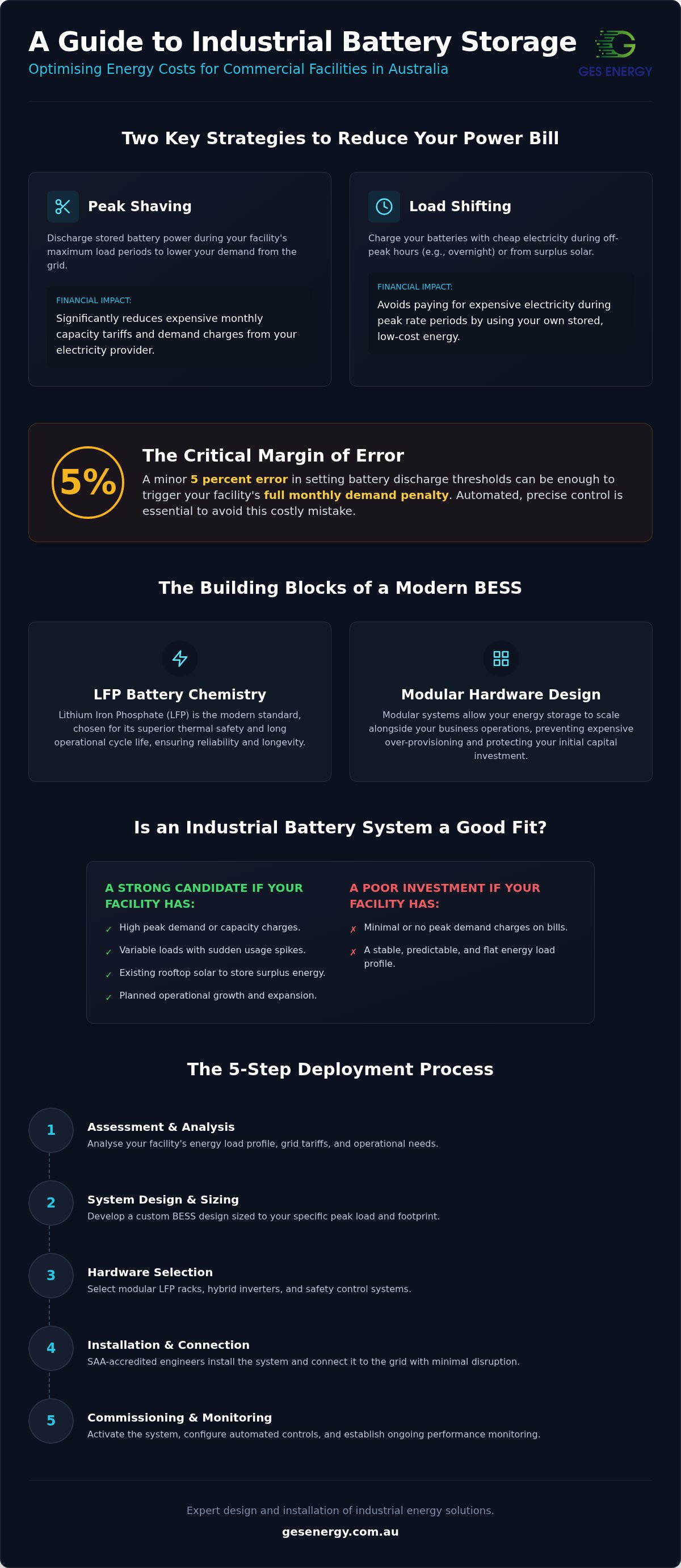
- A 5 percent error in setting discharge thresholds can trigger full monthly demand penalties.
- Industrial storage is a poor investment if facilities have minimal peak charges or stable loads.
- Select modular hardware for growing sites to prevent over-provisioning and protect initial capital reserves.
- The article provides a five-step deployment process for containerized storage from assessment to commissioning. Industrial battery storage solutions allow commercial facilities to store excess energy and dispatch power during peak grid demand periods. System investment varies based on chemistry choices, containerised footprints, and site-specific grid connection requirements. You can optimise overall facility expenditure by selecting modular hardware tailored to your operational profile: decide whether modular scale fits your load growth, whether peak shaving offsets your demand charges, and whether your site profile justifies the capital outlay at all.
Match battery architecture to footprint and peak load
Selecting the right energy storage design depends on your available footprint, voltage targets, and operational load profile. Typical situations guide the first cut: a compact warehouse with limited floor space runs better on modular indoor racks than on outdoor containers; a heavy-process plant with high peak draw needs containerised outdoor enclosures sized to actual peak load rather than nameplate ambition; a site with surplus rooftop solar pairs storage with flexible Micro-Grid & Energy Storage Solutions so excess daytime production feeds peak-shaving instead of export. With clients we see that matching physical layout to grid capacity prevents costly site retrofits. Matching system scale to actual peak load raises efficiency and avoids thermal stress on inverter units.
A custom setup balances heavy machinery demands while shielding operations from sudden blackout risks. Small sites benefit from modular indoor racks, while large industrial facilities require containerised outdoor enclosures. Choosing modular configurations supports energy independence and protects long-term operational budget stability. Contact SAA-accredited engineers at GES Energy to design a reliable layout for your commercial facility.
LFP chemistry and modular hardware shape commercial storage
Commercial energy storage systems combine battery racks, safety controls, and power conversion units to store electricity efficiently for your facility. They catch surplus solar power during the day for use during peak rate periods.
According to the Wikipedia Battery Energy Storage System 2026 entry, electrochemical batteries convert stored chemical energy into electrical energy to support local power grids. Most modern sites choose Lithium Iron Phosphate (LFP) chemistry because it provides strong thermal safety and long cycle life. Selecting high-voltage modular hardware lets your infrastructure scale alongside expanding operational loads. You can integrate advanced Sigenergy Hybrid Inverter & Battery Systems to streamline both power management and conversion in one continuous setup.
SAA-accredited engineers must sign off on thermal monitoring and automated fire suppression systems to meet Australian grid standards. If you think installation causes downtime, certified installers connect modular units rapidly without interrupting core business activities.
Peak shaving flattens demand charges on your bill
Battery storage systems reduce demand charges by discharging stored energy during facility peak usage periods, flattening your grid load profile. Grid operators calculate these penalties based on your highest power draw within a single billing interval. By supplying power locally during those spikes, your system performs peak shaving to keep grid draw below costly thresholds.
A frequently overlooked risk involves setting battery discharge thresholds merely five percent too low, which can provoke a large demand penalty across the whole month. Situation: monthly capacity tariffs spike after short load bursts. Solution: automate discharge against those intervals with controllable hybrid hardware. Result: grid draw stays under the penalty threshold for the billing window. Selecting Deye Hybrid Inverter & Battery Systems gives you the control needed to automate this process reliably. Managing peak load lets you bypass peak pricing zones and protect your operating budget.
Among GES Energy's Google reviews, HARJIT (5★) wrote:
"Prompt service. Good communication. Done a very good job. No amount of praise is enough. Very good workman ship is provided by an electrician Mr. Laadi. Very well explanation regarding solar. Best after sale service.100% recommended for roof solar."
Professional installation and detailed technical guidance ensure your storage system targets peak loads and limits unnecessary operational charges.
Load shifting and peak shaving cut commercial power costs
Commercial energy storage systems lower your power bills by charging during off-peak hours and discharging during expensive peak periods.
Direct client experience shows that large industrial sites reach faster payback by utilising peak demand shaving. Situation: sudden usage spikes inflate network demand charges on the monthly utility bill. Solution: custom Industrial Grid & HV Energy Solutions sized for those daily peaks. Result: lower capacity tariffs and steadier operating cost. You protect equipment from sudden voltage drops while building a clearer path to energy independence. Payback periods vary significantly by load shape and tariff structure.
| Cost Reduction Strategy | Financial Impact Mechanism | Operational Benefit |
|---|---|---|
| Peak Shaving | Discharges stored power during max load | Reduces monthly capacity tariffs |
| Load Shifting | Stores cheap off-peak electricity | Avoids expensive peak rates |
| Backup Power | Provides instant emergency supply | Prevents costly facility downtime |
These systems soak up cheap off-peak power and release it when rates rise, so overheads shrink under disciplined dispatch. Choosing SAA-accredited installers supports full safety compliance and long-term system reliability. Request a personalised quote from our SAA-accredited Engineering team to estimate returns for your facility.
How scaling modular BESS saves upgrade costs
Deploying a modular battery energy storage system (BESS) allows you to expand capacity gradually, preventing initial over-provisioning expenses. In site work, facility managers often miscalculate initial load profiles by designing for peak future demand. Oversizing equipment creates unused capacity that degrades without generating revenue. Situation: capital locked in idle racks. Solution: add pre-tested battery modules only when power demands increase. Result: protected capital reserves and lower total ownership costs.
You purchase the core power conversion system first, then stack additional battery enclosures directly into the existing footprint. According to the IEA Electric Vehicle Batteries report 2025, battery supply chains are shifting toward standardized cell formats, which helps streamline modular upgrades across commercial operations. Modular sizing fits expanding sites; fixed systems suit stable operations.
Selecting modular configurations over fixed-capacity installations suits growing industrial facilities, because the system can track operational requirements without early asset obsolescence. Ask our SAA-accredited team at GES Energy for a tailored setup quote.
Five deployment steps for containerized battery storage
Deploying modular energy storage requires structured planning to secure safety, performance, and strong financial return for your site.
- Assess energy requirements. Determine your load profile and peak demand limits to size the system correctly.
- Obtain permits. Secure grid interconnection approvals and local planning permissions before installation.
- Prepare site infrastructure. Complete civil engineering work, concrete pad foundation setting, and cabling pathways.
- Deliver and position. Transport the modular enclosure to your location for placement on the prepared slab.
- Commission the system. Complete electrical integration, safety compliance checks, and final control testing.
What few people think of: high ambient temperatures reduce operating efficiency, making thermal management design important during early site assessment. Proper planning avoids costly grid upgrades. Smaller facilities fit standard configurations, while high-demand plants require tailored enclosures. Reach out for a personalized facility quote when you want containerised storage scoped to your load data.
How maintenance preserves long-term BESS ROI
Routine servicing protects your battery energy storage system (BESS) investment by preventing sudden hardware failures and slowing capacity degradation.
Proactive thermal management checks directly extend cell life. Regular inspections identify minor module imbalances before they trigger complete system shutdowns. Dedicated monitoring of your industrial battery storage sustains peak efficiency across decades of heavy operation. Scheduled maintenance visits catch wear early; skipping routine care leads to rapid performance loss.
Proper upkeep maintains valid warranty coverage and secures long-term energy independence. GES Energy delivers comprehensive maintenance programs tailored to your commercial setup. Contact our SAA-accredited team to request a maintenance quote for your facility.
Software-led DER control turns storage into market revenue
Smart energy management system (EMS) software controls your industrial battery storage solutions to raise revenue and keep site grid stability. Integrating these systems with a virtual power plant (VPP) allows commercial sites to automatically trade stored power during price spikes.
In field operations, software setup dictates financial returns. Fine-tuning your platform algorithms turns passive backup hardware into active market assets. Dynamic orchestration reduces local grid stress while capturing wholesale market revenue during high-price windows.
Fully compatible API software fits operations seeking automated frequency control, while custom-coded control hubs suit sites that must keep strict local priority loads. You gain operational resilience alongside lower overall energy bills. Discuss tailored software integration for your business facility with SAA-accredited specialists at GES Energy.
When industrial battery storage is a bad fit
Industrial battery storage is a bad fit if your facility has minimal peak demand charges and highly predictable energy loads.
Low energy consumption makes the capital expense hard to justify. Storing excess power brings little financial return without high grid tariffs.
Installing a commercial energy storage system (CESS) requires adequate space and strong structural support. Facilities lacking proper ventilation or fire safety clearance will face expensive site upgrades.
Off-grid applications demand massive capacity to cover extended periods without sun. For short power outages, a backup generator remains cheaper.
If your facility operates continuously with stable power usage, grid power is often enough. Talk to SAA-accredited specialists at GES Energy to evaluate your site before investing.
Frequently asked questions
What are commercial energy storage systems?
Commercial energy storage systems are industrial battery storage solutions that store surplus electricity for business premises to use during peak periods or power outages. They help sites reduce reliance on the grid and build energy independence.
What are the components of a commercial battery storage system?
A commercial battery storage system consists of battery racks, an integrated battery management system, a power conversion unit, and climate control hardware. Safety features and intelligent energy management software also control system charging cycles.
How do commercial battery storage systems cut costs and increase energy savings?
They save money by storing low-cost off-peak power and releasing it when electricity tariffs rise. By discharging energy during heavy operational periods, these systems lower peak demand charges on your utility bills.
What are the solutions for your commercial and industrial energy storage system?
Options include grid-connected battery installations, microgrid integrations, and containerised systems tailored to specific factory demand profiles. Custom configurations help lower operational expenses on industrial sites.
What kind of maintenance is required for battery storage systems?
Battery storage hardware requires scheduled thermal inspection, software updates, and continuous remote monitoring of battery cell conditions. Working with SAA-accredited specialists keeps performance steady and safety compliance intact.
Next Steps for Your Energy Storage Infrastructure
Engineered industrial battery storage solutions optimise site load profiles across Australia in 2026, but only when modular scale, demand-charge exposure, and site constraints line up with the decision questions set out above. Custom systems keep power available during unexpected mains interruptions, stabilise factory energy demands, and reduce costly peak grid usage when the tariff structure rewards peak shaving.
Balancing network demand prevents critical equipment shutdowns. Proper system sizing directly protects operational continuity.
For a tailored site assessment and financial ROI model, contact the GES Energy advisers at gesenergy.com.au.


