

Why are you still gifting your excess solar power to the grid for a pittance when the 2026 market offers a discount of around 30 per cent to install a battery for solar energy? Most Australian homeowners feel the sting of rising electricity prices despite having panels on the roof. It is frustrating to see your generation peak while you are at work, only to pay top dollar for power once the sun goes down. You want lower bills and the peace of mind that comes with blackout protection, but the technical jargon often creates more questions than answers.
This guide helps you master the technical and financial essentials of energy storage to secure your independence. We understand the anxiety surrounding battery safety in the Australian heat and the fear of investing in a system that might not last a decade. We will clarify the difference between kWh and kW, explain how to qualify for the current federal rebates, and show you how to maximise your self-consumption. By the end of this article, you will have a clear roadmap to choosing a reliable, future-ready storage solution that delivers long-term value and predictable performance for years to come.
Key Takeaways
- Understand why 2026 is the strategic tipping point for home energy storage and how a battery for solar energy serves as a critical asset for grid service participation.
- Learn how to size your system correctly based on daily throughput rather than total capacity to ensure your investment delivers genuine financial returns.
- Compare battery chemistries to identify why Lithium Iron Phosphate (LFP) is often the preferred choice for thermal stability in the Australian heat.
- Navigate the updated 2026 federal rebate landscape, including the expanded Small-scale Renewable Energy Scheme (SRES) and the Cheaper Home Batteries Program.
- Master the technical nuances of AC versus DC coupling to ensure your battery integrates seamlessly with your existing inverter and household infrastructure.
Understanding the Role of a Battery for Solar Energy in 2026
A Battery Energy Storage System (BESS) is far more than a simple box on the wall. For the modern Australian household, it represents a sophisticated management hub that captures excess generation for use when the sun isn't shining. 2026 marks a genuine tipping point for this technology. We are seeing a shift where a battery for solar energy is viewed as a grid-interactive asset rather than just a passive backup. This transition is driven by maturing grid service incentives and the need to mitigate the "solar sponge" effect, where high daytime solar production leads to lower feed-in tariffs and grid instability.
Active load shifting has replaced simple backup as the primary financial driver for storage. While traditional systems only provided power during a blackout, modern installations prioritise discharging during peak tariff windows. By using your own stored energy between 5 pm and 9 pm, you avoid the most expensive electricity rates of the day. This strategic use of power ensures your solar investment works harder for you, providing a shield against the volatility of the national energy market.
The Shift Towards Energy Independence
Moving away from a total reliance on the national grid offers a level of security that standard solar panels cannot provide alone. Many homeowners now prioritise energy independence as a safeguard against extreme weather events and aging infrastructure. When you integrate a reliable storage solution, your property effectively becomes a 24-hour power station. This capability provides immense peace of mind, knowing that your essential appliances will continue to run regardless of external grid conditions or market price spikes.
Key Terminology: kWh vs kW vs DoD
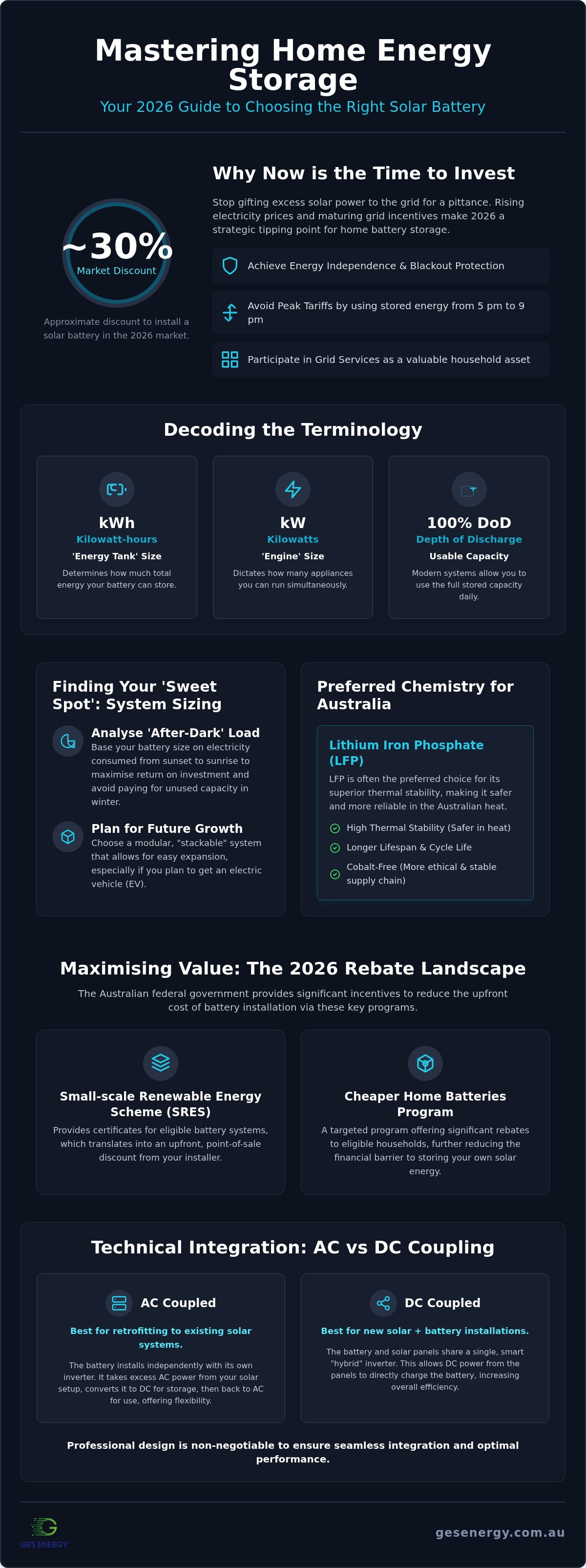
Understanding the technical specifications of modern rechargeable battery technologies is essential for making an informed choice. Capacity, measured in kilowatt-hours (kWh), represents the size of your "energy tank." In contrast, Power Output (kW) determines the "engine size," or how many appliances you can run simultaneously. If you want to operate a heavy load like a ducted air conditioner during a blackout, you need a high kW rating.
Depth of Discharge (DoD) is equally critical. It refers to the percentage of the battery that can be used without causing damage. In 2026, high-quality lithium units typically offer a 100 per cent DoD, allowing you to access the full capacity of your battery for solar energy every single day. This efficiency is a significant improvement over older technologies, ensuring you get the maximum value from your system over its entire lifespan.
Choosing the Right Battery Capacity and Type
Selecting the right capacity is a balancing act between initial cost and long-term savings. While it is tempting to choose the largest unit available, an oversized system often leads to a poor return on investment. You essentially pay for storage capacity that sits empty during the shorter days of winter when solar generation is lower. Conversely, an undersized system will leave you drawing expensive power from the grid during peak evening hours. Finding the "sweet spot" requires a detailed analysis of your daily throughput and generation potential.
The Australian Government's Solar Consumer Guide highlights that matching your storage to your specific household needs is the most effective way to lower energy costs. This involves more than just looking at your total bill; you must understand exactly when you use power. A system engineered for your specific lifestyle ensures that every kilowatt-hour stored is a kilowatt-hour used, rather than wasted capital.
Evaluating Your Daily Energy Profile
To determine the ideal kWh for your home, you must analyse your "after-dark" load. This is the amount of electricity you consume from the moment the sun sets until it rises again. In Australia, seasonal variations play a significant role in this calculation. A system that fills to 100 per cent in summer might only reach 60 per cent in July. If you size your battery for solar energy solely based on summer peaks, you will have idle capacity for half the year. A professional assessment ensures your system is engineered to handle your essential loads year-round without unnecessary capital expenditure.
Modular Systems and Scalability
Many modern households now opt for modular, "stackable" systems to allow for future growth. This is particularly relevant if you are planning to install an electric vehicle (EV) charger or if your family is expanding. Modular units allow you to start with a smaller capacity and add modules as your budget or energy needs increase. However, technical constraints exist. Most manufacturers require new modules to be added within a specific timeframe, usually a few years, to ensure the older and newer cells balance correctly.
Planning for these future loads now prevents costly retrofitting later. Consulting with solar design experts can help you decide whether a fixed-capacity or modular system aligns with your long-term infrastructure goals. A well-planned battery for solar energy should remain a reliable asset for at least a decade, adapting as your lifestyle evolves.
Comparing Battery Chemistries for Australian Conditions
Choosing a battery for solar energy involves more than just picking a brand. You must decide on the underlying cell chemistry. In the Australian market, the competition is primarily between Lithium Iron Phosphate (LFP) and Nickel Manganese Cobalt (NMC). While NMC batteries offer high energy density and a smaller physical footprint, LFP chemistries are rapidly becoming the industry standard for residential storage due to their superior safety profile and longevity. These units are less prone to overheating, making them a more stable choice for home environments.
The primary advantage of LFP cells lies in their thermal stability. They can withstand higher temperatures before risking thermal runaway, which is a critical factor given the extreme heat experienced across the continent. Additionally, LFP units typically boast a longer cycle life. While some NMC systems are rated for around 6,000 cycles, many premium LFP options now guarantee up to 10,000 cycles before reaching their end-of-life capacity. This difference can represent several years of additional service life for your investment, providing better long-term value.
Thermal Management in High-Heat Environments
Australian summer temperatures frequently exceed 40 degrees Celsius, which can accelerate the chemical degradation of battery cells if not managed correctly. Premium systems mitigate this risk through advanced thermal management. Some manufacturers utilise passive cooling, relying on heat sinks and natural airflow, while others employ active liquid cooling to maintain optimal operating temperatures. Ensuring your installation complies with AS/NZS 5139 standards is non-negotiable. These regulations govern safe placement and fire suppression requirements, providing a necessary layer of protection for your home and family.
Cycle Life and Long-Term Performance
A battery does not simply stop working once it reaches its cycle limit. Instead, it hits its "end of life" capacity, which is generally defined as 70 or 80 per cent of its original storage volume. How you use your system also dictates its lifespan. Frequent, high-current discharges, often referred to as high C-rates, can stress the cells more than steady, low-current usage. Round-trip efficiency is the ratio of energy put in versus energy retrieved. Minimising energy loss during the storage process is vital for ensuring your battery for solar energy delivers the best possible financial return over its entire functional lifespan.
Maximising Value: Incentives and the 2026 Rebate Landscape
The financial landscape for energy storage has evolved significantly following the federal government's 13 December 2025 expansion of the Cheaper Home Batteries Program. With a total estimated budget of $7.2 billion, the scheme aims to support over 2 million installations by 2030. This makes 2026 a strategic window for investment. An upfront discount of approximately 30 per cent is available for a battery for solar energy through the Small-scale Renewable Energy Scheme (SRES). This support is delivered via Small-scale Technology Certificates (STCs), which act as a direct reduction in the purchase price of your system.
For the period between May and December 2026, the STC factor is established at 6.8. It's vital to act promptly, as this factor is scheduled to decrease every six months until the end of 2030. By securing your installation now, you lock in a higher number of certificates and a more substantial upfront saving on your hardware and professional labour costs.
Qualifying for the Cheaper Home Batteries Program
To access these incentives, your system must fall within the 5 kWh to 100 kWh capacity range. The government has introduced tapered support levels to ensure the programme remains equitable across different system sizes. You receive the full STC factor for the first 14 kWh of capacity. For every kilowatt-hour between 14 and 28 kWh, the support is applied at 60 per cent. This structure encourages households to size their systems according to genuine daily needs. Crucially, your installer must hold current accreditation from Solar Accreditation Australia (SAA) to ensure the system meets rigorous performance standards.
Virtual Power Plants: The New Revenue Stream
Virtual Power Plants (VPPs) represent a growing trend in the 2026 market, especially in regions where traditional upfront state grants have been replaced by ongoing grid-participation incentives. By joining a VPP, you allow a network operator to draw small amounts of power from your battery for solar energy during periods of peak grid stress. In return, you receive ongoing credits on your electricity bill or a reduced initial cost for your equipment.
When reviewing VPP contracts, you should prioritise agreements that allow you to maintain a "backup reserve." This setting ensures that a specific percentage of your battery capacity is never discharged to the grid, keeping it available for your own use during a blackout. Our specialists can help you navigate these eligibility requirements to ensure you maximise your financial return. Contact GES Energy for an engineered solar and battery solution that secures your energy future through expert design and national support.
Professional Design: Why Installation Expertise is Non-Negotiable
Many retailers treat a battery for solar energy as a simple household appliance. This approach ignores the intricate engineering required to integrate storage with your existing electrical infrastructure. A poorly designed system fails to deliver the promised ROI and may even compromise the safety of your property. Professional design ensures that every component, from the cabling to the protective switchgear, is sized correctly for the specific demands of your household. The inverter acts as the "brains" of this operation, and ensuring full compatibility between the inverter and the battery cells is vital for stable performance.
AC vs DC Coupling: Which is Right for You?
The distinction between AC and DC coupling is one of the most critical decisions during the design phase. AC coupling is the standard choice for retrofitting a battery to an existing solar array. It uses a separate battery inverter to convert stored DC power into AC for the home. While this involves multiple conversion steps, it offers the greatest flexibility for older systems. DC coupling is usually reserved for new installations where a hybrid inverter manages both the panels and the storage. This integrated approach is more efficient and often costs less during a fresh build, but it requires precise hardware matching to function correctly.
The Importance of SAA-Accredited Labour
Engaging SAA-accredited labour is a mandatory requirement for accessing federal rebates, but its importance extends far beyond financial compliance. Professional commissioning ensures your warranty remains valid and that the system operates within its safe thermal limits. Substandard installations can lead to catastrophic failures, including fire hazards or premature cell degradation. For those looking at larger applications, our Commercial Solar Installation: A Strategic Guide for Business provides deeper insights into high-capacity storage engineering and industrial reliability.
We act as diligent stewards of your energy transition. Our background in off-grid and micro-grid solutions means we understand how to build for reliability in harsh Australian environments. We don't just install a battery for solar energy and walk away. We provide comprehensive health checks and ongoing maintenance to ensure your system continues to perform at its peak for its entire lifespan. This methodical approach turns a complex technical transition into a stable, predictable asset for your home.
Securing Your Energy Independence in 2026
Securing your energy independence requires more than just hardware; it demands an engineered approach tailored to the Australian climate. You now understand that matching cell chemistry to our local conditions and sizing your system for genuine daily throughput are the keys to long-term reliability. By acting while the 2026 federal incentives are at their peak, you can significantly reduce your upfront costs and accelerate your return on investment.
Integrating a battery for solar energy is a complex transition that benefits from professional oversight. Our SAA-accredited engineering team brings specialised expertise in complex off-grid and micro-grid systems to every residential project. We provide national Australian support and maintenance to ensure your system remains a stable, high-performing asset for years to come.
Request a custom battery storage design from GES Energy today to take control of your power bills. With the right design and a commitment to quality, your path to a predictable and self-sufficient energy future is closer than ever.
Frequently Asked Questions
Is a battery for solar energy worth it in Australia in 2026?
A battery for solar energy is highly viable in 2026 due to the expanded federal rebate and the increasing gap between feed-in tariffs and peak electricity prices. Most households achieve a positive return by using stored energy during expensive evening periods. Beyond the financial gains, the security of backup power and the ability to participate in Virtual Power Plants provide ongoing value that standard solar panels cannot match alone.
How long does a typical solar battery last?
Modern lithium batteries typically offer a functional lifespan of 10 to 15 years. This duration is measured in charge cycles, with premium units often guaranteed for up to 10,000 cycles. A system reaches its technical end of life when its storage capacity drops to around 70 or 80 per cent of its original rating. Choosing a system with high thermal stability ensures the hardware survives the harsh Australian climate throughout its warranted period.
Can I use a solar battery during a blackout?
Blackout protection is not a standard feature on every system. To run your home during a grid failure, your battery must be equipped with backup functionality and an automatic transfer switch. This hardware allows the system to isolate from the grid and form its own micro-grid. It is essential to specify your backup requirements during the design phase to ensure your essential appliances, such as refrigeration and lighting, remain operational.
What is the difference between AC and DC coupled batteries?
AC coupled systems use a separate battery inverter, making them the ideal choice for retrofitting storage to an existing solar array. DC coupled systems utilise a hybrid inverter to manage both panels and the battery, which is more efficient for new installations. While DC coupling reduces energy conversion losses, AC coupling offers greater flexibility if you already have a high-performing solar system and simply want to add a battery for solar energy.
How much can I save on my electricity bill with a battery?
Savings vary based on your daily consumption patterns and local electricity tariffs. Most households find they can reduce their grid reliance for evening power by up to 90 per cent. By shifting your heavy loads to stored solar energy, you avoid the highest peak rates charged by retailers. When combined with Virtual Power Plant credits, a well-sized system can significantly lower your quarterly bills and provide a more predictable energy cost.
Do I need a special inverter to add a battery to my solar system?
You do not necessarily need to replace your existing solar inverter. If you choose an AC coupled battery, it will come with its own dedicated battery inverter that works alongside your current setup. However, for new systems, a hybrid inverter is the most integrated and efficient solution. Our engineering team assesses your current infrastructure to determine the most cost-effective way to integrate storage without requiring unnecessary hardware replacements.
What is the Cheaper Home Batteries Program and how do I apply?
The Cheaper Home Batteries Program is a federal initiative that provides an upfront discount of approximately 30 per cent on eligible systems. This is delivered through the Small-scale Renewable Energy Scheme by claiming Small-scale Technology Certificates. To apply, you must engage an SAA-accredited installer who will calculate the discount based on your battery's usable capacity. The program was expanded in late 2025 to support over 2 million Australian households by 2030.
Are solar batteries safe to install inside a garage?
Yes, solar batteries are safe for garage installations as long as they comply with the AS/NZS 5139 safety standards. These regulations dictate specific clearances and fire protection requirements to ensure residential safety. We typically recommend Lithium Iron Phosphate (LFP) chemistry for indoor or garage placements. LFP is naturally more thermally stable than other lithium-ion types, significantly reducing the risk of overheating even during the peak of an Australian summer.


