

TL;DR: Commercial EV charging station installation in Australia requires matching hardware to vehicle dwell times while managing site power capacity to control infrastructure costs.
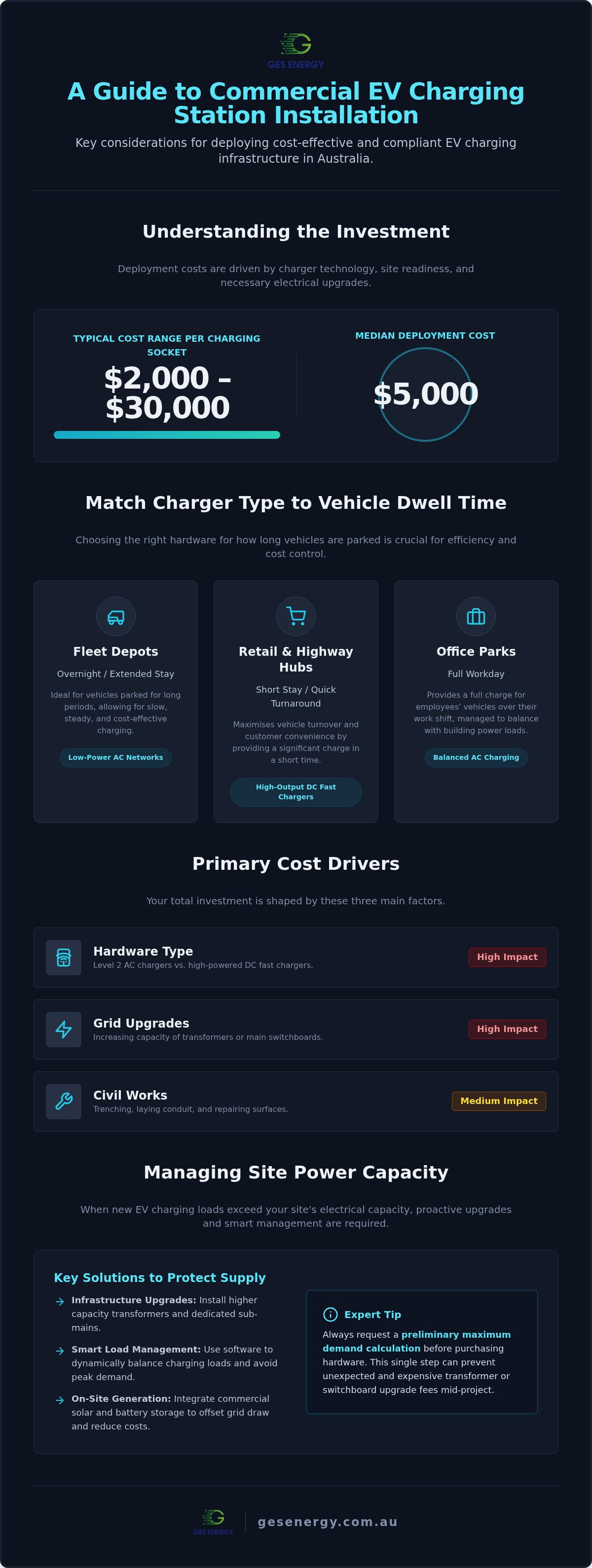
- Deployment costs typically range from $2,000 to $30,000 per socket with a $5,000 median.
- Except when switchboards have sufficient headroom, expensive transformer upgrades or sub-main additions are necessary.
- Therefore, retail hubs should prioritize high-output DC fast chargers while fleet depots utilize AC.
- The 2023 ABCB guide mandates specific fire safety and circuit protection compliance for installations. Installing a commercial EV charger in Australia depends on power output and civil works. The choices that set your budget are which vehicle dwell profile you serve, whether the switchboard already has headroom, and how far onsite solar can offset grid draw. Assessing site capacity and local standards early keeps the build cost-effective and avoids mid-project redesigns.
Match dwell time to charger type and reduce grid upgrade spend
Three patterns show up again and again on commercial sites:
- Delivery vans parked overnight at a depot: low-power AC networks that charge steadily over extended rest periods.
- Short-stay retail or highway bays: high-output DC fast chargers that raise vehicle turnover.
- Office parks where staff stay for a full shift: balanced AC charging matched to employee dwell time.
Matching your commercial EV charger setup to daily operational patterns keeps your fleet moving and reduces grid upgrade costs. Selecting infrastructure on vehicle dwell time prevents unnecessary capital expenditure. A site where delivery vans park overnight needs a completely different electrical layout than a public shopping center bay.
Working with EV Charging Station Contractors Australia helps you identify the right combination of fast-charging hardware and power distribution. Fleet depots typically benefit from low-power AC units that distribute power steadily over extended rest periods. Highway service plazas and customer-facing retail hubs require high-capacity DC fast chargers so short stops still deliver a usable charge.
Power demands vary widely. Managing these loads requires smart balancing software to protect your primary supply board.
Site Type            Primary Goal            Recommended Technology
--------------------------------------------------------------------
Fleet Depots         Overnight Charging      Low-power AC Networks
Retail Centers       Customer Convenience    High-output DC Fast
Office Buildings     Employee Dwell Time     Balanced AC Charging
You lower total ownership expense by choosing hardware tailored to your peak operating hours. High-powered DC units suit short-stop locations, while standard AC chargers fit sites where vehicles sit for hours. GES Energy assists commercial operators in configuring hardware around actual energy demands.
Contact our team to design a scalable charging layout tailored to your facility.
Hardware, grid capacity and civil works that drive charging cost
Hardware selection, grid capacity upgrades, and site preparation dictate your total investment when establishing commercial vehicle charging infrastructure.
Major expenses stem from high-powered fast chargers (DC fast chargers) and required civil engineering works. A destination AC bay with light civil scope sits near the lower end of the band; once DC fast hardware, trenching and board work enter the scope, totals climb. Based on current market rates, commercial deployment costs span a wide price band of $2,000–$3,000 to $30,000 per socket, with $5,000 acting as the typical median expense for standard hardware.
Integrating commercial solar systems reduces ongoing operational expenses by offloading grid reliance during peak daylight hours. Upgrading main switchboards remains the practical path because inadequate electrical supply halts high-speed charging.
| Cost Driver | Description | Impact Level |
|---|---|---|
| Hardware Type | Level 2 AC versus high-powered DC fast chargers | High |
| Grid Upgrades | Transformer or switchboard capacity increases | High |
| Civil Works | Trenching, conduit laying, and surface repair | Medium |
Evaluating your site energy needs with specialist input prevents budget overruns. Pair your infrastructure with Industrial & Commercial Solar Australia solutions to secure long-term energy independence. Real-world project data highlights how proactive planning saves money.
Tip: Always request a preliminary maximum demand calculation before purchasing hardware to avoid unexpected transformer switchboard upgrade fees.
Among GES Energy's Google reviews, Tanzi (5★) wrote:
"GES did an amazing job installing our solar panels and battery. Their customer service was excellent, and the entire process was smooth from start to finish. We’re very happy and highly recommend them!"
Ask for a costed hardware and civil-works breakdown before you order chargers.
Infrastructure upgrades that protect supply when EV load exceeds capacity
Upgrading your site distribution board and main switchboard becomes essential when local EV charging demands surpass existing electrical capacity.
Electrical infrastructure audits frequently uncover hidden load constraints before charger mounting even begins. Undertaking a comprehensive maximum demand calculation ensures your facility avoids nuisance tripping or severe supply disruptions.
When the audit shows the board cannot feed the added EV load, upgrading transformers, installing load management software, or fitting dedicated sub-mains allows your facility to safely handle heavy electrical draws. Integrating a commercial solar battery creates a buffered power reservoir, shielding your site from massive network capacity charges while enhancing overall energy independence. Engaging experienced Solar Installation Specialists lets you evaluate on-site generation options that offset high peak demand periods.
Safety remains paramount during these electrical overhauls. Managing high-voltage power loads is like directing heavy highway traffic through narrow suburban streets without clear traffic lights. SAA-accredited installers must ensure all switchboards, cabling, and isolation switches comply strictly with local regulatory standards.
According to the ABCB EV charging safe installation guide (2023), commercial installations must align with revised Australian National Construction Code provisions covering fire safety and circuit protection. Implementing dynamic load management balances real-time power draw without requiring immediate network supply expansions.
Reach out to SAA-accredited experts at GES Energy for tailored technical guidance on your commercial infrastructure upgrade.
Smart load management that holds demand under your site cap
Smart stations optimise energy use by using dynamic load management to balance power drawing against real-time building demand and solar PV generation.
During site installations, engineers observe that dynamic power management prevents costly grid supply upgrades for Australian businesses. Adjusting hardware outputs dynamically keeps your total electrical demand strictly below local infrastructure limits.
According to a Wikipedia 2025 entry on charging stations, modern networked units distribute available electricity intelligently across multiple vehicles. Integrating your site solar PV allows chargers to capture excess generation during midday peaks and absorb surplus energy. Connecting these systems directly into a Virtual Power Plant (VPP) network lets you monetize spare power while reducing operational overheads.
Software algorithms read real-time building consumption data to throttle charger speeds during facility usage spikes. Deploying a dedicated Tesla Commercial Charging solution allows fleet operators to schedule charging cycles specifically during off-peak tariff periods.
Automated load control fits commercial properties with strict capacity caps. Working with SAA-accredited installers keeps your infrastructure safe, compliant, and set up for energy independence. Request a customized estimate for your business property from GES Energy.
Five installation steps that commission chargers without stopping trade
Staged commercial EV charger deployment keeps your site operational and protects daily business revenue throughout the electrical upgrade.
Scheduling heavy infrastructure works during off-peak hours prevents main grid shutdown issues. Planning circuit isolation early stops unexpected power outages during trading hours, so trading floors and depot lanes stay open while only the active circuit is isolated.
- Detailed site assessment: Qualified installers evaluate your switchboard capacity, cable routes, and local grid constraints.
- Infrastructure preparation: Technicians run specialized cabling and install protective circuit breakers without interrupting primary facility power.
- Hardware mounting: Installers securely fix the charging units to walls or concrete pedestals.
- Commissioning and safety testing: Certified electricians run load checks, test emergency cut-offs, and verify network connectivity.
- Final handover: Operators complete system onboarding and receive full operational documentation.
SAA-accredited installers from GES Energy ensure electrical compliance across Australia while minimizing workplace disruption. Staged installation suits active commercial sites; complete off-peak shutdowns suit facilities that close entirely overnight. Map your project timeline with a personalized quote.
Frequently asked questions
What Impacts the Cost of Commercial EV Charging?
Hardware selection, site civil works, and grid capacity upgrades drive the total investment for a commercial EV charging station installation in Australia. Installing rapid direct current (DC) fast chargers requires significantly higher capital expenditure than basic alternating current (AC) destination units. A personalised quote from a specialist installer ties those drivers to your exact location and board capacity.
What infrastructure upgrades are needed if load exceeds capacity?
Site panel modifications, sub-main cable additions, and transformer replacements become necessary when site power demand surpasses available limits. You must ensure all electrical work meets local grid codes and SAA-accredited standards. A site assessment reviews your electrical headroom before hardware is ordered.
How do smart commercial EV charging stations optimise energy use?
Dynamic load management regulates power delivery across active charging ports in real time to prevent peak demand charges. Smart software schedules vehicle charging during off-peak tariff periods. Automated balancing protects your site supply while driving down operational electricity costs.
Can commercial EV chargers integrate with renewable energy?
Commercial chargers connect directly with onsite solar panels (photovoltaic systems) and battery storage to utilise clean power. Integrated energy systems capture excess daytime solar generation to charge fleet vehicles directly. You reduce grid reliance and build energy independence for your business.
Which industries are leading the adoption of commercial EV chargers?
Commercial real estate, logistics fleets, hospitality venues, and public parking operators lead the rollout of charging infrastructure. Offering charge points attracts high-value patrons and lowers long-term fleet running costs. GES Energy can help you design a corporate charging setup around those use cases.
Lock dwell profile, board headroom and solar offset before you buy hardware
Upgrading your property's infrastructure requires a commercial EV charging station installation Australia project tailored directly to your building's electrical setup. Return to the same three checks you started with: match hardware to dwell time, confirm switchboard and transformer headroom, and decide how far solar and storage should offset grid draw. GES Energy delivers solar and commercial EV charging solutions designed for long-term reliability and energy independence.
Our engineering team assesses your site specifications to ensure safe integration in 2026. A site assessment identifies your precise capacity requirements early.
Contact the Engineering specialists at gesenergy.com.au to request your tailored site assessment and quotation.


