

Australian commercial solar power system (solar PV system) installations receive upfront Small-scale Technology Certificates (STCs) and Large-scale Generation Certificates (LGCs) to reduce initial capital expenditure. These federal incentives lower the net system cost for your enterprise based on current government guidelines. State-based programs provide additional financial support depending on your location and total installation capacity. The decision path is practical: which load profile fits your site, which certificate path applies at your kW scale, and how you stack write-offs with state support without losing eligibility.
Key Takeaways: Business solar incentives provide upfront discounts via STCs for systems under 100 kW or ongoing revenue through LGCs for larger commercial plants exceeding 100 kW.
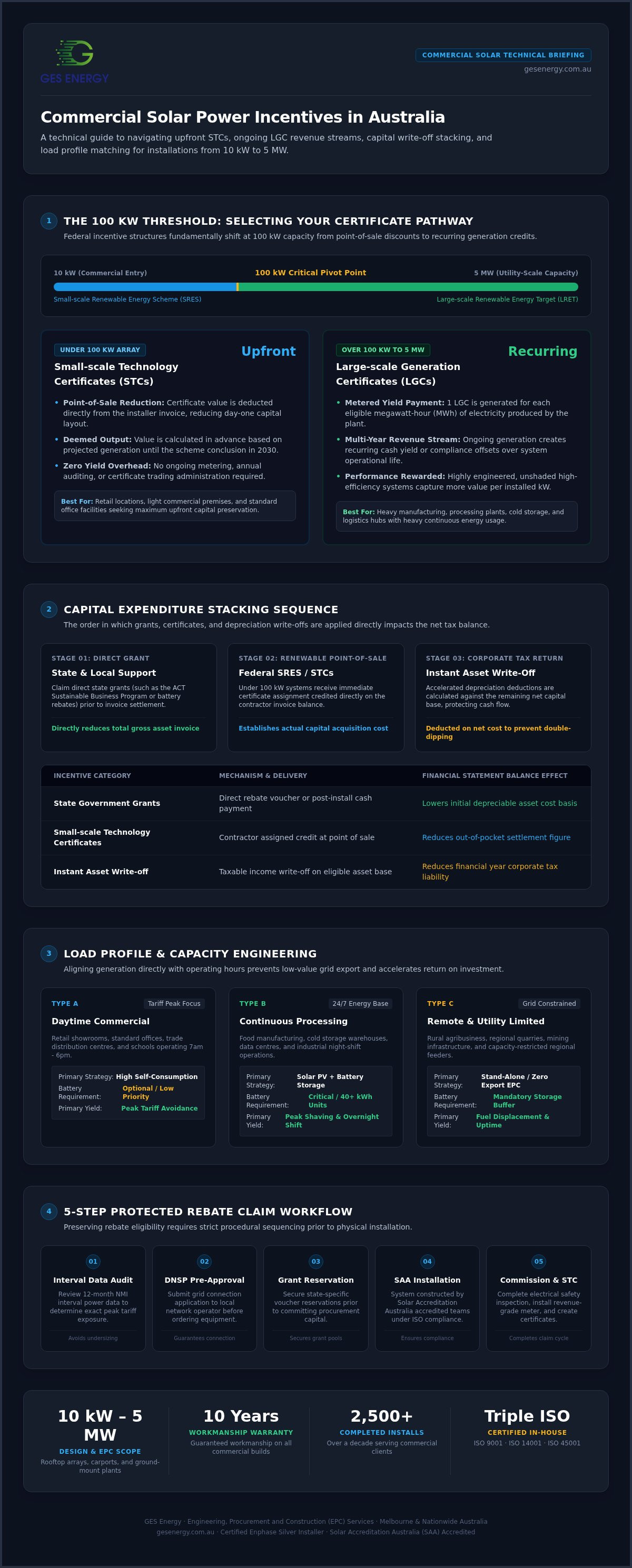
- Systems over 100 kW transition from upfront STC rebates to recurring LGC generation-linked revenue.
- Incentives are not worth it if roof structures are weak or leases are short.
- Apply state-based battery discounts before federal Instant Asset Write-offs to maximize total ROI.
- The 5-step process requires securing system design and pre-approval before starting professional installation.
Match your load profile before you size the array
Your operational hours decide which commercial solar PV system (solar setup) profile delivers durable corporate energy savings, so start with how you already use power rather than with a catalogue size. Matching consumption patterns to solar generation reduces reliance on high grid tariffs, and profile alignment shortens payback on renewable plants.
Three situations come up often:
- Daytime retail, office or light industrial: prioritise roof capacity for direct solar consumption during tariff peaks.
- Continuous manufacturing with night shifts: pair the array with hybrid battery storage so stored daytime energy covers after-dark loads.
- Remote or utility-constrained sites: an off-grid solar system supports continuous operational uptime where grid access is absent.
GES Energy designs systems for capacities from 10 kW to 5 MW, and you gain a 10-year workmanship warranty on that work. The team holds ISO 9001, ISO 14001, and ISO 45001 certifications for compliance discipline. You can lower costs through a Small-scale Renewable Energy Scheme pathway or a Sustainable Business Program battery discount where you qualify. For site-specific figures, ask for a personalised quote.
Federal tax incentives cut the cash you tie up on day one
If capital budgets are tight this financial year, commercial solar is one of the few plant items that can turn a large invoice into tax-effective savings quickly. Installing solar power grants access to immediate asset write-offs, accelerated depreciation, and national renewable certificates that reduce your initial cash commitment.
International schemes such as the US federal tax credit show how commercial clean energy projects historically benefit from targeted credits that offset capital expenditure. In Australia, the Small-scale Renewable Energy Scheme offsets upfront expenses through Small-scale Technology Certificates. You can combine those federal incentives with a localised battery discount (Sustainable Business Program) where your site is eligible.
System scale shapes the return path. Businesses installing solar setup hardware from 10 kW up to 5 MW unlock corporate tax deductions on the eligible asset base. Choosing full EPC services keeps design, procurement and construction inside one compliance chain so the architecture still qualifies for the relief you planned. You may also earn credit by exporting surplus power under a feed-in tariff with your retailer, while a 10-year workmanship warranty supports long-term equipment performance.
LGCs keep paying on commercial systems over 100 kW
Cross the 100 kW line and the incentive logic changes from a one-time discount to a generation-linked revenue stream, which is why larger plants need a different certificate plan from day one. Systems exceeding 100 kW move from upfront STCs to Large-scale Generation Certificates (LGCs), which pay on actual power generation.
LGCs create recurring income across the system’s operational life. You create certificates each year from the clean electricity your commercial setup produces, so the structure rewards sustained output. LGCs suit high-yield commercial enterprises that want ongoing cash flow; smaller installations usually favour immediate upfront STC support. A clear read of current business solar rebates helps you see which federal model matches your load and budget.
System size locks in your certificate process and the administrative path you will run for years. STCs behave like a lump-sum discount at purchase; LGCs behave like a recurring yield tied to metered generation. For large commercial plants, in-house engineering teams hold ISO 9001, ISO 14001, and ISO 45001 certifications and back projects with a 10-year workmanship warranty. Custom designs extend to commercial systems up to 5 MW. Ask for a tailored proposal when you need exact LGC-oriented system detail.
Stack the Instant Asset Write-off after state support
The order of claims changes the asset base your accountant depreciates, so treat grants as the first filter and tax write-offs as the second. You reduce net system outlay by securing state incentives before you apply business tax write-offs. Applying a battery discount up front, where available, lowers the depreciable asset balance for your solar setup; federal deductions then apply to that reduced balance. More on this: Going Solar.
Claim direct grants before you lock financing when you can: that sequence trims interest cost and protects cash flow.
| Incentive Type | Financial Impact | Tax Balance Effect |
|---|---|---|
| State Government Rebate | Immediate cash reduction | Lowers initial asset cost |
| Instant Asset Write-off | Taxable income deduction | Applies to net purchase price |
A disciplined solar system design service keeps equipment inside the rules of the schemes you intend to claim. Custom engineering, procurement and construction (EPC) support is available nationwide. Get a site-specific estimate when you want the stacked figures modelled on your capex.
Upfront grants plus tax write-offs give commercial site owners a clear route to a faster return when the paperwork order is right. Renewable energy specialists can structure that sequence with you before procurement starts.
State and Territory rebates add a second cost cut
Federal certificates rarely tell the whole funding story; your state or Territory can still shave the cheque you write at install. State rebates lower setup costs for your solar setup when your site meets local rules. Picture your roof as on-site generation that offsets the tariff you already pay. In Victoria, business owners can access local incentives that reduce initial capital outlay, and regional funding elsewhere can shorten payback when the grant lands before commissioning.
You can stack state-based support with the national Small-scale Renewable Energy Scheme when both rule sets allow it. For commercial energy storage, a battery discount offers direct assistance in the jurisdictions that run it; eligibility turns on property location, system design, and use of an SAA-accredited installer.
Scaling toward a megawatt-class facility needs early network planning so incentive approval and connection work stay aligned. A dedicated Solar System Design service prepares compliant engineering documentation for grant pathways and reduces rework risk on paperwork. Review state eligibility before you freeze the bill of materials so you do not leave dollars unclaimed.
Among Google reviews for the installer network, one client (5★) wrote:
"Amazing service, got the job done very quickly with no problems. Highly recommend if you are looking to add high quality solar to your property for an amazing price. Unmatched with amazing service and quality."
Fast execution and sound equipment matter when local incentive windows and inspection dates are fixed.
5 Steps that protect your rebate claim
Rebate value leaks when applications lag the build, so treat the admin path as part of the project plan rather than an afterthought. You claim incentives by submitting the required paperwork before and after your solar setup installation. Completing compliance checks early prevents avoidable delays and keeps the timeline predictable.
- Check eligibility: Verify that your business site meets the state and national program requirements that apply to you.
- Secure system design: Obtain a tailored plan through a professional solar system design service.
- Submit formal application: Apply for your battery discount or other government incentive before installation starts, where the scheme demands pre-approval.
- Complete professional installation: Work with an SAA-accredited installer so hardware is fitted to Australian standards.
- Receive financial incentive: Submit final compliance paperwork to claim Small-scale Renewable Energy Scheme incentives or local rebates.
Lodging pre-approval forms early protects eligibility if grant rules shift during planning. SAA-accredited installers anchor compliance on site. ISO 9001, ISO 14001, and ISO 45001 certifications support orderly approvals, and a 10-year warranty is available on commercial and industrial projects. Book a compliance-focused quote when you are ready to map the five steps to your site.
A commenter in the getbirdeye.com.au thread "GES ENERGY, 130 Reviews, Solar Installation in Altona, VIC":
"Thank you, GES, for the quick installation of my solar system and battery storage a year ago! I've been able to reduce my bill to almost zero." (source)
That path is a clear arc: high grid exposure, solar plus battery storage installed under a controlled process, then bills cut toward near zero. Certified installers keep the compliance file tidy so those savings arrive without rework.
When commercial solar power is a poor fit
Not every roof and lease deserves an array, and saying no early protects capital. Commercial solar setup projects stall when roof space is heavily shaded, structurally weak, or leased on a short term. Panels on compromised roofs create safety issues and cap real generation.
Structural reinforcement costs can erase project returns, so building owners need load-capacity checks before purchase. Heavy night-time energy users gain little from daytime generation without storage; adding an Alpha ESS battery or Tesla Powerwall closes that gap by holding unused power. Short leases still make payback harder to defend.
If your electricity bills are already low, incentives such as the Small-scale Renewable Energy Scheme or a battery discount may offer only thin benefit. A site assessment clarifies suitability: compact sites often fit basic packages, while energy-intensive facilities need dedicated engineering, procurement and construction (EPC) services. If you assumed solar fits every commercial building, unviable roofs remain a weak financial choice. Request a property-specific review before you commit capital.
Frequently asked questions
Are there any rebates available?
Yes. Eligible commercial installations can receive support through government programs such as the Small-scale Renewable Energy Scheme. You may also lower capital costs with a local battery discount where you qualify. These pathways use STCs (Small-scale Technology Certificates) for upfront financial incentives. Ask for a modelled rebate range based on your system size.
What is the difference between STCs and LGCs for my business?
STCs suit smaller commercial systems and reduce upfront capital as a certificate discount at install. Once your plant exceeds 100 kW, LGCs apply instead and create certificates each year from metered clean generation, so the value arrives as ongoing revenue rather than a single purchase-time offset. Your system size therefore sets both the certificate type and the admin path you will run.
What happens once I sign the paperwork?
The team runs an end-to-end process that starts with a comprehensive solar system design service, then covers engineering design, procurement, grid connection approvals, and installation compliance across Australia. With over 10 years in renewable energy and more than 2,500 successful installations, utility-scale projects up to 5 MW sit inside that same delivery model. Certified in-house technicians keep safety and programme control on site through commissioning.
Do you offer finance?
EPC services come with assistance on structured financing options tailored to commercial energy projects. Flexible funding models help you fund your solar setup without placing the full capital outlay up front, so you can balance installation cost against operational power-bill savings. Speak with the commercial desk when you want payment options laid out beside your predicted tariff reduction.
How much can the rebate be worth?
Rebate values scale with system capacity and location across Australia. Total incentives for commercial projects also depend on component selection, site conditions, and system design parameters. Those offsets improve return on investment when the design and the scheme rules line up. A facility-specific quote is the reliable way to lock exact figures.
Build your solar return on clear incentive steps
You can reduce upfront costs through the tax incentives and rebate paths available for business solar power, provided system design, certificate choice and claim order stay aligned. Commercial managers often under-weight how engineering choices affect total return; aligning specifications with national scheme requirements protects incentive value on a shorter clock.
Certified system design and complete EPC services are tailored to Australian commercial standards, drawing on over 10 years of installation experience to protect yield.
To evaluate your energy requirements and project ROI, request a custom proposal via GES Energy commercial solar solutions.


