

The financial return of a commercial solar canopy depends on variables like installation labor, structural engineering, and system capacity. While GES Energy does not publish fixed pricing figures online, the total investment is primarily driven by SAA-accredited design, long-term maintenance programs, and strong workmanship warranties.
Key Takeaways: Solar car park shading solutions provide dual-purpose vehicle protection and energy generation, typically achieving financial payback through reduced peak demand charges and self-consumption.
- Cantilevered and T-frame profiles maximize parking yield by eliminating support posts that restrict vehicle maneuvers.
- Integrate 40 kWh battery storage to support rapid DC charging without requiring expensive utility transformer upgrades.
- The 10-year ROI analysis shows that workmanship warranties and SAA-accredited design are critical for long-term reliability.
Before you commit capital, three decision questions shape a sound 10-year outcome: does a canopy fit your footprint better than roof or ground mount, which structural profile protects parking yield and generation, and how do self-consumption, demand charges and EV load change payback. The sections below walk those choices with concrete design ranges, cost drivers and partner checks so you can judge fit before you request engineering.
Match canopy scale to your site load and footprint
Selecting the right commercial car park solar canopy depends directly on your site's physical footprint and daily operational energy demand. Matching structural scale to actual consumption prevents over-investment in unused generating capacity. Small commercial sites need targeted setups, whereas large industrial facilities require megawatt-scale designs to lift returns.
Typical situations and a concrete next step from the ranges already used on commercial sites:
- Small car park with auxiliary loads only: pair a compact overhead structure with a portable off-grid setup so you cover site power without excess steel.
- Mid-sized business running on-site operations and staff EVs: size a medium array to daytime load and plan integrated EV charging points in the same layout.
- Large industrial hub needing broad bay coverage: engineer solar PV arrays with full installation help (EPC services) that scale up to 5 MW against measured peak demand.
Custom sizing aims for coverage without paying for excess steel framework. For stronger financial results, choose a layout sized specifically to your peak load requirements. Tailored solar system designs from GES Energy help match your property footprint with lasting financial returns.
How structural profiles protect your 10-year return
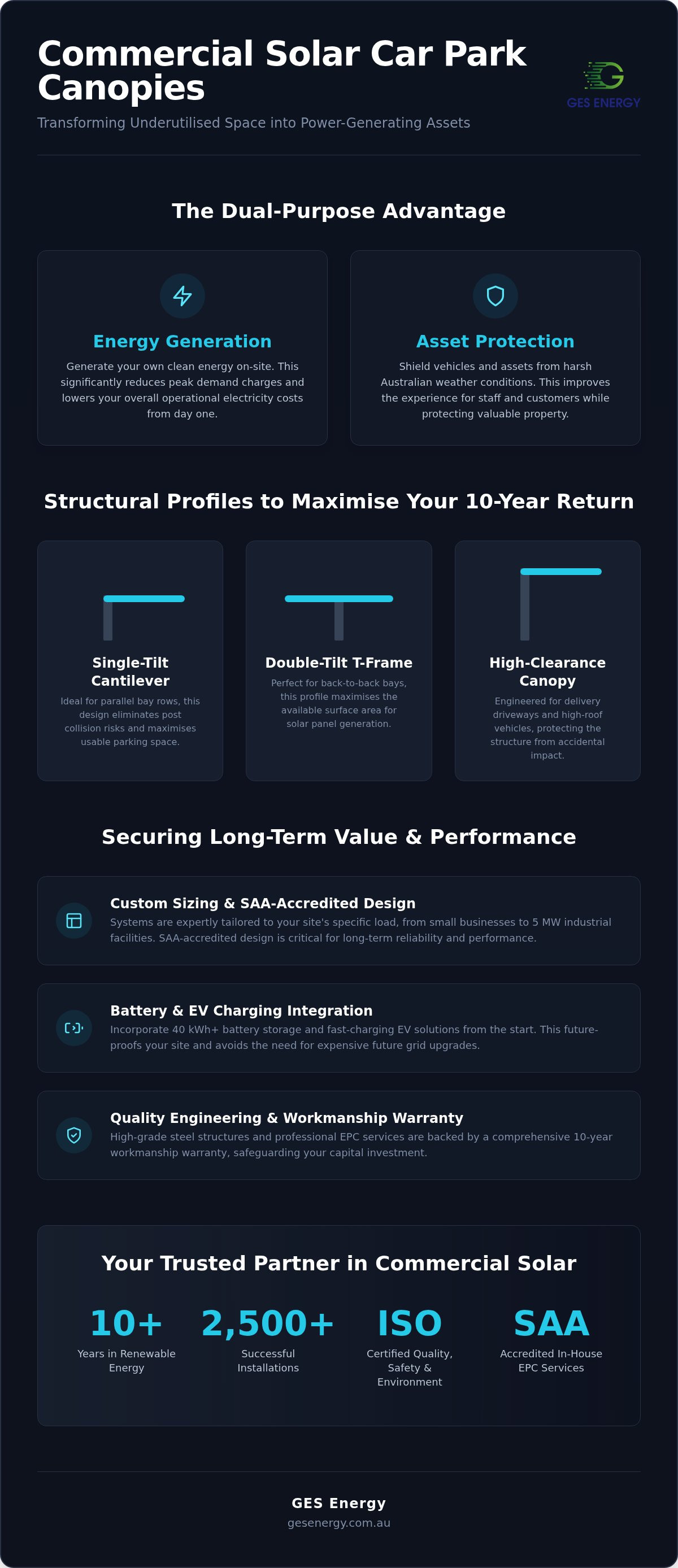
Selecting cantilevered profiles lifts spatial yield by removing support posts that restrict vehicle parking maneuvers. Higher structural clearance allows high-roof transport access, reducing physical impact damage and supporting long-term solar generation stability.
Structural profiles with minimal ground penetrations follow your bay geometry rather than forcing traffic around posts. Custom profile choices directly safeguard your 10-year investment returns. Hybrid solar integrations connect your solar PV system to storage equipment efficiently.
| Profile Design | Car Park Fit | Financial Impact Factor |
|---|---|---|
| Single-Tilt Cantilever | Parallel bay rows | Eliminates post collision risks |
| Double-Tilt T-Frame | Back-to-back bays | Maximises panel generation area |
| High-Clearance Canopy | Delivery driveways | Protects structure from vehicle impact |
Clearance heights must fit your operational vehicles. Low clearances limit site utility, while well-matched designs secure lasting energy returns.
Double-tilt profiles fit high-density car parks, whereas single-tilt layouts suit narrow boundary bays. Across Victoria, GES Energy offers specialised engineering so profile choice preserves your capital infrastructure rather than restricting daily vehicle flow.
What drives square-metre cost and project timeline
Determining total investment for covered parking requires evaluating structural engineering and grid connection needs alongside simple surface area measurements.
Adding EV charging infrastructure (charging station) into your shade plans early avoids costly trenching upgrades later. Commercial solar PV systems require rigid foundations and site assessments to maintain safety standards. Projects typically progress through engineering, system design, and local network approvals before physical construction starts.
Staged execution protects operational workflows during active builds. Planning permissions take time. Experienced installation specialists manage the entire process through structured installation help to reduce site downtime. For standard remote operational needs, a standard off-grid system capacity of 18–32kW serves small businesses efficiently.
High-grade steel structures with a 10-year workmanship warranty give stronger long-term financial security than cheaper lightweight alternatives. GES Energy delivers custom design services backed by ISO certifications to support structural integrity across Victoria.
Execution speed depends heavily on early grid approvals and equipment availability. Early site surveys accelerate these outcomes.
Posting on the getbirdeye.com.au discussion titled "GES ENERGY, 130 Reviews, Solar Installation in Altona, VIC", one user noted:
"Thank you, GES, for the quick installation of my solar system and battery storage a year ago! I've been able to reduce my bill to almost zero." (source)
That path (prompt install, battery storage, near-zero bill) shows how professional system design and fast deployment translate into immediate operational savings on a live commercial account.
Model the cash flows behind a 10-year payback
Solar structures yield higher returns than standard shade covers by turning empty parking space into an active power generator. Peak electricity price offsets can transform project cash flow from the first billing cycles. Direct power production lowers your grid dependency while shielding assets from harsh weather.
- Calculate base generation: Assess your site footprint to forecast annual kilowatt-hour output.
- Model self-consumption: Track real-time site usage to match solar PV generation directly with internal energy needs.
- Map demand charges: Calculate maximum peak reduction to trim recurring monthly network capacity fees.
- Factor incentives: Apply valid Small-scale Renewable Energy Scheme incentives to reduce upfront capital requirements.
Treat the four steps as one cash-flow model for your commercial property, not four isolated estimates. Evaluating these combined cash flows helps you set a realistic financial horizon. Review commercial solar options in Hobart when you need custom engineering aligned to long-term site goals.
Trade-quality installation keeps those targeted financial projections credible over decades of field service.
Among GES Energy's Google reviews, HARJIT (5★) wrote:
"Prompt service. Good communication. Done a very good job. No amount of praise is enough. Very good workman ship is provided by an electrician Mr. Laadi. Very well explanation regarding solar. Best after sale service.100% recommended for roof solar."
Clear communication, solid workmanship and after-sale support are the practical levers that help business owners hold expected long-term returns on commercial solar structures.
When a solar car park is the wrong choice
Solar car parks are inefficient investments for sites with unshaded, structurally sound roofs.
Ground mounts or roof installations deliver higher financial returns when structural upgrades are unnecessary. Steel framing costs increase capital expenditure significantly. If your existing commercial roof has unshaded space, installing a solar PV system there avoids major civil engineering expenses.
Roof mounts suit budget-focused upgrades. Car park structures fit sites with full roofs or high EV adoption. Ground mounts suit open land.
Heavy shading from nearby high-rises or complex underground utility networks also make canopy builds impractical. In these cases, ground-mounted systems or roof-mounted arrays provide simpler grid connection paths.
If your property lacks available roof area, ask for engineering, procurement and construction so the layout constraints are scored before steel is ordered. Request a personalised quote to determine the most cost-effective solar system design service for your site.
Add commercial EV charging without grid upgrade shocks
You can integrate commercial EV charging infrastructure into your solar car park design today or prepare the conduits and switchboard space for later expansion.
Integrating rapid DC charging onto existing site connections often risks costly utility transformer upgrades. Installing an off-grid battery storage system (initial capacity = 40 kWh) prevents these grid congestion issues by buffering local demand. Local battery storage reduces demand spikes during peak operational hours while protecting your site against grid capacity limits. According to the EEA's 2022 report on urban bioclimatic design, smart shading infrastructure directly optimises urban energy efficiency and local microgrids. Combining a solar PV system with high-capacity chargers keeps your fleet powered reliably across Australia.
Installation help can cover complete solar and charging projects nationwide. Selecting integrated battery capacity improves your local self-consumption. Businesses in Victoria can use the Sustainable Business Program to offset initial infrastructure outlay costs.
If you are aligning battery capacity with a staged EV rollout, bring your load profile and charger count into the same design conversation so transformer limits are tested before equipment is ordered.
Choose an SAA-accredited commercial solar partner
Selecting an accredited provider keeps your commercial solar PV system a safe, long-term operational asset.
Look directly for a Solar Accreditation Australia (SAA) SAA-accredited installer to manage your project. Engineering teams holding ISO 9001, ISO 14001, and ISO 45001 certifications support quality control, environmental safety, and occupational health standards. Unaccredited installations often cause expensive inverter failure later; verified compliance reduces those operational disruptions.
Protecting your balance sheet requires clear long-term coverage. Demand a 10-year workmanship warranty against system installation defects. A partner with an established maintenance program simplifies any future inverter warranty claim or direct warranty claim process.
Commercial projects call for proven delivery range. GES Energy brings over 10 years in renewable energy with more than 2,500 successful installations across Australia, and provides complete installation help for systems from 10 kW to 5 MW.
Frequently asked questions
What are solar car park shade structures?
Solar car park shade structures are overhead canopies fitted with a solar PV system that generate electricity while providing vehicle shelter. You can use these dual-purpose installations to lower site electricity expenses and power your EV charging infrastructure directly. Expert solar system design service can tailor these frames to your specific site requirements.
How does the hybrid profile work?
A hybrid profile combines grid power with local energy storage to manage site demand efficiently. You can store solar generation during peak sun hours and dispatch it when energy prices rise. For remote commercial sites, off-grid battery storage systems start at an initial capacity of 40 kWh to maintain continuous energy supply.
What shade profile options are available?
Shade options range from single-row cantilever designs to dual-cantilever layouts that cover two full rows of vehicles. Choosing the right profile depends on your specific traffic layout and daily sunshine exposure. Standard off-grid systems provide a capacity between 18 kW and 32 kW to support various energy loads.
Can existing car parks be retrofitted?
Yes, existing parking areas can be retrofitted with custom structural framing and foundation piers. Professional installation help manages the engineering, procurement, and construction process to minimise operational disruption. Verify your existing electrical infrastructure early to confirm grid connection capability.
How do self-consumption and demand charges shape payback?
Payback tightens when you raise on-site self-consumption, cut peak demand charges, and (where relevant) earn EV charging revenue. Small-scale Renewable Energy Scheme incentives and other available solar battery support can also reduce upfront capital. A personalised quote against your tariff and load profile is the reliable way to size those figures.
Protect Your Asset in 2026
Commercial solar car park shading solutions protect vehicles while generating renewable energy directly for your business. The team brings over 10 years of experience and 2,500 successful installations to every project. With in-house teams certified under ISO 9001, ISO 14001, and ISO 45001, GES Energy delivers complete engineering, procurement, and construction services with a 10-year workmanship warranty across Australia.
Speak with an SAA-accredited engineering team to assess your site's solar potential and obtain a tailored turnkey quote via the Hobart commercial solar page.


