

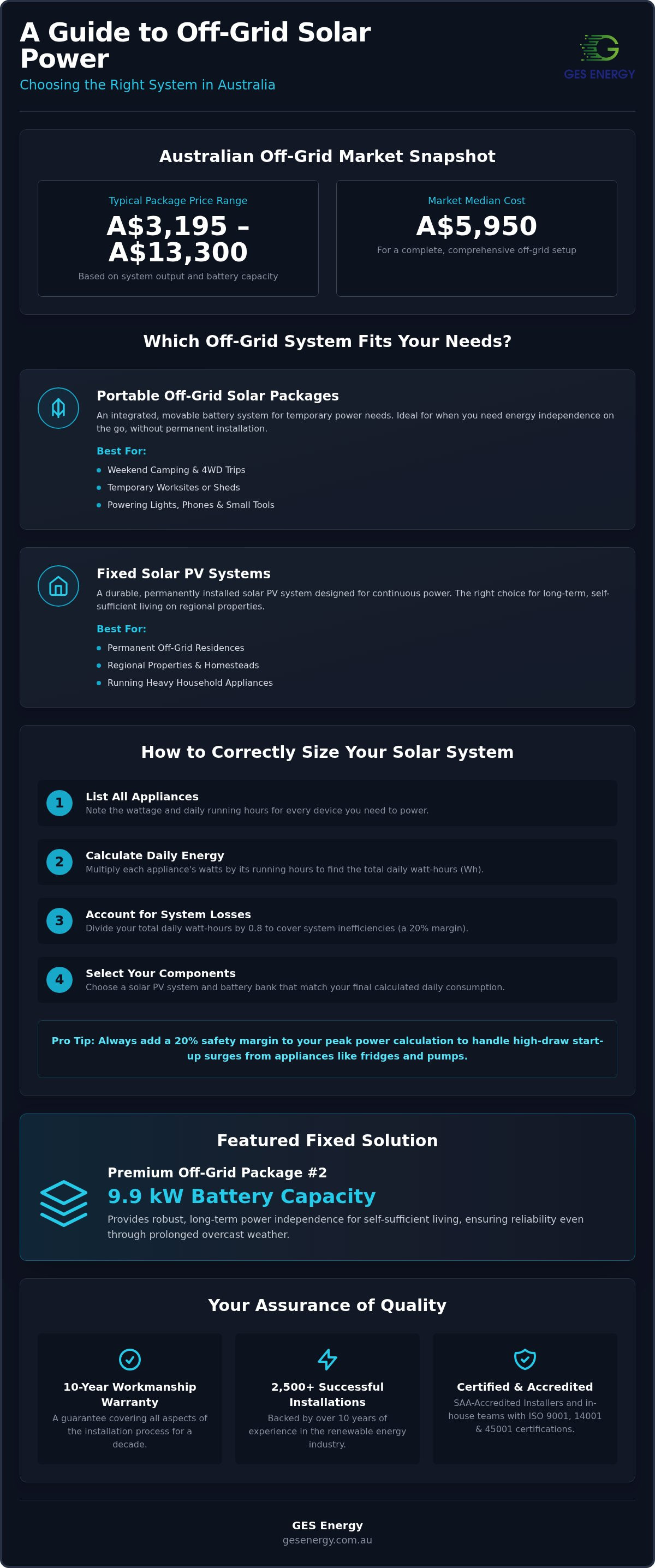
Australian market listings show that comprehensive off-grid power packages generally range from A$3,195 to A$13,300, with a market median cost of A$5,950 depending on total output and battery capacity. Deciding on the right setup means balancing your total daily electrical load against component mobility, surge ratings, and solar panel recharge rates. Selecting certified equipment supports reliable operation across regional properties and keeps the rest of this guide focused on that same choice: portable flexibility or fixed capacity.
Key Takeaways: Portable off-grid power solutions in Australia provide mobile energy independence for temporary sites, typically costing between A$3,195 and A$13,300 depending on capacity.
- Market listings show a median package price of A$5,950 for complete off-grid setups.
- Portable units are unsuitable for permanent residences requiring continuous heavy-duty power for long-term living.
- Therefore, choose portable chassis for weekend camping and fixed installations for regional properties.
- Premium Off-Grid Package #2 provides 9.9 kW of battery power for self-sufficient energy independence.
Finding the off-grid setup that fits your needs
Before you compare chassis sizes or inverter labels, pin down how you actually use power on site. Three situations come up often:
- Weekend camping or a short worksite stay: a compact portable off-grid solar package covers lights, phones, and small tools without permanent mounting.
- Seasonal or multi-month remote living: step up capacity so daily watt-hours and surge loads stay inside the battery and inverter limits.
- Permanent off-grid living on a regional property: choose a durable solar PV system sized for continuous household or shed loads, not a suitcase unit.
With clients, sizing needs differ sharply between short camping trips and long stays. A small unit behaves as a large power bank, whereas large setups run heavy appliances. Market listings place complete package investment in the A$3,195–A$13,300 band (market median A$5,950). Buying an accredited off-grid solar system supports long-term energy independence. Homeowners receive a ten-year workmanship warranty (installation guarantee) on setups supplied by GES Energy for added assurance. Tailored configurations are available across the country through GES Energy when your load profile does not fit a stock kit.
What Is A Portable Power Station?
If you need power at a trackside camp or a temporary shed before any switchboard work is finished, a portable power station is the practical answer. It is a movable battery system that stores electricity for remote access without fixed installation.
Unlike a stationary solar PV system, these compact units integrate an inverter, lithium battery, and charge controller into one transportable chassis. You can charge them via wall outlets, vehicle sockets, or folding solar panels. A portable off-grid solar generator pairs rechargeable batteries with solar panel chargers to deliver off-grid electricity. Fixed hardware attaches permanently to structures, whereas portable units move easily between vehicles and campsites.
Fixed setups suit permanent residences. Portable units suit mobile travel. If you require flexible power for remote Australian sites, a portable off-grid package offers immediate energy independence without the installation path used for fixed workmanship warranties.
How to Size Your Solar Power System
Guessing capacity is how you end up with a flat battery at 7 p.m. when the pump or fridge still needs to run. Sizing your off-grid solar system means calculating daily watt-hours and peak power demands against the market package band already noted (A$3,195–A$13,300, median A$5,950).
Inverter surge ratings restrict heavy-duty devices during initial power-up periods, so compressor loads need headroom beyond steady running watts.
To calculate your exact requirements:
- List appliances: Write down the wattage and daily running hours for every device.
- Calculate energy: Multiply watts by hours to determine total daily watt-hours.
- Account for losses: Divide your daily watt-hours by 0.8 to cover conversion inefficiencies.
- Size components: Select a solar PV system matching your daily consumption goals.
For extensive power needs, exploring Micro-Grid & Energy Storage Solutions keeps supply dependable. Choosing the Premium Off-Grid Package #2 provides a 9.9 kW battery capacity for long-term power independence. Proper battery sizing prevents complete system shutdowns during prolonged overcast weather. More on this: Micro-Grid & Energy Storage Solutions.
Tip: Always calculate your essential continuous running watts and add a 20% safety margin for high-draw compressor start-up surges.
A commenter in the getbirdeye.com.au thread "GES ENERGY, 130 Reviews, Solar Installation in Altona, VIC" reported the outcome of professional sizing in plain terms:
"Thank you, GES, for the quick installation of my solar system and battery storage a year ago! I've been able to reduce my bill to almost zero." (source)
"Mr Kaium and Ladd was very professional. Whenever I had any queries the team
"This is an amazing event to attend. We get to talk to experts from all parts
That result follows t (source)he same path this section describes: accurate load lists, battery capacity matched to daily watt-hours, and storage that carries you through weak solar days. When those steps are done properly, bill reduction and energy independence stop being abstract goals and show up on your meter.
When a portable generator is the wrong choice
A portable chassis stops being the right tool when your property needs continuous, heavy-duty power for long-term off-grid living. In field use, mobile units struggle with continuous high loads over extended periods. Small fuel tanks on combustion generators demand constant refuelling and regular mechanical upkeep, and a small battery portable asked to run a full homestead will rack up frustration in the same way.
Portable units suit short camping trips. Fixed properties need permanent infrastructure instead. Investing in permanent hybrid solar solutions provides higher reliability and lower running expenses. Fixed installations also deliver consistent output without constant manual effort, which is the practical reason to step up once your loads are no longer occasional.
Portable vs Fixed System Specifications Compared
You feel the difference the first time you either tow a unit to a new pad or switch on a workshop welder from a fixed array. Portable off-grid solar generators give you total mobility and instant electricity for remote sites without setup delays. Fixed arrays require professional mounting but sustain heavy equipment continuously.
Mobile units suit temporary worksites. Larger fixed builds suit permanent remote homesteads. GES Energy offers fully tailored designs to match your precise load profiles across Victoria and nationwide.
| System Type | Capacity Range | Key Advantage |
|---|---|---|
| Portable Generator | Mobile unit | Rapid deployment |
| Premium Off-Grid Package #2 | 18–32 kW | High continuous output |
| Commercial Array | Up to 5 MW | Scalable infrastructure |
Fixed options such as Premium Off-Grid Package #2 feature scalable storage capacity starting from 40 kWh (client package figure). Every permanent installation includes a 10-year workmanship warranty. Choose portable units when you need agility, or install fixed panels when you need sustained capacity. GES Energy delivers both with certified expertise.
Market Pricing and Package Costs in Australia
Price only makes sense next to the reliability you expect over the system’s life. Across regional suppliers, market listings (market research figure) place a complete portable off-grid solar package typically in the A$3,195–A$13,300 range, with a market median of A$5,950. A$3,195–A$13,300, A$5,950 Buying cheaper units often leads to frequent battery replacements.
Balance-of-system components and solar system design service choices often dictate your final ongoing expenditure more than the initial base hardware. For complete independence, Premium Off-Grid Package #2 offers a structured approach that avoids hidden setup costs. GES Energy provides clear technical guidance to help you navigate available solar battery incentives and the Small-scale Renewable Energy Scheme to lower your net outlay. Ask for a line-item quote when you want those incentives applied to your specific postcode and load list.
Integrating Solar Panels for Continuous Charging
A portable off-grid solar system only stays useful on a long stay if panel input keeps pace with what you draw after dark. In field applications, balancing daily power consumption with panel wattage determines overall system autonomy. Continuous energy production requires sufficient daylight exposure and careful solar panel orientation. Advanced battery management systems regulate charging currents to protect internal storage cells during high solar yields.
That sustained charging path is what turns mobile generators into reliable remote power sources. Choosing a higher input capacity fits permanent remote setups, while smaller foldable panels suit temporary mobile trips. Match panel watts to the consumption figure you calculated earlier, and the battery you already sized will finish each day with usable reserve instead of an empty gauge.
Commercial Power Options Beyond Mobile Units
When a trailer-mounted unit cannot cover a processing line, a pump field, or a full camp kitchen at industrial scale, you move to stationary storage. Large industrial projects require energy storage beyond standard mobile equipment, so you scale your off-grid solar system by upgrading to permanent commercial batteries.
Designed for major utility applications, the EVO Power system capacity range spans from 250 kWh to mWh. Your operational profile dictates which block of that range you need. Scaling your infrastructure protects remote operations against unexpected grid supply failures. GES Energy delivers custom solar PV system engineering, procurement, and construction (EPC services) for complex Australian sites.
Every installation includes a 10-year workmanship warranty to protect your assets. Request a personalised design quote when you are ready to lock capacity to your load schedule.
Frequently asked questions
What Is A Portable Power Station?
A portable off-grid solar generator is a mobile battery system that stores electricity from solar panels to run appliances off the grid. Compact units handle light camping gear, whereas high-capacity systems suit heavy remote demands. Package pricing sits in the Australian market band described in the pricing section above.
What's the difference between portable and fixed off-grid power systems?
Portable off-grid solar package units deliver mobile, plug-and-play energy that you can transport anywhere without fixed structural installation. Fixed installations connect permanently to your building wiring to provide higher continuous power outputs. Choosing fixed hardware fits primary residences, while mobile systems suit flexible remote applications.
Can these systems fully replace grid power for off-grid living?
Yes, a properly sized solar PV system can supply your daily electrical needs without any grid connection. For example, Premium Off-Grid Package #2 provides 9.9 kW of battery power for self-sufficient energy independence, and Premium Off-Grid Package #2 supplies 18–32 kW where continuous loads are higher. Large commercial scale setups like the EVO Power system cover capacity ranges from 250 kWh up to megawatt levels.
Are the power stations quiet and emission‑free?
Battery-based power stations operate silently and produce zero direct exhaust emissions while running your essential electronic equipment. Unlike noisy diesel generators, they store clean energy directly from solar panels to maintain quiet remote sites and limit impact on the surrounding environment.
Which battery types work with your kits?
Custom solar setups support advanced lithium energy storage, including the Alpha ESS battery and Tesla Powerwall units. GES Energy designs systems that integrate with established renewable storage technology for strong day-to-day performance. You receive a standard 10-year workmanship warranty covering solar installation projects from the team.
Choosing Your Portable Off-Grid Power Solutions in Australia
Your daily power draw still dictates whether a mobile generator or a fixed off-grid solar PV system suits your site: that is the same decision this guide opened with. Portable units act as a reliable digital safety net for mobile work, whereas fixed packages handle heavy daily appliances inside the market package band used throughout.
Advisers with over 10 years of renewable experience and 2,500 successful installations evaluate your load profile directly. SAA-accredited installers back every project with a 10-year installation guarantee (workmanship warranty). Explore engineered site options on the industrial solar solutions page and request a personalised quote when you want capacity matched to your loads.


