

Australian businesses can fund renewable upgrades through five core structures: chattel mortgages, power purchase agreements (PPAs), solar leasing, operating leases, and paying cash (upfront capital expenditure). Commercial system sizes scale according to operational energy demands, with engineering choices tailored to your site requirements. To secure accurate pricing tailored to your specific location and capacity needs, ask for a personalised quote.
Key Takeaways: Australian businesses can fund solar through chattel mortgages, leasing, or PPAs to preserve capital, often structuring repayments to be fully covered by monthly energy savings.
- Chattel mortgages provide immediate ownership and tax depreciation while PPAs require zero upfront capital.
- Financing is not recommended if high interest rates outpace power savings or building leases expire.
- Select upfront cash purchases to eliminate interest and fees for the highest total ROI.
- You can bundle batteries and EV chargers into one finance package to streamline repayments.
Match your solar finance structure to cash flow, scale and tax goals
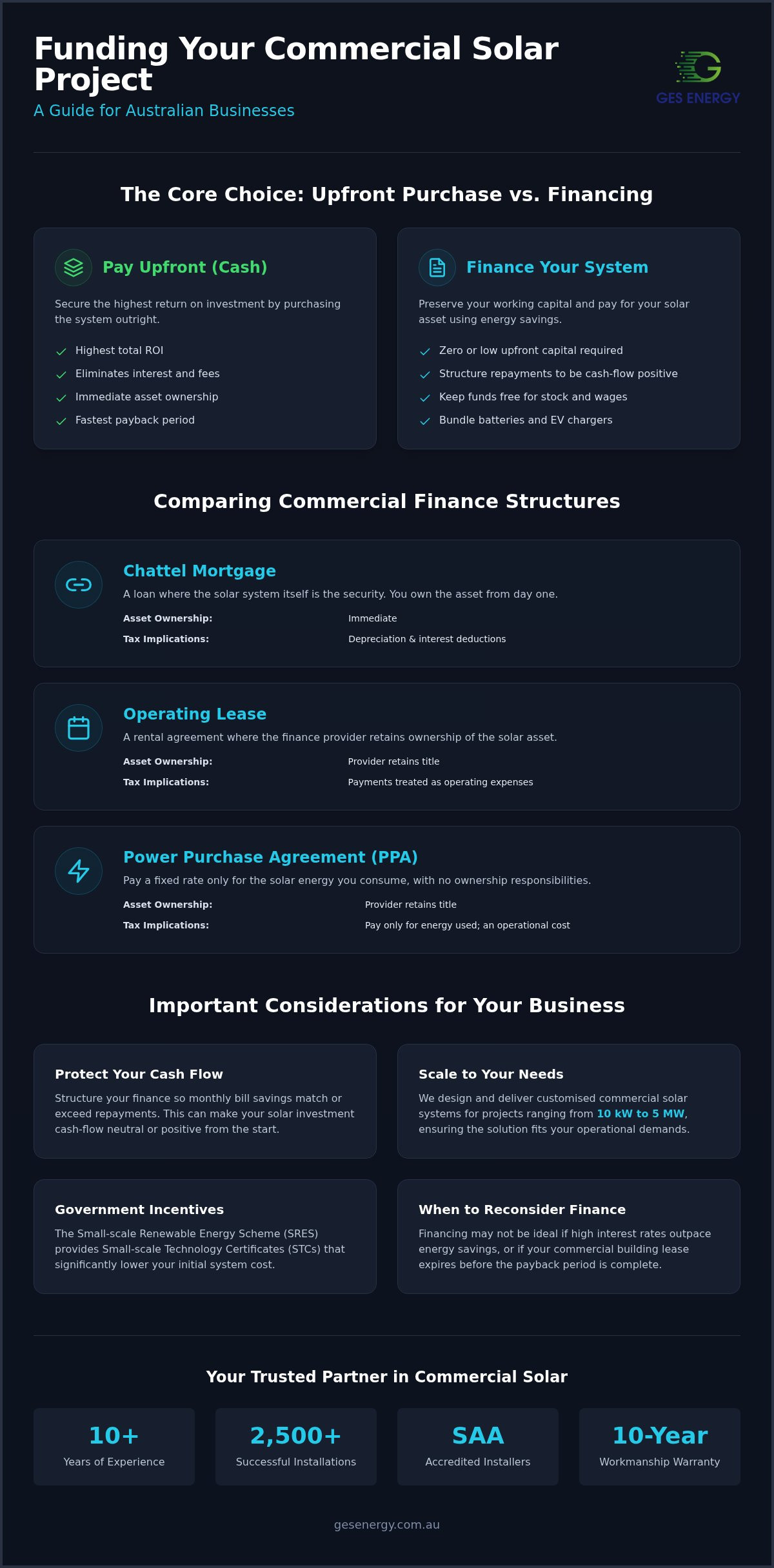
If you need cash free for stock and wages, a chattel mortgage deploys solar while you repay from operating revenue. If you prefer the asset off the balance sheet, an operating lease or PPA leaves title with the provider and treats payments as operating expenses. If you hold surplus capital and want depreciation from day one, paying cash removes interest and processing fees.
Select commercial solar finance (EPC services financing) options based on cash flow requirements, system sizing, and tax preferences. Choosing between paying cash and alternative arrangements often hinges on immediate budget constraints. Chattel mortgages preserve capital while allowing rapid deployment of clean infrastructure.
Your choice also depends on operational scale. Direct ownership suits businesses seeking immediate asset depreciation. Operating leases help companies keep liabilities off balance sheets while upgrading equipment with less friction.
GES Energy delivers customised system designs for projects ranging from 10 kW to 5 MW across nationwide locations. Comparing long-term power yields against annual repayments (chattel mortgage instalments) clarifies true profitability. Working with a Solar Accreditation Australia (SAA) accredited installer supports system performance and grid compliance. Review your energy profiles and pick the funding route that serves your ROI targets. Explore tailored commercial solar setups for your site.
Compare chattel mortgages, leases and PPAs for your business
Ownership timing, accounting treatment, and upfront cash decide whether a chattel mortgage, a lease, or a power purchase agreement fits you better than the alternatives.
Businesses that need the asset on the balance sheet straight away usually favour paying cash. Tax deductions for depreciation can reduce your effective costs over time.
Commercial options vary by ownership structure, operational terms, and tax treatment:
| Financial Structure | Asset Ownership | Key Tax Implications |
|---|---|---|
| Chattel Mortgage | Immediate ownership | Depreciation and interest deductions |
| Operating Lease | Provider retains title | Repayments treated as operating expenses |
| Power Purchase Agreement (PPA) | Provider retains title | Pay only for generated energy consumed |
According to Wikipedia's Solar Power in Australia (2024), total solar capacity across the country has expanded rapidly, driving competitive funding structures nationwide. SolarCity
Selecting solar finance with structured repayments helps preserve working capital while locking in predictable long-term energy yields. If your business operates away from main electrical networks, an off-grid solar system provides energy independence without standard utility grid reliance.
Finance commercial solar so bill savings protect your cash flow
You can structure solar finance so that monthly bill savings match or exceed your repayments. Picture the amount you already pay the utility: under a well-sized system that same outlay services your own power asset instead. For Victoria businesses, that approach neutralises immediate cash-flow shock.
Pairing your array with hybrid solar solutions lets you store cheap off-peak energy for peak operating hours, widening the gap between grid costs and system output. GES Energy designs system layouts from 10 kW to 5 MW to optimise these daily offsets.
The Small-scale Renewable Energy Scheme provides STCs that lower your initial system costs further. Positive cash-flow financing works when energy savings directly subsidise system ownership.
Among GES Energy's Google reviews, a customer (5★) wrote:
"Mr Kaium and Ladd was very professional. Whenever I had any queries the team always responded. My overall experience of establishing the Solar at my place with Mr Kaium and the team was smooth and happy with their service."
"This is an amazing event to attend. We get to talk to experts from all parts
Reliable communication (source) and clear technical support keep your commercial energy transition on track.
Weigh upfront purchase against a payment plan on total system cost
Selecting an upfront capital expenditure (paying cash) yields a lower overall system cost because processing fees and interest charges drop out entirely.
In engineering evaluations, SAA-accredited installers observe that system owners who clear equipment costs immediately secure faster payback periods on their return on investment. Cash purchases remove ongoing administrative costs and support stronger total energy savings over a system's full 25-year lifespan.
When comparing market values, solar installation figures spanning a 1,400–12,000 A$ range with an 8,000 A$ median show how fees alter long-term yields, according to current market rates. Choose paying cash if you have idle capital, or pick solar finance if flexible cash flow matters more.
You can also lower initial expenses through government incentives such as 2025 solar battery rebates or the national Small-scale Renewable Energy Scheme. Financing trades a higher final bill for immediate operational savings, much as a property mortgage does. GES Energy pairs your chosen commercial package with a 10-year workmanship warranty for operational security. More on this: Big Savings Ahead with 2025.
Uncover hidden APR costs before you sign a solar finance contract
Advertised rates rarely tell the full story: commercial solar finance contracts can bury balloon payments, exit fees, and administration charges in the fine print. Choosing an agreement on nominal interest alone is a material risk because uncalculated balloon liabilities inflate your total commitment. An upfront cash purchase bypasses finance charges completely; a properly assessed structured contract still helps you preserve operational liquidity when cash must stay free.
Client reviews of signed agreements show that subtle clauses shift expected return metrics over the loan life. Check every fee structure before you commit.
Commercial contracts need complete fee transparency. Verify whether upfront processing charges or early payout penalties apply. Factoring each fee into your repayments calculation reveals the true comparison value.
Tip: Always calculate the total payout figure over the full loan term rather than relying on low advertised monthly repayments.
A commenter in the getbirdeye.com.au thread "GES ENERGY, 130 Reviews, Solar Installation in Altona, VIC":
"Thank you, GES, for the quick installation of my solar system and battery storage a year ago! I've been able to reduce my bill to almost zero." (source)
Bill reductions of that kind show how systematic solar funding models can deliver operational independence for local enterprise sites.
Bundle batteries and EV chargers into one commercial finance package
You can place batteries and EV chargers on the same commercial solar finance facility as your panels, which cuts duplicate applications and aligns hardware delivery with one approval path.
Integrated financing covers hardware, software, and install labour. Combining these assets lowers your administrative burden and streamlines monthly repayments.
Integrated projects improve operational resilience. Adding an Alpha ESS battery provides immediate backup power, peak shaving (reducing electricity use during expensive peak hours), and demand response capability. Installing an ABB All-in-One High Power Charger lets your fleet charge from direct solar output.
Buying the full stack with paying cash can strain operating capital. Consolidated solar finance turns that stack into a manageable operational expense. GES Energy designs, procures, and installs these multi-tech commercial projects under one 10-year workmanship warranty nationwide. Ask the Melbourne team for figures matched to your load profile.
Four steps to secure business solar funding in Victoria
You secure solar finance in Victoria through a structured approval process run with SAA-accredited installers, so hardware choices and incentive paperwork stay aligned from the first site visit.
Early financial reviews prevent unexpected project delays. Early engineering reviews confirm that your chosen hardware qualifies for relevant state incentives.
- Assess energy requirements: Your business evaluates current power usage and site feasibility for a solar system design service.
- Apply for incentives: Submit your details through the official portal to complete the essential solar battery grant application steps.
- Select qualified hardware: Choose certified components like the Alpha ESS battery, which manages voltage control, peak shaving, and demand response.
- Finalise your agreement: Secure your approval so repayments stay within target before installation begins.
High-volume energy users gain the most from custom grid-connected designs sized to their half-hourly profile.
Recognise when commercial solar finance is the wrong choice
Paying cash makes more sense than solar finance when your business holds excess liquidity and wants a stronger ROI without interest drag. Avoid new debt when your building lease expires shortly or roof repairs are still pending.
Funded systems underperform when high interest rates outpace operational power savings. Net cash-flow modelling should come before any agreement terms are locked.
Borrowing adds overhead for companies that already hold abundant cash reserves. A cash purchase delivers the full benefit from the first generation day, and interest costs still erode long-term savings even when short-term capital looks protected.
Frequently asked questions
What are the advantages of paying cash for solar panels?
Paying cash eliminates interest charges entirely, supporting your long-term return on investment and giving you immediate ownership of your solar assets. Your business locks in electricity bill savings from day one while avoiding ongoing debt obligations. Purchasing the asset directly also lets you claim relevant government incentives at once, such as the Small-scale Renewable Energy Scheme via Small-scale Technology Certificates.
How does a cash flow positive system work?
A cash flow positive solar system generates monthly energy cost savings that exceed your recurring commercial solar finance payments. By designing a tailored solution to match your precise energy consumption, your business reduces grid power purchases immediately. The money saved on your electricity bill covers the funding costs, leaving extra working capital in your account each month.
What are green loans and how do they differ from regular personal loans?
Green loans offer discounted interest rates specifically for accredited energy-efficiency projects, so they cost less than standard commercial or personal debt facilities. Lenders require proof that the funded equipment meets set sustainability criteria before approving the lower rates. These products often feature flexible repayment terms aligned with your expected operational energy savings.
What are the pros and cons of BNPL for solar purchases?
Buy Now Pay Later arrangements offer rapid approval without an initial deposit from your capital reserves. These payment models often hide higher merchant fees or account administration charges inside the contract structure. They can also limit your access to direct government rebates or detailed technical system design support compared with conventional commercial options.
How do chattel mortgages and PPAs differ for a business solar project?
A chattel mortgage gives you immediate ownership, so you can claim depreciation and interest deductions while the asset sits on your balance sheet. A power purchase agreement leaves title with the provider: you pay only for the energy you consume and keep the arrangement off the ownership column. Pick the mortgage path when control and tax depreciation matter; pick the PPA when zero upfront capital and simple operating expense treatment matter more.
Choose the structure that protects cash flow and still builds the asset
The right solar finance structure lets your business deploy clean energy without stripping working capital. Weighing paying cash against structured repayments changes your monthly cash position as much as it changes your asset register.
Matching system sizing with federal STCs (Small-scale Technology Certificates) supports a faster return. Sound engineering also reduces the chance of costly grid curtailment later.
As certified Enphase Silver Installers, GES Energy advisers deliver engineered systems from 10 kW to 5 MW. You receive a 10-year workmanship warranty on installations. Review solar design services for a layout sized to your site, then contact the Melbourne-based team for a custom quote.


