

What if one rooftop solar system could reduce energy costs across a multi-tenant property, rather than benefiting only one meter? Multi-tenant commercial solar solutions can help distribute on-site solar across shared areas and tenant spaces, but the panels are only part of the plan.
If you manage a commercial building, you may be dealing with complex billing, limited roof space and a split incentive: the landlord funds the system while tenants receive some of the savings. Solar sharing and embedded networks can provide ways to allocate solar generation across multiple meters, provided the building’s electrical design, metering and compliance requirements are addressed.
This guide explains how to assess your property, plan fair energy sharing and identify opportunities to lower common-area power bills. You’ll also learn how a well-designed solar project may support property appeal for tenants seeking stronger green credentials. GES Energy delivers commercial solar EPC services for projects up to 5 MW, backed by a 10-year workmanship warranty.
Key Takeaways
- Compare shared-solar models against your building’s meters, roof space and tenant arrangements.
- Assess how multi-tenant commercial solar solutions could share on-site generation and reduce common-area energy costs.
- Model different tenant charging arrangements to balance the landlord’s investment with tenant savings.
- Check current certificate eligibility and state-based incentives, as requirements and available programs can vary.
- Consider how GES Energy’s EPC services for projects up to 5 MW and 10-year workmanship warranty could support planning for a multi-metered site.
The Challenge of Multi-Tenant Energy Management
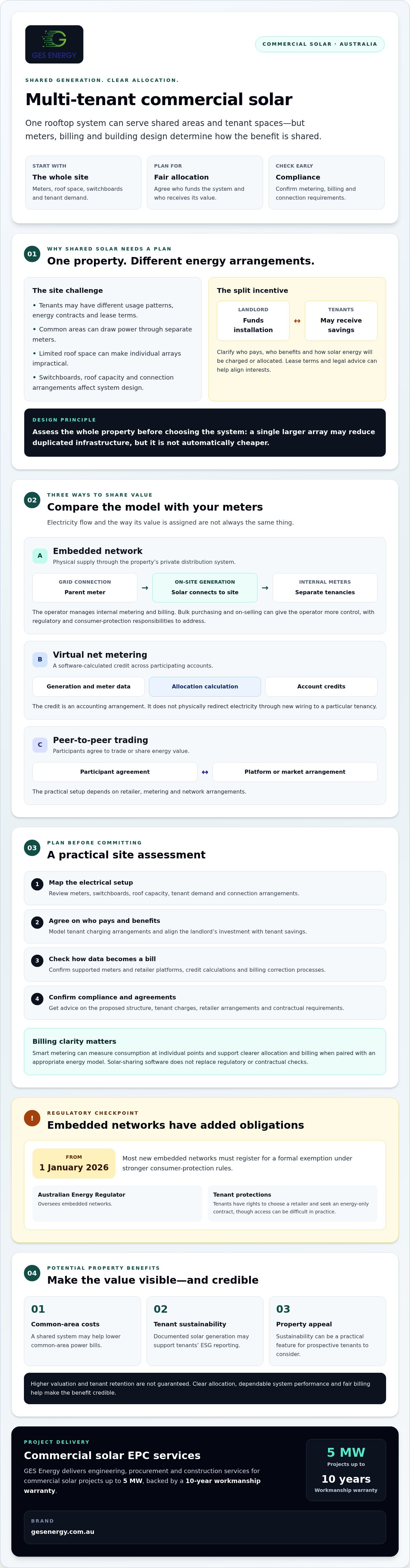
A solar system designed around one business’s meter may not suit a shared commercial property. Tenants can have different usage patterns, energy contracts and lease terms, while common areas draw power through separate meters. Limited roof space can also make individual arrays impractical. A coordinated design assesses the whole site and considers how generation could serve shared loads and, where the metering arrangement allows, tenant spaces.
The financial arrangements need equal care. In a split-incentive situation, the landlord pays for the installation while tenants may receive some of the benefit through lower electricity costs. Before committing, clarify who funds the system, who receives its value and how solar energy will be charged or allocated. Lease terms and legal advice can help align those interests.
Understanding the Multi-Meter Complexity
Multiple small systems can duplicate inverters, electrical work and approvals. Each array must also suit its roof area and meter. A single, larger system may reduce duplicated infrastructure, but it is not automatically cheaper. A site assessment should account for switchboards, roof capacity, tenant demand and connection arrangements. Smart metering can measure consumption at individual points and support clearer allocation and billing when paired with an appropriate energy model.
Regulatory and Billing Responsibilities
Sharing electricity across a private site can bring metering, billing and consumer-protection responsibilities. An embedded network uses a parent grid connection and internal meters to supply separate parts of a property. The Australian Energy Regulator oversees embedded networks. Operators typically need an exemption and must meet applicable requirements. Since 1 January 2026, most new embedded networks must register for a formal exemption under stronger consumer-protection rules. Tenants also have rights to choose a retailer and seek an energy-only contract, though access can be difficult in practice. Get advice on the proposed structure before setting tenant charges.
The Shift Toward Precinct-Wide Energy Independence
A shared system lets a property plan generation around the precinct’s combined needs, rather than treating each tenancy as an isolated energy user. This approach reflects the principles behind community solar programs, which can extend access to people unable to install panels themselves. For a commercial property, documented solar generation may also support tenants’ environmental, social and governance (ESG) reporting.
Electricity costs affect operating budgets and tenancy decisions. A well-planned shared system can help lower common-area power bills and give prospective tenants a practical sustainability feature to consider. It may strengthen a property’s appeal, but higher valuation and tenant retention are not guaranteed. Clear allocation, dependable system performance and fair billing are essential to making the benefit credible.
Technical Models for Shared Commercial Solar
Shared solar can be distributed through a building’s electrical network or allocated as a billing credit. The right model depends on existing meters, switchboards, retailer arrangements and how much billing administration the property manager is prepared to take on. When comparing multi-tenant commercial solar solutions, distinguish how electricity physically flows from how its value is assigned to tenants.
Three approaches are commonly discussed:
- Embedded network: A parent meter records electricity entering the site, while child meters measure supply to individual tenancies. On-site solar connects to the site’s electrical infrastructure, and the operator manages internal metering and billing.
- Virtual net metering: Software calculates how generation should be credited across participating accounts. The credit is an accounting arrangement. It does not physically redirect electricity through new wiring to a particular tenancy.
- Peer-to-peer trading: Participants agree to trade or share energy value through an agreed platform or market arrangement. The practical setup depends on retailer, metering and network arrangements.
Solar-sharing software can apply agreed allocation rules using generation and meter data, then pass results into billing workflows. Before selecting a platform, confirm which meters and retailer platforms it supports, how credits are calculated and how billing corrections are handled. Software does not replace the need to confirm regulatory and contractual requirements for the site.
Embedded Networks: The High-Control Model
In an embedded network, electricity passes from the grid connection and parent meter through the site’s private distribution system to child meters. The property operator may buy electricity in bulk and on-sell it to tenants, acting in a micro-retailer role. This can give the operator more control over internal billing, but it also brings responsibilities. The Australian Energy Regulator oversees embedded networks, and operators typically need an exemption and must meet applicable consumer protections. Seek specialist advice before choosing this structure.
Virtual Net Metering: The Software-Led Approach
Virtual allocation may suit a site where rewiring to distribute solar physically between tenancies is impractical or costly. The building’s wiring continues to supply each tenancy as it does today. Software applies solar credits through billing rather than changing the electrical path. Before relying on this model, check whether your retailer and billing platform support the required data and credit arrangements. Availability and implementation depend on the site and participating providers.
Plan the Hardware Around the Model
A shared system may include solar panels, inverters that convert their output, meters that measure grid imports and site consumption, and a gateway that sends system and meter data to monitoring or allocation software. Equipment depends on the electrical design and chosen model. A technical assessment should confirm switchboard capacity, meter compatibility, communications coverage and how generation data will reach billing systems.
For a multi-metered property, align the electrical design, metering and billing plan before installation. GES Energy’s commercial solar EPC services can help assess the site’s generation and infrastructure requirements.
Maximising ROI for Landlords and Tenants
A shared solar project can create value through reduced electricity purchases, tenant energy charges and better use of on-site generation. To assess the return, model expected cash flows across the system’s life, including installation and operating costs, energy used on site, tenant payments, export revenue and maintenance. Use site-specific meter data and test different energy-price and occupancy assumptions. There is no reliable universal payback period for a multi-tenant system.
Build a Return Model That Reflects Both Parties
In Australian commercial property, the “split incentive” describes a situation where the landlord funds an upgrade but tenants receive some of its bill savings. Compare ways to share the value, then document responsibilities and charging terms in the relevant contracts. Get legal advice where needed.
- Fixed fee: Charge an agreed amount for access to the solar arrangement. This can make billing more predictable, but the fee should reflect the benefit tenants receive.
- Power purchase agreement (PPA): Charge for solar electricity supplied under agreed pricing and billing terms. Define how generation is measured and how charges are reconciled.
Calculate savings on common-area loads separately from tenant income. A battery can store surplus solar for later use, helping shift energy to periods when the building needs it. Its value depends on the site’s demand profile, tariffs, operating strategy and system costs.
Direct Revenue and Indirect Value
Solar may help attract and retain tenants by giving businesses a visible sustainability feature and better information about energy use. Do not assume installation will increase a Green Star rating. Any rating outcome depends on the relevant assessment criteria and evidence. Check requirements with the rating body or a qualified adviser, then include any confirmed rating benefit in your financial case.
Planning a 100 kW to 1 MW Precinct
For a project in this size range, treat generic payback estimates as examples, not forecasts. Build the model from interval consumption data, generation estimates, the proposed tenant allocation and lifecycle costs. Compare outcomes with and without storage, and test how vacancies or changes in tenant demand could affect returns.
The Small-scale Renewable Energy Scheme provides Small-scale Technology Certificates (STCs) for eligible systems. Under the announced expansion, eligibility is set to extend from a 100 kW system-size cap to 1 MW for systems installed from 1 October 2026, subject to final regulations. Confirm current eligibility and certificate assumptions before including an incentive in your model. Planned maintenance can also help protect long-term performance. For complex precinct projects, commercial solar EPC services can coordinate system design and delivery.
Navigating Australian Regulations and Incentives
Incentives and compliance can affect the financial case for multi-tenant commercial solar solutions. Eligibility depends on system size, installation date, location and project structure. Confirm the current rules before approving a design or including a rebate in your forecast.
Understand Certificates and Embedded Network Rules
The Small-scale Renewable Energy Scheme (SRES) provides Small-scale Technology Certificates (STCs) for eligible systems. As of September 2026, eligibility is set to expand from a 100 kW system-size cap to 1 MW for systems installed from 1 October 2026, subject to final regulations. Large-scale Generation Certificates (LGCs) operate under a separate scheme. Check which certificate pathway, if any, applies to your project and confirm current requirements before relying on certificate value in your business case.
If you plan to on-sell electricity through an embedded network, the Australian Energy Regulator (AER) oversees operator exemptions and consumer protections. From 1 January 2026, most new embedded networks must register for a formal exemption and meet stronger consumer-protection rules. Get advice on the proposed network and billing arrangement before setting tenant charges.
Victorian Incentives and Local Approvals
For Victorian commercial properties, the Victorian Energy Upgrades (VEU) program offers upfront discounts for eligible solar PV systems between 30 kW and 200 kW. Indicative discounts, based on a certificate price of $70, are around $9,100 for a 100 kW system and $34,300 for a 200 kW system. Eligible projects may be able to combine VEU support with federal SRES incentives. Check current eligibility and terms before applying. Victoria’s Solar for Business Program ended on 30 June 2023. Do not assume it remains available or that a Solar Victoria household offer applies to a commercial property. For rooftop projects, check planning requirements with the relevant local council or planning authority, as these can depend on the site and proposal.
Plan Compliance and Battery Applications
Ask your project team to identify the standards and evidence relevant to the design. Key installation standards include AS/NZS 5033 for solar panels, AS/NZS 4777 for inverters and grid connection, and AS/NZS 5139:2019 for battery safety. SAA-accredited installers support compliant installation and are relevant to certificate eligibility. GES Energy’s in-house teams hold ISO 9001, ISO 14001 and ISO 45001 certifications, which can support procurement requirements where a tender specifies them.
For battery incentives, first check the program’s eligibility, obtain a project quote and follow its application process. Since 1 March 2026, installers must submit geotagged, timestamped photos of specified battery labels to the Clean Energy Regulator for installations seeking STCs. To plan a compliant commercial project, discuss solar EPC services for your property.
GES Energy: Expert EPC Services for Multi-Tenant Sites
Multi-tenant commercial solar solutions need more than panels sized to roof area. The design must account for how electricity moves through the property, which meters serve each tenancy and when shared and tenant loads use power. GES Energy delivers commercial and industrial solar projects from 10 kW to 5 MW, with EPC services that coordinate engineering, procurement and construction for complex sites.
Engineering and Design for Multi-Metered Properties
A site-specific solar system design can map roof capacity, switchboards, meter arrangements and energy demand before equipment is selected. Load analysis helps align expected solar production with tenant and common-area consumption, informing system sizing and energy-sharing plans. GES Energy’s in-house teams hold ISO 9001, ISO 14001 and ISO 45001 certifications. These systems support quality, environmental and safety management, although specific tender requirements vary. For broader commercial project considerations, read the Commercial Solar: 2026 Guide for Australian Businesses.
GES Energy is based in Melbourne and serves projects across Australia. Its commercial and industrial projects include a 10-year workmanship warranty, which can help protect your investment against defects arising from installation work.
Plan for Storage and EV Charging
Battery storage can complement shared solar by storing some daytime generation for later use. Whether it improves the project’s financial or operational case depends on the site’s load profile, tariff structure, battery design and allocation model. Assess these together rather than treating storage as an automatic add-on.
Planning for an EV charging station also starts with the site’s electrical capacity and expected charging demand. An ABB All-in-One High Power Charger may be considered as part of a suitable charging design, subject to project requirements and equipment compatibility. Solar, storage and charging need coordinated electrical design so new loads fit the property’s infrastructure and do not compromise the intended energy-sharing arrangement.
With projects ranging from commercial systems to utility-scale installations up to 5 MW, GES Energy can assess the generation, storage and charging requirements of a multi-tenant site. Contact GES Energy for a precinct energy assessment to discuss your property’s needs.
Plan a Shared Solar System That Works for Your Property
Successful multi-tenant commercial solar solutions depend on more than generation capacity. The energy-sharing model needs to match the property’s meters, electrical infrastructure and tenant arrangements. The financial plan should also make the value clear to landlords and tenants.
Start with reliable consumption data, then assess how solar generation could serve common areas and participating tenancies. Compare the practical demands of each sharing model, agree how energy charges will be managed, and check current incentive and compliance requirements before committing to a design. This groundwork helps you make decisions based on your building’s actual needs rather than a generic payback estimate.
GES Energy supports commercial and industrial projects with SAA-accredited installers, utility-scale capacity up to 5 MW and a 10-year workmanship warranty on commercial and industrial projects. For a site-specific discussion of your property’s potential, book a multi-tenant solar feasibility study with GES Energy.
With a clear plan for generation, allocation and ongoing performance, you can take a considered step towards lower shared energy costs and a more attractive commercial property.
Frequently Asked Questions
What is an embedded network in a commercial building?
An embedded network is a private electricity network within a property. Electricity enters through a parent meter, then flows through the site’s internal network to child meters that measure supply to individual tenancies. The operator may manage internal billing and on-sell electricity, so metering, consumer protections and Australian Energy Regulator requirements need attention. Before adopting this structure, check the applicable exemption and registration requirements for your building.
How do you bill multiple tenants for solar power?
Choose a clear allocation and billing method before the system operates. For example, an embedded network can use child-meter data to calculate tenant consumption, while agreed software or billing arrangements may allocate solar credits. You might charge a fixed fee or use a power purchase agreement, but document how generation is measured, how charges are calculated and how disputes are handled. Have the proposed structure reviewed for contractual and regulatory requirements.
Can tenants choose their own electricity provider in a solar-shared building?
Tenants in an embedded network have the right to choose their own electricity retailer and seek an “energy only” contract, though doing so can be difficult in practice. The available options depend on the building’s network and billing arrangements. If you manage the property, explain the process to tenants and confirm how a retailer change affects solar credits, metering and any separate charges under the tenancy agreement.
What are the main benefits of EPC services for multi-tenant solar?
EPC services bring engineering, procurement and construction into a coordinated project. For multi-tenant commercial solar solutions, this helps align system design with site demand, switchboards, meters, roof conditions and installation requirements. It also gives the property manager a clearer view of how the system will be built and commissioned. Confirm the proposed scope, compliance responsibilities, handover documents and workmanship warranty with your project provider before work begins.
How much roof space is needed for a 100 kW multi-tenant system?
There is no single roof-area figure for every 100 kW system. The required space depends on the selected panels, their layout, roof shape, shading, access needs and structural constraints. A site assessment can establish the usable area and whether the roof can support the proposed design. Ask for a layout showing panel placement, access clearances and any constraints, rather than relying on a generic area estimate.
Are there specific Australian grants for multi-tenant solar projects?
Eligible projects may access incentives such as Small-scale Technology Certificates (STCs) under the Small-scale Renewable Energy Scheme. In Victoria, the Victorian Energy Upgrades program offers discounts for eligible commercial solar PV systems between 30 kW and 200 kW. Eligibility depends on the project and current program rules, so confirm requirements before including an incentive in your financial forecast. Some programs may not apply to every multi-tenant site.
What happens if a tenant moves out of a solar-equipped building?
The solar system remains part of the property, but the outgoing tenant’s billing and energy allocation need to be reconciled under the building’s arrangements. Review the tenancy agreement and metering records to settle charges up to the move-out date, then update account and allocation details for the incoming tenant. Clear lease terms and a consistent handover process help prevent billing confusion during a change of occupancy.
Does GES Energy provide maintenance for systems installed by others?
Yes. GES Energy provides maintenance, inverter repairs and warranty assistance for solar systems regardless of the original installer. The company serves customers across Melbourne, Geelong, Ballarat, Bendigo, Shepperton, Melton, Mildura, Wodonga, Traralgon, Wangaratta, Horsham, Sale, Colac, Echuca, Ararat, Portland, Swan Hill, Benalla and Maryborough. Ask about the system information and maintenance scope required for your property.


