

What if a larger solar array produces less value for your plant than a system sized around your production schedule? For solar for manufacturing plants australia, panel capacity is only part of the decision. Daytime demand, site conditions and electrical infrastructure all influence how much generated power your operations can use.
It’s understandable to question whether production will align with solar generation, or whether roof, land or connection constraints will affect a project. The right configuration depends on your actual load profile, not a standard system size. This guide compares solar-only, battery-integrated and grid-connected approaches, and explains how to assess site fit, energy needs and project delivery. You’ll also see what information to prepare for a qualified assessment, from interval energy data and operating hours to site and electrical details. GES Energy designs and installs commercial and industrial solar systems, with EPC services for suitable projects.
Key Takeaways
- Assess solar for manufacturing plants australia against production hours and interval consumption data, not roof area alone.
- Compare grid-connected solar, battery storage and microgrid options against your plant’s operating needs and site conditions.
- Gather energy bills, interval data, shift schedules and planned expansions to support an informed solar assessment.
- Check a project partner’s industrial experience, design capability, installation credentials and maintenance approach.
- Ask how EPC services can coordinate engineering, procurement and construction for a suitable project.
Solar for manufacturing plants Australia: what should a project solve?
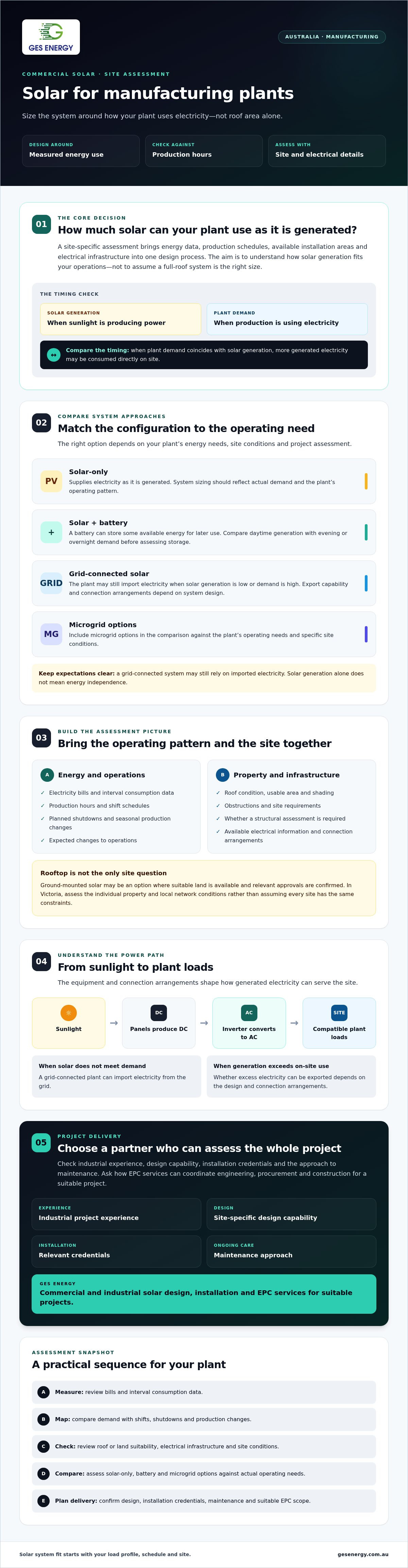
A manufacturing solar project should be designed around the site’s energy demand and operating conditions, not panel capacity or roof area alone. For solar for manufacturing plants australia, the practical question is how much solar generation can be used on site while production is running, and what happens when demand changes. A site-specific assessment brings energy data, production schedules, available installation areas and electrical infrastructure into one design process.
The goal is usually to reduce electricity imported from the grid during periods when solar is generating. That is different from energy independence: a grid-connected system may still rely on imported electricity when generation is low or plant demand is high. An assessment should clarify the likely operating fit without promising either outcome. For wider context, see this overview of the state of solar power in Australia.
This video provides additional context on solar technology and Australian manufacturing:
A site-specific solar assessment matches generation to a plant’s measured energy use, operating schedule and physical and electrical conditions.
How does a plant’s load profile shape solar suitability?
Start with electricity bills and interval consumption data, then compare demand patterns with production hours across the year. Daytime generation is most useful when the plant can consume it as it is produced. If demand regularly falls below generation, some output may not be used on site. System sizing should reflect actual demand rather than an assumed full-roof installation.
Include shift work, planned shutdowns, seasonal production changes and expected changes to operations. A plant running fewer shifts at certain times may have a different daytime load from one operating steadily through the week. These patterns help an assessor test whether the design aligns with current use and future plans.
Which site details should manufacturers check first?
Check roof condition, usable area and shading, and identify whether a structural assessment is required before rooftop equipment is considered. Obstructions and site requirements can reduce usable space, so the roof’s total footprint does not confirm how much area is suitable. Have the available electrical information reviewed as part of site planning, too.
Ground-mounted solar may be an option where suitable land is available and relevant approvals are confirmed. For Victorian plants, assess the specific property and local network conditions rather than assuming every site faces the same constraints. These checks can identify potential delivery issues early and give the design team a practical basis for comparing options.
How manufacturing solar systems work with plant operations
Solar panels convert sunlight into direct current (DC) electricity. Inverters convert that output to alternating current (AC), which can supply compatible plant loads. If the system is grid-connected, electricity can also be imported from the grid when solar generation does not meet demand. Whether excess generation can be exported, and how the system operates, depends on its design and connection arrangements. Confirm these details during project assessment rather than assuming every site can export power.
On-site solar use depends on timing: the more plant demand coincides with solar generation, the more generated electricity may be consumed directly rather than drawn from the grid. This is known as self-consumption. Reviewing production schedules alongside interval data can help identify when generation is likely to match demand.
What is the difference between solar-only and solar-plus-battery?
A solar-only system supplies electricity as it is generated. A battery adds the option to store some available energy for use later, but its suitability depends on when the plant needs electricity, its operating requirements and the project assessment. For example, compare daytime generation with evening or overnight demand before deciding whether storage merits further assessment. The published guide to industrial battery storage solutions can help you consider the relevant factors.
Battery storage is not an automatic requirement for every manufacturing site. The design should account for how the system will operate alongside plant loads and the grid, including the intended use of stored energy.
When might a microgrid or staged project be relevant?
A microgrid may be worth assessing where a site has more complex energy requirements or needs coordinated management of multiple energy assets. Its suitability depends on the plant’s operations, existing infrastructure and project design. The guide to microgrid solutions in Australia provides further context for considering this option.
Staged delivery may also be considered when a manufacturer wants to plan project components in sequence. Treat this as a planning possibility, not a guarantee of lower costs or better performance. Each stage needs assessment for how it will connect with the wider system and changing production needs.
For manufacturers considering external project support, ARENA's Advancing Renewables Program outlines a funding programme to review. Check the programme’s current criteria and whether they apply to your project before relying on funding in a business case.
A site-specific solar system design can help compare configurations against actual demand and operating plans. GES Energy designs and installs commercial and industrial solar systems across Australia. Explore commercial and industrial solar as a starting point for considering a site assessment.
Solar-only, batteries or a microgrid: compare options for your plant
There’s no standard package that suits every factory. The right configuration for solar for manufacturing plants australia depends on when your plant uses power, how the site is set up and what you want the energy system to do. Compare options against measured demand and operating requirements, then confirm potential performance through project-specific design and modelling.
| Configuration | Operating fit | Storage | Site needs and complexity | Questions to assess |
|---|---|---|---|---|
| Grid-connected solar | May suit plants with demand during solar generation hours. | No battery included. | Requires a suitable installation area, engineering review and assessment of connection conditions. | How closely does daytime demand match expected generation? What connection conditions apply? |
| Solar with battery storage | May warrant assessment when generation and demand occur at different times. | Stores some generated energy for later use, subject to system design. | Requires space and integration planning for the solar, battery and plant loads. | When would stored energy be used, and what operating need would it serve? |
| Microgrid | May suit sites with more complex energy requirements. | Storage may be considered as part of the wider design. | Requires site-specific planning for energy assets, loads and system operation. | Which site requirements call for coordinated energy management? |
When could grid-connected solar be a suitable starting point?
A plant that uses electricity during daylight hours may be a candidate for grid-connected solar, but the fit depends on its load profile and site. System size should reflect demand, connection conditions and engineering review, not roof area alone. Ask the designer to explain the assumptions behind the proposal, including how generation, on-site use and any possible exports are treated. Savings, payback and export income need project-specific assessment.
When should a manufacturer assess battery storage or a microgrid?
Consider storage if there’s a recurring timing gap between solar generation and plant demand, then assess whether shifting energy use would support a defined operating need. Resilience or greater energy independence may also be objectives to examine, but neither is assured by adding a battery or microgrid. The design must account for site loads and the intended operation of the system. For financial evaluation, consult the published commercial solar return on investment guide and test its assumptions against your own project.
Available services and expected project outcomes are different things. GES Energy offers battery storage and microgrid solutions alongside commercial and industrial solar. Whether any configuration suits your plant, and what it may deliver, requires site-specific assessment and modelling.
How to prepare a manufacturing plant for a solar assessment
A well-prepared assessment can help a designer understand how solar might fit your plant before recommending a configuration. Gather operating and site information first, then arrange the necessary site reviews. This gives you a clearer basis for comparing proposals for solar for manufacturing plants australia, including their assumptions, scope and limitations.
What information should you provide to a solar designer?
Collect the information you already have. Complete records are useful, but don’t delay an initial discussion if some details are unavailable. Share:
- Electricity bills and available interval consumption data for relevant periods.
- Operating hours, shift patterns, planned shutdowns and seasonal production changes.
- Known expansion plans or future capacity needs that could change electricity demand.
- Site plans, roof information and details of existing electrical infrastructure, where available.
These inputs help the designer compare energy use with likely solar generation and account for planned operational changes. They also help identify what needs further investigation. For example, a proposed rooftop system may need a structural review, while the site’s electrical arrangements and connection requirements may need assessment by qualified professionals. Discuss site access so relevant areas can be inspected safely.
What should a proposal explain before you compare it?
Review each proposal for clarity, not just system size. Ask the designer to explain how the proposed system relates to your plant’s energy use and what information supports its estimates. Check whether the document identifies constraints and assumptions rather than presenting expected outcomes as certain.
- Design and performance: Does it explain the system design, expected generation and factors that could limit output or on-site use?
- Scope and responsibilities: Does it set out the equipment included, installation responsibilities and what sits outside the proposed work?
- Delivery and operation: Does it describe commissioning, ongoing maintenance provisions and how installation disruption will be managed?
- Safety and compliance: Does it explain the proposed safety planning and how applicable requirements will be identified and addressed?
Site access, roof structure, electrical infrastructure and connection arrangements need appropriate review. Don’t treat an early estimate as confirmation that every detail has been resolved. If incentives may affect your business case, check current eligibility and programme information with the relevant official source before including any assumed benefit.
GES Energy’s solar system design service provides a site-specific starting point for assessing commercial and industrial solar. To discuss a manufacturing solar assessment, contact GES Energy.
Choosing a manufacturing solar project partner in Australia
A manufacturing solar project involves more than selecting panels and an installer. Your partner should understand how production demand, site conditions and electrical infrastructure shape system design and delivery. For solar for manufacturing plants australia, look for clear answers about project scope, responsibilities and the assumptions behind expected performance.
What should you ask a commercial solar provider?
Use these questions to compare providers and check whether their approach suits your plant:
- Industrial experience: What experience do they have with commercial and industrial sites, and projects of a similar scale and operating profile?
- Design approach: How will the design account for interval demand, shift patterns, shutdowns and planned expansion?
- Project responsibilities: Who coordinates engineering, procurement, construction, commissioning and ongoing support? Ask what is included and who manages each stage.
- Installation credentials: What accreditation applies to the installation team and proposed work? Ask for current details and confirm the scope.
- Warranty and maintenance: What does each warranty cover, and what maintenance provisions are available? Request clear terms, including the scope of any workmanship warranty.
Strong answers should connect the proposed system to your site data, rather than rely on a standard package or broad performance claims. Ask the provider to identify project-specific assumptions and explain what still needs engineering or site review.
How can GES Energy support an industrial solar project?
GES Energy designs and installs solar power systems for commercial and industrial customers, and offers EPC services for utility-scale and microgrid projects. EPC services cover the project lifecycle up to 5 MW. GES Energy also offers battery storage, microgrid development and ongoing maintenance for solar installations. Maintenance services include system health checks, inverter repairs and warranty assistance.
For manufacturers in Melbourne, Geelong, Ballarat, Bendigo, Shepperton, Melton, Mildura, Wodonga, Traralgon, Wangaratta, Horsham, Sale, Colac, Echuca, Arrarat, Portland, Swanhill, Benalla and Maryborough, site conditions and operating needs still determine what system may be suitable. Ask for the proposed project’s design, delivery responsibilities and maintenance arrangements in writing.
Each system and its expected outcomes require project-specific assessment. A provider should explain how the proposed design relates to your plant’s load profile, site constraints and operating plans, without presenting estimates as guaranteed results.
To discuss your site requirements and possible project approach, discuss your manufacturing plant’s solar project with GES Energy.
Make your next solar decision site-specific
The strongest starting point for solar for manufacturing plants australia is your plant’s actual energy profile. Match daytime generation to production demand, then compare solar-only, battery storage and microgrid options against your site conditions and operating needs. Interval data, shift schedules and expansion plans help turn an initial idea into a practical assessment.
Before comparing proposals, check the assumptions behind expected generation, system scope, connection requirements and ongoing maintenance. GES Energy offers commercial and industrial solar design and installation, EPC services, battery storage, microgrid development and maintenance. Ask for the project scope and applicable terms to be confirmed for your site.
A clear assessment can help you understand which options merit further design, without assuming that one configuration suits every plant. Discuss your manufacturing plant’s solar requirements with GES Energy and take the next step with a site-specific plan.
Frequently Asked Questions
Is solar suitable for a manufacturing plant in Australia?
Solar may suit a manufacturing plant if its energy use, site conditions and electrical arrangements support a workable design. Compare interval consumption data with production hours to see how much demand coincides with daylight generation. Roof condition, shading, structural requirements and grid connection arrangements also need assessment. Solar for manufacturing plants australia is not a standard fit: a site-specific review helps identify suitable configurations and constraints before you decide.
How much solar capacity does a manufacturing plant need?
The required capacity depends on the plant’s electricity demand, operating schedule, available installation area and connection conditions. Review interval data and bills alongside shift patterns, shutdowns and seasonal production changes. Include planned expansion, as future loads can affect system sizing. A designer should model the proposed system against the plant’s actual demand and explain key assumptions. Roof area alone doesn’t determine the appropriate capacity or expected on-site use.
Can a factory run on solar power during a night shift?
Solar panels generate electricity when there is sunlight, so they can’t directly supply night-shift demand from current generation. A grid-connected factory can draw electricity from the grid when solar output is unavailable. Battery storage may store some solar energy for later use, subject to system design, storage capacity and operating demand. Whether a battery can support particular night operations needs assessment; don’t assume solar alone will cover overnight loads.
Should a manufacturing plant add battery storage to its solar system?
Add battery storage only after assessing when your plant uses electricity and what operational need storage would serve. A battery may be worth considering if solar generation and demand occur at different times, but its suitability depends on the load profile, site and proposed system design. Compare solar-only and battery-integrated options using interval data, including shift patterns and shutdowns. Ask the designer to explain how stored energy would be used and what the model assumes.
What happens to excess solar generation at a manufacturing site?
Excess generation may be exported to the grid if the system design and connection arrangements allow it. Otherwise, the system’s operation may need to manage generation in line with site and network requirements. Confirm export arrangements with the project designer and relevant network parties; don’t assume every site can export surplus electricity or will receive a particular payment. A load-profile assessment can help determine when generation may exceed plant demand and inform system sizing.
How long does it take to install solar at a manufacturing plant?
There’s no single timeframe for every manufacturing project. Site assessment, design, structural and electrical reviews, connection requirements, procurement and construction planning can all affect the schedule. The installation plan should also explain commissioning, safety arrangements and how work may affect plant operations. Ask prospective providers for a project-specific programme, including dependencies and any site information or decisions needed from your team. Plan early enough to assess each stage before committing to a schedule.
Are government incentives available for manufacturing solar in Australia?
Government incentives may be available, but eligibility depends on the programme, system and project circumstances. Check current rules and application requirements directly with the relevant government source before including an incentive in your business case. Victorian businesses should also confirm whether any state-based programme applies to their site and proposed system. Don’t rely on an assumed rebate or discount until eligibility, timing and applicable terms have been verified.


