

Your solar inverter isn't just another box on the wall; it's the central heartbeat of your entire energy ecosystem. When it fails, your property stops being a self-sufficient power plant and starts drawing expensive electricity from the grid once more. It's incredibly frustrating to watch your daily feed-in tariffs vanish while trying to decipher confusing error codes on a flickering display. Finding reliable solar inverter repair australia services shouldn't feel like a gamble, particularly if you're trying to source technicians who understand older or obscure brands that others might ignore.
This guide provides the technical clarity you need to restore your energy independence. You'll learn how to identify specific inverter faults, evaluate whether a targeted repair or a full system replacement is the most cost-effective path, and manage complex warranty claims with confidence. We look at the latest Australian standards and technical requirements for 2026 to ensure your infrastructure remains compliant and efficient. Whether you're managing a residential battery setup or a large commercial array, these insights will help you secure expert support and return your system to peak performance.
Key Takeaways
- Learn to interpret common LCD error messages and status indicators to determine the actual health of your solar power conversion system.
- Determine if a professional solar inverter repair australia service is viable or if upgrading to 2026 technology provides better long-term energy savings.
- Benefit from SAA-accredited technical inspections and remote data analysis to identify faults accurately before they lead to significant energy losses.
- Understand your rights under Australian Consumer Law and the latest AS/NZS 4777.2:2020 standards when pursuing manufacturer warranty claims.
- Restore reliability to complex industrial systems and micro-grid networks through specialised servicing of high-capacity string and central inverters.
Common Solar Inverter Faults and Error Codes in Australia
A Solar inverter is the most hard-working component of your renewable energy system. It operates under constant electrical load while exposed to the elements. When performance drops, the first sign is usually a red status light or a static error message on the LCD. Understanding these signals is the first step toward an effective solar inverter repair australia process. Many faults are safety-driven, meaning the unit has shut itself down to prevent damage to your property or the wider grid.
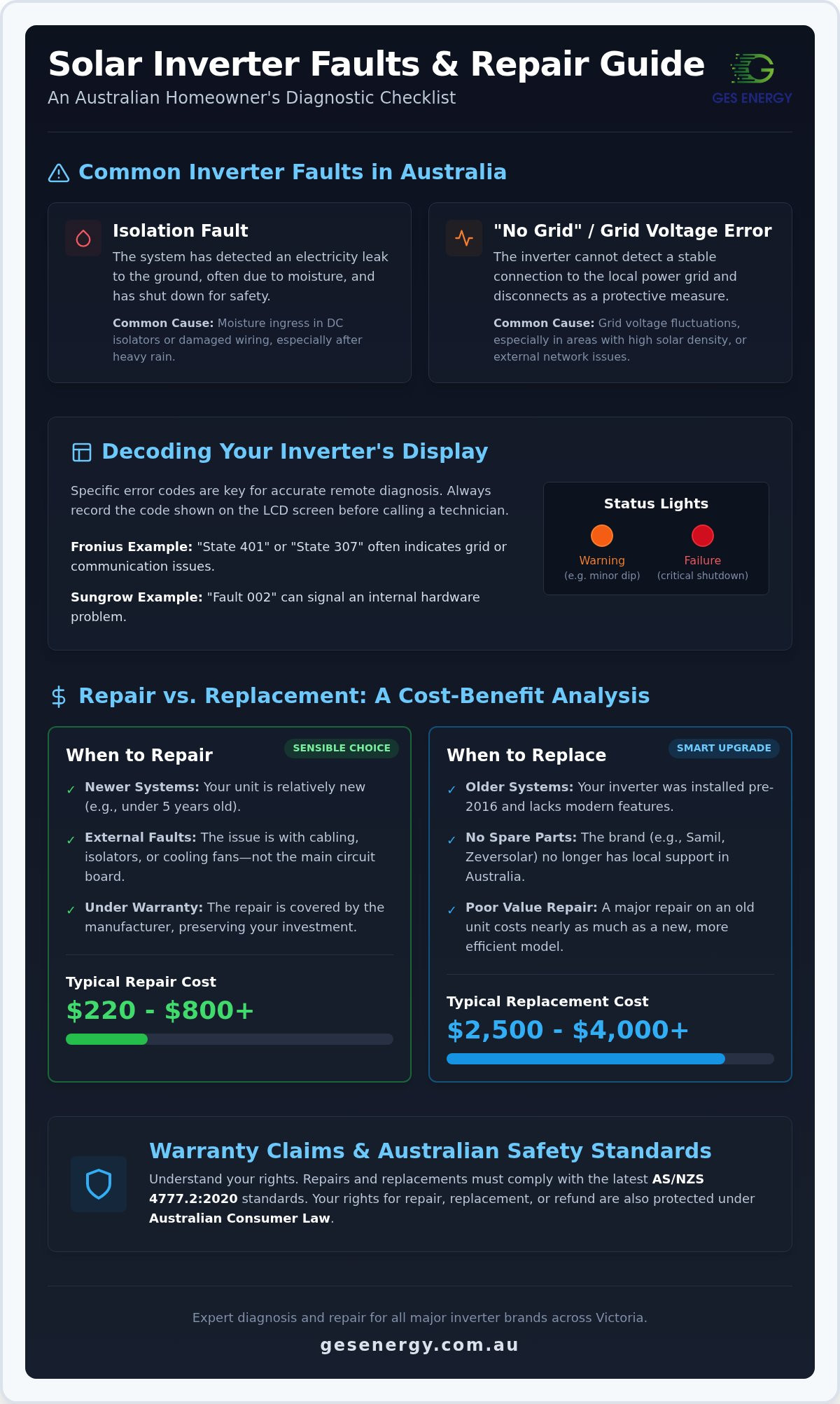
Isolation faults are among the most frequent issues reported across Victoria. These occur when the system detects a leak of electricity to the ground, often caused by moisture ingress in DC isolators or damaged panel wiring. In Australia, heavy rain following a long dry spell is a common trigger for these alerts. The inverter identifies the risk and ceases operation to ensure the system remains safe.
"No Grid" or "Grid Under Voltage" errors are also common. These don't always indicate a broken unit. Instead, they often mean the inverter cannot detect a stable connection from the local network. In areas with high solar density, grid voltage can fluctuate significantly. If the voltage exceeds set limits, the inverter disconnects as a protective measure. Persistent grid errors require a technical inspection to determine if the issue lies with the unit's internal sensors or the external network connection.
Decoding Your Inverter Display
Different manufacturers use specific codes to communicate system health. For example, Fronius units often display "State 401" or "State 307" when communication or grid issues arise. Sungrow displays might show "Fault 002" to indicate an internal hardware problem. It's vital to distinguish between a flashing orange warning and a solid red failure light. A warning might suggest a minor communication dip, while a red light typically signals a critical shutdown. If you notice your energy production has flatlined on your monitoring app, record the specific code immediately. This data allows technicians to provide more accurate remote support.
Environmental Stress on Victorian Solar Systems
The Australian climate is notoriously harsh on sensitive electronics. In coastal regions like Geelong and Portland, salt air can lead to the rapid corrosion of internal components if the unit's seals are compromised. Heat is the primary enemy of longevity. During Victorian summer heatwaves, internal temperatures can reach extreme levels. If your inverter is mounted on a north-facing wall without a heat shield or installed in a cramped, unventilated garage, the cooling fans must work much harder. Over time, dust accumulates on these fans and heat sinks, leading to overheating and component failure. Maintaining clear airflow and ensuring the unit is shielded from direct afternoon sun are simple ways to prevent a premature solar inverter repair australia callout.
Repair vs Replacement: A Cost-Benefit Analysis for Your System
Deciding on a solar inverter repair australia requires a clear look at the age of your infrastructure. If your system was installed before 2016, you're likely using technology that lacks modern grid-support features and high-speed monitoring. While a minor repair might cost as little as $220 plus GST for a simple component swap, spending $800 on a logic board for a decade-old unit is often poor value. In contrast, if your high-end unit is only four years old, a repair keeps your existing warranty intact and avoids the $2,500 to $4,000 cost of a new single-phase replacement.
The availability of spare parts is a significant factor for older installations. Many brands that were popular a decade ago, such as Samil or Zeversolar, no longer have local technical support or warehouses in Australia. Attempting to source refurbished parts for these discontinued models often leads to repeated failures and extended downtime. In these cases, moving to 2026 technology is the only reliable way to restore energy production and ensure long-term stability.
When Is Repair the Sensible Choice?
Repairing is the logical path when the fault is external to the main circuit board. Issues like perished DC isolators, faulty external cabling, or clogged cooling fans are straightforward fixes that don't require replacing the entire unit. If your inverter is still under its original manufacturer warranty, a repair is usually covered at no cost to you, preserving your initial investment. For large-scale industrial units, component-level maintenance is standard practice. These high-capacity assets are designed for longevity, and replacing a 50kW unit prematurely can be an unnecessary capital expense when a targeted service can restore peak efficiency.
The Case for Full Inverter Replacement
Modern inverters available in 2026 offer efficiency ratings often exceeding 98%, which is a noticeable jump from the 90% to 94% seen in older models. Upgrading allows you to access advanced monitoring tools like Solar Analytics, giving you precise data on how your property consumes energy. Perhaps most importantly, new units are future-proofed for battery storage and EV charging. All new grid-connected installs must now comply with the AS/NZS 4777.2:2020 standard, which includes mandatory grid-support functions that older units lack. If your system is over 10 years old, you may also qualify for the Victorian Solar Homes Program rebate of up to $1,400 for a full system replacement, making an upgrade more financially attractive than a costly repair. Before making a final decision, it is worth booking a professional system audit to see which path offers the best return on your investment.
The GES Energy Diagnostic and Maintenance Process
Engineering-led diagnostics are the foundation of a reliable solar inverter repair australia service. Instead of relying on guesswork, we apply a methodical approach to identify the root cause of system failures. This process begins the moment you provide your system data; it doesn't matter if we performed the original installation or not. Our SAA-accredited technicians specialise in complex commercial and industrial setups where system downtime results in immediate financial loss. By combining technical proficiency with high-level data analysis, we ensure your infrastructure is restored to its peak operating state.
Remote Monitoring and Performance Tracking
Remote monitoring serves as an early warning system for your energy infrastructure. We review historical performance data to identify anomalies before they lead to a total shutdown. Our team interprets performance curves to spot issues like string imbalances or voltage spikes that indicate hardware fatigue. For commercial and industrial sites across Melbourne, Geelong, and Bendigo, this tracking is essential for energy security. It allows for scheduled maintenance that fits your operational needs, preventing the chaos of an unexpected power loss. We focus on the practical benefits of predictability, ensuring your system delivers the efficiency promised at the time of design.
Off-Grid and Standalone System Specialist Care
Off-grid properties in remote Victorian regions like Mildura or the High Country require a unique maintenance framework. These standalone systems rely on sophisticated inverter-chargers that manage the delicate balance between solar generation and battery storage. During an on-site service, we conduct thorough testing of battery integration to ensure the inverter is communicating perfectly with the battery management system. We check all physical connections and protection devices, which is critical for sites in Ballarat or Portland where reliability is non-negotiable. This specialised care preserves your energy independence and protects the long-term health of your storage assets.
Every diagnostic visit concludes with a thorough technical report. This document provides a clear overview of your system’s current performance, any identified safety risks, and our professional recommendations for future-proofing your site. We prioritise transparency, giving you a clear roadmap to maintain your energy infrastructure. Whether you need a simple component replacement or a complex system recalibration, our goal is to provide the stability and control you need to manage your energy future. This structured approach to solar inverter repair australia ensures that every repair is a building block toward a more resilient energy ecosystem.
Warranty Claims and Australian Safety Standards
Navigating the administrative side of a solar inverter repair australia often feels as complex as the technical fault itself. When your system stops producing energy, the financial protection offered by your warranty is your first line of defence. However, manufacturer warranties and your rights under Australian Consumer Law (ACL) operate on different levels. While a manufacturer might offer a five or ten-year limited warranty, the ACL provides statutory guarantees that products must be of acceptable quality and fit for purpose. Understanding this distinction is vital for Victorian property owners facing premature equipment failure.
Ensuring your system remains compliant with national standards is not just a matter of performance; it's a legal requirement. Inverters are the primary interface between your solar panels and the local electricity grid. As such, they must adhere to strict safety protocols to prevent electrical fires or grid instability. Working with accredited specialists ensures that any intervention on your system maintains its integrity and safety certifications.
Managing Manufacturer Warranty Requests
Securing a successful warranty outcome requires precise documentation. You'll need the inverter serial number, the specific error codes identified during the initial diagnosis, and the original certificate of electrical safety. Manufacturers often request detailed technical evidence to prove the fault isn't caused by external factors like grid surges or poor installation. If your original solar installer has ceased trading, a common occurrence in the Australian market, you aren't left without options. We specialise in stepping in as your technical advocate, providing the engineering reports and site data required to satisfy manufacturer requirements. This support ensures your claim is processed efficiently, reducing the period your system remains offline.
Compliance and Safety for Victorian Businesses
Safety standards in Australia are strictly regulated to protect both the property owner and the national grid. All repairs and replacements must now adhere to the AS/NZS 4777.2:2020 standard, which governs how inverters interact with the electricity network. In Victoria, Energy Safe Victoria (ESV) mandates that only qualified, SAA-accredited electricians perform this work. Using unaccredited labour or non-compliant components does more than just risk a system failure; it can actively void your building insurance. For industrial and commercial sites, the stakes are even higher. Accredited technicians ensure that every component, from the internal circuit boards to the external DC isolators, meets current safety benchmarks. This commitment to compliance provides the peace of mind that your infrastructure is safe, legal, and optimised for long-term performance.
If you're struggling to navigate a complex fault or need assistance with a manufacturer claim, you can contact our technical team for expert warranty support. We ensure your system meets all Victorian regulatory requirements while restoring your energy independence.
Industrial Inverter Solutions and Micro-Grid Reliability
Industrial energy systems operate on a scale where a single inverter failure can jeopardise an entire production line or site operations. While residential units are relatively simple, servicing central and string inverters up to 5 MW requires a deep understanding of high-voltage engineering and grid-side harmonics. We provide a specialised solar inverter repair australia service that addresses the unique technical demands of large-scale arrays. Our team focuses on minimising operational downtime through rapid, engineering-led diagnostics and on-site technical interventions. This approach ensures your facility maintains its energy independence while protecting expensive downstream equipment from electrical inconsistencies.
Managing high-demand energy environments requires a partner who understands the full lifecycle of the infrastructure. From the initial engineering design to ongoing maintenance, our goal is to provide a total energy ecosystem that you can control with confidence. We act as diligent stewards for your energy assets, ensuring that your transition to renewable technology remains a sound financial and operational investment.
Commercial and Industrial Maintenance Plans
Preventative maintenance is the most effective way to ensure commercial energy security. We perform scheduled servicing that includes testing protection settings, checking thermal management systems, and verifying communication links across large arrays. These proactive health checks identify hardware fatigue before it results in an emergency shutdown, allowing businesses in Shepperton and Melton to maintain predictable energy costs and operational stability. For a broader look at managing your energy assets, see our Commercial Solar Installation: A Strategic Guide for Business.
Restoring Off-Grid Energy Independence
Reliability is paramount for remote Victorian properties and industrial sites that operate entirely outside the main grid. We specialise in the maintenance of complex micro-grid networks where solar inverters must work in perfect synchronisation with battery storage and backup generators. This includes repairing specialised units like the Mobil-Grid® and other portable PV generators that provide essential power in Mildura and other regional centres. Precise inverter calibration is required to ensure micro-grid stability, particularly when high-demand machinery is introduced to the circuit. For more information on standalone power solutions, read our Off Grid Solar Systems: The 2026 Guide to Standalone Power in Australia.
Securing Your Energy Future with Expert Technical Support
Restoring your solar system's performance requires more than a simple reset or a component swap. By choosing an engineering-led approach to solar inverter repair australia, you ensure that your infrastructure remains a reliable asset rather than a liability. Whether you're managing a complex industrial micro-grid or a residential battery setup, understanding the balance between targeted repair costs and the efficiency gains of 2026 technology is essential for long-term savings. Professional diagnostics provide the clarity needed to make informed decisions about your energy future.
Our team provides SAA-accredited labour and safety assurances across Melbourne, Geelong, Ballarat, and regional Victoria. We specialise in commercial and off-grid energy, offering the technical proficiency required to navigate complex warranty claims and regulatory compliance. You don't have to manage these technical challenges alone. Book an SAA-accredited technician for your solar inverter repair today to restore your energy independence and protect your investment. Your path to a resilient, future-proofed energy system starts with the right technical partner.
Frequently Asked Questions
How much does it cost to repair a solar inverter in Australia?
When seeking a solar inverter repair australia, a minor repair by a qualified technician typically starts from $220 plus GST. This cost covers basic fault-finding and the replacement of small components like external isolators or cooling fans. If a major internal failure occurs, costs increase depending on the unit's capacity. For larger residential or industrial systems, the total investment for a full replacement often ranges between $2,500 and $6,500. We focus on providing clear technical advice to ensure your system returns to peak performance.
Is it worth repairing an inverter that is more than 10 years old?
Generally, it's more cost-effective to replace an inverter older than 10 years. Older technology lacks current grid-support features and modern efficiency ratings found in 2026 models. In Victoria, replacing an aged system often allows you to re-qualify for the Solar Homes Program rebate of up to $1,400. Investing in a new unit provides better monitoring, higher energy yields, and a fresh manufacturer warranty that protects your energy independence and long-term savings.
Can I restart my solar inverter myself to clear an error code?
You can perform a basic system reboot by following the specific shutdown procedure labelled on your inverter or main switchboard. This involves turning off the Solar Supply Main Switch and the PV Array DC Isolator in the correct sequence. While a restart might clear minor communication glitches, it won't fix underlying hardware faults or isolation issues. If an error code persists after a reboot, you should contact an SAA-accredited technician for a professional diagnosis to prevent further damage.
How long does a typical solar inverter repair take in Victoria?
Most on-site technical inspections and minor repairs are completed within two to four hours. If your unit requires a specific spare part that isn't carried as standard stock, the process may take several days while components are sourced. For Victorian businesses in Melbourne or Geelong, we prioritise rapid diagnostics to minimise operational downtime. If a full replacement is required under warranty, lead times depend on the manufacturer's local stock levels and current shipping schedules across regional Victoria.
What happens if my inverter manufacturer has gone out of business?
If your manufacturer is no longer operating, sourcing proprietary spare parts becomes difficult and often unreliable. In these cases, we typically recommend a full replacement with a reputable, current brand that offers local Australian support. This ensures your system remains compliant with the latest AS/NZS 4777.2:2020 standards. Upgrading to a supported brand protects you from future technical issues and ensures you have access to functional monitoring apps and expert technical assistance when needed.
Do you provide inverter repairs for systems you did not install?
Yes, we specialise in providing technical support for solar systems regardless of the original installer. Many solar companies have ceased trading in Victoria, leaving property owners without a clear point of contact for maintenance. Our SAA-accredited electricians serve Melbourne, Ballarat, and regional centres, offering expert solar inverter repair australia services for a wide range of brands. We focus on engineering-led diagnostics to restore systems that other providers may find too complex or obscure to service effectively.
Does a faulty inverter mean my solar panels are also broken?
Not necessarily. A faulty inverter is often an isolated hardware failure, as it's the most complex part of the system. However, certain error codes, such as isolation faults, can be triggered by damaged panel wiring or moisture ingress on the roof. During a professional service, we test the entire DC circuit to ensure the panels are performing correctly. This check confirms whether the issue is internal to the unit or caused by an external wiring fault that requires attention.
Can a faulty inverter pose a fire risk to my property?
While modern inverters have advanced safety shut-off mechanisms, a faulty unit or poorly maintained DC isolators can pose a risk. Arcing in damaged cables or internal component failure can generate significant heat. This is why adhering to Energy Safe Victoria regulations and using SAA-accredited technicians is critical. Regular maintenance and responding promptly to error codes ensure your energy infrastructure remains safe and compliant with the highest Australian electrical standards, providing peace of mind for your property.


