

Australia currently maintains the highest rate of household solar uptake globally, yet a staggering number of homeowners still face unexpected "bill shock" because their systems aren't optimised for the 2026 energy landscape. You've likely felt the sting of rising quarterly electricity costs and the growing confusion surrounding shifting government incentives. It's understandable to feel wary about investing in rooftop solar for homes when you're faced with complex technical jargon and the fear of low-quality components failing under the intense Australian sun.
We're here to provide the clarity you need to take back control of your power. This guide masters the essentials of modern solar design, from navigating the federal battery rebate which currently offers approximately $252 per usable kWh, to ensuring your hardware meets the latest CSIP-AUS compliance standards. You'll learn how to integrate high-reliability battery storage and select engineering-grade components that guarantee a 25-year performance life. We will explore the strategic steps required to eliminate energy bills, maximise your return on investment, and secure a predictable, independent energy future for your household.
Key Takeaways
- Understand how to transition your property from supplementary power to primary generation through precision-engineered system design.
- Evaluate the functional benefits of hybrid and off-grid configurations to determine the ideal level of energy autonomy for your household.
- Navigate the 2026 SRES landscape to secure the maximum point-of-sale discount when investing in rooftop solar for homes.
- Identify the relationship between roof orientation and annual yield to ensure your system delivers the highest possible return on investment.
- Ensure long-term reliability and warranty compliance by prioritising SAA-accredited labour and a structured maintenance schedule.
Why Rooftop Solar for Homes is Essential in the 2026 Energy Market
Homeowners across Australia are no longer viewing photovoltaic panels as an optional luxury or a minor way to offset a few dollars. Instead, installing rooftop solar for homes has become a critical piece of domestic infrastructure, as essential as plumbing or high-speed internet. As utility providers continue to adjust their pricing structures, the role of these systems has fundamentally shifted. We've moved away from "supplementary power" where solar merely helped during the day. Today, a precision-engineered array serves as the primary generation source for the modern household, powering everything from induction cooktops to electric vehicles. This transition is a direct response to persistent utility price hikes that have left many families feeling vulnerable and frustrated by a lack of control over their living costs.
Combating Bill Shock and Energy Volatility
Energy volatility remains a significant concern for Australian families facing unpredictable quarterly statements. By generating your own electricity, you create a robust hedge against fluctuating wholesale prices. This provides a level of financial predictability that traditional grid reliance simply cannot match. A key strategy for 2026 is embracing the "daylight economy." This involves actively shifting heavy energy loads; such as dishwashers, pool pumps, and climate control systems; to peak production hours. By doing so, you maximise self-consumption and insulate your household budget from expensive peak-hour tariffs. Owning your own power station means your energy costs are largely fixed for the next two decades, providing much-needed peace of mind and long-term stability.
The Environmental and Social Contribution
The rapid growth of Solar power in Australia reflects a broader societal commitment to a cleaner, more sustainable future. Individual rooftop arrays play a vital role in reducing the collective carbon footprint of our communities. Beyond personal savings, your system contributes significantly to national grid stability. Decentralised energy production helps manage demand during extreme heat or weather events, reducing the strain on ageing centralised infrastructure. Investing in rooftop solar for homes allows you to achieve your personal sustainability goals without sacrificing the modern comforts your family relies on. You aren't just saving money; you're acting as a diligent steward for a more resilient and reliable energy ecosystem for all Australians.
Designing Your Home Solar Array for Maximum Efficiency
Generic "one-size-fits-all" solar kits often fail to deliver the savings homeowners expect because they ignore the unique geometry of the property and the specific habits of the residents. A system designed for a retired couple will look fundamentally different from one engineered for a young family with two electric vehicles. Designing rooftop solar for homes requires a precision approach that considers every variable, from roof shading to future energy upgrades. Without this level of customisation, you risk installing a system that underperforms during peak demand or fails prematurely due to poor component matching.
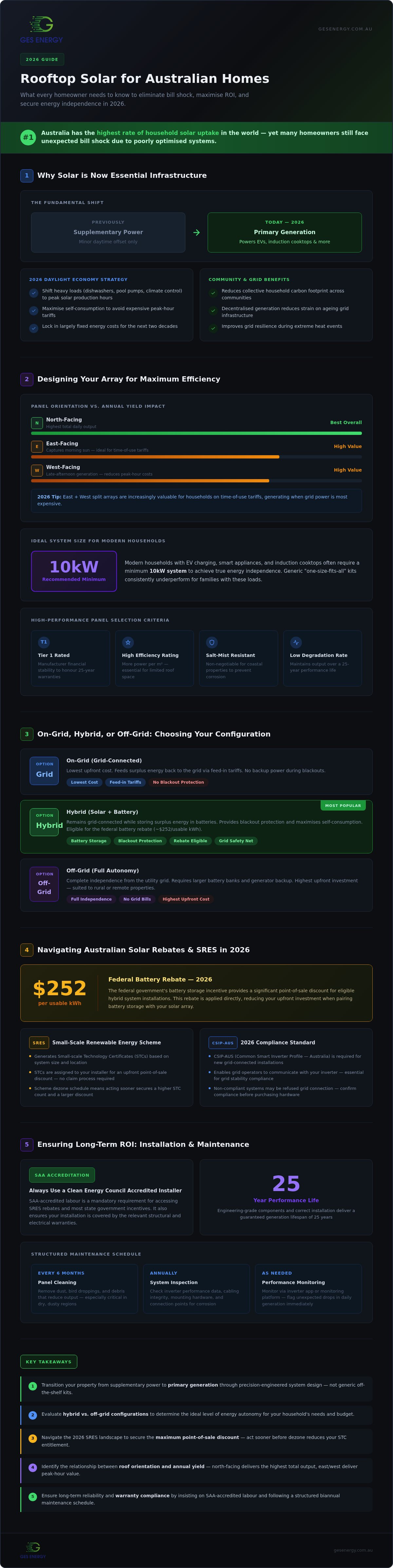
Orientation and pitch are the primary drivers of annual kilowatt-hour yield. While north-facing panels provide the highest total output, east and west orientations are increasingly valuable in 2026 for capturing morning and late-afternoon sun. This alignment is particularly effective for households on "time of use" tariffs, where power is most expensive during the late afternoon. When evaluating solar array design considerations, we must also account for modern heavy loads like EV charging and smart appliances. These requirements often push the ideal system size toward 10kW to ensure true energy independence and long-term financial predictability.
Selecting High-Performance Solar PV Panels
Not all panels are capable of withstanding the intense Australian sun for 25 years. Tier 1 technology is the baseline for any reliable installation, as it indicates the manufacturer has the financial stability to honour long-term warranties. For properties in coastal areas, salt-mist resistance is a non-negotiable requirement to prevent corrosion. Efficiency ratings are equally vital, especially when roof space is limited. High-efficiency panels generate more power per square metre, allowing you to maximise your generation capacity. You should also prioritise hardware with low degradation rates, ensuring your investment continues to perform at over 80% of its original capacity well into the 2050s.
The Critical Role of the Solar Inverter
The inverter acts as the brain of your energy ecosystem, converting the DC power from your panels into usable AC electricity. Choosing between a central string inverter and micro-inverters depends largely on your roof's shading profile. Micro-inverters allow each panel to operate independently, which is essential if nearby trees or chimneys cast shadows during the day. Modern inverters must also be CSIP-AUS compliant to meet 2026 regulatory standards, ensuring they can communicate effectively with the grid. To ensure your hardware is perfectly matched to your property's needs, you can explore custom solar design solutions that focus on engineering integrity and real-time performance monitoring.
On-Grid, Hybrid, or Off-Grid: Choosing the Right Configuration
Selecting the right architecture for your energy ecosystem is the most consequential decision in the design process. A standard grid-connected setup is the most common entry point; however, it relies on exporting excess power for a modest credit. As feed-in tariffs in 2026 often sit between 4c and 8c per kilowatt-hour, the financial incentive to sell power back to the utility has diminished. This shift has made rooftop solar for homes far more effective when configured to prioritise self-consumption rather than grid export.
Integrating Solar + Batteries for Homes has become the primary strategy for achieving 24/7 power and total bill elimination. This hybrid configuration allows you to store the energy generated during the day for use when the sun goes down, effectively insulating your household from expensive peak-period grid rates. For a typical Australian family, a battery capacity of 10kWh to 14kWh provides a reliable balance between the initial investment and the ability to cover evening energy loads, especially during the winter months when generation hours are shorter.
The Advantages of Hybrid Solar and Battery Storage
Hybrid systems offer a sophisticated middle ground by remaining connected to the utility network while using local storage to perform "load shifting." You can use your own stored solar energy during the expensive evening hours when grid rates are at their highest. These systems also provide critical blackout protection through Emergency Power Supply (EPS) functionality. If the grid fails, your system automatically switches to battery power to keep essential appliances running. Furthermore, hybrid setups are future-ready for Virtual Power Plant (VPP) participation, which can provide additional financial returns for supporting grid stability.
Is a Standalone Off-Grid System Right for You?
For those in remote locations or households seeking total autonomy, Off Grid Solar Systems represent the ultimate expression of energy independence. These setups are engineered to manage 100% of your generation and storage requirements without any utility connection. It's a complex engineering task that requires meticulous planning to ensure reliability during consecutive days of low sunlight. Because there is no grid safety net, these systems demand higher hardware standards and a commitment to regular maintenance to monitor battery health and system performance. This is a specialised solution for homeowners who prioritise self-sufficiency and long-term resilience above all else.
Navigating Australian Solar Rebates and the SRES Scheme in 2026
The Small-scale Renewable Energy Scheme (SRES) remains the primary financial mechanism supporting the installation of rooftop solar for homes across Australia. In 2026, this scheme continues its scheduled phase-out, which means the volume of Small-scale Technology Certificates (STCs) your system generates reduces on 1 January every year until the programme concludes in 2030. A major regulatory shift occurred on 1 October 2026, with the SRES eligibility expanding to include systems up to 1 MW. While this expansion primarily caters to larger commercial installations, it reinforces the stability of the certificate market for residential users. To protect your investment, you must avoid "solar cowboys" who inflate rebate values or fail to disclose that STCs are a point-of-sale discount rather than a government cash payment.
Securing these incentives requires strict adherence to national standards. Only systems using hardware approved by the Clean Energy Council and installed by SAA-accredited labour are eligible to create certificates. Homeowners should ensure their installer provides a transparent breakdown of the STC value based on their specific postcode zone. By assigning these certificates to a registered agent, you receive an immediate reduction in the upfront cost of your system, which significantly improves your initial return on investment. To ensure your project meets every regulatory requirement for 2026, you can request a technical rebate assessment from our engineering team.
Step-by-Step Guide to Claiming Your Solar Incentives
The process of claiming incentives is highly structured to ensure system safety and performance. First, verify that your proposed inverter is CSIP-AUS v1.2 compliant, a requirement that became mandatory for new installations on 1 October 2026. Your installer will calculate the number of STCs your system earns based on its geographical location and the solar radiation expected in that zone. Once the installation is complete and safety certificates are issued, the STCs are created and traded. Most households find it most efficient to assign these to the installer in exchange for a lower invoice price, avoiding the complexity of the certificate spot market.
Understanding Feed-in Tariffs (FiTs)
A Feed-in Tariff is the credit applied to your electricity bill for excess energy your system exports to the utility network. In 2026, a competitive rate is generally considered to be between 4c and 8c per kWh, though some retailers offer slightly higher rates for specific green energy plans. Modern billing uses net metering, which prioritises powering your home first and only exporting what remains. Because the cost of purchasing grid power far exceeds the credit received for exports, the focus has shifted. High self-consumption is now the most effective way to eliminate bill shock, making a high FiT less important than a well-timed energy usage profile.
Ensuring Long-Term ROI: Installation and Maintenance
The longevity of your investment depends as much on the calibre of the installation as the quality of the hardware itself. Even the most advanced rooftop solar for homes will fail to meet its 25-year performance potential if the electrical commissioning is rushed or the mounting system is poorly secured. Utilising SAA-accredited labour is a non-negotiable requirement for ensuring both operational safety and strict warranty compliance. This professional oversight guarantees that every component, from the DC isolators to the rooftop racking, is installed to withstand the unique stresses of the Australian climate. GES Energy acts as a diligent steward throughout this process, transitioning from an engineering consultant to a long-term performance partner.
What to Expect During the Installation Process
A successful project begins long before the first panel is lifted onto the roof. A comprehensive pre-installation site inspection and engineering review are essential to identify potential structural limitations or shading variables. During the physical installation, technical teams follow rigorous safety protocols for working at heights and high-voltage electrical commissioning. The final handover is equally critical; it's where you learn to navigate your monitoring software. This digital tool allows you to track real-time savings and verify that your system is performing exactly as designed. Understanding these metrics is the first step toward active energy management and bill elimination.
Routine Maintenance and Warranty Assistance
Routine maintenance is the key to preventing "inverter fatigue" and identifying micro-cracks before they impact your annual yield. Annual health checks involve more than just a visual inspection. They include electrical testing and professional cleaning to remove the dust and salt spray that can accumulate on rooftop solar for homes. If a component fails, managing warranty claims can be difficult if the manufacturer is based overseas. We provide the necessary technical support to handle these intricacies, ensuring your system remains a high-performing asset. Regular upkeep ensures your infrastructure remains safe, efficient, and capable of delivering the maximum return on your investment over its entire operational life.
Securing Your Energy Future with Precision Engineering
Achieving true energy independence requires more than just hardware; it demands a system engineered for your specific load profile and the unique challenges of the Australian climate. By navigating the 2026 rebate landscape and integrating high-reliability storage, you can effectively eliminate bill shock and protect your household from future grid volatility. The long-term success of rooftop solar for homes relies on the synergy between Tier 1 components and SAA-accredited technical oversight.
GES Energy acts as a dedicated partner throughout this transition, providing specialised expertise in complex off-grid and battery systems alongside comprehensive national maintenance and repair services. Our engineering-first approach ensures your infrastructure is not only compliant with the latest standards but optimised for a 25-year performance life. You have the power to take control of your energy costs and secure a predictable, sustainable future for your property.
Request a custom solar design and quote from GES Energy today to begin your journey toward total energy autonomy.
Frequently Asked Questions
Is rooftop solar still worth it in Australia in 2026?
Yes, rooftop solar for homes remains a highly effective investment because it offsets grid prices that far exceed current export credits. While feed-in tariffs have declined nationally, the "daylight economy" strategy allows you to power heavy appliances for approximately 4c per kilowatt-hour over the system's life. This creates a fixed-cost hedge against utility inflation. Integrating a battery further enhances this value by allowing you to use your own generation during expensive evening peak periods.
How many solar panels do I need to run a standard Australian home?
A typical Australian household now requires a system between 6.6kW and 10kW to achieve meaningful energy independence. If you own an electric vehicle or use induction cooking, a 10kW array is often the baseline for covering these modern loads. This size generally requires 16 to 25 high-efficiency panels, depending on the wattage of the specific modules chosen. Custom engineering ensures the array is sized correctly for your roof space and annual kilowatt-hour requirements.
What is the difference between STCs and LGCs for home solar?
Small-scale Technology Certificates (STCs) are the primary incentives for residential systems, now expanded to cover installations up to 1MW as of late 2026. These provide an upfront point-of-sale discount. Large-scale Generation Certificates (LGCs) are typically reserved for utility-scale projects or systems exceeding the 1MW threshold. Most homeowners find STCs more beneficial because they provide immediate financial relief rather than ongoing payments that require complex annual reporting and certificate trading.
Can I add a battery to my existing rooftop solar system later?
You can certainly add a battery to an existing system, though the method depends on your current hardware. If you have a standard string inverter, we can use "AC coupling" to integrate storage without replacing your existing equipment. Alternatively, you might choose to upgrade to a hybrid inverter when your current unit reaches the end of its service life. It's essential to ensure any new battery is CSIP-AUS v1.2 compliant to meet 2026 regulatory standards.
How long does a typical home solar installation take from start to finish?
The physical installation of rooftop solar for homes usually takes one to two days for a standard residential property. However, the end-to-end process typically spans four to eight weeks. This timeframe includes the initial engineering design, structural roof assessments, and securing the necessary grid connection approvals from your local Distributed Network Service Provider (DNSP). Once these administrative milestones are met, the physical commissioning and handover of the monitoring software happen quite rapidly.
What happens to my solar power during a grid blackout?
Standard grid-connected systems automatically shut down during a blackout to prevent "islanding," which protects technicians working on the lines. If you require power during an outage, you must install a hybrid or off-grid configuration with Emergency Power Supply (EPS) functionality. These systems use a battery and a specialised inverter to create a local micro-grid, allowing your home to remain powered independently from the utility network until grid services are restored.
Do solar panels require regular cleaning to maintain efficiency?
Yes, panels require periodic maintenance to ensure they reach their full generation potential. Dust, salt spray, and bird droppings can create "hot spots" or shading that reduces efficiency by 5% to 15% if left unaddressed. We recommend a professional cleaning and electrical health check at least once every twelve months. This service identifies micro-cracks or inverter fatigue early, ensuring your system continues to perform reliably throughout its expected 25-year operational lifespan.
How do I know if my roof is suitable for solar panels?
Suitability is determined by your roof's structural integrity, available surface area, and shading profile. While north-facing roofs are ideal for total yield, east and west orientations are excellent for capturing morning and afternoon sun in 2026. Our engineering team performs a detailed site review to check for obstructions like chimneys or nearby trees. We also verify that the roof material and framing can safely support the additional weight of the mounting rails and panels.


