

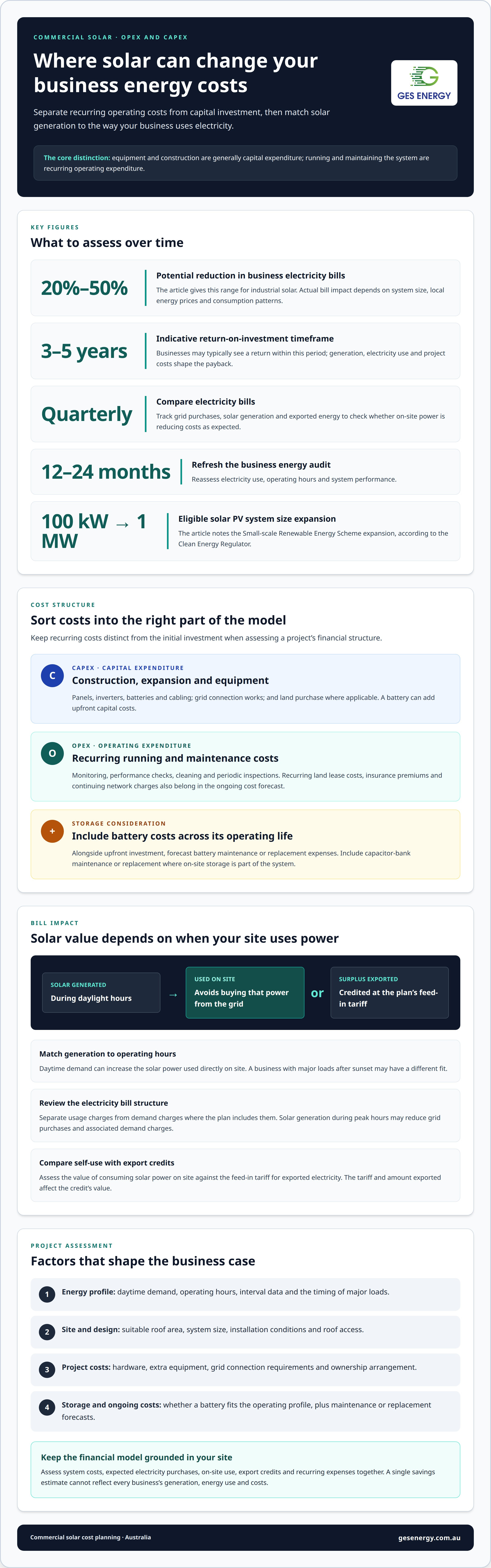
Solar’s value to your business lies not only in the equipment you install, but also in the operating costs it can change over time. Reducing business opex with solar energy starts by separating recurring running and maintenance expenses from capital expenditure (CAPEX), which covers construction or expansion. Panels, inverters, batteries and cabling are capital items; maintenance and performance monitoring are ongoing operating costs.
That distinction matters when assessing a project’s returns. On-site solar generation can reduce the electricity your business buys from the grid, while system size, energy-use patterns and operating requirements shape the business case. A battery adds storage costs, but it may also let your business use stored solar energy when it needs it.
This article explains which solar costs are usually treated as OPEX or CAPEX, how on-site generation can affect electricity bills, and how Australian incentives and eligible carbon credits may shape returns. It also covers what to consider when comparing system costs, ongoing maintenance and potential savings for businesses, including those in Victoria.
Key Takeaways
- Separate recurring operation and maintenance costs from capital costs such as panels, inverters, batteries and cabling to assess a solar project’s financial structure.
- Match solar generation to your business’s electricity-use patterns to identify where on-site power could reduce grid purchases and daytime bills.
- Assess returns against system size, installation requirements, energy costs and battery needs rather than relying on a single savings estimate.
- Explore relevant Australian incentives and carbon-credit opportunities, including the Small-scale Renewable Energy Scheme’s eligible solar PV system size expansion from 100 kW to 1 MW, according to the Clean Energy Regulator.
- Understand how system ownership and payment arrangements affect the balance between upfront capital investment and ongoing solar costs.
What areas of a solar energy system fall under the operating costs of solar?
Solar operating expenditure (OPEX) covers recurring costs to run and maintain a system; capital expenditure (CAPEX) covers construction or expansion. A project assessment considers your electricity use and site, then informs the system design, installation and grid connection. Key factors include daytime demand, suitable roof area, system size and whether a battery fits your operating profile.
For a commercial solar PV system, panels generate electricity on site and can reduce the amount bought from the grid during daylight hours. Monitoring and maintenance are recurring OPEX, including performance checks, cleaning and periodic inspections. A solar energy services arrangement may include monitoring and maintenance. These costs belong in the term financial model alongside expected electricity purchases, so you can assess ongoing expenses against the system’s contribution.
Industrial solar installation costs depend on system size, hardware, installation conditions, roof access and extra equipment. A battery can add upfront capital costs and later maintenance or replacement expenses. Panels, inverters, cabling and batteries are examples of CAPEX for a solar plant, while routine servicing is OPEX. Businesses may typically see a return on investment within 3 to 5 years, although the project’s generation, electricity use and costs shape its payback.
Some businesses outsource monitoring and maintenance to a renewable energy service company, gaining performance oversight and maintenance support without assigning every specialist task to their internal team. Skilled personnel can also help improve operational efficiency and reduce costly errors. For systems with on-site storage, include battery and capacitor-bank maintenance or replacement in the operating-cost forecast.
Land, insurance and grid connection costs need separate treatment in the project model. Purchasing land is a construction-related capital cost; a recurring land lease and insurance premiums are ongoing expenses. Grid connection works can form part of the initial investment, while continuing network charges affect later bills. Record these costs separately from panel maintenance, as their relevance and amount depend on the site, connection requirements and ownership arrangement.
After installation, a professional tracks generation, system performance and electricity bills to identify changes in operating costs. Compare bills quarterly to see whether on-site generation is reducing grid purchases as expected. A fresh business energy audit every 12 to 24 months can reassess electricity use, operating hours and system performance. Regular panel cleaning and periodic inspections also help maintain generation and system longevity.
Lower electricity bills through on-site solar generation
Solar panels generate renewable energy at your premises, helping your business buy less electricity from the grid while the system is producing power. The bill impact depends on how closely generation matches operating hours. A business using electricity during daylight, for example, can consume more solar power directly than one whose largest loads run after sunset. On-site use matters because exported electricity earns a feed-in tariff, while consumed solar power avoids purchases at the applicable grid rate.
A solar professional can assess your energy use by reviewing bills, interval data and the timing of major loads. The analysis links consumption to operating schedules and compares those patterns with expected solar generation. A production site, for instance, may use power for daytime machinery, while a warehouse may have different demand from lighting, refrigeration or charging equipment. This helps shape the system around actual consumption, rather than roof space alone.
Bill analysis should separate usage charges from demand charges where the electricity plan includes them. Solar generation during peak hours can reduce electricity bought from the grid and associated demand charges. Compare bills across periods, noting changes in consumption, solar generation and exported energy. Reviewing bills quarterly gives your business a practical way to track energy costs and assess progress in reducing business opex with solar energy.
When panels produce more electricity than the site uses, the surplus may flow to the grid. A feed-in tariff credits exported electricity under the business’s electricity plan. The value depends on the tariff and amount exported, so assess it alongside the value of using solar power on site. A business with substantial daytime demand may benefit more from consuming generation directly than relying on export credits to reduce expenses.
Industrial solar can reduce business electricity bills by 20% to 50%, depending on system size, local energy prices and consumption patterns. The share of power used on site and the business’s tariff determine where a site sits within that range. A professional can model those variables against the bills and operating schedule, helping assess how reducing business opex with solar energy could work for a specific site.
For a site-specific view, a commercial solar assessment can connect your bill profile with system design and projected on-site use.
Hypothetical solar savings and return on investment
A solar investment’s return depends on the gap between project costs and the electricity expenses it avoids. A professional estimates system size from your energy use, operating hours and suitable roof area. The model also accounts for hardware quality, installation, roof access, extra equipment and whether a battery is included. These factors shape upfront costs and the amount of solar electricity your business can use.
To estimate savings, compare expected generation with your consumption and electricity tariff. Assess how much generation the business uses on site, how much it exports and how much grid electricity remains necessary. A site running machinery through daylight hours has a different load profile from a business whose greatest demand occurs after hours. Those patterns influence projected bill reductions and payback.
Solar costs and savings vary across Australian states, locations and business types because solar conditions, electricity tariffs, export arrangements and operating schedules differ. A Victorian warehouse and a regional production site, for example, may have different roof access, energy demand and grid connection needs. An estimate should reflect these site-specific factors, rather than apply one national savings figure to every business.
Payback is the time required for accumulated savings to recover the initial investment. Business solar systems can typically see a return on investment within 3 to 5 years. The calculation compares upfront project costs with savings from reduced grid purchases, then includes ongoing maintenance and any battery-related costs. A battery can shift solar energy to later use, but its upfront cost can extend payback compared with solar PV alone.
Staff practices can improve the system’s value without changing its equipment. Where operations allow, a facility manager can schedule energy-intensive tasks during solar production hours. Staff can also switch off idle equipment and report unusual consumption. Tracking bills quarterly helps compare energy costs over time and see whether operational changes are reducing grid use.
Solar panels can operate for over 25 years, so a return model should assess performance across the system’s useful life, not only its early savings. A professional can test different consumption and tariff assumptions, then show how each changes projected cash flow. This helps decision-makers weigh financial returns alongside sustainability goals and plan investment around the business’s operating needs.
Renewable energy incentives and carbon credits
Australian incentives can affect a solar project’s upfront cost, while tax treatment and ownership shape its financial returns. Compare each option with the system design and payment arrangement.
Australian government solar incentives
The Small-scale Renewable Energy Scheme (SRES) provides financial assistance through Small-scale Technology Certificates (STCs) for eligible solar installations. According to the Clean Energy Regulator, the Small-scale Renewable Energy Scheme’s eligible solar PV system size has expanded from 100 kW to 1 MW. Eligibility depends on scheme criteria as well as system size, so capacity alone does not establish that a commercial project qualifies.
The Large-scale Renewable Energy Target (LRET) is relevant to businesses investing in large-scale solar projects. Victoria’s Solar for Business Program provides additional rebates and incentives. These programs have different scopes and can affect the upfront project calculation. Include only incentives relevant to the project and its location when modelling expected returns.
Tax incentives, rebates and financing
Tax incentives, rebates and financing affect different parts of a project’s cash flow. A rebate can reduce eligible upfront costs, while financing changes when the business pays for the system. Australian businesses may be able to access tax incentives for solar installations. Tax treatment depends on the business and project, so an accountant or tax adviser can assess the circumstances.
For example, compare a purchase funded from business capital with a financed arrangement. The first uses more capital upfront; the second spreads payments over time. Model those payments alongside electricity savings and maintenance expenses. This shows how an incentive or financing choice may affect cash flow, rather than treating the headline rebate as the project’s full return.
STCs are certificates available through the SRES for eligible installations. For commercial solar, the scheme’s eligible PV system size extends up to 1 MW, but meeting the capacity threshold does not alone establish eligibility. System and installation criteria also apply, so the STC value should enter a project model only when the installation qualifies.
Ownership also changes the comparison. With an outright rooftop purchase, the business owns the system and bears the upfront costs. A lease shifts payment into an ongoing arrangement, while a power purchase agreement (PPA) typically means the business does not own the system outright and pays a fixed or variable fee for generated electricity. Compare payments, responsibilities and expected bill savings across the agreement term.
Carbon credits are a potential revenue stream, not an automatic benefit of installing solar panels. Model them separately from electricity bill savings, and include them only where the business and project meet the relevant eligibility and accounting requirements. This keeps projected returns grounded in direct savings, applicable incentives and any independently eligible credit income.
Solar power and lower business energy bills
Solar power can lower business energy bills by reducing electricity purchased from the grid. The key is how much generated electricity your site uses while the panels are producing. A daytime production line, for example, can use solar generation directly. If demand is low during those hours, more electricity may be exported instead, with its value determined by the feed-in tariff in the electricity plan.
Compare the value of self-consumption with export credits, not just total panel generation. Avoided grid electricity is valued at the business’s tariff, while exported electricity earns the applicable feed-in tariff. An assessment can map generation against operating hours and major loads, such as refrigeration, machinery or ventilation. This makes the bill forecast specific to the site’s demand profile and shows where solar power can reduce ongoing operating costs.
Demand charges can also affect the bill. Where an electricity plan includes a demand charge, solar generation during peak hours can reduce grid electricity use and associated charges. A business battery may store excess daytime generation for later use, including periods when electricity costs more or panels produce less. Its value depends on the site’s load pattern, tariff structure and battery maintenance costs, all of which belong in the operating-cost comparison.
Ownership changes how solar appears in the business budget. Under a solar OPEX model, the customer does not own the system outright and pays a fixed or variable fee for the electricity it generates. This can shift spending away from an upfront system purchase, but weigh the fee against the grid electricity avoided. Compare the agreement’s payment structure with expected generation and existing electricity charges.
For a useful comparison, track bills quarterly and separate grid imports, solar use, exports and any demand charges. Compare equivalent billing periods and note operational changes, such as a shift in production hours or new equipment. This helps explain whether a change in total expenses came from solar generation, altered demand or a different operating schedule. Rebates may affect project costs, but bill savings still depend on the electricity your business avoids buying.
The practical takeaway is to size and assess a system around the electricity your business can use, not generation alone. A professional can model your load, tariff and battery requirements together, then explain how each affects ongoing costs. Discuss a commercial solar project to assess how on-site generation could fit your business’s energy profile.
GES ENERGY
GES ENERGY helps Australian businesses assess how solar fits their energy use, operating costs and site requirements. Its Commercial and Industrial Solar service connects system design and installation with practical considerations such as daytime demand, grid electricity, storage needs and ongoing performance. Energy storage and off-grid systems can also form part of a wider energy plan.
Turn to GES ENERGY when you’re ready to move from bill analysis to a project assessment. Your electricity bills, operating schedule and site details help shape a system suited to your business, rather than a generic estimate. Contact GES ENERGY to discuss your business’s solar requirements.
Plan your business’s next energy decision
Translate your energy priorities into a project brief. Set out the outcomes your business needs, such as lower grid reliance, energy storage or charging infrastructure. Include site constraints and operating requirements so the proposed system can be assessed against the way your business runs.
A plan for reducing business opex with solar energy should also account for changing energy needs. New equipment, altered production schedules or a growing vehicle fleet can affect future demand. Including these plans in the project discussion can help align system design with your business’s direction, not only its current electricity use.
GES ENERGY offers Commercial and Industrial Solar, Off Grid Solar Systems and EV Charging Stations. These services support different site and energy requirements, from grid-connected business systems to off-grid power and workplace charging. A project discussion can help establish which scope best fits your operational priorities.
Contact GES ENERGY to discuss your business’s energy project and take a considered next step.
Frequently Asked Questions
How long does it take to see a return on investment (ROI) from solar panels?
There is no single timeframe that applies to every business. ROI timing depends on system output, how much electricity your site uses and total project costs. An assessment should distinguish estimated savings from cash flow, including maintenance and financing payments where applicable. For a useful comparison, base the calculation on your business’s actual operating profile, not a generic example from another industry.
What Is OPEX and Why Is It Key to Optimise It?
OPEX is the ongoing spending needed to keep business operations running. Managing it helps a business understand where recurring expenses arise and how they affect budgets and performance. For example, finance teams can compare planned energy spending with actual bills, then investigate changes against production or occupancy. This gives managers a clearer basis for budgeting and identifying operational changes that could lower recurring costs.
What are the initial costs associated with installing solar panels for industries?
Industrial project quotes can include engineering, equipment procurement, transport and logistics, civil or mechanical construction, electrical infrastructure, commissioning and connection. A project may also require site-specific design work or battery equipment. Ask for the scope to distinguish included works from optional items, such as an ongoing maintenance program. This clarifies what the initial project budget covers without treating future operating expenses as installation costs.
How much can Australian businesses save on electricity bills with solar?
Your bill reduction depends on the value of electricity your business no longer buys, minus continuing charges and any costs under its solar arrangement. For a practical assessment, compare bills before and after installation while accounting for changes in production, occupancy or operating hours. A site that adds equipment after installation, for example, may see total bills rise even as solar offsets part of its increased electricity use.
What is the average commercial solar system cost in Australia in 2026?
One average cannot describe the different scopes of commercial projects across Australia. System capacity, equipment choices, site access, construction requirements and connection work shape the quote. Battery storage and additional electrical infrastructure can also change the project scope. For budgeting, request a project-specific breakdown of included equipment and works, then compare quotes for the same system capacity and scope.
What is the payback period and ROI for commercial solar in Australia?
Payback measures how long it takes for project savings to recover the initial investment; ROI measures the return relative to that investment. Assess both by comparing the project’s net financial benefit with its capital and ongoing expenses. Keep assumptions consistent: use the same project scope, energy-use profile and accounting period when comparing purchase, lease or power purchase agreement options.
How do business electricity tariffs, demand charges and time-of-use rates affect solar savings?
These charges determine how a business is billed for electricity at different times and under different usage conditions. Review the bill’s charge categories and compare them with the site’s operating schedule. For example, a business with flexible production tasks can assess whether shifting some electricity use to solar-producing hours suits its operations. Demand charges and time-of-use periods vary by plan, so include the actual tariff structure in the project assessment.
What Australian rebates, incentives or tax deductions are available for business solar?
Potential support includes Small-scale Technology Certificates through the Small-scale Renewable Energy Scheme, the Large-scale Renewable Energy Target for large-scale solar investment, and state programs such as Victoria’s Solar for Business Program. These are different forms of support, and tax treatment is a separate consideration. An accountant or tax adviser can assess deductions for your business, while a project assessment can identify incentive programs relevant to its location and system.


