

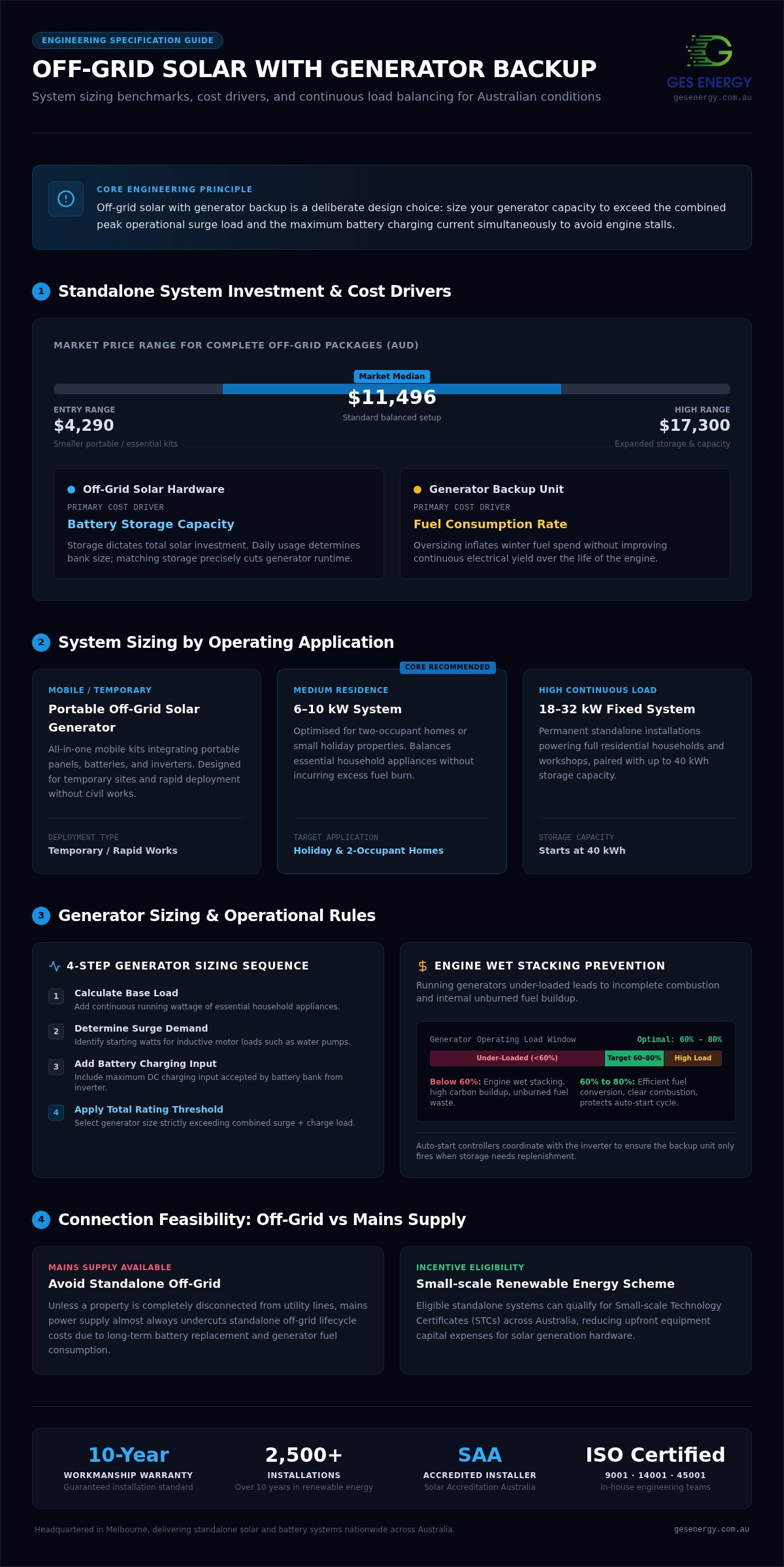
Off-grid solar with generator backup is a design choice, not a catalogue pick: you decide whether remote independence beats grid connection cost, then you match panels, storage and a generator size to your real continuous load. Market listings place complete standalone setups between $4,290 and $17,300 (median $11,496), and your final figure moves with component quality, storage capacity and continuous power demand. Get the load profile right and you keep reliable electricity across Victoria and nationwide; get it wrong and you burn fuel or sit in the dark.
Key Takeaways: To ensure reliable off-grid solar with generator backup, size your generator to exceed the combined peak surge load and maximum battery charging current.
- Market prices for complete off-grid packages range from $4,290 to $17,300 with an $11,496 median.
- Avoid off-grid setups unless grid connection is unavailable because mains supply usually undercuts standalone costs.
- Select a 6–10kW system for medium homes or holiday properties to balance essential loads efficiently.
- Maintain the generator at 60 to 80 percent load capacity to prevent engine wet stacking.
Match your off-grid profile to daily load and surge demand
You choose an off-grid solar setup from daily continuous load and peak surge, not from a brochure label. In client work, matching battery capacity to generator size is what stops dropouts in dark Victorian winters, and that balance lets the backup engine run without constant overload.
Three situations we size again and again:
- Small holiday or two-occupant house: a 6–10kW medium home off-grid system covers essential appliances without excess fuel burn.
- Temporary site or rapid deployment: portable off-grid kits give flexible power without fixed civil works.
- Remote property with no utility line: a fixed standalone array plus auto-start generator sized to surge and charge current keeps supply continuous.
Think of storage the way you size a water tank: daily usage sets how much you hold, while pump speed caps peak flow. GES Energy engineers the load profile to those numbers so the generator only runs when storage needs it. Ask for a site-specific quote when your appliance list is ready.
Pick the off-grid architecture that fits how you use power
Your energy profile sets the dimensions: smaller kits cover lighting and essentials, while larger 32kW fixed systems run full households and workshops. A standalone solar generator packages portable panels, batteries and inverters into one mobile unit for temporary sites. Permanent residences need a fixed array, battery bank and a generator that can both cover surge and recharge storage after cloudy spells.
One owner on the getbirdeye.com.au thread "GES ENERGY, 130 Reviews, Solar Installation in Altona, VIC" described the path from high bills to near-zero running cost after a solar-and-battery install:
"Thank you, GES, for the quick installation of my solar system and battery storage a year ago! I've been able to reduce my bill to almost zero." (source)
That arc is the point: high grid spend, integrated storage, then bills that collapse. You can also read ten off-grid facts for performance context. For remote reliability, the design team adds generator auto-start so batteries never sit flat through a multi-day front. GES Energy keeps the inverter, charge settings and generator size on one coordinated scheme.
Tip: For small holiday homes and two-occupant houses, start with a 6–10kW medium home off-grid system and only step up capacity when measured loads demand it.
What drives the total cost of generator-backed setups
Price follows capacity and hardware grade, not a single sticker figure. Market listings show complete off-grid packages from $4,290–$17,300; battery storage capacity dominates the solar side, while fuel burn dominates the backup side. Pairing Solar with Batteries for Homes cuts long-term generator runtime and diesel spend, which is where remote properties recover the capital. More on this: Solar with Batteries for Homes.
| System Option | Primary Cost Driver |
|---|---|
| Off-Grid Solar Setup | Battery Storage Capacity |
| Generator Backup Unit | Fuel Consumption Rate |
Oversizing the generator size inflates winter fuel use without raising continuous yield, so a tighter match often saves thousands over the engine’s life. Small-scale Renewable Energy Scheme incentives can trim the upfront outlay across Australia. GES Energy installs to compliance standards and backs the work with a 10-year workmanship warranty.
Among Google reviews, one client (5★) wrote:
"GES did an amazing job installing our solar panels and battery. Their customer service was excellent, and the entire process was smooth from start to finish. We’re very happy and highly recommend them!"
"This is an amazing event to attend. We get to talk to experts from all parts
Professional installation (source) turns the spreadsheet into a working system; request a personalised quote to lock the scope to your loads.
Size the generator to your solar load without stalling
Undersized sets stall when a pump or compressor starts while the inverter is still pushing hard charge current into the batteries. You avoid that by adding peak operational load to the inverter’s maximum battery charging current, then selecting a generator size above that total.
- Calculate base load: Add the running wattage of essential household appliances.
- Determine surge demand: Identify starting watts for inductive motor loads like water pumps.
- Add charging power: Factor in the maximum DC charging input your battery bank accepts from an off-grid inverter.
- Apply total rating: Select a generator size exceeding this combined total by twenty percent.
Draw more than your panels and generator can replace and the bank empties; correct headroom keeps supply stable through extended bad weather. For a design check against your meter data, talk to a specialist via the off-grid system page.
Auto-start controllers that protect batteries when you are away
Auto-start controllers fire the generator when battery voltage drops below a safe setpoint, which matters on unmanned sites and during overnight weather events. Manual switches fail when nobody is there to flip them; automation prevents deep discharge and preserves storage life.
Integrated modules sync with the inverter so charge starts and stops on real state-of-charge, not guesswork. You monitor status from the system interface while the controller holds fuel use to actual need. SAA-accredited installers complete the work under Australian safety rules, and workmanship warranties cover the assembly long term. GES Energy specifies these controls across Victorian and wider Australian off-grid jobs so backup arrives before the bank is flat. Contact the team for a personalised quote on your site layout.
Pair proven inverters with a clean generator supply
Stable hybrid power needs an inverter charger that accepts the generator cleanly and hands load across without dropping sensitive circuits. Inverter chargers from Victron Energy and Selectronic pair well with auto-start diesel sets: Victron models give fast switchover that protects electronics from voltage dips, while Selectronic units absorb heavy surge from pumps and workshop tools. Together they charge the battery bank efficiently and cut unnecessary engine hours.
A low total harmonic distortion rating on the generator stops the inverter from rejecting the AC source; high distortion leads to repeated disconnects. Quality inverter chargers also improve battery management and surge headroom compared with budget units. GES Energy specifies pairings for off-grid longevity so the backup path stays available when sunlight does not. GES Energy can map inverter limits to your chosen generator size before hardware lands on site.
When generator-backed off-grid is the wrong financial call
Off-grid solar with generator backup loses the cost argument when a grid connection is already at the boundary and cheap to use. In suburban Victoria, mains supply usually undercuts standalone batteries plus a quiet diesel set on total cost of ownership. Fuel deliveries add logistics you do not need when the utility meter is already there, and noise rules in built-up streets make late-hour generator runs impractical.
If demand is minimal, a portable off-grid solar generator covers lighting and devices without fixed wiring. For fixed homes with high daily loads and existing poles, a grid-tied arrangement with storage is often the clearer financial path. Reserve full off-grid plant for genuine remote sites without utility lines. Request a personalised quote if you want a side-by-side read of off-grid versus grid connection for your address.
Fuel efficiency and maintenance that keep the engine alive
A correctly sized backup generator lowers fuel spend and extends engine life because it spends its hours in the right load band. On Victorian sites, light electrical loads produce wet stacking and wasted diesel; holding the set near 60 to 80 percent load capacity avoids that damage. Treating a diesel backup like a casual petrol mower is a fast route to alternator faults.
Schedule oil and filter changes every 200 operating hours to keep warranty conditions intact and to avoid mid-winter failures when solar input is thin. Servicing plus sober generator size selection is what keeps power up when panels are quiet for days. Book a design review if you want runtime and service intervals written into the commissioning pack.
Frequently asked questions
What diesel generators are available for off‑grid solar backup?
Off-grid systems use diesel units to hold power through long cloudy stretches. You pick stationary low-speed industrial frames or mobile skids from site access and noise limits. A portable off‑grid solar generator suits rapid deployment on temporary or remote Victorian blocks. Long-runtime certified options keep critical circuits up when the bank needs a full recharge.
What is the price of each generator?
Generator cost tracks fuel type, output capacity and acoustic casing. Broader market listings for related off-grid packages sit between $4,290–$17,300, while your line item still moves with transfer switching and install complexity. A personalised quote pins the figure to the set and switchgear you actually need.
What sizes (kVA) are available?
Backup units run from small 5 kVA portable frames up to industrial machines above 100 kVA. A medium home off-grid system at 6–10 kW suits small holiday homes, weekend properties or two-occupant dwellings. Match generator size to inverter charge current and surge so you avoid nuisance trips and stalled starts.
Do the generators have automatic start controllers?
Modern off-grid backup sets include auto-generator start that watches battery state-of-charge. When storage falls below the setpoint, the controller starts the engine, recharges, then shuts down at a safe capacity. You get continuity without standing beside the set in the rain.
Can I add a generator backup?
You can add a diesel unit to an existing off-grid inverter so rain weeks no longer flatten the bank. Certified installers wire auto-start outputs to the inverter control terminals, which limits deep discharge and protects cycle life. Design work stays aligned with Australian standards and site safety rules.
Secure Your Off-Grid Power System
A coherent off-grid solar and generator backup plant gives you independent electricity on Australian sites where the grid never arrives or arrives too dear. The decision thread is the same one you opened with: measure continuous and surge load, size storage and generator size together, then install auto-start so the engine only runs when the bank needs it.
SAA-accredited engineers design and verify systems from Melbourne across Victoria, drawing on more than 10 years in renewable work and over 2,500 installations, with a 10-year workmanship warranty on the build. Explore the custom solar system design service when you want a quote tied to your property’s load list.


