

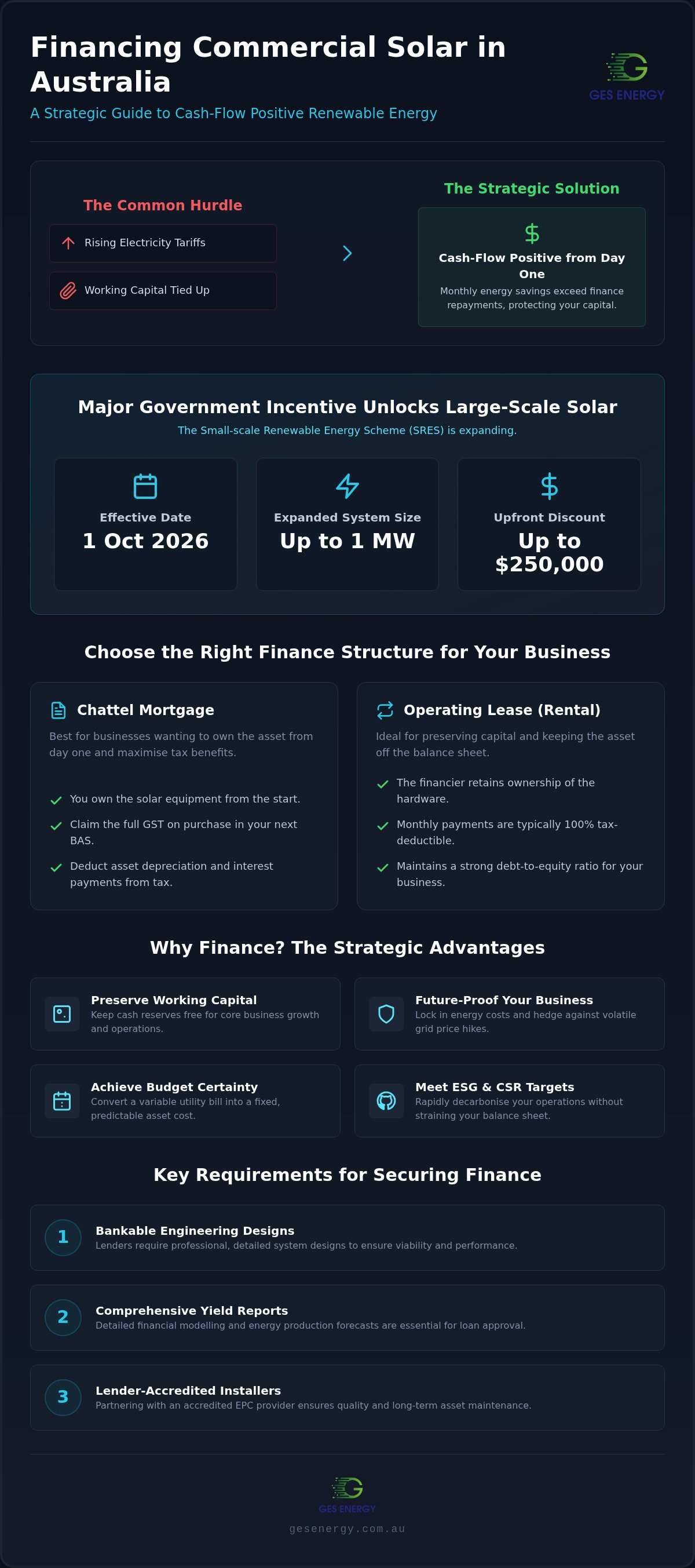
Starting 1 October 2026, the Australian Government's expansion of the Small-scale Renewable Energy Scheme (SRES) to include systems up to 1 MW means your business could access an upfront discount worth up to $250,000. Most Australian directors recognise the value of renewables, yet the primary hurdle remains the difficulty of financing commercial solar panels australia without depleting vital working capital. You've likely seen rising electricity tariffs squeeze your margins while your funds stay tied up in daily operations. It's a common challenge, especially when rebate schedules seem to shift just as you're ready to commit.
We're here to help you regain control over your energy future with a clear, strategic approach. This guide demonstrates how to fund your transition with zero upfront capital while ensuring your project remains cash-flow positive from the first day. We'll examine the latest 2026 incentives, such as the NSW Peak Demand Reduction Scheme for battery storage, and explain how bankable engineering designs simplify the lending process. By the end of this article, you'll have a roadmap for securing energy independence and meeting ESG targets through a fully integrated, financed solar solution.
Key Takeaways
- Learn how to structure a cash-flow positive transition where monthly utility savings exceed your finance repayments from the first day of operation.
- Compare the distinct tax advantages of chattel mortgages against the off-balance sheet benefits of operating leases to suit your specific business goals.
- Understand how the 2026 expansion of the Small-scale Renewable Energy Scheme (SRES) provides significant upfront discounts for systems up to 1 MW.
- Discover why bankable engineering designs and detailed yield reports are essential for securing approval when financing commercial solar panels australia.
- Identify the importance of partnering with lender-accredited installers to ensure your financed energy assets are maintained for peak long-term performance.
Why Finance Commercial Solar Panels in Australia? Protecting Your Cash Flow
For many Australian businesses, the decision to transition to renewable energy is often stalled by the perceived weight of the initial investment. Traditionally, solar was viewed as a significant capital expenditure (CAPEX) that competed with other vital business needs like inventory or headcount. However, the financial landscape has shifted. Strategic financing commercial solar panels australia allows companies to treat energy infrastructure as an operating expense (OPEX) that is often neutral or even positive from the outset.
The primary objective of this approach is to achieve a "Cash Flow Positive" state. This occurs when the monthly reductions in your grid electricity bill are larger than the finance repayments required for the system. Instead of waiting years for a return on investment, your business starts retaining more cash immediately. This financial structure is particularly relevant for meeting 2026 corporate sustainability and ESG (Environmental, Social, and Governance) targets, as it allows for rapid decarbonisation without straining the balance sheet.
Preserving Capital for Core Operations
Maintaining liquidity is essential for navigating market shifts. By choosing to finance rather than buy outright, you keep your cash reserves available for core business growth, such as facility expansions or staff development. Fixed repayments also provide a level of certainty that grid energy providers cannot match. Solar finance is a strategic tool for converting a variable utility bill into a fixed, predictable asset cost. This conversion provides long-term peace of mind, as it shields your operations from the volatility of the wholesale energy market.
The 2026 Energy Market Context
With the rapid evolution of Solar power in Australia, waiting for lower hardware prices is often a false economy. The cost of inaction is high, especially when considering the 2026 grid tariff projections and the increasing frequency of peak demand charges. By securing finance now, you lock in your energy costs at today's rates while benefiting from immediate self-generation.
Future-proofing your business against electricity price hikes is no longer just an environmental goal; it's a fundamental risk management strategy. A financed solar asset protects your margins by providing a stable energy price floor for the next decade or more. This allows your management team to focus on growth rather than fluctuating overheads.
Commercial Solar Finance Options: Chattel Mortgages, Leases, and PPAs
Selecting the right financial structure is as critical as the engineering design of the array itself. In the Australian market, the choice usually depends on your tax position, how you prefer to manage your balance sheet, and whether you intend to own the asset outright. There isn't a single "best" way to approach financing commercial solar panels australia; instead, you should align the finance product with your business's specific fiscal objectives.
Chattel Mortgage vs. Operating Lease
A Chattel Mortgage is one of the most common choices for profitable businesses. Under this arrangement, your business owns the solar equipment from day one, and the financier takes a mortgage over the asset as security. The primary advantage here is the GST treatment. GST-registered businesses can typically claim the full GST amount on the purchase price in their next Business Activity Statement (BAS), providing a significant cash injection early in the project. Because the asset is on your balance sheet, you can also claim depreciation and interest as tax deductions.
Operating Leases, or "rental" agreements, offer a different set of benefits. The financier retains ownership of the hardware, and your business pays a monthly fee to use it. This structure is often preferred by companies looking to maintain a strong debt-to-equity ratio, as the lease can often be kept "off-balance sheet." Monthly payments are typically 100% tax-deductible as an operating expense, making it a simple, predictable model for cash flow management. While selecting a structure, it's wise to review current government rebates and loans that may complement your chosen finance model.
PPAs and EUAs: Alternative Funding Models
For large-scale industrial sites or businesses that prefer not to take on any debt, a Power Purchase Agreement (PPA) is an effective alternative. You don't buy the solar system; instead, a provider installs it on your roof, and you simply buy the generated electricity at a rate significantly lower than the grid. This requires zero capital outlay and provides immediate savings on every kilowatt-hour consumed.
Environmental Upgrade Agreements (EUAs) are another specialized tool. This is a three-way agreement between the business, a financier, and the local council. Repayments are made via a charge on the property's council rates. Because the loan is tied to the land rather than the business owner, it often allows for longer terms and lower interest rates. This is particularly useful for financing comprehensive C&I Energy Storage Systems alongside solar arrays, ensuring your business can manage peak demand charges effectively. A well-designed commercial solar installation should be paired with a finance product that matches your business’s unique financial profile.
Maximising ROI: Tax Benefits and Incentive Schemes for 2026
The 2026 financial environment for renewable energy is defined by a significant expansion of the Small-scale Renewable Energy Scheme (SRES). As of 1 October 2026, the eligibility for the SRES has been extended from 100 kW to 1 MW. This change is a cornerstone of the Australian Government's strategy to support the "missing middle" of commercial industry. When you're financing commercial solar panels australia, these incentives aren't just bonuses; they're integral components of your project's bankability and long-term yield.
Understanding STCs and LGCs in 2026
The expansion of the SRES means that systems up to 1 MW can now access Small-scale Technology Certificates (STCs). These certificates act as an upfront discount, potentially reducing the initial cost of a mid-scale system by approximately 20%. For a 1 MW installation, this could represent a discount of up to $250,000 depending on the market value of the certificates at the time of installation. It's vital to act sooner rather than later, as the STC multiplier continues its scheduled annual decline toward the scheme's conclusion in 2030.
For industrial-scale projects exceeding 1 MW, the Large-scale Renewable Energy Target (LRET) remains the primary mechanism. These systems generate Large-scale Generation Certificates (LGCs), which are created based on actual energy production and sold on the open market. While many businesses opt for Solar Power Purchase Agreements (PPAs) to avoid capital expenditure, those who choose to own the system through finance can unlock these ongoing revenue streams to offset their loan repayments.
Tax Depreciation and the Instant Asset Write-off
Beyond direct rebates, the Australian tax system provides several levers to improve your return on investment. Under current 2026 regulations, businesses can utilise general depreciation schedules to write off the value of the solar array over its effective life. While the specific thresholds for the Instant Asset Write-off can vary, most commercial entities find that the interest paid on solar loans is a fully tax-deductible operating expense. This effectively reduces the net cost of borrowing while your business enjoys the full benefit of lower electricity bills. Tax benefits and incentives can reduce the effective payback period of a commercial system by several years. By integrating these tax advantages into your initial financial modeling, you can ensure that your transition to renewable energy is as fiscally sound as it is environmentally responsible.
The Selection Process: Choosing the Right Finance Partner for Industrial Scale
Securing the right partner for financing commercial solar panels australia is a decision that extends far beyond the interest rate. Because industrial-scale assets are intended to perform for 25 years or more, your financier needs a deep understanding of the local renewable energy sector. Many generic business lenders fail to account for the specific risk profiles or certificate revenue streams associated with large-scale arrays. In contrast, specialised green finance providers, including dedicated divisions within major Australian banks, often offer lower interest rates for projects that meet high energy-efficiency standards.
Lenders also prioritise security. Most will only approve funding if the project is delivered by a lender-accredited installer. This accreditation ensures the provider has the technical capacity and financial stability to complete the installation and support the asset throughout its life. It's a layer of protection for both the bank and your business, guaranteeing that the hardware isn't just installed, but commissioned to a bankable standard.
Evaluating Lender Specialisation
Specialised lenders understand that the value of a solar array lies in its generation potential. They look for bankable hardware, meaning panels and inverters from Tier 1 manufacturers with strong Australian support networks. When you present an EPC-ready design, including detailed yield simulations and site-specific engineering, you significantly speed up the credit approval process. Lenders are more likely to offer flexible terms, such as stepped repayments or minimal balloon payments, when they have confidence in the project’s technical integrity.
Common Pitfalls in Solar Financing
It's easy to be distracted by a low headline interest rate, but the fine print often holds the true cost. You should watch for hidden fees in lease agreements, such as high documentation costs or restrictive early repayment penalties. Another common risk is over-specifying or under-powering the system. A system that is too large for your daytime load may generate excess energy that is sold back to the grid at low rates, potentially undermining the finance case. Conversely, a system that is too small won't provide the savings needed to cover the repayments.
Avoiding these traps requires a partner who understands the intersection of finance and engineering. If you're ready to see how a custom design can secure better funding terms, you can explore our commercial solar solutions to find a structure that fits your operational needs. By aligning your finance partner with a qualified EPC provider, you ensure the system is optimised for both maximum generation and maximum fiscal benefit.
How GES Energy Streamlines Solar Finance and EPC Delivery
At GES Energy, we recognise that the technical integrity of a renewable asset is the foundation of its financial success. We don't treat engineering and finance as separate silos; instead, we integrate financial viability into the very first stages of our design process. Our approach to commercial solar installation focuses on creating a "bankable" project that meets the rigorous standards of Australian lenders. By providing the detailed yield reports and ROI projections that financiers require for industrial projects, we help remove the friction often found in the approval stage of financing commercial solar panels australia.
Operating as a comprehensive, end-to-end specialist, we provide a single point of contact for design, procurement, and ongoing maintenance. This unified structure is particularly beneficial for utility-scale projects up to 5 MW. Our EPC (Engineering, Procurement, and Construction) services ensure that every component is technically compliant with the requirements for Large-scale Generation Certificate (LGC) financing. This level of oversight gives both the business owner and the financier peace of mind that the system will perform according to its modelled expectations.
Bankable Engineering and Design
Lenders need certainty before they release capital. We use advanced solar analytics to provide "investment-grade" production data that accurately reflects your site's generation potential. Our SAA-accredited labour handles the commissioning and installation, ensuring that the system meets all safety and performance standards required for insurance and bank security. We also specialise in customising C&I Energy Storage Systems alongside solar arrays. By integrating battery storage into the initial design, we help you maximise the value of the financed asset by shifting energy usage away from expensive peak tariff periods.
Long-term Asset Protection
A financed solar system is a long-term commitment, and protecting its performance is essential for maintaining a positive cash flow. We provide ongoing maintenance and repair support specifically designed to protect the financier's interest in the hardware. If an issue arises, our team manages warranty assistance for inverters and panels directly, ensuring that your generation remains seamless. This proactive stewardship ensures that the system continues to pay for itself throughout the life of the loan. To see how a custom-engineered solution can fit your balance sheet, Organise a feasibility study with GES Energy and discover your projected ROI.
Securing Your Energy Independence with Strategic Finance
The 2026 energy landscape offers Australian businesses a unique window to transition with zero upfront capital. By leveraging the expanded SRES and choosing a structure like a chattel mortgage or PPA, you can protect your margins from rising grid costs while maintaining vital liquidity for core operations. Success in financing commercial solar panels australia depends on aligning your financial strategy with investment-grade engineering. GES Energy provides the end-to-end expertise required to make this transition seamless and fiscally sound.
We offer expert EPC services for projects up to 5 MW and ensure every system is backed by SAA-accredited installation and commissioning. With our national coverage for industrial maintenance, your energy asset remains a reliable source of savings for decades. It's time to take control of your infrastructure and future-proof your operations against volatile utility markets. You can request a bankable solar feasibility report from GES Energy to see exactly how these incentives and finance models apply to your specific site. Start your journey toward energy independence today and lock in your competitive advantage for the long term.
Frequently Asked Questions
Can my business claim the GST back on a financed solar system?
Yes, if your business is GST-registered and you utilise a Chattel Mortgage for financing commercial solar panels australia, you can typically claim the full GST amount on your next Business Activity Statement (BAS). Because you take ownership of the asset from the outset, the Australian Taxation Office (ATO) allows for this upfront credit. This provides a significant cash flow injection early in the project life, helping to offset initial costs before the energy savings fully accumulate.
What is the difference between a PPA and a Chattel Mortgage for solar?
The primary difference lies in ownership and capital responsibility. With a Chattel Mortgage, your business owns the hardware from day one and manages the loan repayments like a standard equipment finance deal. In contrast, a Power Purchase Agreement (PPA) involves a third party owning and maintaining the system on your roof. You simply purchase the generated electricity at a lower rate than the grid, requiring zero capital outlay or debt on your balance sheet.
Does commercial solar finance require a deposit in 2026?
Many specialised lenders offer 100% finance for commercial solar installations in 2026, meaning no upfront deposit is required. This structure is designed to ensure the project is cash-flow positive from the first day of operation. By matching the repayment schedule to your projected energy savings, financiers allow you to preserve your working capital for core business activities while the solar array effectively pays for itself through reduced monthly utility bills.
How do STCs work for commercial systems under 100kW?
Small-scale Technology Certificates (STCs) function as an upfront discount on the total cost of systems under 100kW. These certificates are created based on the expected renewable energy generation until 2030. Most businesses assign these certificates to their installer in exchange for a lower invoice price. This reduces the total amount you need to borrow when financing commercial solar panels australia, directly lowering your monthly repayments and improving the overall return on investment for your company.
Is industrial battery storage eligible for the same financing as solar panels?
Yes, industrial battery storage can be bundled into the same finance agreement as your solar panels, often as a single energy asset. Lenders increasingly recognise the value of C&I Energy Storage Systems in managing peak demand charges and improving energy security. By financing both components together, you can achieve a more comprehensive energy solution that maximises self-consumption and provides greater predictability over your long-term operational expenses without requiring multiple separate loan applications.
What happens to the finance agreement if I sell my commercial property?
If you sell your commercial property, you generally have two main options regarding your finance agreement. You can choose to pay out the remaining balance of the loan using the proceeds from the sale, or you may be able to transfer the agreement to the new owner, subject to the financier's approval. Environmental Upgrade Agreements (EUAs) are particularly useful here, as they are tied to the land's council rates and naturally transfer to the next property owner.
Are the interest payments on a commercial solar loan tax-deductible?
Interest payments on a commercial solar loan are typically 100% tax-deductible for Australian businesses when the system is used for income-producing purposes. This deduction reduces your taxable income, effectively lowering the net cost of the finance. When combined with standard depreciation schedules for the hardware, these tax benefits significantly shorten the payback period. It's always advisable to consult with your tax professional to confirm how these incentives apply to your specific company structure and fiscal goals.
How long are the typical finance terms for a 500kW commercial solar array?
Typical finance terms for a 500kW commercial solar array range from five to ten years, though some specialised green loans may offer longer durations. The term is usually selected to ensure that monthly repayments remain lower than the savings generated by the system. This methodical approach ensures a steady, positive cash flow. For larger utility-scale projects, financiers may offer customised repayment structures that align with the specific generation profile and LGC revenue streams of the industrial site.


