

What if your electricity bill wasn't a volatile overhead, but a controlled asset you could forecast with precision? Most Australian directors see rising tariffs and complex demand charges as unavoidable costs of doing business, yet a well-engineered solar system often delivers an internal rate of return between 15% and 30%. Understanding how to calculate commercial solar payback period is the first step toward reclaiming that capital. By looking past the upfront cost, you can identify the exact point where your system transitions from a capital expenditure to a profit centre.
We understand that the shift toward renewable energy can feel daunting when faced with fluctuating government rebates and the 2026 expansion of the Small-scale Renewable Energy Scheme. This guide will help you master the financial metrics of your investment by providing a clear, step-by-step framework for calculating ROI. You'll learn how to account for the permanent $20,000 instant asset write-off, the impact of daytime self-consumption, and how to build a defensible business case that satisfies both your board and your ESG targets. By the end of this article, you'll have the tools to move from grid uncertainty to energy independence.
Key Takeaways
- Understand the fundamental formula for your investment by learning how to calculate commercial solar payback period using net system costs and projected energy generation.
- Discover how the permanent $20,000 instant asset write-off and expanded STC rebates for systems up to 1 MW can significantly accelerate your return on investment.
- Learn why matching your operational load profile to solar output is critical for businesses with high daytime energy demands, such as cold storage or retail centres.
- Identify the "Self-Consumption Rule" and how maximising on-site energy use reduces reliance on the grid while improving your ESG credentials.
- Recognise why custom engineering and ongoing maintenance are essential to move beyond generic estimates and secure a defensible business case for your specific site.
Understanding the Commercial Solar Payback Period
The commercial solar payback period represents the duration required for the cumulative electricity savings generated by your system to equal the initial capital investment. For Australian businesses in 2026, this metric has become the primary driver for boardroom approval. With the Small-scale Renewable Energy Scheme (SRES) recently expanded to cover systems up to 1 MW, the upfront financial barrier has dropped significantly. Learning how to calculate commercial solar payback period allows you to transform a technical discussion into a clear financial strategy that prioritises long-term stability.
While most managers focus on "Simple Payback," which is the net cost divided by annual savings, sophisticated financial planning often requires a "Discounted Payback" model. This approach accounts for the time value of money, ensuring that future savings are adjusted for inflation and potential interest rates. Regardless of the method used, solar serves as a powerful hedge against the volatile price hikes often seen from traditional electricity retailers. It provides a level of cost predictability that is otherwise impossible in the current energy market.
Simple Payback vs. Total Return on Investment (ROI)
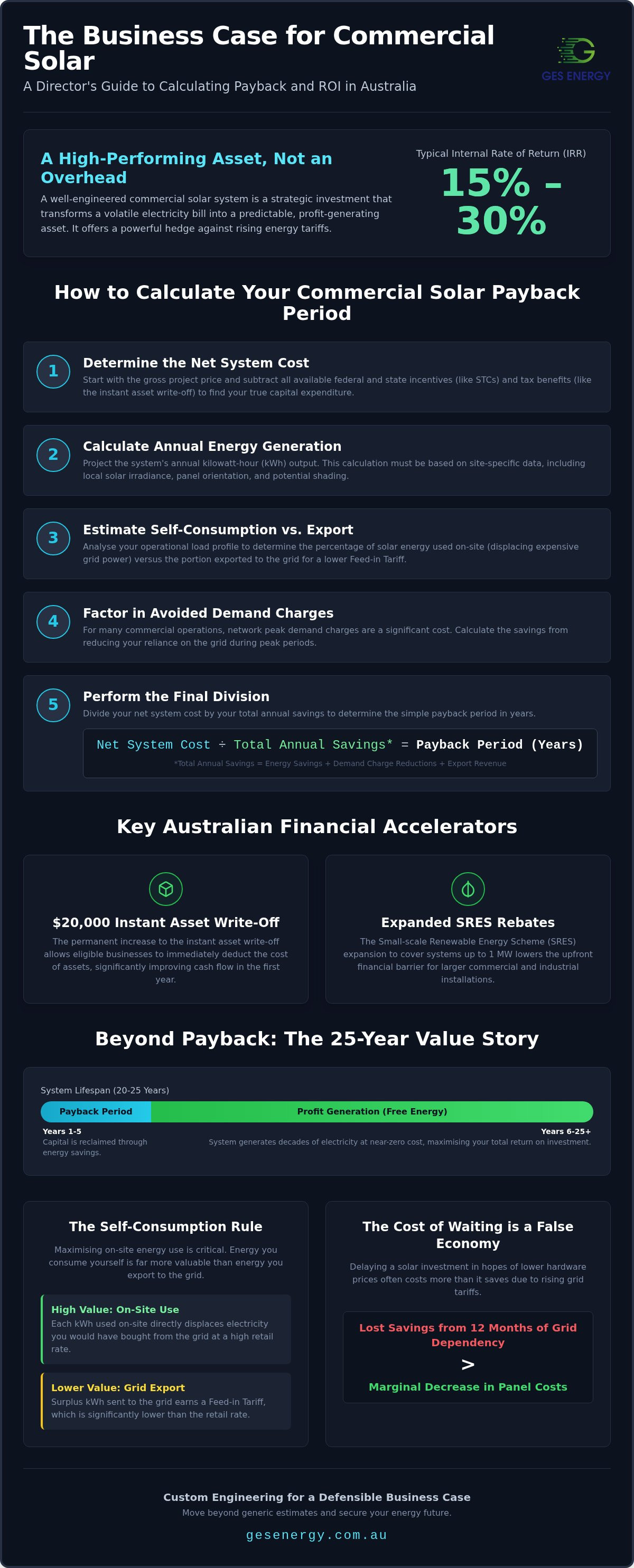
The payback period is a vital milestone, but it's only the first chapter of the story. While a system might pay for itself in three to five years, the total ROI extends far beyond that point. Modern photovoltaic systems are engineered to provide reliable power for 20 to 25 years. This means after the break-even point, your organisation enjoys over 15 years of essentially free energy. To get a true sense of value, directors should look at the Internal Rate of Return (IRR), which typically ranges between 15% and 30% for commercial installations. Expertly maintained systems ensure these performance levels remain consistent, protecting your initial business case.
The Impact of Rising Energy Costs on Payback Speed
The speed of your payback is inextricably linked to the cost of grid power. Every time a retailer increases their tariffs, your solar system becomes more valuable because it increases the "avoided cost" of every kilowatt-hour produced. Understanding how to calculate commercial solar payback period in the context of these rising costs is essential for accurate forecasting. Choosing to wait for hardware prices to drop is often a false economy. The savings lost by remaining fully dependent on the grid for an extra twelve months usually far outweigh any marginal decrease in panel costs. Custom engineering ensures your system is sized to maximise these savings from day one.
The Step-by-Step Formula for Calculating Solar Payback
Determining the financial viability of a large-scale project requires a methodical approach that accounts for the unique complexities of Australian energy markets. While residential systems use a basic division, learning how to calculate commercial solar payback period for an industrial site involves balancing upfront incentives with ongoing operational shifts. The process begins with establishing your true net cost, which serves as the foundation for all subsequent ROI projections. By following these five steps, you can move from a rough estimate to a precise financial forecast.
- Step 1: Determine the Net System Cost. Subtract all federal and state incentives from the gross project price to find your actual out-of-pocket expenditure.
- Step 2: Calculate Annual Energy Generation. Use site-specific irradiance data and panel orientation to project how many kilowatt-hours (kWh) your system will produce each year.
- Step 3: Estimate Self-Consumption Ratios. Identify how much solar energy will be used on-site versus how much will be exported to the grid as a Feed-in Tariff.
- Step 4: Factor in Avoided Demand Charges. Calculate the reduction in network "peak demand" fees, which often make up a significant portion of commercial electricity bills.
- Step 5: Perform the Final Division. Divide the net system cost by the total annual savings (energy savings + demand charge reductions + export revenue) to identify the payback year.
When you partner with an EPC specialist to perform these calculations, the result is a defensible business case that accounts for every variable of your specific energy profile.
Calculating Your Net System Cost
Your net cost is significantly influenced by the size of the installation and the available certificates. From 1 October 2026, the Small-scale Renewable Energy Scheme (SRES) expansion allows systems up to 1 MW to claim Small-scale Technology Certificates (STCs), providing an upfront discount that can reduce project costs by approximately 20%. For utility-scale projects exceeding this cap, Large-scale Generation Certificates (LGCs) offer an ongoing revenue stream rather than an upfront reduction. Accuracy here requires including all engineering, procurement, and construction (EPC) fees to ensure no hidden costs skew your final payback timeline.
Estimating Annual Operational Savings
The most accurate way to project savings is by analysing your interval data. This granular look at your energy usage identifies exactly when your business draws power from the grid. Because Australian feed-in tariffs remain low, often between 3.4 and 6.5 cents per kWh, the highest value comes from "behind-the-meter" consumption. Every kWh your solar system provides to your machinery or HVAC system is a kWh you don't have to buy from a retailer at a much higher rate. Additionally, solar can significantly lower your demand charges by reducing your building's peak draw during daylight hours, which often accelerates the payback period by several months.
Australian Financial Incentives and Tax Implications
Navigating the financial landscape of renewable energy requires more than just looking at the sticker price. When determining how to calculate commercial solar payback period, the inclusion of federal and state incentives is non-negotiable. These mechanisms don't just reduce the initial capital outlay; they fundamentally alter the long-term yield of the asset. In the 2026 Australian market, several layers of support exist to shorten the gap between installation and profitability, provided your business case is built on current regulatory data.
Beyond upfront rebates, tax treatment plays a pivotal role in the "real-world" cost of your system. Solar assets are treated as depreciable equipment on the balance sheet, providing ongoing tax relief over their operational life. Various state-run energy efficiency programs and peak demand reduction schemes offer additional certificates that can be traded for cash or discounts. Integrating these variables into your financial model ensures your projected payback remains accurate and defensible during a board review.
LGCs vs. STCs: Which One Applies to Your Business?
The distinction between Small-scale Technology Certificates (STCs) and Large-scale Generation Certificates (LGCs) typically hinges on the 100kW system threshold. However, following the 2026 SRES expansion, systems up to 1 MW can now access the STC market. This provides a significant upfront financial incentive that reduces the net project cost immediately upon installation. For projects exceeding the 1 MW cap, LGCs remain the standard, providing an ongoing revenue stream based on every megawatt-hour of clean energy your system generates. Managing the creation and sale of these certificates is a technical administrative task that your EPC partner should handle to ensure no value is left on the table. This distinction is a primary factor in how to calculate commercial solar payback period for larger industrial portfolios.
The Strategic Advantage of the Instant Asset Write-Off
For eligible small businesses with a turnover under $10 million, the $20,000 instant asset write-off is a permanent feature of the Australian tax system. This allows for the immediate deduction of the full cost of eligible solar components up to that threshold in the year they're installed. For assets exceeding this limit, the Australian Taxation Office (ATO) allows for a 20-year effective life for solar PV systems, which translates to a 5% annual deduction under the prime cost method. A 100kW system provides a dual benefit of immediate STC discounts and long-term depreciation, effectively lowering the out-of-pocket cost by thousands before the first kilowatt-hour is even produced. Consulting with your tax professional allows you to align procurement with the end of the financial year to maximise these cash flow benefits.
A standard financial model provides a baseline, but your site's unique operational habits dictate the actual speed of return. When you examine how to calculate commercial solar payback period, you must prioritise the "Self-Consumption Rule." This principle highlights that energy used "behind the meter" is worth significantly more than energy exported to the grid for a minor feed-in credit. Consequently, 7-day operations like cold storage facilities or retail centres typically achieve a faster payback than 5-day offices. These facilities utilise their own generation every day of the week, whereas an office may see its solar energy exported at lower rates during the weekend when the building is vacant.
System orientation and tilt also serve as critical variables. While north-facing panels generally produce the highest total yield, an east-west configuration might be more profitable if your facility experiences heavy demand during the early morning or late afternoon. Aligning your generation profile with your specific load profile is the most effective strategy to shorten your break-even timeline. Small adjustments in engineering design can lead to significant differences in your final ROI.
Matching Solar Generation to Your Operational Hours
Businesses with a traditional 9-to-5 schedule are often the ideal candidates for a rapid solar return. Their peak operational hours align almost perfectly with the sun's peak output, allowing for self-consumption rates that frequently exceed 80%. To enhance this effect, we recommend shifting heavy loads like HVAC pre-cooling or industrial machinery cycles to the middle of the day. If your facility remains closed on weekends, your financial model must account for the lower value of exported energy during those 104 days each year to remain accurate.
Integrating Battery Storage for Peak Shaving
Industrial energy storage systems (BESS) introduce a more complex calculation into the financial strategy. Although a battery increases the initial capital outlay, it offers a functional benefit known as peak shaving. This involves using stored energy to offset sudden demand spikes that would otherwise trigger high demand charges on your commercial bill. When you consider how to calculate commercial solar payback period for a hybrid setup, the value is found in both energy savings and the reduction of these expensive network fees. This combination provides greater energy security and long-term price stability.
To understand how these specific variables will impact your facility's bottom line, you can book a custom engineering consultation with our specialist team today.
While understanding how to calculate commercial solar payback period provides a theoretical baseline, real-world implementation requires moving beyond generic spreadsheets. Online calculators often fail to account for the unique architectural and electrical constraints of industrial sites. A successful solar strategy isn't just about the number of panels on a roof; it's about the precision of the engineering behind them. Moving from a rough estimate to a detailed, defensible business case ensures your organisation isn't surprised by hidden costs or underperforming assets.Why Custom Engineering Beats Generic Estimates
Generic estimates usually assume perfect conditions, yet few Australian industrial roofs are without challenges. Custom engineering addresses site-specific obstacles such as complex shading from neighbouring structures, specific roof orientations, and existing switchboard capacities. At GES Energy, our design process prioritises maximum energy yield rather than just a minimum entry price. We focus on finding the "sweet spot" in system sizing, ensuring you aren't paying for excess capacity you won't use, nor missing out on potential savings from an undersized array. We also consider your facility's future growth, ensuring the system can support upcoming infrastructure like EV charging stations or additional machinery without requiring a complete overhaul. This level of foresight protects your ROI by preventing expensive remedial works.
Securing Your Investment with Professional Maintenance
The calculated payback period is a forecast that depends on the system maintaining peak performance. Even a 10% degradation in output due to dust accumulation, panel faults, or inverter inefficiencies can add an entire year to your payback timeline. Protecting your investment requires SAA-accredited labour for the initial installation and a commitment to ongoing maintenance. Using accredited professionals ensures that your system meets the strict safety and performance standards required to claim federal rebates. We utilise remote monitoring and regular health checks to identify issues before they impact your bottom line. For a broader look at the current market, see our Commercial Solar: 2026 Guide for Australian Businesses.
The transition to renewable energy is a significant milestone for any enterprise. By moving past the initial question of how to calculate commercial solar payback period and focusing on high-quality engineering, you secure a profit centre that serves your business for decades. The next step is a detailed site assessment to refine your financial model into an actionable strategy that provides peace of mind and long-term value.
Securing Your Energy Independence and Financial Future
Businesses that master the financial metrics of renewable energy gain a significant competitive advantage in an increasingly volatile market. We've explored the critical importance of load profile matching and the substantial impact of the 2026 SRES expansion on initial capital requirements. Understanding how to calculate commercial solar payback period is the first step for any director looking to stabilise operational overheads while simultaneously improving ESG credentials. By accounting for tax depreciation and avoided demand charges, you can transform a technical installation into a predictable profit centre.
To move from general estimates to a precise, defensible financial model, request a custom Business Case Analysis from GES Energy. Our SAA-accredited engineering team specialises in utility-scale C&I systems up to 5 MW, providing the expert technical oversight required to maximise your long-term return. With national coverage across Australia and dedicated maintenance services, we ensure your infrastructure remains a high-performing asset for its entire lifespan. Taking control of your energy future starts with a single, data-driven decision that provides both peace of mind and lasting value.
Frequently Asked Questions
What is the average payback period for commercial solar in Australia in 2026?
Most Australian businesses currently see a payback period between 3 and 5 years for systems purchased outright. This duration depends on your specific daytime energy consumption and current retail tariffs. While individual results vary based on engineering specifics, the high efficiency of modern components ensures that the system pays for itself long before its 25-year operational life concludes. This provides a clear path to energy independence and long-term cost control.
How does the 100kW limit affect my solar rebates and payback?
The 100kW threshold has changed significantly with the 2026 expansion of the Small-scale Renewable Energy Scheme (SRES). Systems up to 1 MW now qualify for Small-scale Technology Certificates (STCs), providing an upfront discount of approximately 20%. For projects exceeding 1 MW, the rebate structure shifts to Large-scale Generation Certificates (LGCs), which offer an ongoing revenue stream rather than an immediate price reduction at the time of purchase.
Can I include the cost of roof repairs in my solar payback calculation?
You should factor any necessary roof structural work into your initial capital expenditure to ensure an accurate ROI forecast. While these costs are separate from the solar hardware, they're essential for a safe and compliant installation. We recommend consulting with a structural engineer early in the process, as including these preparations in your business case ensures the calculated payback period accounts for all necessary infrastructure improvements and long-term asset protection.
Does a commercial solar battery storage system always extend the payback period?
While adding a battery increases the initial investment, it doesn't always result in a disadvantageous payback timeline. For facilities with high demand charges, a battery storage system provides peak shaving benefits that panels alone cannot deliver. By reducing expensive network fees triggered during consumption spikes, a battery can stabilise your energy costs and protect your business against future tariff increases from traditional retailers, potentially improving the total internal rate of return.
Is the Instant Asset Write-Off still available for solar in 2026?
Yes, the $20,000 instant asset write-off is a permanent feature for Australian small businesses with a turnover under $10 million. This allows for an immediate tax deduction of the full cost of eligible solar components in the year they're installed. For larger investments, the Australian Taxation Office provides a 20-year effective life for solar assets, allowing for consistent annual depreciation that supports your long-term financial strategy and improves the net present value of the system.
How do Feed-in Tariffs (FiTs) impact the business case for large-scale solar?
Feed-in tariffs have a minimal impact on the business case for large-scale solar because export rates are significantly lower than grid costs. Typical benchmark ranges across Australia often fall between 3.4 and 6.5 cents per kWh, which is far below the cost of purchasing power. Consequently, the most profitable solar strategies focus on maximising on-site consumption to avoid high retail prices rather than relying on export revenue to shorten the payback.
Will my payback period change if my business operates 24/7 instead of 9-5?
A 24/7 operation typically sees a different return trajectory than a standard 9-5 business. While a 9-5 operation aligns perfectly with peak solar output, a 24/7 facility benefits from a constant base load that can absorb all generated energy during daylight hours. Understanding these consumption patterns is essential when learning how to calculate commercial solar payback period for industrial sites that require power around the clock for machinery or refrigeration.
How often should I factor in maintenance costs when calculating ROI?
We recommend factoring in annual maintenance costs of roughly 1% to 2% of the initial system value. This includes regular health checks and cleaning to prevent output degradation caused by dust or technical faults. Budgeting for these services is a proactive way to protect your ROI, as even minor performance drops can lengthen how to calculate commercial solar payback period by several months over the life of the asset.


