

Could a strategic policy shift in 2026 be the catalyst that finally eliminates your company’s electricity overheads? Many Australian directors feel the weight of rising grid costs and the heavy administrative burden of traditional energy procurement. You've likely noticed that the landscape for commercial solar grants australia 2026 has shifted, especially with the expansion of the Small-scale Renewable Energy Scheme (SRES) to include systems up to 1MW. This move represents a transition from minor rebates to genuine industrial-scale transformation for local businesses.
It's understandable if the technical jargon and complex paperwork for Large-scale Generation Certificates feel like a barrier to progress. We agree that your focus should remain on your core operations, not on deciphering government compliance. This guide provides a definitive roadmap to every incentive available this year, showing you how to slash the upfront costs of both solar and battery storage. We'll outline how to reduce the payback period of a 500kW plus system to under four years while securing long-term energy independence. By following this structured approach, you'll gain the clarity needed to transform your energy infrastructure into a predictable, high-performing asset.
Key Takeaways
- Understand how the SRES expansion to 1MW allows larger commercial operations to access upfront rebates that were previously restricted to smaller systems.
- Identify the specific state-based incentives, such as Energy Savings Schemes, that can be layered with federal funding to maximise your total financial benefit.
- Learn how to navigate the evolving landscape of commercial solar grants australia 2026 to significantly reduce the initial capital required for your energy transition.
- Discover the latest funding avenues for industrial battery storage (BESS) designed to stabilise your power supply and improve long-term energy independence.
- Recognise the importance of end-to-end compliance management to ensure your business successfully secures every available certificate without administrative delays.
Navigating the 2026 Commercial Solar Incentive Landscape
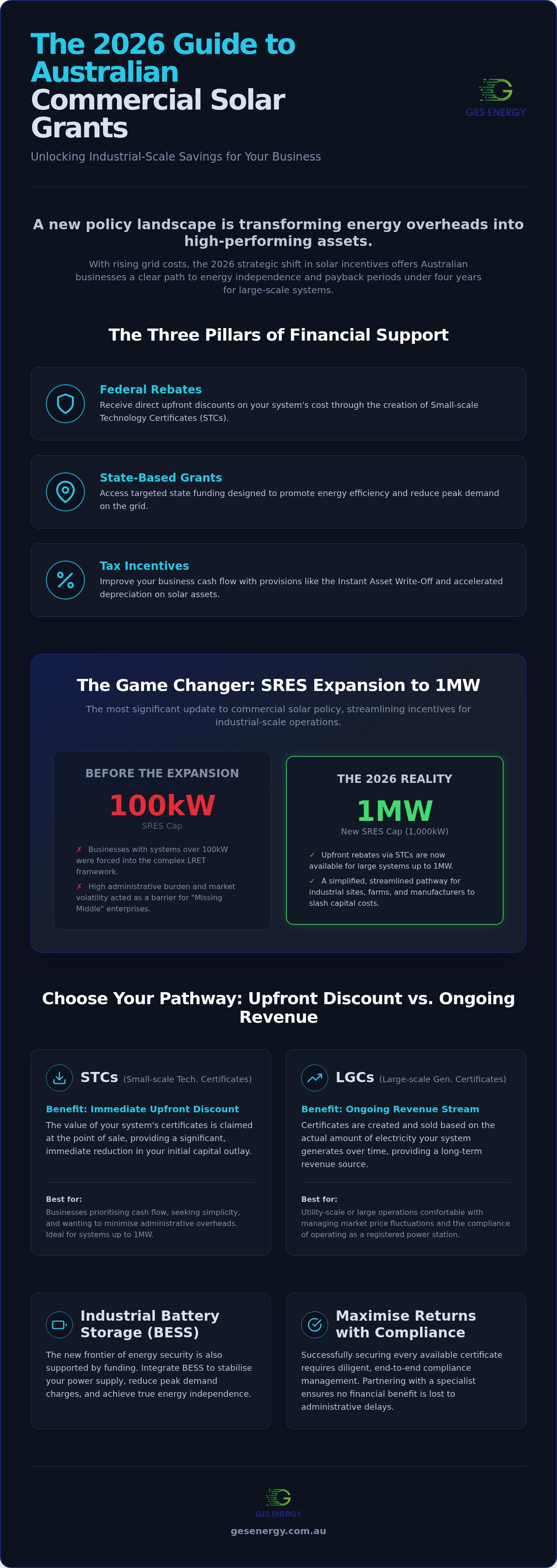
2026 marks a definitive shift in how Australian businesses approach energy infrastructure. It’s the year that commercial solar grants australia 2026 move beyond simple residential-style rebates into comprehensive industrial support. This transition specifically addresses the "Missing Middle." These are the medium-sized enterprises that previously found themselves too large for small-scale certificates but too small for complex utility-scale arrangements. The current framework organises financial assistance into three distinct pillars:
- Federal Rebates: Direct upfront reductions through certificate creation.
- State Grants: Targeted funding for energy efficiency and peak demand reduction.
- Tax Incentives: Provisions like accelerated depreciation that improve cash flow.
The Business Case for Solar in a Volatile Market
Energy prices remain unpredictable, making grid reliance a significant operational risk. Grants serve as a financial hedge, locking in lower operational costs for decades. In 2026, financial eligibility is increasingly tied to corporate carbon reduction targets. This means your sustainability goals now directly lower your capital expenditure. Identifying the "sweet spot" for system sizing is crucial. It involves balancing your peak load with available roof space to maximise the return on investment from these subsidies. A well-designed system doesn't just save money; it provides a level of predictability that traditional energy procurement cannot match.
Grant Categories: Upfront Discounts vs. Ongoing Revenue
Understanding the difference between Small-scale Technology Certificates (STCs) and Large-scale Generation Certificates (LGCs) is essential for your financial planning. STCs typically provide an immediate discount on the system purchase price. In contrast, LGCs offer ongoing revenue based on the actual performance of your installation. The Clean Energy Regulator maintains strict oversight in 2026, ensuring that only high-quality, compliant hardware qualifies for commercial solar grants australia 2026. Your choice of solar installer is a critical factor in this process. Working with a specialist who manages the entire design and procurement lifecycle ensures that every technical detail meets regulatory standards. This professional oversight protects your eligibility and removes the administrative burden from your internal team.
The SRES Expansion: Unlocking Rebates for Systems up to 1MW
The 1MW reform represents the most significant update to the Small-scale Renewable Energy Scheme since its inception. Previously, any system exceeding 100kW was forced into the Large-scale Renewable Energy Target (LRET) framework. This required businesses to register as power stations and manage complex monthly certificate sales. By expanding the SRES cap to 1MW, the federal government has streamlined the process for industrial sites and large-scale primary producers. You can now claim the value of your certificates as an upfront discount, significantly reducing the initial capital required for commercial solar grants australia 2026.
Eligibility extends across diverse sectors. Large-scale farms, community sports facilities, and manufacturing plants can all benefit from this simplified pathway. The calculation relies on the number of Small-scale Technology Certificates (STCs) the system is expected to generate. These certificates are essentially a form of currency, traded by liable entities to meet their renewable energy obligations. For many organisations, this shift removes the barrier of entry for systems that were previously considered too small for utility-scale management but too large for standard rebates.
STCs vs. LGCs: Which Pathway Suits Your Load?
Choosing between STCs and LGCs depends on your cash flow priorities. STCs provide an immediate reduction in the purchase price, whereas Large-scale Generation Certificates (LGCs) act as an ongoing revenue stream based on actual generation. The SRES 1MW expansion serves as the primary driver for commercial solar ROI in 2026. While LGCs might offer higher total value over fifteen years, the administrative burden and market volatility of certificate prices often make the upfront STC discount more attractive for medium enterprises. If you're unsure which path fits your specific energy profile, consulting with an EPC specialist can help clarify the long-term financial outcomes.
Calculating the Financial Impact of the SRES
The financial weight of these certificates is determined by the "deeming period." This is the number of years of renewable energy generation the system is credited for upfront. Because the SRES is scheduled to phase out by 2030, the deeming period reduces every year on the 1st of January. In 2026, your system will receive a lower certificate count than it would have in previous years, making the timing of your installation critical for maximising returns.
Location also plays a vital role. Australia is divided into four main zones based on solar radiation levels. A system installed in a high-exposure area like Zone 1 will generate more certificates than an identical system in Zone 4. Integrating these STCs into your initial CAPEX budget is a precise exercise. It requires an accurate assessment of both your geographic location and the current market price for certificates to ensure your projected payback period is realistic and achievable.
Federal vs. State Incentives: Mapping Your Eligibility
Navigating the intersection of federal and state support is where many businesses find their greatest savings. While the SRES provides a national baseline, state-specific programs like the Energy Savings Scheme (ESS) in New South Wales or the Victorian Energy Upgrades (VEU) programme offer additional layers of funding. Successfully securing commercial solar grants australia 2026 requires a clear understanding of "double-dipping" rules. Generally, you can claim federal STCs alongside state grants, but you cannot claim multiple state-based certificates for the exact same energy-saving activity. This distinction is vital for accurate financial forecasting and prevents compliance audits from stalling your project.
The role of Peak Demand Reduction Schemes (PDRS) has grown significantly. These programs focus on reducing the strain on the grid during high-use periods, often by incentivising the installation of smart inverters and battery storage. To access these state-level benefits, using SAA-accredited labour is a non-negotiable requirement. This accreditation ensures the installation meets the technical standards required for certificate creation, protecting your investment from the outset.
Major State-Based Commercial Programs in 2026
In New South Wales, the PDRS has become a cornerstone for businesses installing C&I energy storage systems. It provides financial incentives for reducing peak grid pressure, effectively lowering the cost of industrial-scale batteries. Victoria’s Solar for Business incentives remain a popular choice for small-to-medium enterprises, offering direct rebates that complement the federal SRES. Meanwhile, Queensland and South Australia have pivoted their focus toward Virtual Power Plant (VPP) participation. These states prioritise incentives for businesses that can export power or reduce load during critical grid events, turning a standard solar array into a dynamic, revenue-generating asset.
Eligibility Check: Is Your Business Ready?
Eligibility often hinges on the specific status of your facility. Most commercial solar grants australia 2026 target retrofitting existing buildings rather than new builds, as the primary goal of these policies is to improve the efficiency of the current building stock. If you operate from a leased premises, the "split incentive" problem can be managed through green leases or structured power purchase agreements. These arrangements allow the financial benefits of solar to be shared between the landlord and the tenant, ensuring both parties see a return on the infrastructure. While federal rebates are national, state incentives often target peak demand reduction. Understanding this geographic nuance ensures you don't leave money on the table when designing your system.
Industrial Battery Grants: The New Frontier of Energy Security
The expansion of the Cheaper Home Batteries Program to include small businesses and community facilities marks a strategic shift in federal energy policy. While earlier iterations of this scheme were restricted to residential use, the 2026 framework prioritises industrial battery storage systems (BESS) as a key component of national energy security. These systems qualify for federal support because they allow for sophisticated "Load Shifting" strategies. By leveraging commercial solar grants australia 2026, you can store surplus solar energy during low-demand periods and deploy it when grid prices are at their peak. This approach directly addresses the rising operational overheads that many Australian businesses face.
Participation in Virtual Power Plants (VPPs) adds another layer of financial benefit. By allowing your subsidised battery to support the grid during critical events, you can generate ongoing revenue that further offsets the cost of your infrastructure. This transition from being a simple consumer to an active grid partner is a cornerstone of modern energy management. It provides a level of control over your energy destiny that was previously unavailable to most commercial enterprises.
Sizing Your Battery for Maximum Incentive
For most commercial entities, the 5kWh to 100kWh nominal capacity range is the most efficient tier for securing federal rebates. This capacity aligns with the typical requirements of medium-sized industrial sites. Scaling up to larger C&I energy storage systems involves more complex engineering, yet the available incentives for these projects remain significant. A critical requirement for "Grant-Ready" status is the use of high-specification battery inverters that meet strict grid-interaction standards. If you are considering a large-scale deployment, request a technical BESS assessment to ensure your hardware choices align with federal compliance rules.
ROI Analysis: Solar + Battery vs. Solar Only
An integrated solar and battery system offers protection that a solar-only installation cannot provide, particularly in a "negative price" grid. As solar penetration increases, wholesale electricity prices can occasionally drop below zero during the day. In these scenarios, exporting power provides no financial benefit and may even incur costs. A battery protects the value of your generation by capturing that power for use during the night. We explore these market dynamics in our Commercial Solar: 2026 Guide for Australian Businesses. Recent case studies of industrial sites demonstrate that those with integrated storage achieve 24/7 reliability and significantly lower payback periods compared to traditional setups.
Maximising Returns: Partnering for Grant Compliance
The grant application is arguably the most critical phase of your energy transition. While identifying commercial solar grants australia 2026 is the first step, securing them requires meticulous technical documentation and strict adherence to submission windows. Attempting a DIY approach to grant management often leads to avoidable risks. Compliance errors, failed audits, or missed deadlines can result in the forfeiture of significant certificate value. By the time an error is discovered during a Clean Energy Regulator audit, the window to rectify the paperwork has often closed. Professional oversight ensures that your financial projections remain accurate and your project stays on schedule.
Working with an end-to-end EPC specialist like GES Energy streamlines this entire lifecycle. We don't just install panels; we manage the design, procurement, and SRES/LRET compliance as a unified process. This integrated oversight ensures that every component of your system is engineered specifically to meet the eligibility criteria of the chosen incentive. It removes the administrative burden from your internal team, allowing you to focus on your core business operations while we handle the technical complexities of the energy market.
The EPC Advantage: Engineering for Eligibility
Custom system design is essential for meeting the strict technical standards of the expanded SRES. Using "Tier 1" hardware isn't merely a quality choice; it's a strategic move to secure long-term certificate value. High-performance components are less likely to suffer from the degradation or failures that can trigger compliance reviews. As project managers for national commercial rollouts, we ensure that your infrastructure is future-proofed and fully aligned with the requirements for commercial solar grants australia 2026. This diligent stewardship continues beyond the installation through ongoing maintenance, which is vital for protecting performance-based revenue streams.
Tax Incentives and Asset Write-Offs
Beyond direct grants, the financial viability of your project is bolstered by specific tax provisions. You should consult with your tax professional to explore how solar assets can be depreciated or if they qualify for current asset write-off schemes. Combining these tax benefits with upfront rebates creates a powerful multiplier for your return on investment. To ensure your project remains on track, follow these five steps to secure your 2026 commercial solar grant:
- Step 1: Conduct a site-specific energy audit to determine your peak load and roof capacity.
- Step 2: Verify the SAA accreditation and track record of your installation partner.
- Step 3: Confirm that all proposed hardware appears on the Clean Energy Council’s approved list.
- Step 4: Secure a detailed financial model showing the impact of STCs or LGCs on your CAPEX.
- Step 5: Establish a compliance-led maintenance schedule to ensure ongoing certificate eligibility.
Securing Your Energy Independence in 2026
The current landscape of commercial solar grants australia 2026 provides a definitive pathway for businesses to reclaim control over their operational costs. We've explored how the 1MW SRES expansion simplifies upfront rebates and how state-based battery incentives are transforming industrial energy security. Transitioning to a high-performance energy ecosystem is no longer just a sustainability goal; it's a strategic necessity in a volatile market. By integrating solar and storage, your business gains the predictability and resilience needed to thrive.
Success depends on precise engineering and rigorous compliance management. Our SAA-accredited engineering team specialises in 100kW to 5MW commercial projects, providing the end-to-end EPC management required to secure every available incentive. We handle the technical design and the complex paperwork so you don't have to. This comprehensive approach ensures that your infrastructure performs at its peak while meeting every regulatory standard.
To begin your transition with confidence, request a custom solar design and grant feasibility study from GES Energy. Taking this step today ensures your facility is ready to capitalise on the most significant financial support available this decade. We look forward to helping you achieve lasting energy independence and long-term value.
Frequently Asked Questions
Can my business claim the solar rebate if we have already installed a system?
No, you generally cannot claim rebates retrospectively for systems that are already in place. Most incentives, including the SRES and various state-based grants, require approval and certificate registration before or during the installation process. The certificates are created based on the commissioning of new, compliant hardware. If you have already completed your project, you've likely missed the window for these specific 2026 financial incentives. It is always best to secure your grant feasibility study during the design phase to avoid losing out on significant capital reductions.
What is the difference between STCs and LGCs for a 200kW system?
For a 200kW system, you now have a choice between two certificate pathways thanks to the 1MW expansion. STCs provide an upfront discount by "deeming" several years of renewable generation at the point of purchase. In contrast, LGCs are performance-based certificates created annually after the system starts producing power. While STCs simplify your initial CAPEX, LGCs can offer higher long-term value if certificate prices remain strong. We recommend a detailed financial model to determine which path best suits your company’s cash flow requirements.
Are there specific grants for off-grid commercial solar systems in 2026?
Yes, specific incentives exist for off-grid and micro-grid solutions, particularly for regional industrial sites with unreliable grid connections. Federal support often focuses on reducing diesel reliance through the deployment of large-scale battery storage and solar arrays. These projects frequently qualify for different funding pools than standard grid-connected systems. Because off-grid engineering is highly specialised, eligibility often depends on demonstrating a significant reduction in carbon emissions or a measurable improvement in energy security for the surrounding local community.
How much can a business actually save upfront with the 1MW SRES expansion?
The 1MW SRES expansion allows businesses to reduce the initial purchase price of systems up to ten times larger than the previous 100kW limit. While exact amounts depend on your geographic location and the current market price of certificates, this change significantly lowers the barrier for medium-sized enterprises. By claiming commercial solar grants australia 2026 upfront, you avoid the administrative complexity of monthly LGC reporting. This often results in a capital reduction that can shorten your system's payback period by several years.
Does the 2026 battery rebate apply to large industrial warehouses?
Yes, large industrial warehouses are primary candidates for the 2026 battery incentives, especially those with high peak demand. These facilities can use subsidised storage to manage "load shifting" and avoid expensive peak grid charges. While some programs have capacity limits, many state-based schemes specifically target large-scale energy storage systems (BESS) that help stabilise the broader network. Using a battery in a warehouse environment also protects the value of your solar generation during periods of negative grid pricing when exporting power is less profitable.
What happens to the solar grant if my business moves premises?
Solar grants and rebates are typically tied to the physical installation at a specific site, not to the business entity itself. If you move premises, the solar system and its associated financial benefits usually remain with the building. This can significantly increase the valuation or rental yield of the property you are leaving. When moving to a new site, you may be eligible to apply for fresh commercial solar grants australia 2026 for a new installation at that location, provided the new system meets all current eligibility criteria.
How long does the approval process take for federal commercial solar incentives?
Approval times vary depending on the complexity of your system and the specific incentive tier you are targeting. For standard STC-based projects, the process is relatively fast as the discount is usually applied at the point of sale by your installer. However, for systems requiring LGC registration or large-scale state grants, the paperwork and technical audits can take several months. Working with an EPC partner who manages the documentation ensures that your application moves through the Clean Energy Regulator's system without unnecessary delays or compliance errors.
Can a business in a leased building apply for a solar grant?
Businesses in leased premises can certainly access solar incentives, though it requires close coordination with the property owner. Many tenants use "green leases" or solar power purchase agreements to share the financial benefits with their landlords. This approach allows you to lower your operational costs while the landlord sees a permanent improvement in their asset's value. Grants are still applicable in these scenarios, provided the installation meets all technical and safety standards required for certificate creation by the relevant authorities.


