

What if the right electric vehicle charging plan starts with your site’s energy supply, not the charger? For Australian businesses, choosing equipment before checking switchboard capacity, vehicle use and available charging times can lead to a system that doesn’t fit day-to-day needs.
It’s reasonable to ask how staff, fleet vehicles or visitors will use chargers, whether your site can support them and how charging may affect energy use. Plan these factors together, including any solar or battery integration, to make informed decisions and prepare for future demand.
This guide explains the main components and uses of business EV charging, and what to gather about your site, fleet and energy supply before planning a project. You’ll learn how AC and DC chargers suit different needs, what to consider when assessing electrical infrastructure, and how to move from an initial assessment to a tailored solution. GES Energy designs and installs EV charging infrastructure across Australia, and can consider charging alongside solar and energy storage projects.
Key Takeaways
- Plan electric vehicle charging around how your fleet, staff, customers or operational vehicles will use it.
- Check your site’s electrical supply and distribution before choosing charging equipment.
- Compare charging options by vehicle access, parking time, energy supply and room to expand.
- Gather site, fleet, parking and operating details to support a practical initial assessment.
- Consider how EV charging could work alongside solar and battery storage in a wider energy project.
What electric vehicle charging means for Australian businesses
An EV charging station is equipment that supplies electricity to electric vehicles. For a business, the station is one part of a wider setup. The site’s electrical supply and distribution deliver power to it, while electrical works prepare the site for installation. Depending on the project, software may help manage access or charging, and maintenance helps keep equipment in service.
Electric vehicle charging can support business fleets, staff charging at work, customers or visitors using destination charging, and operational vehicles that need to be ready for scheduled work. The purpose matters: a fleet depot may prioritise vehicle availability, while a workplace or customer car park may need clear arrangements for people sharing chargers.
Charging requirements depend on the vehicle, how long it remains parked, site access and your business objectives. Charger capability alone doesn’t determine how quickly a vehicle can charge. The vehicle and available site supply also affect what the setup can deliver. A suitable plan considers the full EV charging system, from the connection point to the way people use it.
Who uses business EV charging stations?
Fleet vehicles often follow regular routes and return to a depot or workplace, so planners can compare parking periods with departure times. Employee vehicles may remain on site through a working day, while customer and visitor parking can involve shorter or less predictable stays.
These patterns affect charger selection, parking allocation and access rules. A business may need separate arrangements for operational vehicles and public or staff use, rather than expecting one charging area to suit everyone. Start by listing who needs to charge, when vehicles arrive and depart, and whether access should be reserved or shared.
How does business charging differ from home charging?
Business sites may serve several vehicles and user groups, with charging needs tied to work schedules and operational availability. Shared access, parking layout and electrical load therefore need to be considered together. A charger near suitable parking may still be impractical if it blocks vehicle movements or can’t serve the intended users.
Assess electrical capacity alongside where vehicles park and how charging will be managed. Don’t assume every business needs the same number or type of chargers. A defined use case helps identify a suitable starting point and leaves room to adjust as fleet needs, staff access or customer use changes.
How an EV charging system works with your site energy supply
A business charging setup connects four parts: the site’s electrical supply, its distribution equipment, the EV charging station and the vehicle. Power flows from the supply through the site’s electrical distribution to the charger, then through the vehicle connection to the battery. Each part affects the system’s practical capability.
Charging capability depends on the vehicle, charger and electricity available at the site. A charger can’t deliver more than the vehicle can accept, and existing infrastructure may limit what the site can supply at a given time. A qualified project assessment should confirm technical compatibility, site requirements and feasible charging configurations before equipment is selected.
What affects charging capacity at a business site?
Start with the electrical infrastructure, including the site supply and distribution equipment. Then map vehicle demand against operating hours. For example, a site where vehicles return at similar times may have different charging requirements from one where vehicles arrive and leave throughout the day.
The assessment should establish what the site can support and whether electrical changes need consideration. This lets you compare workable options before settling on a design. Avoid choosing equipment based on its stated capability alone: the complete installation and vehicle requirements also matter.
How can solar and battery storage fit into EV charging?
Solar generation, battery storage and charging demand can be assessed as parts of the same energy system. Start with practical questions: when are vehicles parked, when is solar generation available, and when does the site need stored energy for other operations? The answers help shape a design around actual site conditions rather than assumptions.
Coordinating these elements may help your business make better use of on-site energy, but the outcome depends on system design and operating patterns. A qualified assessment should consider existing or planned solar, storage, site demand and charger use together. For background on storage fundamentals, refer to a Solar and Battery Systems guide.
For Australian EV industry information, the Electric Vehicle Council is a useful reference. For project planning, GES Energy can assess business EV charging infrastructure alongside solar and battery systems, with site conditions and charging use informing the design.
How to assess EV charging options for your Australian business
The right setup depends on how vehicles use your site, not on a standard charger count. Compare options against actual fleet, parking and energy information. This helps you weigh a smaller initial installation against managed charging or a design that allows for future expansion, without assuming one approach suits every business.
| Planning factor | Questions to ask | Why it matters |
|---|---|---|
| Use case | Are chargers for fleet vehicles, staff, visitors or customers? | Different users may need different access arrangements and priorities. |
| Access | Who can charge, and how will shared spaces be managed? | Clear access rules help prevent conflicts between user groups. |
| Dwell time | How long are vehicles usually parked? | Available charging time influences which options are practical. |
| Energy supply | What can the site supply support, and is solar or storage part of the plan? | Site conditions shape feasible charging configurations. |
| Scalability | Could vehicle numbers, locations or usage patterns change? | Planning for likely needs can help avoid decisions that restrict later changes. |
Which charging approach fits your fleet or workplace?
Match charging access to operating patterns. A fleet that returns to one depot may need a different assessment from vehicles that visit several business locations. Staff or visitor charging also needs consideration if those groups share parking with operational vehicles.
Before comparing a limited initial installation with managed site charging, confirm the assumptions behind each option. Use fleet schedules, parking use, vehicle locations and expected demand. If records are incomplete, treat estimates as assumptions to check during the site assessment, not as established requirements.
What should you check before selecting charging equipment?
Check vehicle and charger compatibility, electrical and parking conditions, user access arrangements and ongoing maintenance needs. In Victoria or elsewhere in Australia, have qualified project professionals assess applicable site and installation requirements before equipment is selected.
The ABB All-in-One High Power Charger may be considered where its current availability, verified specifications and project suitability match the assessed need. Don’t select it, or any other equipment, by name alone. For further background, consult an EV Charging in Australia infrastructure guide and compare its general guidance with your site-specific assessment.
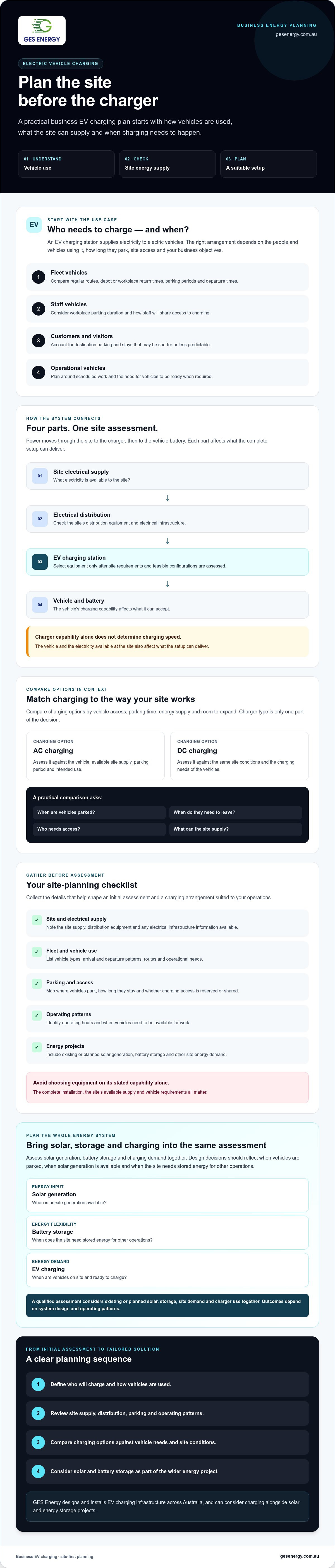
How to plan EV charger installation in Victoria and across Australia
Use this sequence to plan an EV charger installation around your site and business needs:
- Define the use case: Identify whether charging is for fleet vehicles, employees, customers, visitors or a mix of users.
- Gather site and operating information: Record vehicle numbers, parking periods, access groups, charging locations and operating hours.
- Assess the site: Have qualified project professionals review the electrical supply, site distribution, parking layout and any existing solar or battery storage.
- Confirm the design and scope: Use assessment findings to determine suitable equipment, electrical works, access arrangements and provision for future needs.
- Complete installation and commissioning: Coordinate engineering, equipment procurement and installation, then confirm the relevant commissioning, safety and compliance checks.
- Plan ongoing care: Establish how the charging equipment will be monitored, maintained and supported as business needs change.
Requirements can vary by location and project. In Victoria and elsewhere in Australia, ask qualified professionals to confirm the current electrical, safety and planning requirements that apply to your site before work begins.
What information should you gather before a site assessment?
Prepare a clear picture of how vehicles use the site. Include fleet numbers, typical arrival and departure times, parking duration, intended charger locations and who needs access. If vehicles return to more than one business location, note that too.
Gather available information about the site’s electrical supply and distribution, plus existing or planned solar generation and battery storage. Record planned changes, such as fleet growth, new parking areas or site redevelopment, that could affect future charging demand. These details help the project team assess actual conditions before recommending a design.
What happens during design, installation and commissioning?
After the assessment, project design sets out proposed equipment and electrical works in response to site findings. Procurement and installation follow the agreed scope. Commissioning then checks that the installed system operates as intended, with applicable safety and compliance checks confirmed for the specific project.
If you’re also reviewing on-site generation, a Commercial Solar guide can help frame the wider energy-planning discussion. GES Energy plans EV charging alongside solar and battery projects, subject to site requirements. Discuss your business EV charging project with GES Energy as a step towards a site-specific assessment.
How GES ENERGY can support integrated EV charging projects
GES Energy designs and installs EV charging infrastructure alongside solar, battery, off-grid and EPC projects. The business serves customers across Australia and can consider electric vehicle charging as part of your site’s wider energy plans, rather than treating a charger as a standalone purchase.
Project design can account for site conditions, how vehicles will use the chargers and whether existing or planned solar generation or battery storage forms part of the project. This helps align equipment selection and project scope with the site assessment. The ABB All-in-One High Power Charger may be considered where its current availability, specifications and suitability have been confirmed for your project.
When should you consider an EPC approach?
EPC services coordinate engineering, procurement and construction for relevant solar and EV projects. This approach may suit a larger project or one that combines charging with solar or energy storage, where design and delivery need to be considered together.
The project scope should reflect the site assessment, operating needs and technical requirements. Ask the project team to clarify which stages are included and how installation, commissioning and ongoing care will be handled. For details about EPC services, consult GES Energy’s Solar EPC Australia guide.
What should you prepare before speaking with a project team?
A useful first discussion starts with the basics. Gather:
- Site details: location, parking layout and intended charger areas.
- Vehicle use: fleet or user groups, vehicle movements and typical parking periods.
- Project objectives: who needs access and what the charging setup should support.
- Energy information: available details about your electrical supply, solar generation and battery storage.
- Future plans: proposed changes to the site, fleet or charging demand that could affect the design.
GES Energy also provides maintenance and repair support for relevant projects. Confirm the proposed scope, response arrangements and applicable service coverage for your installation, as these depend on the project.
If you’re considering EV charging alongside solar or storage, prepare the site and operating details above, then discuss your project requirements with GES Energy. That conversation can help clarify what needs assessment before equipment or project scope is selected.
Plan your next step with confidence
Effective electric vehicle charging starts with your business needs, site conditions and energy supply. Match charger access and equipment to how vehicles are used, then assess electrical capacity, parking, operating patterns and potential solar or battery integration before setting the project scope.
GES Energy designs and installs solar and EV charging projects across Australia. Its EPC services cover solar, battery and EV charging projects, with the specific scope confirmed during assessment. This can help you consider charging infrastructure as part of a wider site energy plan.
Before discussing your project, gather your site location, vehicle use, parking arrangements, energy-system details and objectives. These details give the project team a clearer starting point for assessing your requirements.
Discuss an EV charging project with GES Energy and explore a site-specific path forward. With the right information and planning, you can take the next step towards charging infrastructure suited to your business.
Frequently Asked Questions
What is an EV charging station?
An EV charging station is equipment that supplies electricity to an electric vehicle. For a business, it connects to the site’s electrical infrastructure and forms part of a wider setup that may include access arrangements and energy management. The right arrangement depends on vehicle requirements, parking time, site conditions and operational needs. A qualified assessment can check compatibility and identify options that suit your business.
How do businesses choose an electric vehicle charging solution?
Start by identifying who needs to charge, which vehicles will use the equipment and when they’re typically parked. Then assess your electrical supply, parking layout, existing energy systems and future plans. Compare proposed options against these details rather than relying on one equipment specification alone. Ask qualified project professionals to confirm the design and applicable compliance requirements for your site before installation begins.
Can solar power be used for electric vehicle charging?
Yes, solar generation can be considered as part of a business EV charging design. Its practical contribution depends on when solar power is available, when vehicles are parked and how the site uses energy. Battery storage may also be assessed as part of the design. Don’t assume charging will always run on solar; a site assessment and system design must establish how generation, storage and charging demand can work together.
Does my business need a battery for EV charging?
No, a battery isn’t automatically required for EV charging. Whether storage suits your project depends on charging demand, site energy supply, operating patterns and business objectives. A project assessment can compare charging with the existing supply and consider solar or battery storage where relevant. This helps you understand which options are feasible for your site without adding equipment that may not fit your requirements.
How is EV charger installation planned in Victoria?
Planning typically starts by defining the business use case and gathering site and vehicle information. A project team can then assess conditions, develop a design, select equipment and plan installation and commissioning. Ask qualified professionals to confirm current Victorian and Australian electrical, safety and planning requirements for your project. Requirements depend on the site and scope, so a general checklist isn’t a substitute for project-specific advice.
How much does business EV charging cost?
Business EV charging costs depend on the site, selected equipment, electrical works, charging requirements and any solar or battery integration. A reliable estimate requires a defined project scope and site information. Request a project-specific assessment and quote that explains what the proposed work includes. Check separately whether any incentives apply to your business and location, as eligibility and program conditions can change.
Can a business add more EV charging stations later?
It may be possible to expand a charging setup, but future growth should be considered during initial planning. A project team can assess expected vehicle demand, available parking, electrical infrastructure and possible energy-system changes. Feasibility depends on verified site conditions and the original design. GES Energy serves businesses across Australia, including Melbourne, Geelong, Ballarat, Bendigo, Shepperton, Melton, Mildura, Wodonga, Traralgon, Wangaratta, Horsham, Sale, Colac, Echuca, Arrarat, Portland, Swan Hill, Benalla and Maryborough.


