

Your utility bill's "peak demand" line item isn't just a cost of doing business; it's a strategic vulnerability that most Australian companies are overpaying for. You've likely noticed that even as wholesale prices shift, those punishing demand charges continue to erode your operational margins. Finding the right balance is difficult, which is why a comprehensive commercial solar battery sizing guide australia is now essential for any facility looking to stabilise its energy overheads.
This guide provides the engineering clarity you need to move beyond guesswork. We understand that a battery isn't just a backup; it's a financial hedge against an unpredictable market. By accurately matching storage capacity to your specific load profile, you can systematically eliminate expensive demand spikes and secure genuine energy independence. We'll examine the latest 2026 incentive shifts, such as the expanded 1MW Small-scale Renewable Energy Scheme, and provide a methodical framework for calculating a system that delivers a clear ROI pathway and long term operational resilience.
Key Takeaways
- Understand the vital distinction between energy capacity (kWh) and power output (kW) to ensure your infrastructure can handle heavy industrial start-up loads.
- Learn how to utilise 15-minute interval data to implement peak shaving, a strategy designed to cap demand spikes and lower your monthly utility charges.
- Compare LFP and NMC battery chemistries to determine which BESS technology offers the best safety and performance profile for your specific site conditions.
- Follow our commercial solar battery sizing guide australia to audit your 12-month load history and accurately define the critical loads needed for business continuity.
- Discover the long-term benefits of custom engineering and end-to-end EPC services in creating a future-proof energy ecosystem for your Australian business.
What is Commercial Solar Battery Sizing and Why Does it Matter?
Commercial battery sizing is the methodical process of aligning your energy storage capacity (kWh) and power output (kW) with your facility’s unique consumption patterns. It's an engineering discipline that transforms a simple battery into a strategic financial asset. This commercial solar battery sizing guide australia aims to help decision makers understand that precision is the only way to ensure a return on investment. If a system is over-engineered, you've essentially stranded capital in unused hardware. Conversely, if it's under-sized, your facility remains vulnerable to the very peak demand charges you intended to avoid. Getting this balance right requires a deep dive into your historical data, ensuring every kilowatt of capacity serves a specific purpose.
The Financial Driver: Capacity vs. Power
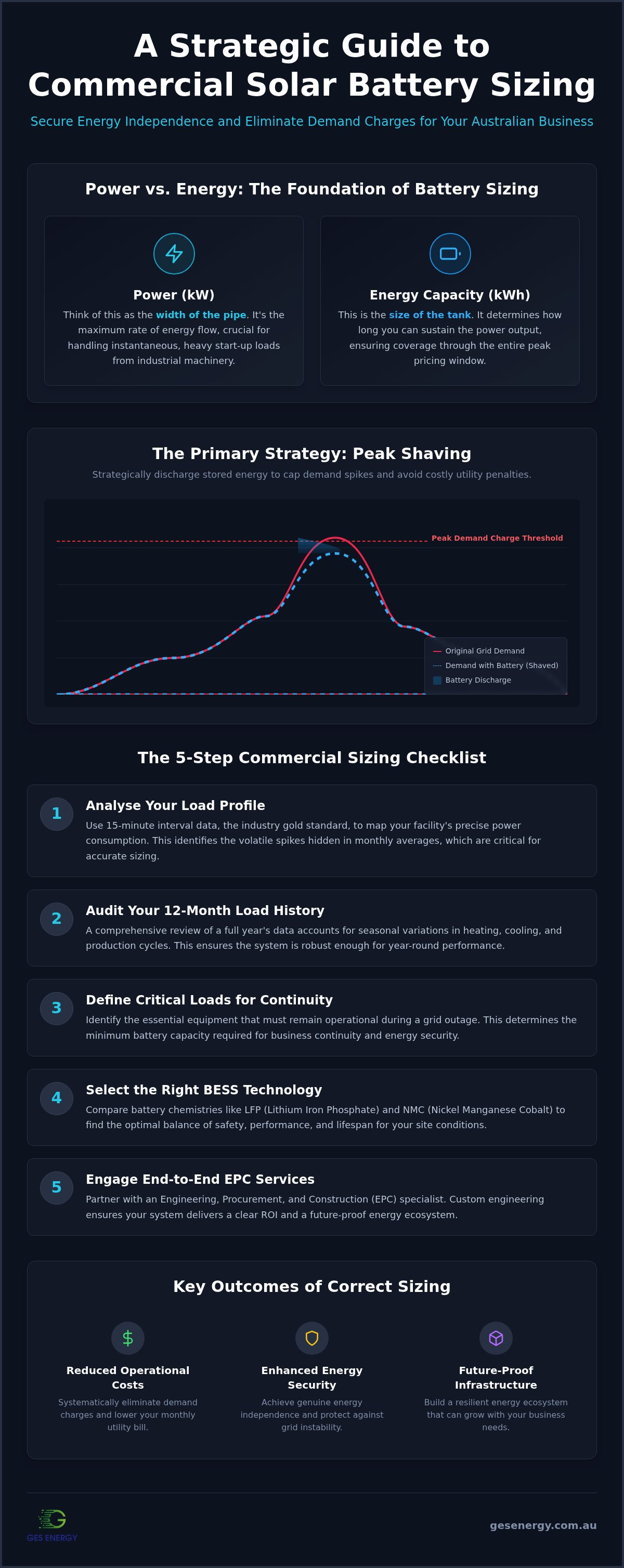
Understanding the difference between power and energy is fundamental for commercial managers. Think of power (kW) as the width of a pipe; it determines how much energy can flow at any single moment. This is what allows you to "shave" the top off your utility demand spikes. Energy capacity (kWh) is the size of the storage tank, which dictates how long you can sustain that discharge. A robust Battery Energy Storage System (BESS) must be designed so that the "pipe" is wide enough to cover your heaviest machinery starts, while the "tank" is large enough to last through the entire peak pricing window. Without this balance, your system might have the energy to run your site but lack the "punch" to stop a demand charge from being triggered by a large motor starting up.
Why Businesses are Decoupling from the National Grid
Australian businesses are increasingly seeking energy independence to shield themselves from volatile network costs and infrastructure reliability issues. By integrating storage with a commercial solar installation, a facility can move from being a passive consumer to an active manager of its own micro-grid. This shift isn't just about cost; it's about energy security. For production lines where a momentary grid dip can cause hours of downtime, a correctly sized battery provides a critical buffer. Relying on an EPC partner like GES Energy ensures these calculations aren't left to chance. Our engineering focus prioritises site-specific load data to build systems that handle the rigours of industrial operations while securing your energy future. We move beyond "one size fits all" solutions to provide a tailored infrastructure that grows with your business needs.
Analysing Your Load Profile for Peak Shaving and Load Shifting
Relying on daily averages is a common pitfall for industrial managers. While a monthly bill shows total consumption, it hides the volatile spikes that drive your costs. This commercial solar battery sizing guide australia emphasises the use of 15-minute interval data, the industry gold standard for identifying exactly when your facility draws maximum power. By mapping this granular data, we can distinguish between your base load and the intermittent surges caused by heavy machinery or cooling systems. This level of detail is necessary to ensure the battery is sized to handle real-world operational stress rather than theoretical averages.
Peak shaving and load shifting are the two primary mechanisms for cost reduction. Peak shaving is the strategic discharge of stored energy to maintain a pre-set grid usage limit. It targets the highest points of your demand profile to avoid expensive utility penalties. Load shifting, however, focuses on timing; it moves energy consumption from high-tariff evening periods to the middle of the day when your solar generation is abundant. In the Australian context, seasonal variations play a major role. Sizing must account for shorter winter days to ensure you have enough stored energy to cover evening peaks when solar production is at its lowest.
The Impact of Demand Charges on Industrial Bills
Utility providers often calculate demand charges based on your single highest 15-minute window of usage during a billing cycle. This means one equipment malfunction or poorly timed startup can inflate your entire month's bill. A correctly sized battery acts as a shock absorber, blunting these spikes automatically before they reach the grid meter. This predictability is essential for accurate financial modelling and long-term budget stability, turning a volatile expense into a controlled operational cost.
Integrating EV Charging Infrastructure into the Load
As we move into 2026, corporate EV charging is no longer an optional luxury. Adding a fleet of electric vehicles creates a new, significant load that often coincides with other facility peaks. Battery sizing must be forward-looking; it needs to account for future EV expansion to prevent your BESS from becoming a stranded asset. A professional audit can help you optimise your energy infrastructure for these emerging requirements, ensuring your system remains resilient as your operational needs evolve.
BESS Technologies: Selecting the Right Industrial Battery System
Industrial energy storage is a different beast compared to residential setups. While home systems often focus on aesthetics and simple backup, a professional commercial solar battery sizing guide australia must prioritise safety, thermal stability, and long-term scalability. The choice of battery chemistry is the first critical decision for any facility manager. Lithium Iron Phosphate (LFP) has become the industrial standard across Australia. It offers superior thermal stability and a longer cycle life compared to Nickel Manganese Cobalt (NMC), which, while energy-dense, carries a higher risk of thermal runaway. For a business operating heavy machinery or sensitive production lines, the peace of mind provided by LFP’s safety profile is a non-negotiable requirement.
Modularity is another cornerstone of industrial design. Instead of a single fixed unit, modern C&I energy storage systems are built using modular racks or strings. This allows a facility to start with a baseline capacity and expand as operational needs or EV fleet requirements grow. By adding more racks to an existing busbar, you avoid the need for a complete system overhaul, ensuring your initial investment remains productive for its full lifespan. This flexibility is essential for businesses that plan to scale their operations over the next decade.
Containerised vs. Rack-Mounted Solutions
The physical footprint of your BESS depends on your site’s scale and available space. Large-scale industrial sites often opt for containerised BESS solutions, where 20ft or 40ft shipping containers house the entire battery array, fire suppression, and HVAC systems. These are ideal for outdoor installations where space is abundant but environmental protection is needed. Conversely, indoor rack-mounted systems are better suited for facilities with dedicated, climate-controlled plant rooms. In the harsh Australian climate, thermal management is paramount. Containerised units come with integrated cooling to maintain optimal cell temperatures, which is vital for preventing degradation during extreme heat events.
Inverter Sizing and Efficiency
The inverter acts as the brain of your energy ecosystem, managing the complex interface between your solar panels, the battery, and the utility grid. Choosing between DC-coupled and AC-coupled systems is a strategic decision; AC-coupling is often preferred for commercial retrofits because it allows the battery to be integrated without disturbing existing solar arrays. However, the efficiency of these transitions depends on precise inverter sizing. Commissioning these complex systems requires SAA-accredited labour to ensure compliance with Australian standards and grid protection settings. At GES Energy, we oversee this end-to-end procurement and installation process, ensuring your inverter is perfectly matched to your discharge requirements for maximum efficiency.
The 5-Step Commercial Sizing Checklist for 2026
Implementing a robust energy strategy requires more than just high-quality hardware. This commercial solar battery sizing guide australia provides a structured framework to ensure your investment matches your operational reality. By following a methodical checklist, you can avoid the common errors that lead to stranded assets or insufficient demand mitigation. Precision at this stage is what separates a successful infrastructure project from a costly misstep.
- Step 1: Audit 12 months of interval data. You must identify your highest peak demand window to set an accurate discharge threshold for your battery.
- Step 2: Define the critical load. Determine which production lines, cold storage, or IT systems require absolute continuity during grid instability or outages.
- Step 3: Calculate the solar multiplier. Your battery needs a reliable "fuel" source; ensure your solar capacity can generate enough daily excess to fully recharge the storage system.
- Step 4: Factor in Depth of Discharge (DoD) and efficiency. Account for round-trip efficiency losses and ensure your gross capacity is high enough to provide the required usable energy without over-stressing the cells.
- Step 5: Model ROI with 2026 incentives. Incorporate the expanded STC eligibility for systems up to 1MW and state-specific credits like the NSW Peak Demand Reduction Scheme (PDRS) to find your true payback period.
Accounting for Australian Network Constraints
Australian Distributed Network Service Providers (DNSPs) often impose strict export limits that can hinder the financial performance of a solar-only system. A correctly sized battery allows you to capture energy that would otherwise be curtailed, storing it for use when the sun isn't shining. Navigating these approval processes requires technical oversight to ensure your BESS complies with local grid protection settings. Additionally, participating in a Virtual Power Plant (VPP) can provide a secondary revenue stream, though this may require slightly larger battery sizing to ensure you have spare capacity to trade without compromising your own peak shaving requirements.
Calculating ROI and Payback Periods
Moving beyond a simple "years to payback" calculation is essential for industrial projects. We recommend focusing on the Internal Rate of Return (IRR) and the total cost of ownership over the battery's 10 to 15-year lifecycle. While demand charge reduction is the primary financial driver, the value of energy security provides a significant boost to your ROI. A single avoided production outage can often justify a large portion of the initial capital expenditure. To ensure your financial modelling is accurate and accounts for your specific tariff structure, you can request a technical site audit from our engineering team.
Designing Your Energy Future with GES Energy EPC Services
Navigating a commercial solar battery sizing guide australia provides the foundational knowledge, but the transition to a high-performance energy ecosystem requires a specialised partner. At GES Energy, we move beyond the "cookie-cutter" approach of pre-packaged kits. Our focus is on custom engineering that respects the unique load profiles and environmental challenges of your specific site. As a national EPC specialist, we take full responsibility for the design, sourcing, and commissioning of your infrastructure. This end-to-end oversight ensures that the theoretical benefits of energy storage are translated into measurable operational outcomes.
Reliability is built into every stage of our process. By using SAA-accredited labour for all installations, we guarantee that your system meets the highest safety and performance standards. However, our commitment doesn't end when the battery is commissioned. Ongoing maintenance and proactive health checks are essential for maximising the longevity of a BESS. Our team acts as a diligent steward, managing the health of your cells and inverters to ensure the system delivers peak performance for its entire service life. This long-term partnership provides the stability needed to justify significant capital investments in new energy technology.
Custom Engineering for Industrial Reliability
For businesses operating in remote areas or harsh environments, off-grid solar systems and micro-grid solutions are often a necessity rather than a choice. We specialise in designing systems that maintain industrial reliability even when the national grid is unavailable. Our engineering team conducts site-specific analysis to account for local climate conditions, ensuring thermal management systems are sized correctly for the Australian heat. GES Energy provides fixed-price EPC contracts for projects up to 5 MW, giving you financial certainty from the initial design phase through to final commissioning.
Starting Your Transition to Energy Independence
The energy landscape in 2026 represents a pivotal moment for Australian businesses. With expanded incentives and more mature technology, the pathway to energy independence has never been clearer. The process begins with a detailed feasibility study and load analysis, where we use your interval data to model exactly how a battery will perform under your specific operating conditions. This data-driven approach removes the guesswork and provides a clear ROI roadmap for your board. To take the next step in securing your facility's future, you can organise a professional load analysis and sizing consultation with GES Energy.
Securing Your Facility's Energy Independence
Transitioning to a high-performance energy ecosystem is no longer a theoretical exercise but a practical necessity for Australian industry. By utilising 15-minute interval data and prioritising peak shaving, you can transform a volatile utility expense into a controlled operational cost. This commercial solar battery sizing guide australia has provided the framework to help you navigate these technical complexities. Whether you're managing a remote industrial site or a large-scale production facility, the focus must remain on precision engineering and scalable modularity to ensure a viable return on investment.
Reliability is the foundation of every successful BESS project. Our SAA-accredited engineering team specialising in 100kW to 5MW industrial projects ensures your system is designed for the rigours of the Australian climate. We provide national support and maintenance to guarantee your infrastructure delivers long-term value and operational resilience. Take the first step toward stabilising your energy future today. Consult our EPC specialists for a custom commercial sizing analysis and gain the clarity needed to secure your energy independence.
Frequently Asked Questions
What is the average lifespan of an industrial solar battery in Australia?
Most industrial energy storage systems are designed for a service life of 10 to 15 years. This duration is largely determined by the number of charge and discharge cycles the system performs daily. Using high quality Lithium Iron Phosphate (LFP) cells and maintaining optimal operating temperatures can extend this period. Regular maintenance checks are essential to ensure the battery management system is functioning correctly and the cells aren't degrading prematurely under heavy loads.
Can I add more battery storage to my commercial system later?
You can expand your storage capacity if your initial system utilises a modular design. Many C&I energy storage systems allow for the addition of extra battery racks or strings as your facility's load profile grows or as you introduce more EV charging stations. It's vital to ensure your original inverter and balance of system components are sized with future expansion in mind to avoid costly hardware replacements during the upgrade process.
How does a commercial battery help with demand charges?
Commercial batteries mitigate demand charges through a process called peak shaving. By discharging stored energy during periods of high facility usage, the battery prevents your draw from the utility grid from exceeding a specific threshold. Because demand charges are often set by your single highest 15 minute usage window in a billing cycle, this automatic blunting of spikes can lead to significant reductions in your monthly electricity overheads and improved budget predictability.
Do I need a specific type of solar inverter for industrial batteries?
Industrial applications require specialised multi-mode or battery-specific inverters capable of managing large-scale energy flows. These units act as the brain of your micro-grid, synchronising the solar array, battery storage, and utility connection. In this commercial solar battery sizing guide australia, we recommend choosing an inverter that supports the specific discharge rates required by your machinery. SAA-accredited engineers must commission these complex units to ensure they comply with Australian grid protection standards.
Is Lithium Iron Phosphate (LFP) safer for commercial buildings?
Lithium Iron Phosphate (LFP) chemistry is widely considered the safest option for commercial and industrial buildings. Unlike Nickel Manganese Cobalt (NMC) batteries, LFP cells are highly resistant to thermal runaway and can withstand higher operating temperatures without risk of fire. This chemical stability makes them ideal for Australian environments where summer heat can be extreme. They provide the peace of mind necessary for facilities housing expensive production equipment or high-density workforces.
What government incentives are available for commercial batteries in 2026?
In 2026, the federal Small-scale Renewable Energy Scheme (SRES) has expanded to include systems up to 1MW, which significantly reduces the upfront cost of larger commercial installations. Additionally, businesses in New South Wales can access the Peak Demand Reduction Scheme (PDRS), specifically the BESS4 and BESS5 incentives. These programs provide discounts based on the battery's ability to reduce peak grid pressure. Other state-specific grants often apply, depending on your project's scale and energy efficiency goals.
How much space does a 100kWh commercial battery require?
A 100kWh commercial battery system typically requires roughly 1.5 to 2 square metres of floor space when using a vertical rack-mounted configuration. This footprint includes the necessary clearance for ventilation and maintenance access. If you opt for an outdoor containerised solution, the space requirement is slightly larger to accommodate the protective housing and integrated cooling systems. Most industrial sites easily accommodate these units within existing plant rooms or on a small external concrete plinth.
Can a commercial battery provide full off-grid capability for a factory?
It's technically possible to provide full off-grid capability for a factory, though it requires meticulous sizing of both the solar array and the battery storage. Most businesses opt for a micro-grid solution that prioritises critical loads during an outage rather than trying to power the entire facility indefinitely. Achieving true energy independence for heavy industrial processes involves balancing your peak start-up currents with enough energy capacity to sustain operations through several days of low solar generation.


