

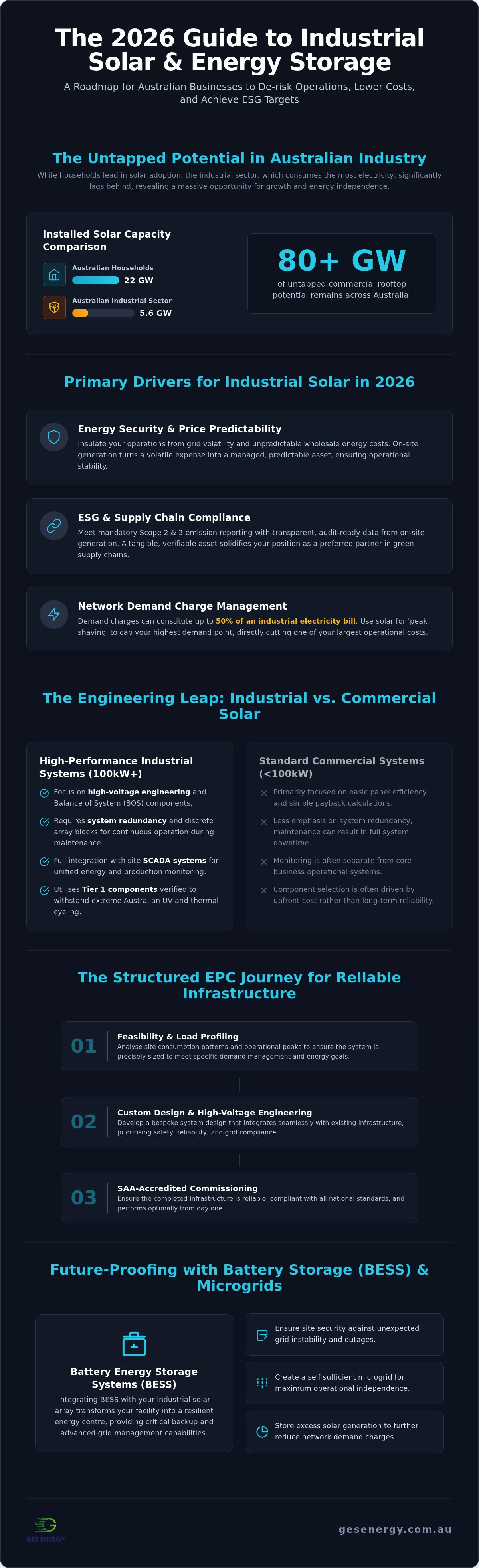
While Australian households have successfully installed 22GW of solar capacity, the industrial sector lags behind with just 5.6GW, even though businesses consume the vast majority of our electricity. It's frustrating to manage rising network demand charges and reliability issues in fringe-of-grid areas while trying to meet increasingly strict ESG targets. You've likely realised that traditional energy procurement is no longer enough to protect your margins or ensure operational stability.
This 2026 guide shows you how to reclaim control using high-scale industrial solar systems Australia wide and integrated battery storage to de-risk your operations and significantly lower your electricity bills. We'll provide a clear roadmap for navigating the complexity of large-scale infrastructure projects while securing long-term price predictability. Our focus is on practical, engineering-led solutions that turn energy from a volatile expense into a managed asset.
We'll examine the recent expansion of the Small-scale Renewable Energy Scheme to 1MW, the strategic role of BESS in ensuring site security, and how a professional EPC partner simplifies the transition. By the end of this article, you'll understand how to turn your facility into a high-performing energy centre that delivers measurable progress toward your Scope 2 and Scope 3 emission targets.
Key Takeaways
- Learn the engineering requirements for multi-megawatt industrial solar systems Australia wide and how they differ from standard commercial installations to meet high-voltage operational needs.
- Gain clarity on the 2026 financial landscape, including how to leverage the expanded Small-scale Technology Certificate (STC) threshold and Large-scale Generation Certificates (LGCs) for maximum ROI.
- Discover how a structured EPC process, from feasibility studies to SAA-accredited commissioning, ensures your energy infrastructure is reliable and compliant with national standards.
- Understand the role of Battery Energy Storage Systems (BESS) and micro-grids in future-proofing your site against network demand charges and unexpected grid instability.
- Identify how to align your energy strategy with corporate sustainability goals to achieve measurable progress toward Scope 2 and Scope 3 emission targets.
The Australian Industrial Energy Landscape in 2026
Industrial solar systems Australia wide are undergoing a fundamental shift in purpose and scale. While small commercial setups might hover around 30kW, true industrial applications typically start at 100kW and frequently reach multi-megawatt scales to support energy-intensive factories, processing plants, and mines. According to an Overview of solar power in Australia, our nation still has over 80GW of untapped commercial rooftop potential, with only 5.6GW currently utilised despite businesses being the largest consumers of electricity.
By 2026, the motivation for adopting these systems has evolved beyond simple cost-cutting. While slashing operational expenditure remains vital, the primary driver is now energy security and price predictability. Australian manufacturing competitiveness is increasingly tied to how well a firm can insulate itself from grid volatility and rising wholesale costs. Large enterprises are also grappling with mandatory Scope 3 emission reporting requirements that came into effect this year. Generating power on-site provides the most transparent, audit-ready data for ESG compliance, making it a cornerstone of modern industrial strategy.
Rising Network Charges and Demand Management
For heavy industrial users, network demand charges often represent up to 50% of the total electricity bill. These fees aren't based on total consumption but on the highest point of demand recorded during a billing period. Well-engineered industrial solar systems Australia businesses deploy can facilitate "peak shaving." This process uses solar generation to cover load spikes during the day, preventing the facility from hitting expensive demand thresholds. We always recommend a detailed load profiling phase before design; this ensures the system is sized to tackle specific operational peaks rather than just general usage.
Regulatory Drivers and ESG Compliance
The 2026 reporting landscape requires large enterprises to provide granular data on their carbon footprint. The Clean Energy Regulator has increased oversight of large-scale systems, rewarding those with robust, on-site generation. On-site solar offers a direct solution for meeting Scope 2 targets while providing the necessary data for partners to meet their Scope 3 obligations. Unlike offshore offsets, on-site solar provides a tangible asset that can be physically audited. It ensures your business remains a preferred partner in a supply chain that now demands total environmental transparency and verified progress toward net-zero targets.
Engineering High-Performance Industrial Solar Systems
Stepping up from a standard commercial installation to a multi-megawatt industrial array isn't just a matter of scale. It's a leap into high-voltage engineering. While a small office might focus on basic panel efficiency, true industrial solar systems Australia wide require a focus on balance of system (BOS) components and high-voltage protection settings. These systems must integrate seamlessly with existing site infrastructure, often requiring custom engineering to ensure they don't compromise power quality or site safety. Selecting Tier 1 components isn't just about brand recognition; it's about verifying that the glass, frames, and internal circuitry can withstand the extreme UV and thermal cycling common across the continent.
Reliability is non-negotiable in an industrial setting. We prioritise system redundancy to ensure production never halts. This means designing the array in discrete blocks so that maintenance on one section doesn't take the entire system offline. Modern industrial systems must also communicate with site Supervisory Control and Data Acquisition (SCADA) systems. This integration allows plant managers to monitor solar generation alongside production metrics, providing a unified view of energy efficiency across the entire operation. For those managing complex sites, choosing a partner who provides end-to-end industrial energy solutions ensures these technical details are handled from the outset.
Inverter Technology and Grid Stability
The choice between string and central inverters depends heavily on site layout and scale. Central inverters are often the preferred choice for multi-megawatt ground-mount arrays due to their robustness and ease of centralised maintenance. However, string inverters provide better granularity for complex roof shapes. In 2026, we're seeing a shift toward grid-forming inverters. These advanced units don't just follow the grid; they help stabilise it by providing synthetic inertia and fault-current contribution. This is critical for sites operating at the fringe of the grid where voltage fluctuations are common. All high-voltage commissioning must be performed by SAA-accredited engineers to meet strict national safety and utility standards.
Industrial Mounting and Structural Integrity
Australian conditions are notoriously harsh on physical infrastructure. Industrial roofs often have large spans that require specialised mounting systems to distribute weight without compromising structural integrity. In high-wind zones, systems must meet stringent wind-load requirements, often requiring additional fixing points and reinforced rails to ensure long-term safety. For coastal industrial hubs, we specify high-grade corrosion-resistant materials to prevent salt-spray degradation. These engineering choices ensure that industrial solar systems Australia wide reach their full 25-year design life without requiring premature structural repairs or component replacements.
The Business Case: ROI, LGCs, and Financing in 2026
The financial justification for industrial solar systems australia wide has moved beyond simple electricity bill reductions. In 2026, sophisticated energy users focus on the Levelised Cost of Energy (LCOE), a metric that accounts for the total cost of building and operating a system over its entire lifecycle. With well-designed industrial arrays delivering annual returns of 15% to 30%, solar has become a core infrastructure asset rather than a discretionary expense. Payback periods typically range from 3 to 7 years, but the real value lies in long-term price predictability during a period of ongoing grid price volatility.
When evaluating the business case, we help partners choose between "Behind the Meter" and "Export" models. The most profitable approach for Australian industry is usually maximising self-consumption to avoid high retail rates and network charges. However, for multi-megawatt sites with significant roof space or available land, the export model provides a secondary revenue stream that can hedge against periods of lower production. The decision often rests on your specific load profile and how closely it aligns with solar generation hours.
LGCs and the Renewable Energy Target
The certificate market is a critical component of industrial ROI. A major shift occurred on 1 October 2026, when eligibility for Small-scale Technology Certificates (STCs) was expanded from 100kW to include systems up to 1MW. This change has effectively reduced the upfront cost of medium-scale industrial solar by roughly 20%. As of late August 2026, STC spot prices remain stable around $39.65 to $39.85. For systems exceeding 1MW, Large-scale Generation Certificates (LGCs) are the primary vehicle, currently trading between $7.25 and $7.75. Businesses must decide whether to sell certificates immediately to reduce capital outlay or hold them to surrender against their own carbon liability targets.
Financing Models: Capex vs. PPA
Financing an industrial energy transition requires a strategy that balances cash flow with long-term ownership goals. While many firms opt for direct capital expenditure (Capex) to maximise total lifetime savings and take advantage of depreciation schedules, others prefer Power Purchase Agreements (PPAs). A PPA allows you to host an industrial solar systems australia project with zero upfront cost, only paying for the energy the system generates at a predetermined rate that is lower than your current retail tariff.
Solar leasing serves as a middle ground, preserving your working capital for core business operations while providing the eventual benefits of asset ownership. In 2026, interest rates continue to influence these decisions, making it vital to model different scenarios. Tax benefits, including the potential for instant asset write-offs depending on current federal policy, can significantly accelerate your return on investment. We recommend consulting with your financial controller to determine which model best supports your 2026 balance sheet requirements.
The EPC Journey: From Custom Design to Commissioning
The transition to industrial solar systems australia wide requires more than just hardware; it demands a rigorous Engineering, Procurement, and Construction (EPC) framework. For projects exceeding 1MW, the complexity increases exponentially compared to standard commercial setups. We don't just supply panels; we manage a multi-stage lifecycle that ensures every component integrates with your existing high-voltage infrastructure. This end-to-end oversight is what distinguishes a professional industrial partner from a standard installer, providing you with a single point of accountability from the first site visit to final energisation.
Managing the grid connection application is often the most technical part of the journey. We handle all negotiations with Distributed Network Service Providers (DNSPs) to secure your offer to connect. This involves detailed power quality studies and protection setting coordination to ensure your site remains stable. Without this specialised expertise, projects can stall for months in regulatory limbo. Our SAA-accredited engineers ensure that every aspect of the design meets the latest national standards for high-voltage commissioning, giving you peace of mind that your asset is both safe and compliant.
Feasibility and Custom Engineering
Precision starts long before the first panel arrives. We utilise LIDAR and 3D modelling to create a digital twin of your facility. This allows us to optimise panel placement for maximum yield while accounting for shading from vents, plant equipment, or neighbouring structures. A critical part of this phase is the "single sentence" energy audit, where we identify exactly where energy is being wasted before we design the solution. Every large-scale roof installation also requires a structural engineering certificate to ensure the building can handle the additional static and dynamic wind loads over its 25-year lifespan.
Procurement and Project Management
Sourcing for a 1MW+ project involves managing the logistics of thousands of panels and kilometres of industrial-grade cabling. We coordinate these deliveries to minimise disruption to your daily operations. Safety is our absolute priority on live industrial sites. Our project managers implement strict exclusion zones and permit-to-work systems to keep your staff and our installers safe. The final commissioning process is a methodical handover where we verify every string, inverter, and protection relay before training your facility management team on the monitoring software. Ready to start your transition? Consult with our EPC specialists to begin your feasibility study today.
Future-Proofing with Industrial Battery Storage and Micro-grids
The final stage of achieving true energy independence involves moving beyond simple generation to sophisticated storage and management. Industrial solar systems Australia wide are increasingly paired with Battery Energy Storage Systems (BESS) to facilitate 24/7 operations. This integration allows a facility to capture surplus energy during peak solar windows and deploy it when the sun isn't shining. It transforms the site from a passive consumer into an active participant in the energy market, providing a level of control that was previously impossible for heavy industry.
Beyond storage, the rise of the industrial micro-grid represents the pinnacle of site resilience. By integrating solar, batteries, and existing backup generation through a central hybrid controller, businesses can "island" their operations. This means the site can continue to function at full capacity even during a total grid failure. For facilities where a few hours of downtime can result in hundreds of thousands of dollars in lost production, the security provided by a micro-grid is an essential insurance policy. It's also a necessary foundation for the roll-out of heavy-vehicle EV charging infrastructure, which adds significant new loads to the site's energy profile.
BESS: Load Shifting and Arbitrage
Modern battery systems do more than just store power; they act as financial tools for energy arbitrage. By storing excess solar and discharging it during the most expensive peak periods, businesses can avoid the highest retail tariffs. Large-scale industrial sites can also participate in Frequency Control Ancillary Services (FCAS). This involves providing short bursts of power to the National Electricity Market (NEM) to help balance grid frequency, creating a lucrative secondary revenue stream. We ensure all BESS installations meet the highest safety and fire-suppression standards, whether using high-density lithium-ion or long-duration flow battery technologies.
Micro-grids and Off-grid Reliability
For remote mining or processing sites, a micro-grid is often the only viable way to ensure 100% uptime. These self-sufficient systems use intelligent hybrid controllers to manage the mix of solar, battery storage, and backup diesel generation. The controller prioritises solar and battery usage, only firing up diesel generators when absolutely necessary. This dramatically reduces fuel costs and maintenance intervals for the generators. You can find more context on how these technologies fit into a broader business strategy in our Commercial Solar Guide.
To ensure these complex systems continue to perform, we deploy advanced Solar Analytics and ongoing maintenance programmes. Real-time monitoring allows us to detect and rectify minor issues before they lead to system degradation or costly downtime. This proactive approach ensures that industrial solar systems Australia businesses invest in today will continue to deliver energy security and financial returns well into the 2030s.
Securing Your Industrial Energy Future
The transition to industrial solar systems australia wide is now a strategic necessity for maintaining manufacturing competitiveness and meeting mandatory ESG standards. By integrating high-performance generation with intelligent storage, your facility can move from a state of grid dependence to one of predictable, managed energy security. We've explored how the 2026 expansion of certificate schemes and the rise of micro-grid technology provide clear pathways for de-risking your operations while significantly lowering overheads.
Success in this space requires a partner who understands the technical rigour of high-voltage engineering. Our SAA-accredited engineering team specialises in end-to-end EPC management for projects up to 5MW, including complex remote off-grid and micro-grid applications. We handle the entire journey from feasibility to ongoing maintenance, ensuring your infrastructure remains a high-performing asset for decades. This methodical approach provides the stability needed to navigate a volatile energy market with confidence.
If you're ready to stabilise your energy costs and secure your site's future, enquire about a custom EPC solution for your industrial site today. Taking control of your energy profile is the most effective way to ensure long-term operational resilience in an evolving landscape.
Frequently Asked Questions
What is the typical ROI for an industrial solar system in Australia in 2026?
Large-scale solar assets typically deliver annual returns between 15% and 30%. Most facilities see a full payback on their investment within 3 to 7 years. The 2026 expansion of certificate eligibility for systems up to 1MW has further accelerated these timelines. Your exact return depends on how closely your load profile matches daytime generation and your ability to mitigate high network demand charges through strategic self-consumption.
How much roof space is required for a 500kW industrial solar array?
A 500kW system generally needs between 2,500 and 3,500 square metres of clear, usable roof area. This calculation includes space for safe maintenance walkways and structural setbacks required by national building codes. We use LIDAR and 3D modelling to maximise yield on complex roof shapes. If rooftop space is insufficient, ground-mount arrays or high-efficiency modules can achieve the same power density on a smaller footprint.
Can an industrial solar system operate entirely off-grid?
Industrial sites can operate entirely off-grid by deploying a robust micro-grid. This setup integrates a large solar array with a Battery Energy Storage System (BESS) and a hybrid controller to manage backup generation. While many urban sites remain grid-connected for added redundancy, remote processing and mining operations frequently use this technology to achieve total energy independence and avoid the prohibitive costs of long-distance network extensions.
What is the difference between STCs and LGCs for large-scale solar?
The choice depends on system size and your financial strategy. As of late 2026, Small-scale Technology Certificates (STCs) provide an upfront capital reduction for systems up to 1MW. In contrast, Large-scale Generation Certificates (LGCs) are created annually based on actual output for systems exceeding 1MW. LGCs currently trade between $7.25 and $7.75, offering a recurring revenue stream that can be sold or surrendered to meet ESG targets.
How do industrial solar systems handle power outages on the national grid?
Standard industrial solar systems australia wide typically disconnect during an outage to ensure grid safety. However, by installing grid-forming inverters and battery storage, your facility can "island" from the main network. This allows you to maintain critical production lines using on-site generation and stored reserves. This resilience is vital for protecting high-value equipment and preventing the significant financial losses associated with unexpected downtime.
What maintenance is required for a multi-megawatt solar installation?
Multi-megawatt systems require a professional maintenance programme to ensure long-term performance. This involves annual SAA-accredited electrical audits, thermal imaging to identify module faults, and regular health checks of high-voltage inverters. We also utilise advanced analytics to monitor performance at the string level. Proactive servicing prevents minor issues from escalating into major faults, ensuring the system reaches its full 25-year design life and continues to meet Scope 2 targets.
Are there government grants available for industrial solar in 2026?
In 2026, various state-based incentives complement federal certificate schemes. These often focus on peak demand reduction and large-scale battery storage to support grid stability. Some jurisdictions offer specific rebates for energy-intensive industries to upgrade their infrastructure. While the availability of these programmes varies across the country, they can often be stacked with federal incentives to further reduce the net cost of industrial solar systems australia projects.
How long does the EPC process take for a 1MW solar project?
The end-to-end EPC lifecycle for a 1MW project generally spans 4 to 8 months. The engineering and feasibility stages take roughly 4 to 6 weeks, while grid connection applications with network providers can take up to 3 months depending on site complexity. Once approvals are granted, the physical construction and SAA-accredited commissioning phase typically requires 6 to 10 weeks, ensuring a safe and compliant handover to your facility team.


